What the FTC settlement requires
Paddle.com Market Limited will pay $5 million and is permanently banned from processing payments for tech-support telemarketers.
By Dana Rourke, Lead Reviewer. Reviewed by Campaign Buyer Editorial. Updated 22 October 2026.
Our verdict
Paddle is the checkout to pick if you sell software or SaaS and want a platform that becomes the legal seller for you. It calculates sales tax, handles fraud screening, and takes dispute management off your plate. It is the wrong tool for direct response, because its rules bar most high-risk products, you cannot send a declined charge to a second account you own, and the percentage on each sale gets expensive as volume grows.
The FTC settlement
The Federal Trade Commission's June 2025 press release names Paddle.com Market Limited and its subsidiary, Paddle.com, Inc. The money supplements redress for consumers harmed by the Restoro-Reimage tech support scheme.
In its complaint, the agency alleged that Paddle and its subsidiary processed payments for deceptive tech-support schemes aimed at U.S. consumers, including older adults. The statutes named are the FTC Act, the Telemarketing Sales Rule, and the Restore Online Shoppers' Confidence Act. The release says Paddle opened merchant accounts as a merchant of record, or as a reseller, for unrelated third parties, and that those accounts gave overseas schemes access to the card system and a way to evade detection. The scheme named above used fake virus alerts impersonating brands. The complaint also says Paddle billed auto-renewing subscriptions without a clear disclosure of the recurring charge.
Any subscription Paddle processes has to show its terms clearly and conspicuously. Paddle has to get express informed consent, and buyers need a simple way to cancel that stops the recurring charge. The press release says Paddle must screen clients and keep monitoring them. The stipulated order requires a prospective client, before service starts, to say whether they know the business was on the MATCH list in the past five years, and to report a material change within 30 days.
If you sell tech support by phone, Paddle cannot process the payments. A software subscription is a different business. The screening, the MATCH notice, and the subscription rules above still apply.
What Paddle handles
Paddle solves a different problem from the rest of this category. It is a merchant of record, which means Paddle itself is the legal seller: it takes the payment, charges the tax, and answers to the card networks. For a software or SaaS business selling into dozens of countries, Paddle takes on worldwide tax compliance. That is the tedious part of payments, and it is why this is the right checkout for that seller.
You cannot move a charge between your own accounts, because every payment runs on Paddle's. It will not take high-risk business at all, so a direct-response supplement offer is a non-starter under its rules. Disputes are handled for you, which sounds ideal until you want to fight one your own way, and Paddle still keeps the fee and will suspend a seller who drifts above a 0.65% rate. Its recovery flow for failed renewals is genuinely good, with up to seven retries and a sequence of emails, though it runs on Paddle's schedule with little for you to adjust.
There is no monthly platform fee. The percentage on each sale is simple, and it gets expensive once sales volume picks up. Pick Paddle when you sell mainstream software and want the tax and compliance load gone. Skip it when you send ad traffic to your own offers. Letting Paddle be the seller makes checkout easy, but a direct-response seller gives up the control they need.
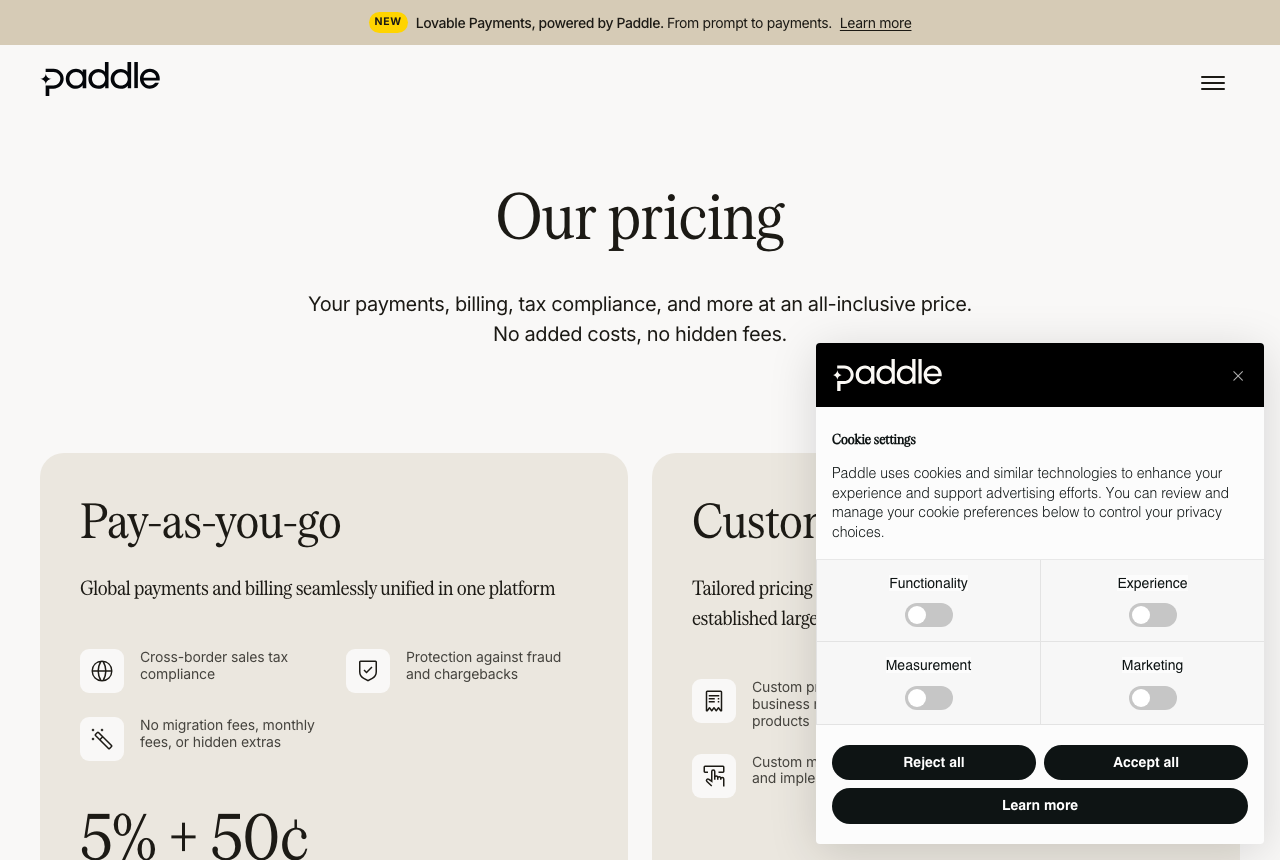
Inside the Paddle interface
Pros and cons
What works
- Paddle registers as the seller for tax purposes. It calculates, files, and remits sales tax and VAT worldwide, and it handles that compliance for you.
- One bundled rate covers payments, fraud screening, subscription billing, buyer support and disputes, with no separate platform fee
- Its payment recovery retries a failed renewal up to seven times across about a month and emails the customer to update a card
- It contests chargebacks for you automatically, using the transaction evidence it already holds as the seller on the receipt
What to watch
- Its rules bar a long list of restricted categories, so most nutra, supplement and other high-risk sellers cannot onboard at all
- You cannot move volume between several of your own accounts. You sell on Paddle's rails, so if a card is declined, there is no second processor to fall back on.
- At 5% plus $0.50 a transaction it sits well above the bare processor rate, and that gap only widens as you scale
- You never control a dispute. Paddle keeps its fee even when it wins one, and can throttle or suspend a seller above a 0.65% chargeback rate
Pricing
Paddle charges no monthly subscription. You pay a percentage of each sale instead, on the terms below.
5% + $0.50 per checkout transaction; no monthly fee. Custom pricing for high volume or products under $10.
Prices as of 24 October 2026
Changelog
- 22 October 2026. Added the Federal Trade Commission settlement details from the press release and stipulated order, along with what the ban means for software companies using Paddle.
Frequently asked questions
How much does Paddle cost?
Related reading
- When you want a different tool, start with the alternatives page.
- Head-to-head: Paddle vs ThriveCart
- Head-to-head: Paddle vs SamCart
- Head-to-head: Paddle vs Gumroad
- Head-to-head: Checkout Champ vs Paddle
- Guide: What is multi-MID routing, and who needs it?
- Guide: How to read a chargeback rate
- Rebills: what dunning is, and how failed-payment recovery works on renewals.
- Browse all comparisons and reviews.

Written by
Dana Rourke
Lead Reviewer
Dana Rourke is the lead reviewer at Campaign Buyer. She covers trackers and attribution on this site: she reads what long-term users report about each tool, checks its documentation and pricing, and verifies prices with the vendor before writing the verdict. Keeping the rankings honest mostly means writing down what the top pick gets wrong, so she does that first.
Last checked 2026-10-22
Comments
No comments yet. Questions and your own experience are welcome.
Thank you. Your comment will appear once it has been reviewed.