A cheap cloud click tracker against an enterprise measurement platformmedia buyer software
BeMob vs Fospha
By Dana Rourke, Lead reviewer. Reviewed by Campaign Buyer Editorial. Updated 28 September 2026.
Quick answer
Pick BeMob if you are a solo buyer or a small team learning tracking or running light spend and want click-level tracking you can start free and grow into cheaply; pick Fospha if you are a scaling or enterprise retail brand spending at least $100k a month who wants a platform-independent, full-funnel read on where your budget really works.
Side by side
| BeMob | Fospha | |
|---|---|---|
| What it is | Cloud click tracker with a free tier | Full-funnel measurement platform |
| The job | Track every click and conversion by source | Model where the whole budget really works |
| What it measures | Source, campaign, offer, click to conversion | Blended, modeled channel contribution |
| How it tracks | Cloud-hosted, server-to-server postbacks | Pixel-free, modeled, platform-independent |
| Marketplace sales | No | Yes, models Amazon and TikTok Shop |
| Free tier | Yes, 100K events, 10 campaigns | No, demo only |
| Pricing | Free, then from $49/mo | From $1,500/mo, $100k/mo spend floor |
| Setup | Self-serve, wire postbacks yourself | Guided onboarding, live under 28 days |
| Best-fit user | Beginner or low-spend media buyer | Scaling or enterprise retail brand |
| Outside proof | Established, a budget favourite | Case studies, fewer independent reviews |
If BeMob and Fospha are your final two, the first thing to settle is that they are not two grades of the same tool. They answer different questions for different companies at opposite ends of the paid-traffic problem. BeMob records every click on a campaign and catches the conversion, cheaply, so a buyer can see which source and offer paid off. Fospha steps back from the campaign entirely and models where a whole media budget is really working. A reader who has narrowed it to these two has usually not yet named the job they are buying for, and once they do, the choice mostly makes itself.
Two different jobs, and two different budgets
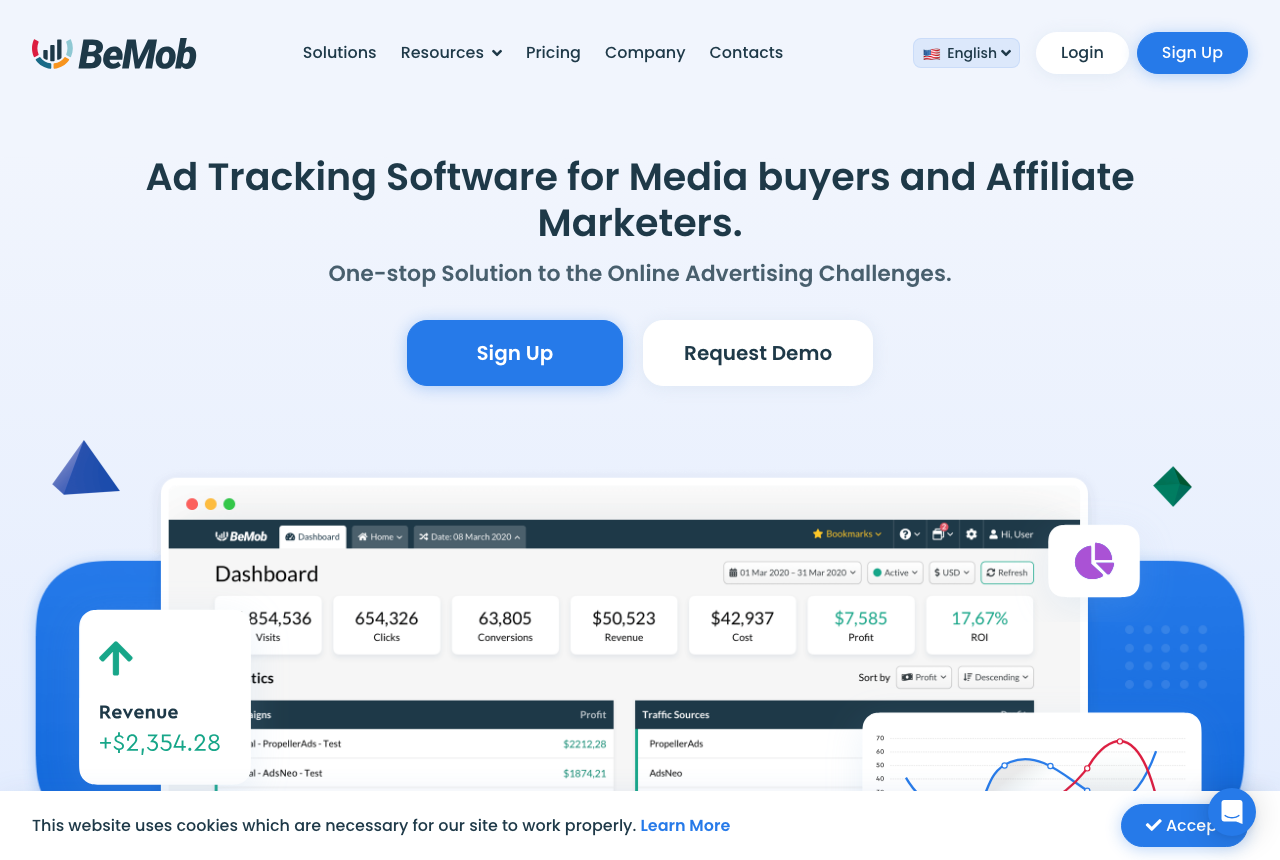
BeMob is a cloud click tracker. It sits between your ads and your offers, stamps each click, and catches the conversion through server-to-server postbacks, then shows profit by source, campaign and offer. It is an operational tool you live in day to day, and its whole appeal is that you can start for nothing and scale into it slowly. The free plan is not a crippled demo: 100,000 events a month, 10 campaigns, real landing-page and offer management, and reporting good enough to learn how postbacks and tokens actually work.
Fospha does not touch the campaign. It ingests your spend and sales across channels and returns a modeled, platform-independent read of what your paid media is really driving, the full funnel included and, unusually, marketplace sales on Amazon and TikTok Shop. It answers a budget question, not a campaign question: given everything you spend, where is the next dollar best spent. It measures and interprets. It does not track individual clicks by source, and it does not feed conversions back to anyone.
So this is not a question of which is better. It is whether you are tracking and optimizing individual campaigns on a modest budget, or allocating a large multi-channel budget you can no longer read by eye. There is almost no middle ground where both fit at once, because a single number decides it before features do: your monthly spend.
BeMob: click tracking you can start free
BeMob earns its place with the buyer whose problem is that they need to see which source made money and cannot yet justify a real monthly bill for the privilege. Its answer is a genuinely usable free tier and a cheap on-ramp: paid entry is $49 a month for a million events, and because it is cloud-hosted there is nothing to install or maintain. For someone validating their first funnels, that is the right place to make mistakes before serious money is on the line.
The limits show up as you scale. BeMob counts every impression, visit and postback as an event, so 100,000 free events disappear fast once you log impressions or run any real volume. Custom tracking domains, which most buyers want before they push serious traffic, only start on the $249 a month Business plan. And once you are past the testing phase, BeMob has less depth than Voluum or RedTrack for a buyer who needs heavier reporting and integrations. None of that changes what it is good at: it is the gentlest, cheapest way into real click tracking, and for a small or learning account that is exactly the job.
Fospha: a platform-independent read on the whole budget
Fospha is for a different reader entirely, the brand spending enough that the question has changed from "which ad worked" to "is my media mix right at all." It is pixel-free and platform-independent, which reviewers say reads truer than the numbers each ad platform reports about itself, and its Halo product models how paid media drives Amazon and TikTok Shop sales that most DTC dashboards cannot see. Onboarding is light for a platform at this level: brands report going live inside 28 days with 24 months of history and no pixel install, and it publishes its pricing openly, which is rare in a category that mostly hides behind a demo.
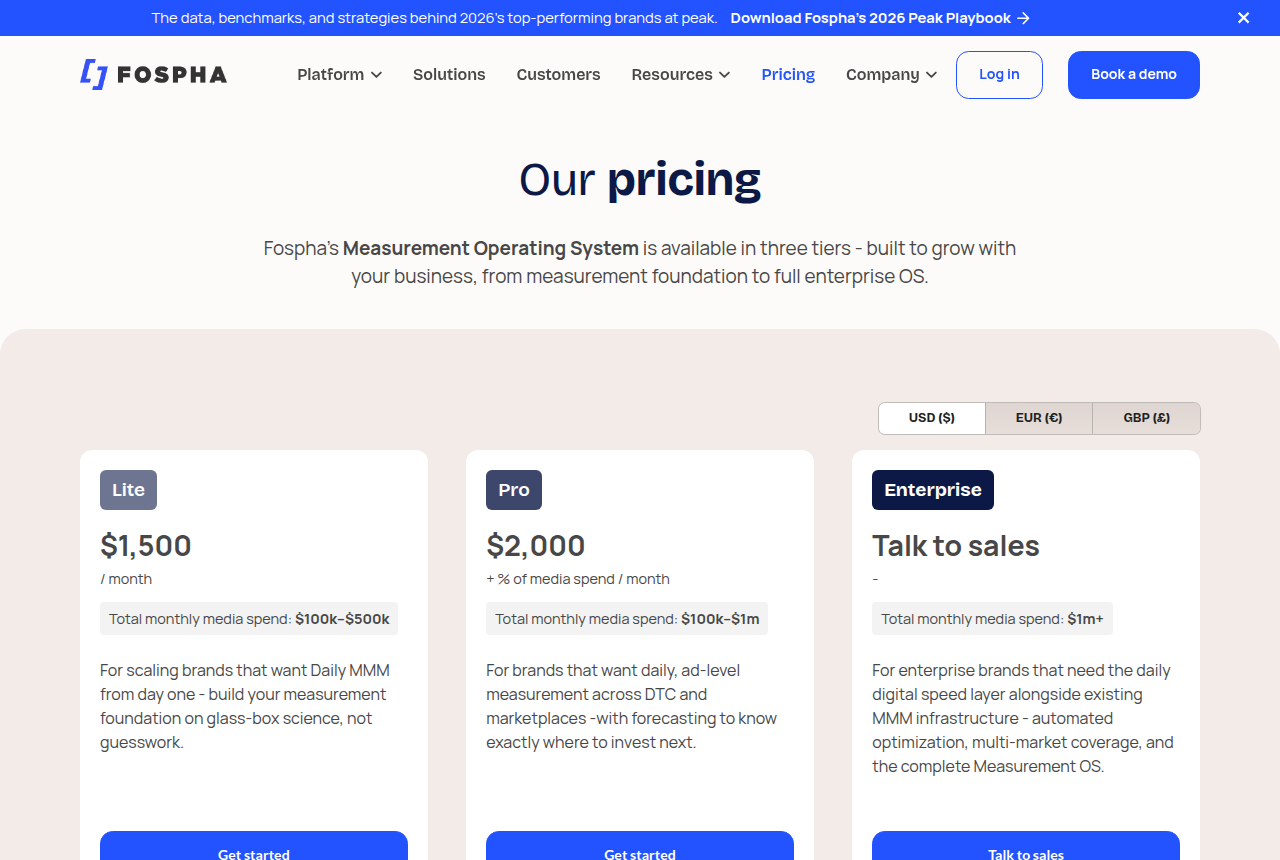
The cost and the fit are the catch, and they are steep. Every plan needs at least $100,000 a month in media spend and starts at $1,500 a month, so a small or pre-scale account is priced out before fit even matters. There is no free tier and no self-serve trial, so you commit through a demo before you can validate it on your own data. There is also a real independence question: Fospha is the endorsed measurement partner of the same platforms it grades, and a competitor argues its impression-weighted model can flatter high-volume upper-funnel channels. Its outputs are directional model estimates, not ground truth, and will not reconcile to the last dollar with any ad platform or your finance team. Read as a decision aid by a brand at scale, it is a strong tool. Read as a way to track clicks, it is the wrong tool, and an impossibly expensive one.
The tool that sits between them
Neither of these builds or hosts the funnel a click actually lands on. BeMob tracks the click and Fospha models the blended budget, but neither builds the page, hosts the checkout, or keeps the click, the order, the rebill and the refund on one record. A team that wants the page, the split test, the checkout and the reporting on one data layer is really shopping for a funnel platform, and ElasticFunnels is worth a look there. Its lead feature is same-URL split testing: variants rotate server-side under one campaign link, so Meta, Google and TikTok keep their learning and a test never sends the ad back through review. Because a click, an order, a rebill and a refund land on one record, nobody reconciles four exports to work out which angle really made money. It starts at $97 a month with a 14-day trial that needs no card, and every feature is on every plan.
The honest caveat is age. ElasticFunnels is newer than the platforms on this page, and there is very little independent third-party review coverage to check its claims against yet, so until you run real volume through it you are largely taking the vendor's word on the reporting. That is what you would expect of a platform this recent, and it matters less if you use the free trial to prove the split testing and the tracking on your own campaigns before you commit. It is not a click tracker like BeMob or a measurement layer like Fospha; it is the build-and-sell layer that sits between them, so weigh it only when that combined job is what you are actually buying for.
Which one for you
Are you a solo buyer or a small team who needs to see which source and offer converted, on a budget that makes a free tier attractive? That is BeMob, and starting free before paying $49 a month is hard to beat for real click tracking. Are you a scaling or enterprise retail brand spending at least $100,000 a month who wants a platform-independent read across your full funnel and your marketplace sales to defend a budget? That is Fospha, and the $1,500 floor is fair once the spend is big enough to act on what it shows. If your spend is anywhere near BeMob's free-plan range, Fospha is not really an option, and BeMob is the answer by default. And if the job is really to build, split-test, sell and report on one platform rather than to track or to measure, that is a funnel tool like ElasticFunnels, not either of these.
BeMob
What works
- A genuinely usable free plan: 100K events, 10 campaigns and real reporting
- Cheap paid entry at $49/mo for 1M events
- Cloud-hosted, so there is nothing to install or maintain
What to watch
- 100K free events disappear fast once you log impressions or run any volume
- Custom tracking domains only start on the $249 Business plan
- Less depth than Voluum or RedTrack once you scale past testing
Fospha
What works
- Platform-independent, pixel-free measurement that reviewers say reads truer than the numbers each ad platform reports about itself
- Measures the full funnel and, unusually, marketplaces: its Halo product models how paid media drives Amazon and TikTok Shop sales, which most DTC dashboards cannot see
- Glass-box modeling with daily outputs and a dedicated measurement team, so the numbers refresh every day and someone helps you defend them in the budget meeting
- Light onboarding for a platform at this level: live in under 28 days with 24 months of history, no pixel install and no dev team required
- Publishes its pricing openly (Lite $1,500, Pro $2,000 plus a percentage of spend), which is rare in a category that mostly hides behind a demo
What to watch
- High floor: every plan needs at least $100k a month in media spend and starts at $1,500/mo, so it is out of reach for small or pre-scale brands
- No free tier and no self-serve trial. You commit through a demo before you can validate it on your own data
- The independence question: Fospha is the endorsed measurement partner of the same platforms it grades, and critics argue its impression-weighted model can flatter high-volume upper-funnel channels
- It is a model, not the truth. Outputs are directional MMM estimates that will not reconcile exactly with each ad platform or your finance team, so someone has to read them as a decision aid
- Dashboard limits reported by users: only campaign-level granularity on the entry tier, filtering that needs manual handling, no direct BI-tool connections without exports, and extra cost for older historical data
- Measurement only: it tells you where to spend but does not execute the changes, so it sits alongside your ad platforms rather than replacing them
Pricing
BeMob: from $49/mo. Free plan (100,000 events/mo, 1-month data retention); Professional $49/mo (1M events, 1-month retention); Business $249/mo (10M events, 3-month retention); Enterprise $499/mo (30M events, 6-month retention). An event is every impression, visit, click or conversion; overage billed per 1,000 events ($0.05 on Professional down to $0.02 on Enterprise). Custom tracking and cloaking domains start on the Business plan.
Fospha: from $1,500/mo. Three published tiers. Lite $1,500/mo for brands spending $100k-$500k/mo on media (one market, daily MMM, channel/campaign granularity). Pro $2,000/mo plus a percentage of media spend for $100k-$1m/mo (ad-level granularity, post-purchase attribution, Beam forecasting, up to three markets, Amazon and TikTok Shop via Halo). Enterprise is quote-based for $1m+/mo (incrementality and offline calibration, Brand Impact, five markets, automation via Smartly). No free tier and no self-serve trial; every plan requires at least $100k/mo in media spend. Prices also listed in EUR and GBP.
Pricing verified against each vendor on 2026-09-27. Check before you buy.
Our pick
BeMob
BeMob is the pick if you are new to tracking or spending lightly and want a real free tier before you commit.
Frequently asked questions
BeMob or Fospha: which should I use?
Which is cheaper, BeMob or Fospha?
Are BeMob and Fospha even the same kind of tool?
I spend under $100k a month. Can I use Fospha?
Is BeMob's free plan enough to run real campaigns on?
Sources
Other sources
2 discussions and reviews read for this page. Quotes are excerpts; open a link to read the original in context.

Written by
Dana Rourke
Lead reviewer
Dana Rourke is the lead reviewer at Campaign Buyer. She owns the tracker and attribution coverage: reading what long-term users report about each tool, checking its documentation and pricing, and verifying prices with the vendor before writing the verdict. Keeping the rankings honest mostly means writing down what the top pick gets wrong, so she does that first.
Last checked 2026-09-28