A proven cloud tracker against a visual funnel tracker
Voluum vs FunnelFlux
By Dana Rourke, Lead reviewer. Reviewed by Campaign Buyer Editorial. Updated 23 September 2026.
Quick answer
Pick Voluum if you buy affiliate or native media at real volume and want the proven, well-documented tracker that holds up under load, provided you can absorb the price; pick FunnelFlux Pro if you run multi-step funnels and want to read the whole journey as a visual map with per-node reporting to see exactly where it leaks.

Side by side
| Voluum | FunnelFlux | |
|---|---|---|
| What it is | Proven cloud click tracker | Visual funnel tracker |
| Best-fit traffic | Affiliate and native at volume | Multi-step direct-response funnels |
| How you read data | Campaign tables and reports | Visual funnel map, per node |
| Conversions to ad platforms | S2S postbacks, standard integrations | S2S postbacks, cookieless JS |
| Ecosystem and docs | Category default, well documented | Smaller community |
| Entry price | $119/mo, billed annually | $99/mo for 2M events |
| Best-fit user | Scaled affiliate and native buyers | Multi-step funnel optimizers |
If you are down to Voluum and FunnelFlux Pro, you have narrowed the field to two cloud trackers that both stamp a click, catch the conversion server-side and tell you which source, lander and offer made money. Neither asks you to run a server. What separates them is not that one tracks and the other does not, but the question each was built to answer. Voluum answers whether your campaigns are tracked reliably at volume with the documented setup other buyers already trust. FunnelFlux answers where in a multi-step funnel your traffic is leaking. That difference decides this more than any single feature.
Voluum leads with reputation, reliability under load and the largest documented ecosystem of any mainstream tracker, and it charges for all three. FunnelFlux leads with a visual funnel canvas and per-node reporting, and it asks more of you to set up. Work out whether your daily problem is a tracker you can trust at scale or a funnel you cannot see through, before you compare a single price.
The two questions that decide it
Answer these first. One: what is your daily problem, a tracker you can rely on or a funnel you cannot read? If your campaigns are mostly click-to-offer and your worry is that the tracker holds up, redirects stay fast and every integration you touch has already been documented, that is Voluum's whole pitch. If you run an advertorial into a lander into an offer with rotations and cannot see which step bleeds, you need to draw the funnel and read it node by node, and that is FunnelFlux's.
Two: how much do you value the ecosystem around the tool against the funnel view itself? Voluum is the default answer in nearly every affiliate and native thread, so the setups, offer types and fixes you will need have already been written down, which matters most when something breaks at 2am. FunnelFlux trades that broad community for a view no click-table tracker gives you. Those two questions usually point at different tools, and that is the honest shape of this matchup. The entry prices are close enough that cost is rarely the deciding factor; which problem is yours is.
Voluum: the proven default for affiliate and native volume
Voluum is the tracker most affiliates learned on, and that history is its real advantage. For Meta and native campaigns it is the default answer in nearly every thread, which means every traffic source, offer type and integration you might need has already been documented by someone before you. When your income depends on the tracker never being the bottleneck, that documented ecosystem is worth more than a feature checkbox.
The infrastructure is genuinely fast. Redirects are reliable at volume, reporting holds up under load, and anti-fraud and traffic-distribution rules are built in rather than bolted on. This site ranks Voluum second among trackers for exactly this buyer: the scaled affiliate or native media buyer who needs the numbers to be right and the tracker to stay up.
And you pay for it. Voluum is the most expensive mainstream tracker here, starting at $119 a month billed annually for 1 million events and climbing to $299 for 5 million, with event overages charged on top, so costs get harder to predict as traffic grows. You are also paying for polish you may not need if your funnels are simple. What it does not give you is the visual funnel view. Voluum reports campaigns as tables, which is fine for click-to-offer tracking but harder to reason about across a three or four step flow, and that gap is exactly where FunnelFlux comes in.
FunnelFlux Pro: the visual tracker for multi-step funnels
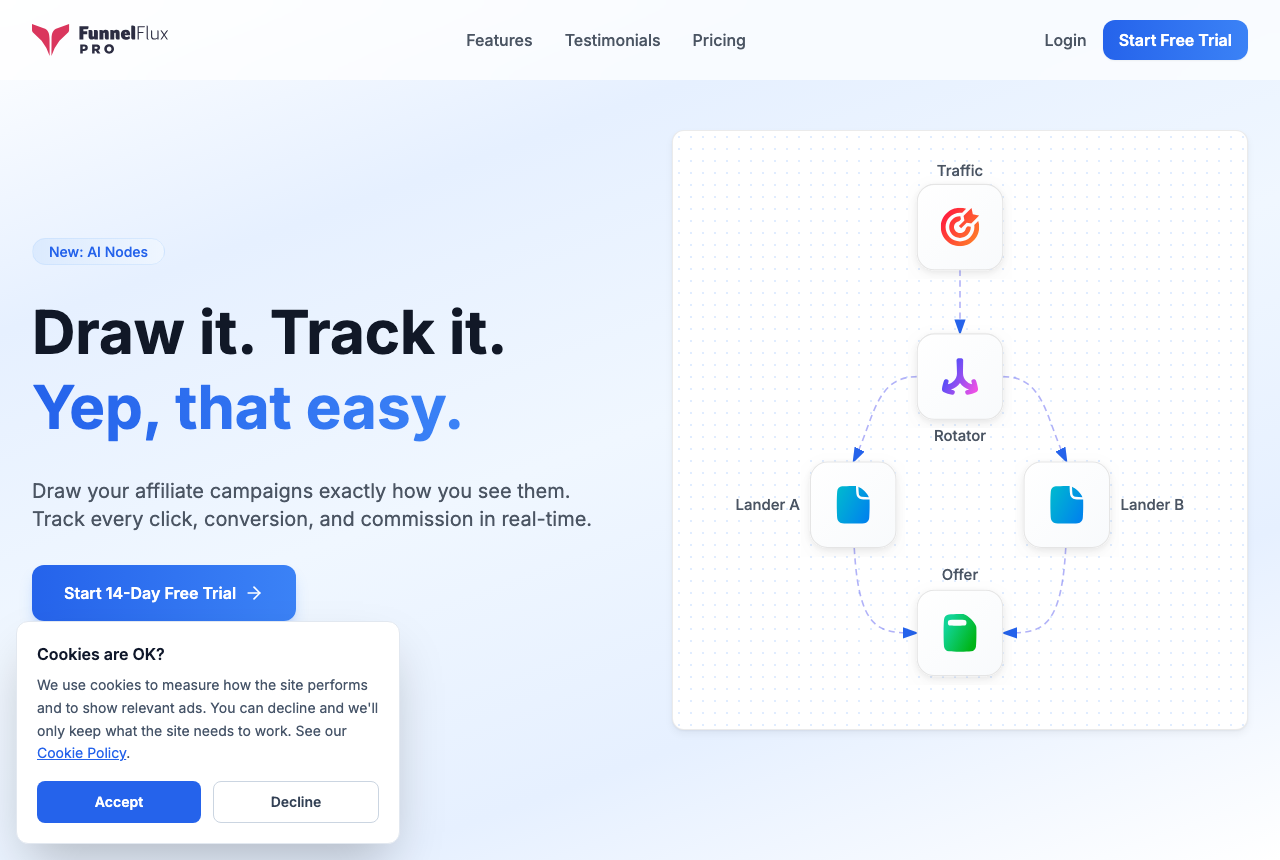
Most trackers show you a table of campaigns. FunnelFlux shows you a map. Landers, offers, rotators and conditional routing are drawn on one canvas, and because the reporting is per node, a leak between the advertorial and the offer is obvious instead of buried in a spreadsheet. For a buyer whose profit comes from optimizing complex multi-step flows, that view is the whole reason to switch, and it is genuinely hard to reproduce in a link-based tracker like Voluum.
It is cloud-hosted, so there is nothing to maintain, and its server-to-server integrations pass conversions to TikTok, Facebook, Microsoft and Google Ads, with cookieless JavaScript tracking that survives browser privacy changes. Pricing is clear: $99 a month covers 2 million events, then $10 per additional million, and the first two custom domains are included.
The costs are worth naming. The flexibility of the visual builder comes with a learning curve the docs do not hide, so plan setup time. Automatic ad-cost sync is not native either: you either pass cost in the URL or add Argosync, FunnelFlux's separate cost-sync product, which is its own subscription. The community is smaller than Voluum's, so you will find fewer walkthroughs when you hit an edge case, and the 14-day trial requires a valid payment method up front, so it is free to try but not card-free. It ranks fifth among trackers on this site not because it is weak, but because it serves a narrower buyer: the one who thinks in funnels, not links.
Where the pricing diverges
The entry numbers are close, but they buy different things. Voluum opens at $119 a month billed annually for 1 million events and reaches $299 for 5 million, with overages above that, and it puts a proven ecosystem and standard anti-fraud rules in the base. FunnelFlux opens at $99 a month for 2 million events, then $10 per additional million, with two custom domains included and the funnel view Voluum does not have, but automatic cost sync as a paid add-on.
Both meter events, so the number that matters is your real monthly volume, not the sticker, and either can run into overage as traffic climbs. Voluum's overages make its cost harder to forecast at scale. Price this on your own event count and on which you actually need: a reliable, well-documented tracker at volume, or a visual map of a multi-step funnel.
A third path if you build and host the funnel yourself
There is a third answer worth naming, because neither of these trackers builds the funnel whose clicks it counts. Voluum and FunnelFlux both follow traffic to pages, offers and checkouts that live somewhere else. ElasticFunnels owns that middle instead. It is a funnel platform for teams running paid traffic that builds the pages, split-tests variants under one URL so the ad platform keeps its learning, and hosts the checkout, and it keeps its ad-spend and conversion reporting on the same data layer as the pages and the sale. So the spend-to-sale record lives where the sale happens rather than in a separate tracker you reconcile against. For affiliate work it fires server-side postbacks to your networks on purchase, refund, chargeback and renewal straight from its own checkout, which is the postback job you would otherwise wire into Voluum or FunnelFlux. It starts with a 14-day free trial that takes no card, which is worth noting next to FunnelFlux's card-required trial, on plans from $97 a month, with a 0.5% fee only on revenue processed through its own checkout.
Two honest limits keep it on its own line rather than in the head-to-head. ElasticFunnels is newer than either tracker here, and there is very little independent third-party review coverage to check its claims against, so until you run real volume through it you are largely taking the vendor's word for how its tracking holds up. Both Voluum and FunnelFlux have years of public setups and threads to check against. And its reporting covers the funnels it hosts, so a buyer whose traffic closes on offers across other people's domains still needs a dedicated tracker like Voluum for that part, and a buyer who wants to map and split-test a complex multi-step flow across pages it does not host still needs FunnelFlux for that view. It is an option for the seller who runs their own funnel and checkout end to end, not a replacement for either tracker.
Which one for you
You buy affiliate or native media at real volume: Voluum. The proven ecosystem, the documented setups, the reliability under load and the standard anti-fraud rules are the reason to pay, and $119 a month billed annually is the price of a tracker that does not become your bottleneck. Absorb the cost if your income depends on the numbers being right.
You run multi-step funnels and want to see where they leak: FunnelFlux Pro. The visual canvas and per-node reporting are the reason to pay, the cloud hosting means nothing to maintain, and $99 for 2 million events is fair for that view. Budget setup time for the learning curve, and add Argosync if you want automatic cost sync.
You build and host your own offer end to end: look at ElasticFunnels alongside them, with the newness caveat above in mind, and keep a dedicated tracker for any traffic that closes off your own domains.
Voluum takes our default pick here, not because it maps funnels better than FunnelFlux (it does not have that view at all), but because more readers who reach this comparison buy affiliate or native media at real volume, which is the buyer Voluum is built for, than run the complex multi-step funnels FunnelFlux specializes in. That is a statement about who is reading this site, not about which product is better built. On its own turf, optimizing a funnel you need to see node by node, FunnelFlux is plainly the better fit, and we rank it fifth in our ad tracker ranking for exactly that buyer, while Voluum sits second as the broad default. If you want to weigh Voluum against a self-hosted tracker instead, our Voluum vs Binom page does that, and if you want to see FunnelFlux against a cheaper cloud tracker, our BeMob vs FunnelFlux Pro page weighs it.
Voluum
What works
- The default recommendation for Meta and native affiliate traffic, so setups and integrations are well documented
- Fast redirect and reporting infrastructure that holds up at volume
- Anti-fraud and traffic-distribution rules come standard
What to watch
- The most expensive mainstream tracker: $119/mo billed annually to start, $299 to reach 5M events
- Event overages are billed on top, so costs are hard to predict as traffic grows
- You pay for polish you may not need if your funnels are simple
FunnelFlux
What works
- A visual funnel canvas: landers, offers, rotators and conditional routing wired together on one screen
- Node-level reporting shows exactly where a funnel leaks
- Predictable pricing: a $99/mo base plus $10 per extra million events
What to watch
- The learning curve is real; the flexibility costs you setup time
- Automatic cost sync needs a separate product, Argosync
- A smaller community than Voluum or RedTrack, so fewer guides when you get stuck
Pricing
Voluum: from $119/mo, billed annually. Profit entry plan is $119/mo on annual billing (1M-event tier); Scale is $299/mo, also annual (5M-event tier). The pricing page's monthly toggle does not expose a month-to-month figure. Overage on Profit is $0.06 per 1,000 events.
FunnelFlux: from $99/mo for 2M events. $99/mo base includes 2M events, then $10 per additional million events. First two custom domains free, then $2 each per month. Monthly, no annual contract.
Pricing verified against each vendor on 2026-09-14. Check before you buy.
Our pick
Voluum
Voluum is the pick if you run affiliate or native campaigns and want the proven, low-friction tracker other buyers already use, provided you can absorb the price.
Frequently asked questions
Voluum or FunnelFlux: which should I use?
Which is cheaper, Voluum or FunnelFlux?
Do Voluum and FunnelFlux Pro do the same thing?
Which is better for a complex multi-step funnel?
Is Voluum worth the higher price?
Sources
Other sources
2 discussions and reviews read for this page. Quotes are excerpts; open a link to read the original in context.

Written by
Dana Rourke
Lead reviewer
Dana Rourke is the lead reviewer at Campaign Buyer. She owns the tracker and attribution coverage: reading what long-term users report about each tool, checking its documentation and pricing, and verifying prices with the vendor before writing the verdict. Keeping the rankings honest mostly means writing down what the top pick gets wrong, so she does that first.
Last checked 2026-09-23