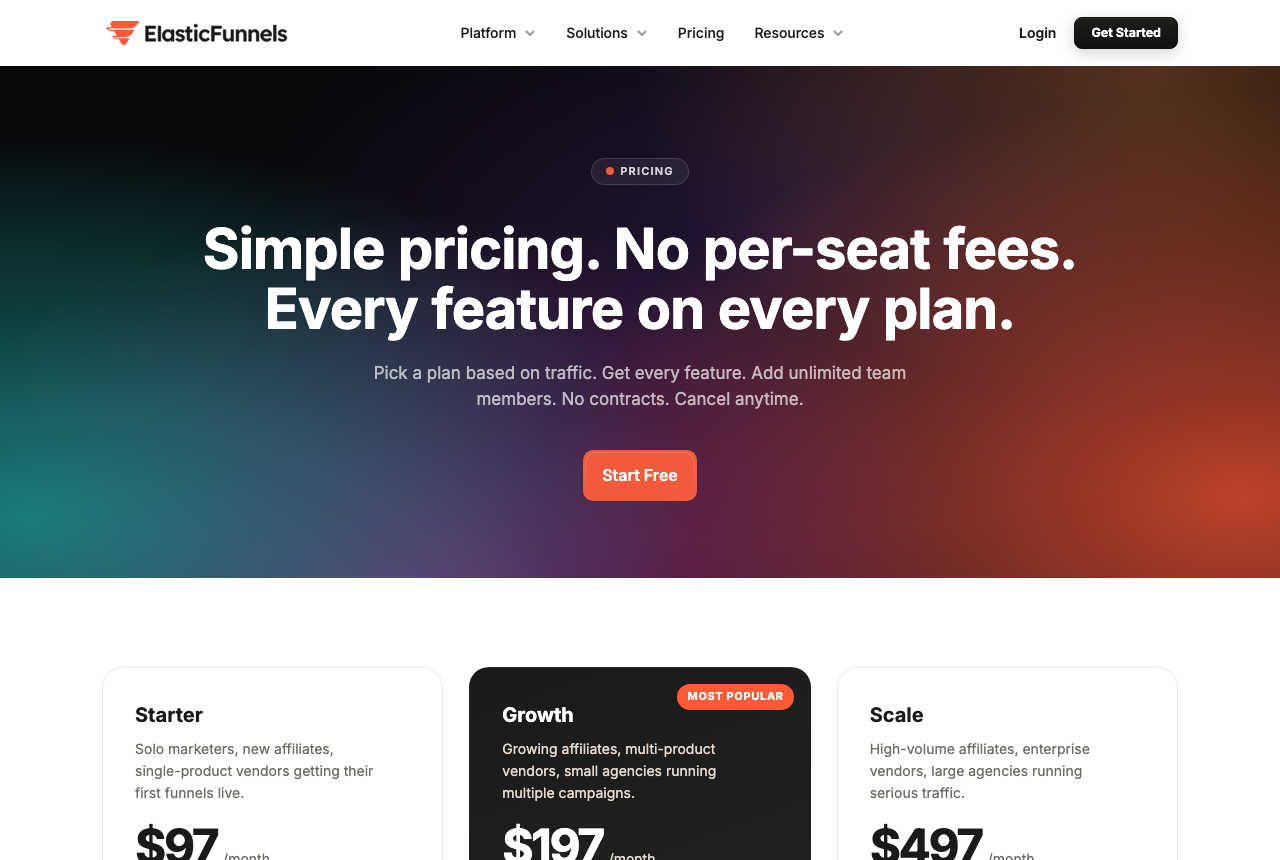
ElasticFunnels is a funnel platform for teams that buy paid traffic. It builds the landing pages, split tests them behind one campaign URL, hosts the checkout with order bumps and one-click upsells, and reports on sessions, orders, rebills and refunds from the same database its CRM reads. Affiliates, product vendors, agencies and ecommerce brands running their own campaigns are the people it is built for. Plans start at $97 a month, and you can try it for 14 days without a card.
The reason most teams switch is testing without resetting ad learning. Up to five weighted variants run under one campaign link while the platform rotates traffic server-side, so Meta, Google and TikTok keep seeing the same live URL and never restart their optimization. The AI page builder generates an editable page from a prompt, and the cloner turns a competitor URL into an editable replica in about a minute. The analytics then put sessions, orders, rebills, refunds and recovery touches on one timeline, sliced by affiliate, geo, device or creative, so you can see which angles only looked profitable before the refunds landed.
The hosted checkout is where a direct-response seller makes or loses the margin. You build it in the page builder on your own domain, add bumps and upsells, and charge through Stripe, NMI, PayPal, Klarna or Authorize.net. On NMI it splits each first sale across several merchant accounts by weight, product, card brand or amount, with a daily cap per account and a report of sales, revenue and refunds per account. Upsells and rebills stay on the account that took the sale. Subscriptions get dunning and save offers, and a built-in call center lets an agent work a failed rebill or a phone order off the same customer record. Sellers in high-risk categories use that routing to run offers on the merchant accounts they already hold.
What ElasticFunnels costs
You pay for traffic, measured in page views. Starter carries the same feature list as Scale, so most buyers move up because of volume or because they run more brands and domains than the entry plan allows. The plan table and overage rates sit further down this review, and the ElasticFunnels pricing breakdown goes through each tier in more detail. Budget on top for the checkout fee on its own gateways and for whatever your processor charges.
Choosing it over a stitched-together stack
The pitch is that its shared data replaces the tools a growth team usually wires together. That stack typically includes a funnel builder like ClickFunnels, Kartra or Systeme.io, a direct-response CRM and checkout like Konnektive, a standalone cart like SamCart, a landing-page tool, and a separate analytics tool. Because the click and everything after it share a database, nobody reconciles four exports to see which creative made money. The vendor's own comparison pages put its flat, traffic-based pricing against the stack it displaces. Treat that as the vendor's math and price it against the specific tools you run today.
How it stacks up against its rivals
Against ClickFunnels, the gap buyers name is one-URL testing and multi-MID checkout: ClickFunnels typically spins up a separate URL per variant and runs one processor per funnel, where ElasticFunnels keeps one URL and routes across several accounts. Our ElasticFunnels vs ClickFunnels page goes through it line by line. Against GoHighLevel the trade is focus for breadth, since GoHighLevel is built for agencies that white-label software for local businesses (the full comparison). Konnektive covers the same direct-response CRM, checkout and MID-routing ground and is the closest on the payment side, but it is a heavier system to run. SamCart and Shopify are carts that stop at the checkout, and Kajabi and Systeme.io lean toward courses and creators.
The landing page builders are the other group buyers weigh it against. Unbounce, Instapage, Leadpages and Landingi are built around the page and its test, and they hand the order to another system for the bump, the upsell, the rebill and the refund. If a page builder is all you need, our head-to-heads against Unbounce, Instapage, Leadpages and Landingi show where each of them is the cheaper answer.
The drawback to weigh first
ElasticFunnels is newer than the platforms it competes with, and almost everything written about it so far comes from the vendor. Independent user reviews are scarce, so until you run real volume through it you are largely taking the vendor's word. That is what you would expect of a platform built since 2023 against rivals that have been reviewed for years, and because the trial needs no card, your own funnel can supply the proof. Sales tax filing and dispute liability also stay with you, because it does not act as merchant of record the way Paddle does.
My take: it earns a trial for a performance marketer, vendor, agency or ecommerce brand that wants the page, the test, the checkout and the reporting in one platform. I would start by moving one live funnel with a split test running, and judge it on whether the per-angle profit after refunds matches what your current stack reports. A first-time seller who only needs a single page and one Stripe account can start simpler and add this later. If it is not for you, our ElasticFunnels alternatives page lists what to look at instead.