Whole funnel vs the pagemedia buyer software
ElasticFunnels vs Leadpages
By Dana Rourke, Lead reviewer. Reviewed by Campaign Buyer Editorial. Updated 29 September 2026.
Quick answer
Pick ElasticFunnels if you buy your own paid traffic and need the pages, a split test that never resets your ad optimization, the checkout and the reporting all on one record; pick Leadpages if you mainly need attractive landing pages and lead capture, forms, pop-ups and lead magnets, on a predictable, uncapped bill and a simple builder, with the checkout living somewhere else.
Side by side
| ElasticFunnels | Leadpages | |
|---|---|---|
| What it is | Paid-traffic funnel platform | Landing page and lead capture |
| Best for | Running paid traffic end to end | Lead-gen pages on a budget |
| Landing pages | AI builder and URL cloner | Templates, drag and drop |
| Lead capture | Forms and built-in CRM | Forms, pop-ups, alert bars |
| Split testing | Same-URL, server-side | Standard A/B, on Grow |
| Checkout | Order bumps and upsells | Simple Stripe, one product |
| Subscriptions | Native billing and dunning | No native billing |
| Multi-account routing | Yes, multi-MID | No |
| Attribution | Click to sale, one record | Page-level analytics |
| Visitor caps | By traffic tier | None |
| Signup | 14-day trial, no card | Free trial, card |
| Entry price | $97/mo | $99/mo |
If you have narrowed the whole market to ElasticFunnels and Leadpages, the first thing to say is that these are not the same kind of tool. Leadpages builds and hosts landing pages and captures leads. ElasticFunnels builds pages too, and then keeps going: the split test, the checkout, the follow-up and the reporting all sit on one platform. So the real question is not which builder is prettier. It is how much of the path from ad click to paid customer you want one tool to own.
Both will put a good-looking page in front of your traffic. Where they part company is everything that happens after the click. That is the split this comes down to, and it is worth settling before you compare a single template.
The one question that decides it: do you need the pages, or the whole path?
Answer that first. If what you need is attractive landing pages and a reliable way to capture leads, forms, pop-ups, alert bars and lead magnets, and your checkout or your CRM already lives somewhere else, you are Leadpages' buyer. If your growth is won after the click, on the checkout, the upsell, the test that must not reset your ad optimization, and being able to see which ad and which page actually made money, you are ElasticFunnels' buyer. The two overlap on page building and split hard underneath, which is where the rest of this goes.
ElasticFunnels: a funnel platform built around the ad click
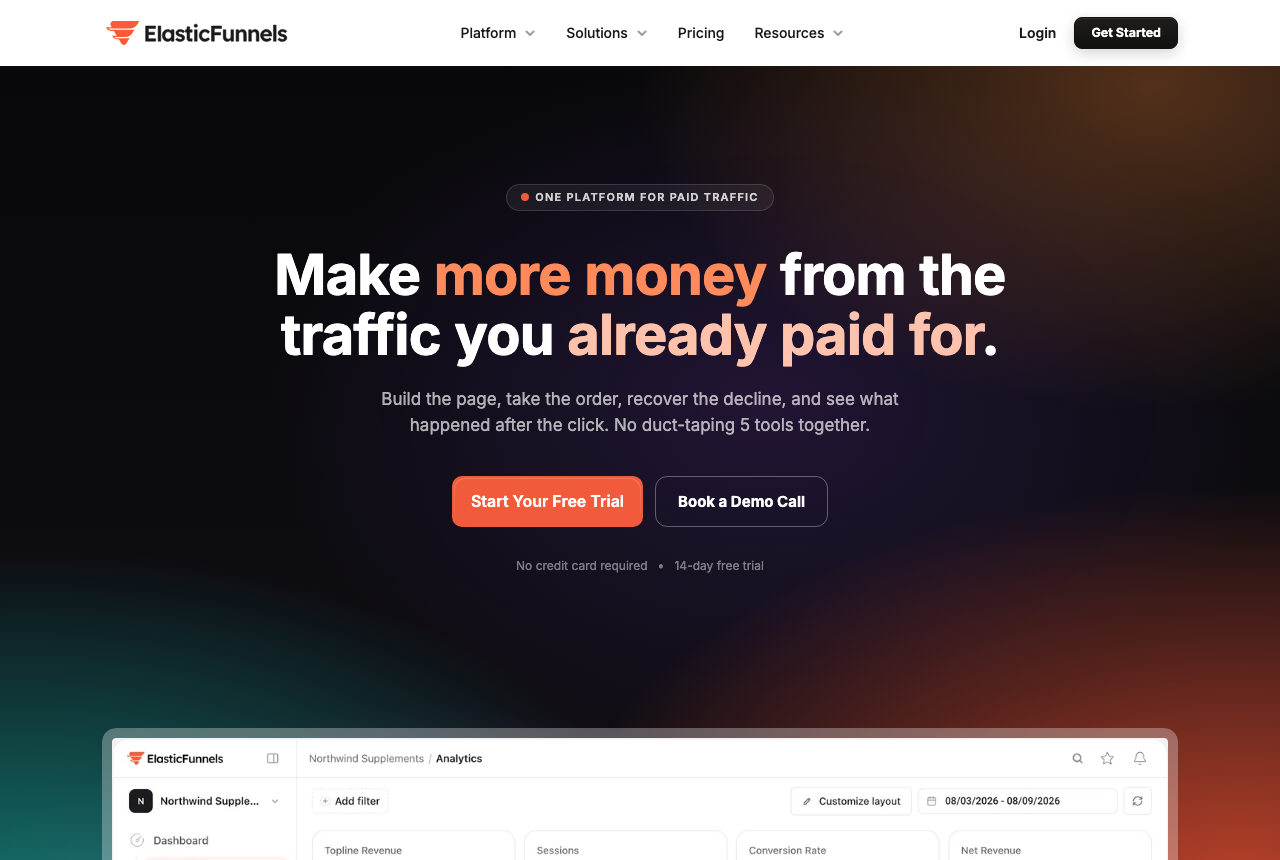
ElasticFunnels is a funnel platform for teams that buy their own traffic: affiliates, product vendors, agencies and ecommerce brands running campaigns on Meta, Google and TikTok. It builds the pages, hosts the checkout, and keeps every session, order, rebill and refund on one timeline with a CRM and reporting on the same data. That single-record design is the point of it, and it is the stack a performance team usually stitches together from four separate tools.
The feature most teams switch for is testing under one URL. Variants rotate server-side behind a single campaign link, so Meta, Google and TikTok keep their learning and a test never sends the ad back through review. Anyone who has watched a redirect-style split test wipe out a well-optimized campaign knows why that matters, and it is the one thing Leadpages cannot do. Around it sit an AI page builder that writes a page from a prompt or clones one from a URL, a checkout with order bumps, one-click upsells and native subscription billing, and multi-MID routing that cascades a charge across the merchant accounts you connect. The reporting ties the click to the sale by affiliate, geo, device or creative, and a built-in CRM and call center work off the same records.
The honest caveat: ElasticFunnels is newer than Leadpages, and there is very little independent third-party review coverage to check its claims against. Until you run real volume through it, you are largely taking the vendor's word for how it holds up. That is what you would expect of a platform this young next to a builder that has been around for well over a decade, and it matters most if you lean on years of public reviews before you trust a tool. The counter is a 14-day trial that takes no card and gates nothing, so you can prove the whole thing on your own funnel first. And multi-MID routing only earns its keep once you already hold several merchant accounts to route between. A seller on a single Stripe account still gets the pages, the same-URL testing, the checkout and the attribution; they just will not use the routing until they add a second account.
Leadpages: the fast, cheap way to get lead-capture pages live
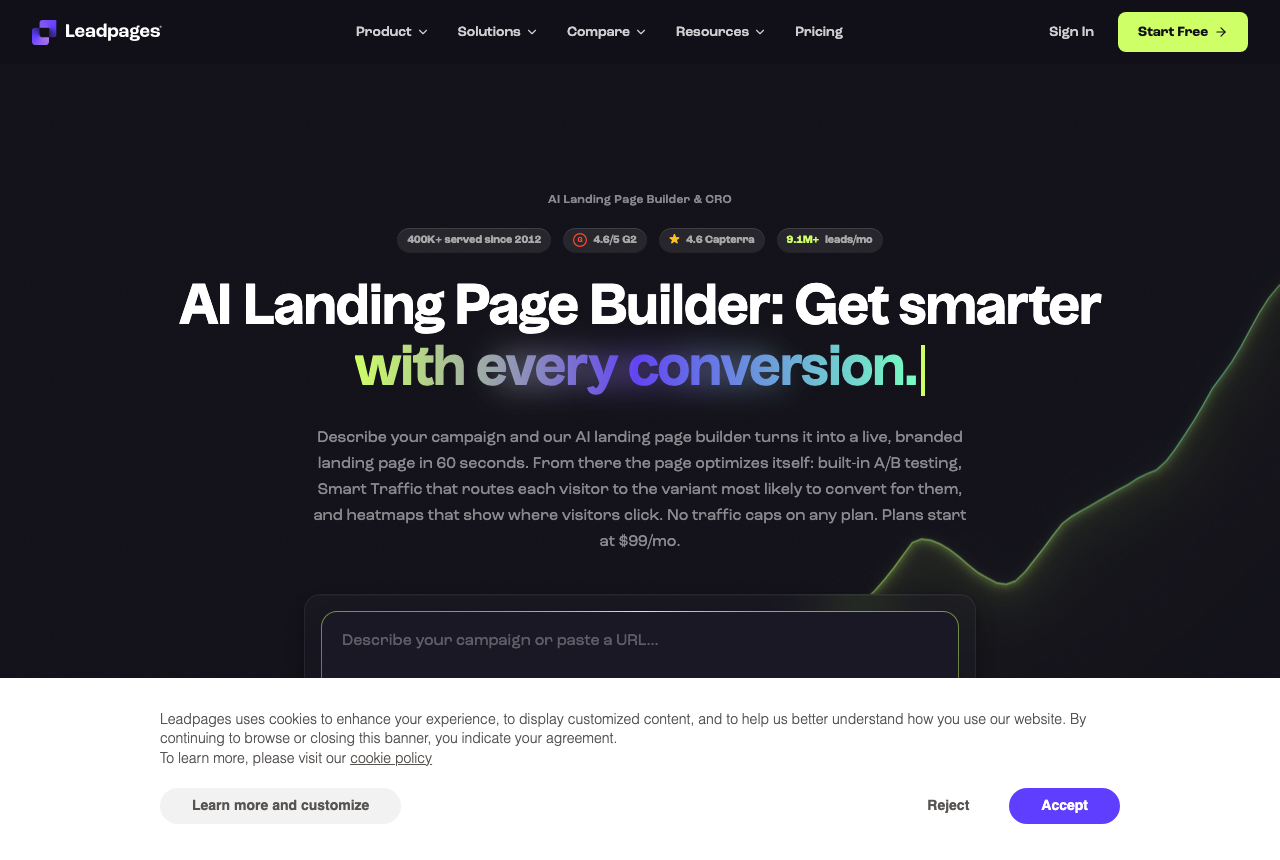
Leadpages is a hosted landing page builder aimed squarely at lead generation. Its strength is capture: forms, pop-ups, alert bars and lead-magnet delivery, plus a large template library and a simple drag-and-drop editor a non-technical marketer can get live in an afternoon. Pages are unlimited, and there are no visitor caps or overage fees at any tier, so a page that suddenly takes off never triggers a surprise bill. A/B testing is included from the $99 Grow plan up, and there is a free trial to start.
For a lead-gen campaign or a straightforward paid-traffic page, that is often all you need, and it is cheaper and simpler than running a whole funnel platform. Leadpages can also take a payment through a basic Stripe checkout, which is enough to sell a single product. What it does not have is the rest of the cart: no order bumps, no true one-click upsells, no native subscription billing, and no way to route charges across multiple merchant accounts. Its testing is standard A/B, not the server-side, same-URL kind that keeps an ad platform's learning intact. And it does not tie a click to an order, a rebill and a refund on one record; its analytics stop at the page. The recurring gripes in user threads are older price jumps against a WordPress builder and support quality.
The real split: pages and leads versus click-to-sale on one record
Strip away the shared page-building surface and the difference is what each one is built to do. Leadpages is built to capture a lead cheaply and reliably, then hand that lead to whatever you use to sell. ElasticFunnels is built so the ad click, the sale, the rebill and the refund are one measurable record, and so a test never costs you the ad platform's optimization. If your job is filling the top of the funnel with leads on a predictable bill, that is Leadpages. If your job is squeezing more revenue and cleaner attribution out of paid traffic you already run, that is ElasticFunnels.
Pricing: two different meters
The entry prices look close, and they mislead. Leadpages prices by plan: A/B testing arrives on its $99-a-month Grow plan ($79 billed annually), and there are no visitor caps or overage fees at any tier, so the bill stays flat as a page scales. ElasticFunnels prices its tiers by traffic, Starter $97, Growth $197 and Scale $497 a month, ships every feature on every plan, and adds a 0.5% fee on revenue processed through its own hosted checkout, with nothing charged on sales run through external networks like ClickBank or BuyGoods. Leadpages is the cheaper flat bill for pages and leads; ElasticFunnels costs more because it is also your checkout and your reporting. Price each on the plan that carries what you actually need, and check both vendors' current pages before you buy.
Which one for you
You buy paid traffic and live on what happens after the click: ElasticFunnels. Same-URL testing that does not reset ad optimization, a checkout with bumps, upsells and subscriptions, multi-MID routing and click-to-sale reporting on one record are the things a performance buyer needs and the things Leadpages does not do. Go in with the newness caveat in mind, and use the free trial to prove it on your own funnel.
You mainly need landing pages and lead capture on a budget: Leadpages. Its forms, pop-ups, alert bars and lead magnets, unlimited pages and flat, cap-free pricing make it the simpler and cheaper pick when the checkout and the follow-up already live somewhere else.
You are somewhere between the two: decide by your next 90 days. If the constraint is getting more revenue and cleaner numbers out of ad spend you already run, that is ElasticFunnels. If it is capturing more leads from more pages without growing the bill, that is Leadpages.
ElasticFunnels
What works
- Replaces the stack a growth team usually stitches together: a funnel builder, a checkout or CRM, a testing tool and an analytics tool, so a click, an order, a rebill and a refund are one record instead of four exports you reconcile on Monday
- Its standout is testing under one URL: variants rotate server-side on one campaign link, so Meta, Google and TikTok keep their learning and a test never sends the ad back for review
- The AI builder writes a page from a prompt across 14 page types, and the cloner turns a competitor URL into a working copy in about a minute
- Its checkout routes each charge across the NMI and Stripe accounts you connect, cascading to the next one on a soft decline, with order bumps, one-click upsells and subscription dunning built in
- Analytics put sessions, orders, rebills and refunds on one timeline, sliced by affiliate, geo, device or creative, and a built-in CRM and call center work off the same records
- A trial tests the whole tool because nothing is gated behind a higher tier: plans differ only by the traffic volume they allow
What to watch
- Newer than the platforms it competes with, with very little independent review coverage to check its claims against, so until you run real volume through it you are largely taking the vendor's word
- Multi-MID routing, the standout in its checkout, only pays off if you already hold several merchant accounts to route between. A seller on a single Stripe account still gets the pages, the testing, the analytics and the CRM, but not that routing advantage
- It is not a merchant of record like Paddle: it will not file your sales tax or carry dispute liability, so that work stays with you and your processors
- The 0.5% checkout fee applies to revenue through its hosted checkout, on top of the monthly plan and your own processor fees, though sales on external networks like ClickBank or BuyGoods are not charged
Leadpages
What works
- No visitor caps or overage fees, so cost stays predictable as you scale
- A/B testing included from the $99 Grow plan up, not gated behind an expensive tier
- Unlimited pages and a fast, simple builder
What to watch
- Fewer advanced PPC features than Unbounce, and no dynamic text replacement
- Older complaints about price jumps versus a WordPress page builder
- Support quality is a recurring gripe
Pricing
ElasticFunnels: from $97/mo. Starter $97, Growth $197, Scale $497/mo. Every feature on every plan; plans differ by traffic. 0.5% fee on revenue through EF-hosted checkouts; external platforms not charged.
Leadpages: from $99/mo. Grow $99/mo, Optimize $199/mo, Scale $399/mo, with about 20% off on annual billing. Every plan has unlimited traffic and no visitor caps, and A/B testing from Grow up (2 variants on Grow, 4 higher). A publishing-only HTML Pub layer starts at $10/mo without A/B testing. The 7-day trial requires a card.
Pricing verified against each vendor on 2026-09-14. Check before you buy.
Our pick
ElasticFunnels
ElasticFunnels is a funnel platform built for teams that run paid traffic: it builds the pages, splits them behind one URL so your ads never reset, hosts the checkout, and keeps the CRM and the reporting on the same data. Same-URL split testing is the reason most teams switch. Its checkout stands out for multi-MID routing, which cascades a charge across the payment accounts you connect and only pays off if you already run more than one. It is newer than the platforms it rivals, though, and third-party proof is thin so far.
Frequently asked questions
ElasticFunnels or Leadpages: which should I use?
Which is cheaper, ElasticFunnels or Leadpages?
Can Leadpages take payments like ElasticFunnels?
Does Leadpages have same-URL split testing?
Which is better for pure lead generation on a budget?

Written by
Dana Rourke
Lead reviewer
Dana Rourke is the lead reviewer at Campaign Buyer. She owns the tracker and attribution coverage: reading what long-term users report about each tool, checking its documentation and pricing, and verifying prices with the vendor before writing the verdict. Keeping the rankings honest mostly means writing down what the top pick gets wrong, so she does that first.
Last checked 2026-09-29