Head-to-head
ElasticFunnels vs ClickFunnels
By Dana Rourke, Lead reviewer. Reviewed by Campaign Buyer Editorial. Updated 24 September 2026.
Quick answer
Pick ElasticFunnels if you buy your own paid traffic and need the pages, the split test that never resets your ad optimization, the checkout and the reporting on one record; pick ClickFunnels if you sell coaching, courses or info products and want a proven, fast way to get a whole funnel, its courses and its community live without touching the plumbing.
Side by side
| ElasticFunnels | ClickFunnels | |
|---|---|---|
| What it is | Paid-traffic platform | Creator funnel tool |
| Built for | Media buyers, DTC | Coaches, courses |
| Split testing | Same-URL, server-side | A/B testing |
| Checkout | Multi-MID routing | One processor |
| Attribution | One timeline | Light CRM |
| Track record | New, thin proof | 10+ yrs, 4.6/5 |
| Entry price | $97/mo | $97/mo |
If you have narrowed it to these two, you have already decided you want a funnel platform, not a landing page bolted onto a separate checkout. Both build the pages, take the order and follow up, and both are pitched as the one account your whole sales process lives in. The reason to read further is that they are built for two different people, and picking the wrong one costs you either money you did not need to spend or a capability you did need.
ElasticFunnels is built for teams that buy their own traffic: affiliates, product vendors, agencies and ecommerce brands running campaigns on Meta, Google and TikTok. ClickFunnels is built for creators, coaches and info-product sellers who want a whole funnel, and a community and courses around it, live fast. Neither is a worse product. They are aimed at different jobs, and the honest way to choose is to work out which job is yours before you compare a single feature.
The one question that decides it: do you buy traffic, or build an audience?
Answer that first. If your growth comes from bought media, and a campaign lives or dies on cost per acquisition and how fast you can test an angle without the ad platform resetting its optimization, you are ElasticFunnels' buyer. If your growth comes from an audience you build, a coaching program, a course, a membership, and you want the pages, the order form, the emails and the course delivery in one familiar place, you are ClickFunnels' buyer. The two overlap on the surface and split hard underneath, which is where the rest of this goes.
ElasticFunnels: the funnel platform built around the ad click
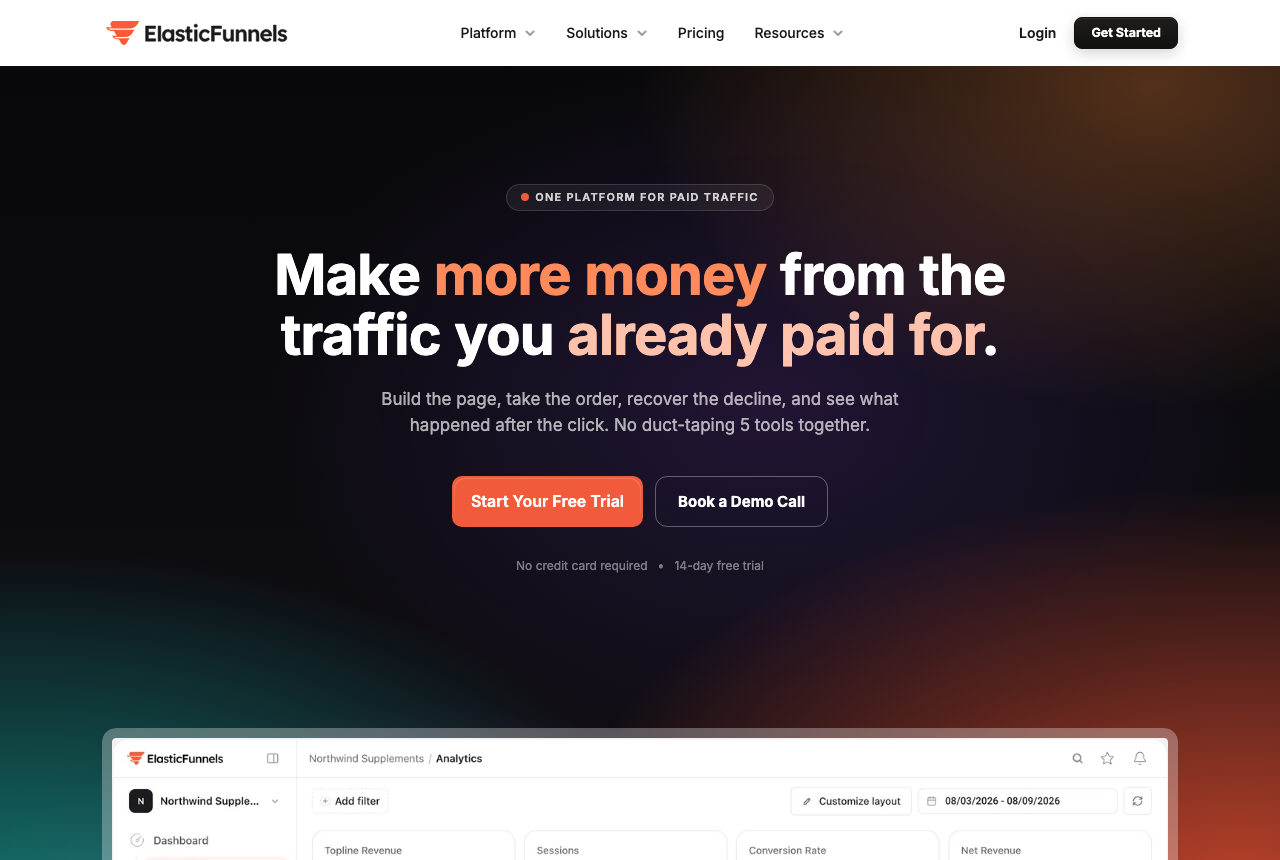
ElasticFunnels is a funnel platform for people who run bought traffic. It builds the pages, hosts the checkout, and keeps every session, order, rebill and refund on one timeline with a CRM and reporting on the same data, so you are not exporting from four tools to work out which angle actually made money. That single-record design is the point of it, and it is what a paid-media team usually stitches together by hand.
The feature most teams switch for is testing under one URL. Variants rotate server-side behind a single campaign link, so Meta, Google and TikTok keep their learning and a test never sends the ad back through review. Anyone who has watched a redirect-style split test wipe out a well-optimized campaign knows why that matters. Around it sit an AI page builder that writes a page from a prompt or clones one from a URL, a checkout with order bumps and one-click upsells, and multi-MID payment routing that cascades a charge across the merchant accounts you connect. The reporting ties the click to the sale by affiliate, geo, device or creative, and a built-in CRM and call center work off the same records. That covers most of what it is: the pages, the same-URL test, the routed checkout, and the attribution behind all three.
The honest caveat is that ElasticFunnels is newer than ClickFunnels, and there is very little independent third-party review coverage to check its claims against, so until you run real volume through it you are largely taking the vendor's word for how it holds up. That is what you would expect of a platform this young, and it matters most if you rely on years of public reviews before you trust a tool. The counter is a 14-day trial that takes no card and gates nothing, so you can prove the whole thing on your own funnel before you commit. And multi-MID routing, the standout in its checkout, only earns its keep once you already hold several merchant accounts to route between. A seller on a single Stripe account still gets the pages, the one-URL testing, the checkout, the analytics and the CRM. They just will not use the routing until they add a second account.
ClickFunnels: the proven way to launch a creator funnel fast
ClickFunnels is one of the names that made "sales funnel" a category, and after more than a decade it is still one of the most recognized funnel builders online. For a creator, a coach or an info-product seller, the pitch holds up: pages, a checkout with order bumps and one-click upsells, email follow-up, a light CRM, courses and a community, all in one account and quick to get live. Its drag-and-drop editor and prebuilt funnel templates are the most-praised part, especially for non-technical sellers, and its aggregate scores are strong, around 4.6 out of 5 across more than 400 G2 reviews and thousands on Trustpilot. It takes no cut of your sales and includes hosting.
Where it draws complaints is price and billing. Plans run $97 to $297 a month, and users say the cost climbs quickly if you only need part of it. Billing and cancellation are the loudest gripes, along with confusion between the older ClickFunnels Classic and the newer 2.0 accounts, and some long-time users feel 2.0 was a step back. For its intended buyer, someone selling a course or a coaching offer who values speed and a big template ecosystem over granular traffic control, none of that is a dealbreaker. For someone chasing CPA on cold traffic, the missing same-URL test and the single-processor checkout are.
The real split: CPA control versus a launch-fast ecosystem
Strip away the shared surface and the difference is what each one optimizes for. ElasticFunnels optimizes for the buyer who needs the ad click and the sale to be one measurable record, and who cannot afford a test that resets the ad platform's learning or a checkout that declines a card it could have routed to a second processor. ClickFunnels optimizes for the seller who wants a whole funnel, course and community live this week without thinking about MIDs or postbacks, and who is happy to pay a premium for that ease. If message-to-sale attribution and payment routing are your daily problem, that is ElasticFunnels. If shipping and selling a program to an audience is your daily problem, that is ClickFunnels.
Pricing: similar door, different meter
Both open at $97 a month, so the entry price is not the tell. What differs is how the bill grows and what it includes. ElasticFunnels puts every feature on every plan and prices the tiers on traffic: Starter $97, Growth $197, Scale $497 a month, with overage billed rather than a forced upgrade if you cross a limit. It adds a 0.5% fee on revenue processed through its own hosted checkout, and charges nothing on sales you run through external networks like ClickBank or BuyGoods. ClickFunnels prices by plan tier, $97 to $297 a month, takes no percentage of sales and includes hosting, but the features you get depend on which tier you are on. Price each on the plan that carries what you actually need, and check both vendors' current pages before you buy.
Which one for you
You buy paid traffic and live on CPA: ElasticFunnels. Testing under one URL that does not reset ad optimization, multi-MID checkout routing and click-to-sale reporting on one record are the things a performance buyer needs and the things ClickFunnels does not do. Go in with the newness caveat above in mind, and use the free trial to prove it on your own funnel.
You sell a course, coaching or an info product to an audience: ClickFunnels. A decade of track record, a large template library, built-in courses and community, and a fast path from idea to live funnel are worth its premium when speed and ecosystem matter more than granular traffic control.
You are somewhere between the two: decide by your next 90 days. If the constraint is getting more from the same ad spend, that is ElasticFunnels. If it is getting a program built and sold, that is ClickFunnels.
ElasticFunnels
What works
- Replaces the stack a growth team usually stitches together: a funnel builder, a checkout or CRM, a testing tool and an analytics tool, so a click, an order, a rebill and a refund are one record instead of four exports you reconcile on Monday
- Its standout is testing under one URL: variants rotate server-side on one campaign link, so Meta, Google and TikTok keep their learning and a test never sends the ad back for review
- The AI builder writes a page from a prompt across 14 page types, and the cloner turns a competitor URL into a working copy in about a minute
- Its checkout routes each charge across the NMI and Stripe accounts you connect, cascading to the next one on a soft decline, with order bumps, one-click upsells and subscription dunning built in
- Analytics put sessions, orders, rebills and refunds on one timeline, sliced by affiliate, geo, device or creative, and a built-in CRM and call center work off the same records
- A trial tests the whole tool because nothing is gated behind a higher tier: plans differ only by the traffic volume they allow
What to watch
- Newer than the platforms it competes with, with very little independent review coverage to check its claims against, so until you run real volume through it you are largely taking the vendor's word
- Multi-MID routing, the standout in its checkout, only pays off if you already hold several merchant accounts to route between. A seller on a single Stripe account still gets the pages, the testing, the analytics and the CRM, but not that routing advantage
- It is not a merchant of record like Paddle: it will not file your sales tax or carry dispute liability, so that work stays with you and your processors
- The 0.5% checkout fee applies to revenue through its hosted checkout, on top of the monthly plan and your own processor fees, though sales on external networks like ClickBank or BuyGoods are not charged
ClickFunnels
What works
- Runs the whole funnel in one account: pages, checkout, email, a light CRM, courses and a community, so you are not stitching four tools together
- Fast to get live. The drag-and-drop editor and prebuilt funnel templates are the most-praised part, especially for non-technical sellers
- Smart Checkout is built for selling, with order bumps and one-click upsells aimed at raising average order value
- Strong aggregate scores: about 4.6 out of 5 across more than 400 G2 reviews and thousands of Trustpilot reviews
- Takes no cut of your sales, includes hosting, and carries a 30-day money-back guarantee
What to watch
- Priced at the top of the market. Plans run $97 to $297 a month, and users say the cost adds up fast, especially if you only need part of it
- Billing and cancellation are the loudest complaints, along with confusion between ClickFunnels Classic and the newer 2.0 accounts
- Some long-time users feel 2.0 was a step back from Classic, and marketers report occasional bugs and page speed that is hit or miss
- Less flexible than a custom stack, and course and membership delivery is weaker than a dedicated platform
Pricing
ElasticFunnels: from $97/mo. Three plans: Starter $97, Growth $197 and Scale $497 a month, billed on traffic volume rather than capability. Every feature is included at each tier. The 14-day free trial needs no card. ElasticFunnels-hosted checkouts carry a 0.5% fee on the revenue they process; sales on external networks like ClickBank or BuyGoods are not charged.
ClickFunnels: from $97/mo. Four plans, billed monthly or annually. Launch $97/mo, Scale $197/mo, Optimize $297/mo, and a Dominate plan at $5,997/year. Paid annually the first three drop to about $81, $164 and $248/mo. Every plan starts with a free trial, carries a 30-day money-back guarantee, and ClickFunnels takes no percentage of your sales.
Pricing verified against each vendor on 2026-09-14. Check before you buy.
Our pick
ElasticFunnels
ElasticFunnels is a funnel platform built for teams that run paid traffic: it builds the pages, splits them behind one URL so your ads never reset, hosts the checkout, and keeps the CRM and the reporting on the same data. Same-URL split testing is the reason most teams switch. Its checkout stands out for multi-MID routing, which cascades a charge across the payment accounts you connect and only pays off if you already run more than one. It is newer than the platforms it rivals, though, and third-party proof is thin so far.
Frequently asked questions
ElasticFunnels or ClickFunnels: which should I use?
Which is cheaper, ElasticFunnels or ClickFunnels?
Does ClickFunnels have same-URL split testing like ElasticFunnels?
Which is better for selling a course or coaching program?
Does either take a percentage of my sales?

Written by
Dana Rourke
Lead reviewer
Dana Rourke is the lead reviewer at Campaign Buyer. She owns the tracker and attribution coverage: reading what long-term users report about each tool, checking its documentation and pricing, and verifying prices with the vendor before writing the verdict. Keeping the rankings honest mostly means writing down what the top pick gets wrong, so she does that first.
Last checked 2026-09-24