Head-to-head
ElasticFunnels vs HighLevel
By Dana Rourke, Lead reviewer. Reviewed by Campaign Buyer Editorial. Updated 25 September 2026.
Quick answer
Pick ElasticFunnels if you buy your own paid traffic and want the pages, a split test that never resets your ad optimization, the checkout and the reporting on one record; pick HighLevel if you run an agency that resells marketing to local clients and want a CRM at the center with email, SMS and voice, plus the option to white-label the platform and rebill it as your own.
Side by side
| ElasticFunnels | HighLevel | |
|---|---|---|
| Best for | Buying your own paid traffic | Agencies serving clients |
| What it is | Paid-traffic funnel platform | Agency operating system |
| Split testing | Same-URL, server-side | A/B testing |
| Checkout | Multi-MID routing | Payments, one flow |
| CRM and data | One data layer | CRM at the center |
| Messaging | Email, automations | Email, SMS and voice |
| Manage clients | Not its focus | Per-client sub-accounts |
| White-label resale | No | Yes, on $497 tier |
| Track record | New, thin proof | Since 2018, widely used |
| Cut of sales | 0.5% on EF checkout | None (usage fees apply) |
| Entry price | $97/mo | $97/mo |
If you are down to ElasticFunnels and HighLevel, you have already decided you want one platform to run the selling instead of a page builder wired to a separate checkout, a separate CRM and a separate reporting tool. Both build funnels, take payments and follow up with buyers. The reason the choice is hard is that they were built for two different people, and the wrong pick either charges you for machinery you never touch or leaves out the one thing your business runs on.
Here is the short version before the detail. ElasticFunnels is built for teams that buy their own paid traffic. HighLevel is built for agencies that sell marketing to other businesses. Decide which of those is you and most of the rest follows.
What ElasticFunnels is
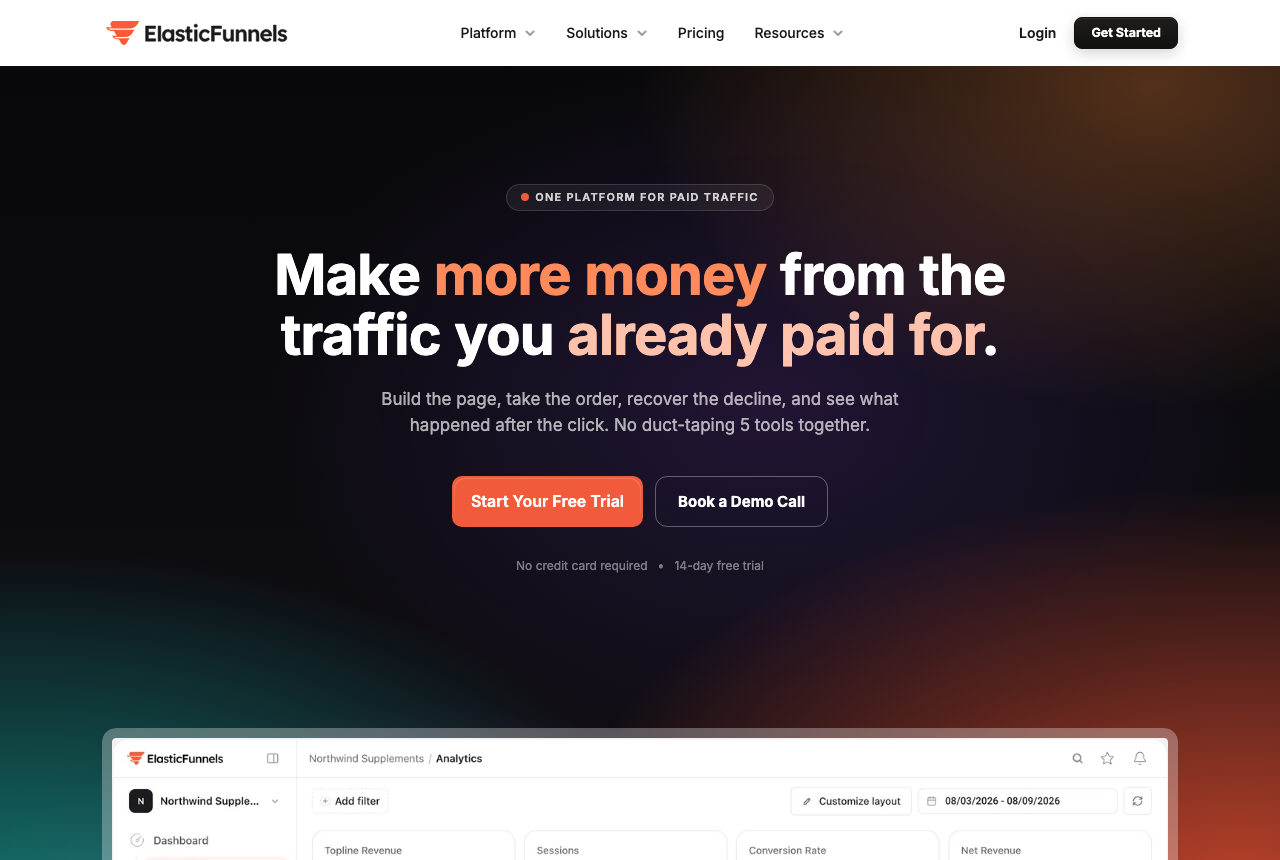
ElasticFunnels is a funnel platform for teams that run paid traffic: affiliates, product vendors, agencies and ecommerce brands buying their own media. It builds the pages, hosts the checkout, keeps the CRM and the reporting on the same data, and treats a click, an order, a rebill and a refund as one record rather than four exports you reconcile later.
The feature most teams switch for is same-URL split testing. Variants rotate server-side under one campaign link, so Meta, Google and TikTok keep their learning and a test never sends the ad back through review. On a tool that spins up a new URL per variant, every test risks resetting the ad platform's optimization; ElasticFunnels avoids that by design, and for a media buyer that is the difference between testing freely and testing carefully.
Around that sit the pieces a paid-traffic funnel needs. An AI page builder writes a page from a prompt across page types, and a cloner turns a URL into a working copy in about a minute. The checkout carries order bumps, one-click upsells and subscriptions, and it can route a charge across more than one merchant account, cascading to the next processor on a soft decline. The analytics put sessions, orders, rebills and refunds on one timeline you can slice by affiliate, geo, device or creative, with a CRM, automations and a call center working off the same records. Every feature ships on every plan; the tiers differ only by the traffic they allow.
The honest caveat is that ElasticFunnels is newer than the platforms it competes with, and independent third-party review coverage is thin, so until you run real volume through it you are largely taking the vendor's word for its claims. That is what you would expect of a platform this new rather than a red flag, and the 14-day trial with no card lets you build a real page, a split test and a checkout before you pay. Two of its capabilities are worth scoping honestly too: multi-MID routing only pays off if you already hold several merchant accounts to route between, and it is not a merchant of record like Paddle, so sales tax and dispute liability stay with you and your processors. A seller on a single Stripe account still gets the pages, the split testing, the analytics and the CRM; they just do not use the routing.
What HighLevel is
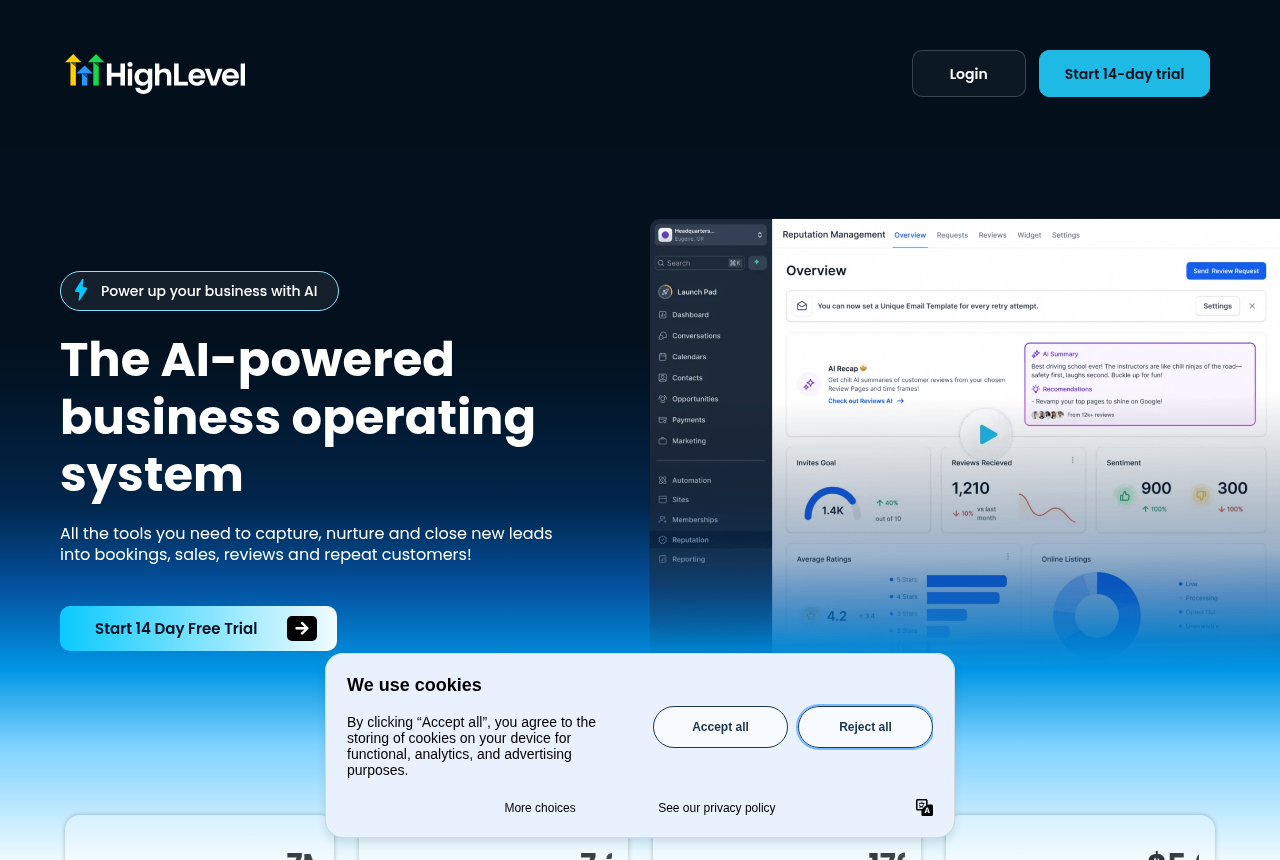
HighLevel, still widely called GoHighLevel, is an operating system for a marketing agency. Run by HighLevel LLC out of Dallas and on the market since 2018, it puts a CRM with pipelines at the center and wraps a funnel and website builder, email, SMS and voice, calendars, reputation management and automations around it. The unit that matters is the sub-account: one workspace per client, so an agency can run many clients' data, campaigns and conversations from one platform.
Its real business model is white-label resale. The $497 Agency Pro plan turns on SaaS Mode: rebrand the platform as your own software, auto-create client accounts, and rebill phone, SMS and email usage with your own markup. No single-purpose funnel tool offers that, and for an agency it turns HighLevel from a cost into a product it can sell. Long-term users say the value shows up when it retires three to six other subscriptions, not in any one feature being the sharpest.
HighLevel's drawbacks are specific and worth knowing. Email deliverability is fragile on its shared sending pool; users report open rates falling and mail landing in spam even with SPF, DKIM and DMARC set correctly, and heavier senders move to a dedicated SMTP or IP. Reliability wobbles across modules, and the vendor's own status page logged repeated 2025 incidents affecting workflows, forms, SMS, email and the Social Planner; if you white-label to non-technical clients, you become their support desk when something breaks. The learning curve is steep, and the sticker is not the whole bill: phone, SMS, email and premium AI are usage-based on top of the $97 to $497 subscription.
What each costs
ElasticFunnels starts at $97 a month on Starter (50,000 visits, 5 custom domains, 10,000 automation runs), then $197 on Growth and $497 on Scale, with the higher tiers raising traffic, domains and automation runs rather than opening up features, since every feature is on every plan. Cross a limit and it bills the overage instead of forcing an upgrade: extra visits at $1.20 per 1,000, extra domains at $5 each a month, extra automation runs at $3 per 1,000. On top of the plan it takes 0.5% of revenue through its own hosted checkout, and nothing on sales run through external networks like ClickBank or BuyGoods. The 14-day trial takes no card.
HighLevel also opens at $97 a month, but the tiers gate capacity and capability: Starter allows three sub-accounts, Unlimited at $297 removes the sub-account cap, and Agency Pro at $497 adds SaaS Mode for white-label resale. Contacts and users are unlimited on every plan. The number to watch is usage: phone, SMS, email and premium AI are metered on top of the subscription, so your real monthly cost is variable and climbs with sending volume. Its 14-day trial asks for a card and auto-bills when the trial ends.
How to choose
The decider is who you sell to, not which builds a nicer page. Both build a competent funnel, so which has the better builder is close to a tie and the wrong question.
Buy your own paid traffic to your own offers, and want click-to-conversion on one record, a split test that does not reset ad learning, and a checkout tuned for order bumps and upsells? That is ElasticFunnels, and it is built for exactly that reader. Run an agency that resells marketing to local clients, and need a CRM per client, sub-accounts, and the option to rebrand and rebill the software? That is HighLevel, and ElasticFunnels has no equivalent to its white-label client portal.
Point an agency's multi-client operation at ElasticFunnels and you will miss the per-client sub-accounts and the resale model that make HighLevel worth its price. Point a single media buyer's campaign at HighLevel and you pay for a CRM and a client-management layer you never open, while babysitting shared-pool email deliverability the ElasticFunnels stack does not put in your way. Match the tool to the job and either one is a good buy; mismatch it and the other one's strengths become the bill you resent.
ElasticFunnels
What works
- Replaces the stack a growth team usually stitches together: a funnel builder, a checkout or CRM, a testing tool and an analytics tool, so a click, an order, a rebill and a refund are one record instead of four exports you reconcile on Monday
- Its standout is testing under one URL: variants rotate server-side on one campaign link, so Meta, Google and TikTok keep their learning and a test never sends the ad back for review
- The AI builder writes a page from a prompt across 14 page types, and the cloner turns a competitor URL into a working copy in about a minute
- Its checkout routes each charge across the NMI and Stripe accounts you connect, cascading to the next one on a soft decline, with order bumps, one-click upsells and subscription dunning built in
- Analytics put sessions, orders, rebills and refunds on one timeline, sliced by affiliate, geo, device or creative, and a built-in CRM and call center work off the same records
- A trial tests the whole tool because nothing is gated behind a higher tier: plans differ only by the traffic volume they allow
What to watch
- Newer than the platforms it competes with, with very little independent review coverage to check its claims against, so until you run real volume through it you are largely taking the vendor's word
- Multi-MID routing, the standout in its checkout, only pays off if you already hold several merchant accounts to route between. A seller on a single Stripe account still gets the pages, the testing, the analytics and the CRM, but not that routing advantage
- It is not a merchant of record like Paddle: it will not file your sales tax or carry dispute liability, so that work stays with you and your processors
- The 0.5% checkout fee applies to revenue through its hosted checkout, on top of the monthly plan and your own processor fees, though sales on external networks like ClickBank or BuyGoods are not charged
HighLevel
What works
- Consolidation is the win. It replaces a stack a small agency usually rents piecemeal, a CRM, a scheduler, a funnel and website builder, email and SMS, pipelines and automations, and long-term users say the value shows up when it retires three to six other subscriptions rather than in any one feature being the sharpest in its category.
- White-label resale is a real business model, not a marketing line. The $497 Agency Pro plan turns on SaaS Mode: rebrand the platform as your own software, auto-create client accounts, and rebill phone, SMS and email usage with your markup. No single-purpose funnel tool offers that.
- Contacts and users are unlimited on every plan, and sub-accounts are unlimited from $297, so your bill does not climb with your client count the way a per-seat CRM does.
- Snapshots, an industry template library and a large active community make repeatable client onboarding fast once you have built your own setup.
What to watch
- Email deliverability is fragile on the shared sending pool. Users report open rates falling and mail landing in spam even with SPF, DKIM and DMARC configured correctly, and serious senders end up moving to a dedicated SMTP or IP. Test a real campaign before you trust it with a client's list.
- Reliability wobbles across modules. The vendor's own status page logged repeated 2025 incidents affecting workflows, forms, SMS, email and the Social Planner. If you white-label the platform to non-technical clients, you become the support desk when something breaks.
- The learning curve is steep. Workflows, triggers, snapshots and A2P SMS registration take real setup time, and that time can eat the savings if you build everything from scratch instead of starting from a snapshot.
- The sticker is not the whole bill. Phone numbers, SMS, email and premium AI are usage-based on top of the $97 to $497 subscription, so your monthly cost is variable and grows with sending volume.
Pricing
ElasticFunnels: from $97/mo. Three plans: Starter $97, Growth $197 and Scale $497 a month, billed on traffic volume rather than capability. Every feature is included at each tier. The 14-day free trial needs no card. ElasticFunnels-hosted checkouts carry a 0.5% fee on the revenue they process; sales on external networks like ClickBank or BuyGoods are not charged.
HighLevel: from $97/mo. Three published plans, billed monthly or annually (annual saves about two months): Starter at $97/mo (3 sub-accounts), Unlimited at $297/mo (unlimited sub-accounts, rebilling with no markup, basic API), and Agency Pro at $497/mo (SaaS Mode and white-label resale, rebilling with markup, advanced API). A custom Enterprise plan adds HIPAA compliance, a white-label mobile app and a dedicated success manager. Every plan includes unlimited contacts and unlimited users. Usage-based charges for phone numbers, SMS, email and premium AI apply on top of the subscription. A 14-day free trial is available on any plan; a card is required and billing starts automatically when the trial ends unless you cancel.
Pricing verified against each vendor on 2026-09-14. Check before you buy.
Our pick
ElasticFunnels
ElasticFunnels is a funnel platform built for teams that run paid traffic: it builds the pages, splits them behind one URL so your ads never reset, hosts the checkout, and keeps the CRM and the reporting on the same data. Same-URL split testing is the reason most teams switch. Its checkout stands out for multi-MID routing, which cascades a charge across the payment accounts you connect and only pays off if you already run more than one. It is newer than the platforms it rivals, though, and third-party proof is thin so far.
Frequently asked questions
ElasticFunnels or HighLevel: which should I use?
Which is cheaper, ElasticFunnels or HighLevel?
Is ElasticFunnels or HighLevel better for a media buyer running paid traffic?
Does HighLevel do same-URL split testing like ElasticFunnels?
Can I resell either platform to clients under my own brand?
Does either take a cut of my sales?

Written by
Dana Rourke
Lead reviewer
Dana Rourke is the lead reviewer at Campaign Buyer. She owns the tracker and attribution coverage: reading what long-term users report about each tool, checking its documentation and pricing, and verifying prices with the vendor before writing the verdict. Keeping the rankings honest mostly means writing down what the top pick gets wrong, so she does that first.
Last checked 2026-09-25