Skip to content
Menu

HighLevel review

The agency operating system for CRM, funnels, email, SMS and white-label resale in one login.

By Dana Rourke, Lead reviewer. Reviewed by Campaign Buyer Editorial. Updated 24 September 2026.

Our verdict

HighLevel is the pick if you run an agency that resells marketing to local clients and wants a CRM, funnels, email, SMS and a white-label client portal in one place. It is real and widely used, but it rewards setup time, its shared email sending needs babysitting, and usage fees for phone, SMS and AI sit on top of the subscription.

You have seen HighLevel, still widely called GoHighLevel, promoted hard by agency owners and affiliates, and the question underneath the hype is a fair one: is it a real tool, and will you regret paying for it? The short answer is that it is real. It is run by HighLevel LLC out of Dallas, it has been on the market since 2018, and it is one of the larger agency platforms going. Capability is not the risk here. The regret risks are specific, and they are worth knowing before you put a card down.

HighLevel is best understood as an operating system for a marketing agency. It bundles a CRM and sales pipelines, a website and funnel builder, email, SMS and voice, booking calendars, reputation management, workflow automation, courses and memberships, payments and invoicing, and an affiliate manager, and it runs all of it from one login. The pitch is that you stop paying for and stitching together five or six separate tools. For an agency that manages many clients, each client sits in its own sub-account under your parent account, which is the shape most competitors do not have.

What it does well

The consolidation is the honest reason to buy it, and long-term users agree. On Reddit, agency owners describe the value as "tech stack consolidation" and call it good "bang for your buck" once they are running several client accounts. The point they make repeatedly is that no single module is the best in its category. The email builder is not as good as a dedicated email platform, the CRM is not Salesforce, the funnels are not ClickFunnels at its sharpest. The value is that they are all present, they talk to each other, and one bill replaces many. If switching to HighLevel lets you cancel three to six subscriptions, the maths works. If it replaces one tool you already like, it does not.

The second real draw is resale. On the $497 Agency Pro plan, SaaS Mode lets you rebrand the platform as your own software, set your own prices, auto-create client accounts when someone subscribes, and rebill their phone, SMS and email usage with a markup you keep. That turns the platform from a cost into a product you sell, and it is the single feature that pulls agencies toward HighLevel over a plain funnel builder. It is not a small undertaking to set up, but it is a genuine business model, not a marketing slogan.

Two structural things also count in its favour. Every plan includes unlimited contacts and unlimited users, and sub-accounts are unlimited from the $297 tier up. That means your software cost does not climb every time you sign a client or add a team member, which is the trap with per-seat CRMs. And because so many agencies run the same industries, there is a deep library of snapshots and templates plus a large, active community, so once you have built your own onboarding once, you can clone it for the next client in an afternoon.

Where you might regret it

Take email deliverability seriously, because it is the complaint that costs real money. HighLevel sends through a shared pool, and users report open rates dropping and messages landing in spam even after they have set up SPF, DKIM and DMARC correctly. The pattern points at shared-IP reputation rather than a single account doing something wrong. Heavy senders end up routing through a dedicated SMTP or a dedicated IP to fix it. There is also a well-voted feature request about the platform lacking throttling controls for custom SMTP, and the person who raised it noted that support tickets on the issue "have gone nowhere." If your business or your client's business lives on email, build one campaign, send it to a seed list, and check inbox placement before you migrate anything important.

Reliability is the second thing to weigh. Users describe a love-hate relationship: a lot of features, but a stream of "continuous roadblocks, errors, and bugs." This is not only anecdote. HighLevel's own public status page logged repeated incidents through 2025 across workflows, forms, SMS delivery, the email builder and the Social Planner. For internal use that is an annoyance. If you white-label the platform and resell it to non-technical local clients, it is more than that, because when a client's automation misfires you are the support desk, not HighLevel. Factor the support load into your pricing before you go SaaS.

Then there is the learning curve, which the same users who recommend the platform are the first to flag. Workflows, triggers, snapshots, calendar logic and A2P SMS registration all take time to get right, and the setup hours can quietly cancel out the money you saved by consolidating, especially if you build every automation from scratch rather than starting from a proven snapshot. Budget for a real ramp, or buy a snapshot to skip part of it.

Finally, the price on the plan card is not the price you pay. Phone numbers, SMS, email and premium AI are all usage-based, billed on top of the $97 to $497 subscription. On the Unlimited and Agency Pro plans you can rebill those costs to clients with a markup, which turns the variable cost into margin. On the Starter plan you simply absorb it. Either way, model your expected sending volume, because the monthly total moves with it.

One more note on trust that has nothing to do with the software. A lot of the glowing HighLevel content online is written by affiliates earning a recurring commission, so "it changed my life" reviews deserve a pinch of salt. That cuts both ways: the product is genuinely capable, but read the praise knowing where some of it comes from, and weight the specific, unglamorous reports above the testimonials.

Who it is for

HighLevel fits an agency that resells marketing to local businesses and wants to run and, eventually, white-label the whole stack from one place. If you manage several clients, will actually retire other subscriptions, and are willing to invest the setup time, it is a defensible pick and the resale model can pay for itself. If you are a solo operator who needs one clean tool, a paid-traffic media buyer who mostly wants funnels and tracking, or a business whose whole model rides on high-volume email, the breadth is more than you need and the deliverability and reliability trade-offs land harder. Its closest comparison is ClickFunnels, which is sharper at the funnel itself but does not do agency resale or native SMS and voice. Read the HighLevel alternatives before you commit, and if you want the tier-by-tier numbers first, we broke down HighLevel pricing separately. Real tool, real ceiling, real homework before you scale spend or clients through it.
Pros and cons

What works

  • Consolidation is the win. It replaces a stack a small agency usually rents piecemeal, a CRM, a scheduler, a funnel and website builder, email and SMS, pipelines and automations, and long-term users say the value shows up when it retires three to six other subscriptions rather than in any one feature being the sharpest in its category.
  • White-label resale is a real business model, not a marketing line. The $497 Agency Pro plan turns on SaaS Mode: rebrand the platform as your own software, auto-create client accounts, and rebill phone, SMS and email usage with your markup. No single-purpose funnel tool offers that.
  • Contacts and users are unlimited on every plan, and sub-accounts are unlimited from $297, so your bill does not climb with your client count the way a per-seat CRM does.
  • Snapshots, an industry template library and a large active community make repeatable client onboarding fast once you have built your own setup.

What to watch

  • Email deliverability is fragile on the shared sending pool. Users report open rates falling and mail landing in spam even with SPF, DKIM and DMARC configured correctly, and serious senders end up moving to a dedicated SMTP or IP. Test a real campaign before you trust it with a client's list.
  • Reliability wobbles across modules. The vendor's own status page logged repeated 2025 incidents affecting workflows, forms, SMS, email and the Social Planner. If you white-label the platform to non-technical clients, you become the support desk when something breaks.
  • The learning curve is steep. Workflows, triggers, snapshots and A2P SMS registration take real setup time, and that time can eat the savings if you build everything from scratch instead of starting from a snapshot.
  • The sticker is not the whole bill. Phone numbers, SMS, email and premium AI are usage-based on top of the $97 to $497 subscription, so your monthly cost is variable and grows with sending volume.

HighLevel, feature by feature

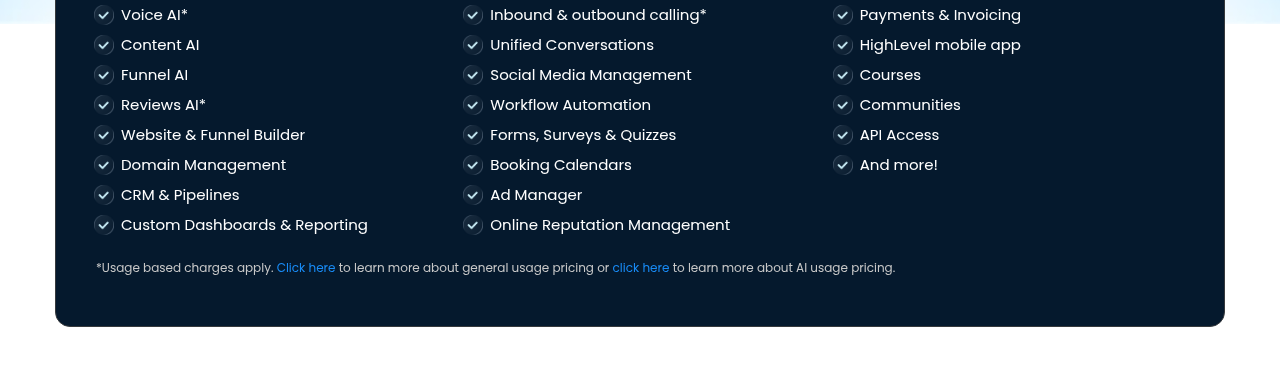
A checklist from the HighLevel pricing page listing the core features included on every plan: Voice AI, Funnel AI, Website and Funnel Builder, CRM and Pipelines, Custom Dashboards and Reporting, Inbound and outbound calling, Unified Conversations, Workflow Automation, Booking Calendars, Ad Manager, Online Reputation Management, Payments and Invoicing, Courses and Communities, with a note that usage-based charges apply.
Core features included on every plan. A checklist from the HighLevel pricing page listing the core features included on every plan: Voice AI, Funnel AI, Website and Funnel Builder, CRM and Pipelines, Custom Dashboards and Reporting, Inbound and outbound calling, Unified Conversations, Workflow Automation, Booking Calendars, Ad Manager, Online Reputation Management, Payments and Invoicing, Courses and Communities, with a note that usage-based charges apply. Screenshot: gohighlevel.com,

What buyers keep saying

Research: unverified

Consolidation is the real value, mostly for agencies ↑ frequently praised

The most consistent praise is that HighLevel earns its price by replacing several subscriptions at once (CRM, scheduler, funnel builder, email and SMS, pipelines, automations) rather than any single feature being best in class. Long-term agency users call it strong value for money when they manage multiple client sub-accounts, because sub-accounts become an easy add-on that improves client retention.

Reliability and bugs across modules ↓ common complaint

Users describe a love-hate relationship: a lot of features, but recurring roadblocks and glitches. The vendor's own public status page backs this up, logging repeated 2025 incidents across workflows, forms, SMS, email and the Social Planner. If you white-label the platform to non-technical clients, you become the support buffer when something breaks.

“continuous roadblocks, errors, and bugs”

Anonymous Reddit: Anyone else experiencing issues with GHL?

“Workflow processing degradation”

Anonymous Blog: Previous incidents | Public GHL Status Page

Email deliverability needs babysitting ↓ common complaint

Deliverability is a recurring worry. Emails land in spam and open rates fall even with SPF, DKIM and DMARC set up correctly, which points at shared sending-pool reputation; serious senders move to a dedicated SMTP or IP. A widely-voted feature request about missing throttling for custom SMTP notes that support tickets went nowhere.

“continuous roadblocks, errors, and bugs”

Anonymous Reddit: Anyone else experiencing issues with GHL?

“have gone nowhere”

Anonymous Blog: GHL's Lack of Email Throttling is Breaking Deliverability fo...

The receipts

We read the threads before we ranked. Here is where the sentiment above comes from, at links you can open.

Pricing

Plans from $97/mo, with a 14-day trial.

Three published plans, billed monthly or annually (annual saves about two months): Starter at $97/mo (3 sub-accounts), Unlimited at $297/mo (unlimited sub-accounts, rebilling with no markup, basic API), and Agency Pro at $497/mo (SaaS Mode and white-label resale, rebilling with markup, advanced API). A custom Enterprise plan adds HIPAA compliance, a white-label mobile app and a dedicated success manager. Every plan includes unlimited contacts and unlimited users. Usage-based charges for phone numbers, SMS, email and premium AI apply on top of the subscription. A 14-day free trial is available on any plan; a card is required and billing starts automatically when the trial ends unless you cancel.

Pricing verified against the vendor on 2026-09-24. Prices go stale. Check the vendor before you buy.

See the full HighLevel pricing breakdown, tier by tier.

Changelog

  • 24 September 2026. First published. Verified pricing and features against the vendor and ranked HighLevel in its category.

Frequently asked questions

How much does HighLevel cost?
Three published plans, billed monthly or annually (annual saves about two months): Starter at $97/mo (3 sub-accounts), Unlimited at $297/mo (unlimited sub-accounts, rebilling with no markup, basic API), and Agency Pro at $497/mo (SaaS Mode and white-label resale, rebilling with markup, advanced API). A custom Enterprise plan adds HIPAA compliance, a white-label mobile app and a dedicated success manager. Every plan includes unlimited contacts and unlimited users. Usage-based charges for phone numbers, SMS, email and premium AI apply on top of the subscription. A 14-day free trial is available on any plan; a card is required and billing starts automatically when the trial ends unless you cancel.
Who is HighLevel best for?
HighLevel is the pick if you run an agency that resells marketing to local clients and wants a CRM, funnels, email, SMS and a white-label client portal in one place. It is real and widely used, but it rewards setup time, its shared email sending needs babysitting, and usage fees for phone, SMS and AI sit on top of the subscription.

Related reading

Dana Rourke

Written by

Dana Rourke

Lead reviewer

Dana Rourke is the lead reviewer at Campaign Buyer. She owns the tracker and attribution coverage: reading what long-term users report about each tool, checking its documentation and pricing, and verifying prices with the vendor before writing the verdict. Keeping the rankings honest mostly means writing down what the top pick gets wrong, so she does that first.

danar@campaignbuyer.com

Last checked 2026-09-24