Head-to-head
ClickFunnels vs HighLevel
By Dana Rourke, Lead reviewer. Reviewed by Campaign Buyer Editorial. Updated 24 September 2026.
Quick answer
Pick ClickFunnels if you sell your own offers, courses, coaching or info products, and want the pages, checkout, upsells and email running as one funnel you can launch fast; pick HighLevel if you run an agency serving multiple clients and want a CRM at the center with email, SMS and voice, plus the option to white-label the platform and rebill it as your own.
Side by side
| ClickFunnels | HighLevel | |
|---|---|---|
| Best for | Selling your own offers | Agencies serving clients |
| What it is | Funnel-first builder | Agency operating system |
| Core strength | Pages, checkout, upsells | CRM, pipelines, SMS, voice |
| Email and SMS | Email follow-up | Email, SMS and voice |
| Sell courses | Built in | Built in |
| Manage clients | Not its job | Per-client sub-accounts |
| White-label resale | No | Yes, on $497 tier |
| Learning curve | Fast to launch | Steep, setup-heavy |
| Cut of sales | None | None (usage fees apply) |
| Entry price | $97/mo | $97/mo |
If you have narrowed the field to ClickFunnels and HighLevel, you have already decided you want one platform to run the selling, not a page builder wired to five other tools. Both build funnels, take payments and follow up with buyers, and both are sold as the single account your whole marketing lives in. But they were built for two different people, and the wrong pick costs you either money you did not need to spend or a capability you did.
ClickFunnels is a funnel-first builder for someone selling their own offers: courses, coaching, info products, a direct-response offer they own. HighLevel is an operating system for an agency that serves other businesses, with a CRM at the center and the option to white-label the whole thing and resell it. That difference decides almost everything below.
The one question that decides it: are you selling your own offers, or serving clients?
Answer that first, before you compare a single feature. If you sell your own courses, coaching or info products and want the pages, the checkout, the upsells and the follow-up email running as one funnel you can launch this week, you are ClickFunnels's buyer. If you run an agency, handle several clients' marketing, and want a CRM you manage per client, plus email, SMS and voice, plus the option to rebrand the platform and rebill it as your own software, you are HighLevel's buyer.
Everything else follows from that. A solo seller does not need per-client sub-accounts or a white-label portal, and paying for them is paying for overhead. An agency needs exactly those things, and a funnel builder with no real CRM leaves it stitching a client database on the side. Both tools are good at their own job. The failure mode is buying the one built for the other person.
ClickFunnels: the funnel-first tool for selling your own offers
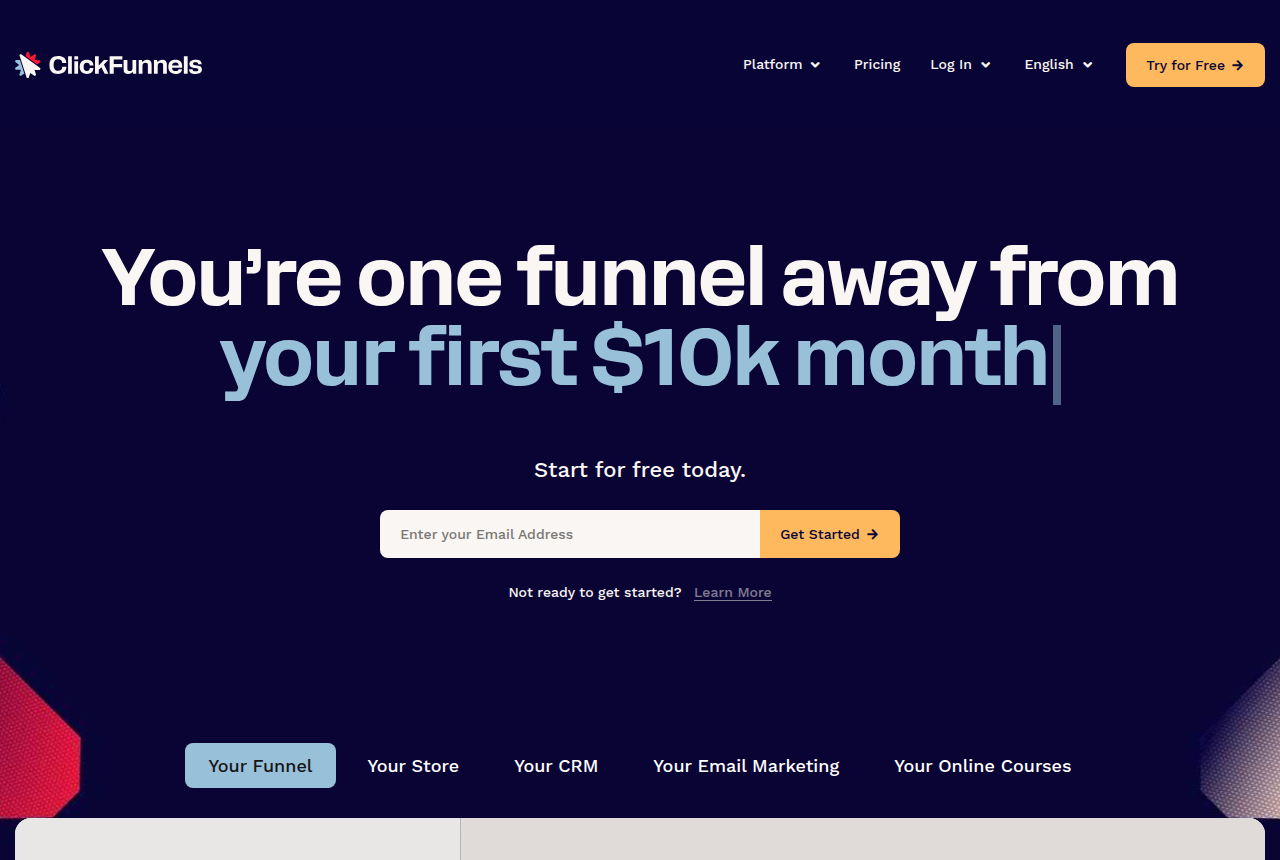
ClickFunnels is one of the names that made "sales funnel" a category, and after more than a decade it is still one of the most recognised funnel builders online. It runs the whole path from click to customer in one account: landing and sales pages, a checkout with order bumps and one-click upsells, email follow-up, a light CRM, and course and community delivery for whatever you sell.
The most-praised part is speed to live. The drag-and-drop editor and the prebuilt funnel templates get a non-technical seller from idea to a working funnel fast, which is the whole reason a creator reaches for it instead of assembling a page builder, a cart and an email tool separately. Its Smart Checkout is built for selling rather than just collecting a payment, with order bumps and one-click upsells aimed at lifting average order value. It takes no cut of your sales, includes hosting, and carries a 30-day money-back guarantee. Aggregate scores back the reputation: roughly 4.6 out of 5 across more than 400 G2 reviews.
The honest costs are two. It sits near the top of the market on price, $97 to $297 a month, and users say the bill adds up fast if you only need part of what it does. And billing and cancellation are the loudest complaints, along with confusion between the older ClickFunnels Classic and the newer 2.0 accounts, where some long-time users feel 2.0 was a step back. It is a funnel tool, not a CRM: for running many clients' data it is the wrong shape.
HighLevel: the operating system for an agency
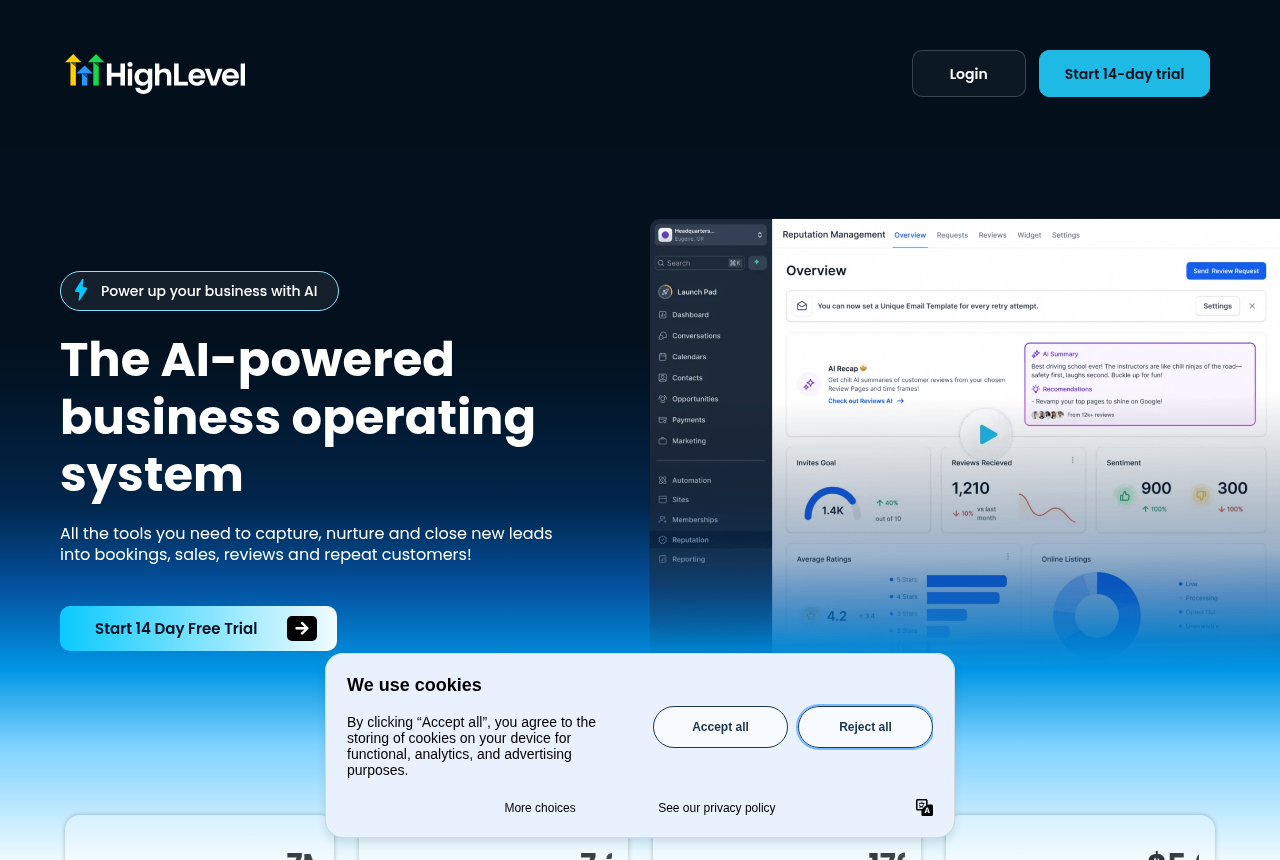
HighLevel, still widely called GoHighLevel, is best understood as an operating system for a marketing agency. It bundles a CRM with pipelines, a funnel and website builder, email, SMS and voice, calendars, reputation management, automations, courses and payments, and it does all of it per client through sub-accounts. Where ClickFunnels is built around the funnel, HighLevel is built around the client database, with the funnel as one module hanging off it.
Two things make it an agency tool rather than a bigger ClickFunnels. First, consolidation: long-term users say the value shows up when it retires three to six other subscriptions, not in any single feature being the sharpest in its category. Contacts and users are unlimited on every plan, and sub-accounts are unlimited from $297, so the bill does not climb with your client count the way a per-seat CRM does. Second, resale: the $497 Agency Pro plan turns on SaaS Mode, which lets you rebrand the platform as your own software, auto-create client accounts, and rebill phone, SMS and email usage with your markup. No single-purpose funnel tool offers that.
The honest costs are real and worth knowing before you put a card down. Email deliverability is fragile on the shared sending pool: users report open rates falling and mail landing in spam even with SPF, DKIM and DMARC set correctly, and serious senders move to a dedicated SMTP or IP. Reliability wobbles across modules, and the vendor's own status page logged repeated 2025 incidents affecting workflows, forms, SMS and email. The learning curve is steep, and phone, SMS, email and premium AI are usage-based on top of the $97 to $497 subscription, so the sticker is not the whole bill.
Where they overlap, and where they don't
The overlap is the funnel builder. Both let you build a landing page, a sales page and a checkout, run an A/B test, and follow up by email, and for a simple offer either one does the job. If all you compared was whether it can build a funnel, you would call it a tie and pick on price.
The gap is on the two ends. ClickFunnels goes deeper on the selling side for your own products: the checkout, the order bumps and upsells, and the course and community delivery are more polished for a creator packaging an offer. HighLevel goes deeper on the operating side for a service business: the CRM, the pipelines, SMS and voice, the per-client sub-accounts and the white-label resale are things ClickFunnels does not try to do. So the real question is never which one builds a better funnel. It is which end of the platform you will actually live in.
A third path if your margin lives in the checkout
Both ClickFunnels and HighLevel assume one merchant account and a standard A/B test. That is fine for most sellers. But if you buy your own paid traffic at volume, two things start to matter that neither is built around. A normal A/B test splits visitors across two URLs, which can reset the ad platform's learning and send a variant back through review. And a single merchant account is a single point of failure once you are processing real volume. ElasticFunnels is a funnel platform built for that reader: it runs same-URL split tests, so variants rotate server-side under one campaign link and Meta, Google and TikTok keep their optimization, and it hosts a checkout that routes charges across several merchant accounts you hold, with order bumps and one-click upsells, keeping the click, the order, the rebill and the refund on one record.
The honest limit to weigh: ElasticFunnels is newer than either platform here, and there is very little independent third-party review coverage to check its claims against, so until you run real volume through it you are largely taking the vendor's word for it, which is what you would expect of a platform this new. That newness touches the outside proof, not the feature list, and it offers a 14-day free trial with no card if you want to prove the workflow yourself. For the job most readers of this page have, a creator selling their own offers or an agency serving clients, ClickFunnels and HighLevel remain the direct answers. Keep ElasticFunnels on its own line of the decision, for the paid-traffic team whose profit turns on the split test and the checkout, rather than as a tiebreaker between these two.
Which one for you
You sell your own courses, coaching or info products: ClickFunnels. The funnel, the selling-focused checkout with upsells, and the course delivery are built for packaging and launching your own offer fast, and you skip the agency machinery you would never use. Accept the top-of-market price and go in knowing billing is where the complaints cluster.
You run an agency serving multiple clients: HighLevel. The CRM, per-client sub-accounts, SMS and voice, and the white-label resale on Agency Pro are the whole point, and consolidation pays for itself when it retires several other subscriptions. Budget setup time, test deliverability on a real list before you trust it with a client's, and remember the usage fees sit on top of the plan.
You buy your own paid traffic and your profit turns on the split test and the checkout: look at ElasticFunnels alongside them, with the newness caveat above in mind.
ClickFunnels
What works
- Runs the whole funnel in one account: pages, checkout, email, a light CRM, courses and a community, so you are not stitching four tools together
- Fast to get live. The drag-and-drop editor and prebuilt funnel templates are the most-praised part, especially for non-technical sellers
- Smart Checkout is built for selling, with order bumps and one-click upsells aimed at raising average order value
- Strong aggregate scores: about 4.6 out of 5 across more than 400 G2 reviews and thousands of Trustpilot reviews
- Takes no cut of your sales, includes hosting, and carries a 30-day money-back guarantee
What to watch
- Priced at the top of the market. Plans run $97 to $297 a month, and users say the cost adds up fast, especially if you only need part of it
- Billing and cancellation are the loudest complaints, along with confusion between ClickFunnels Classic and the newer 2.0 accounts
- Some long-time users feel 2.0 was a step back from Classic, and marketers report occasional bugs and page speed that is hit or miss
- Less flexible than a custom stack, and course and membership delivery is weaker than a dedicated platform
HighLevel
What works
- Consolidation is the win. It replaces a stack a small agency usually rents piecemeal, a CRM, a scheduler, a funnel and website builder, email and SMS, pipelines and automations, and long-term users say the value shows up when it retires three to six other subscriptions rather than in any one feature being the sharpest in its category.
- White-label resale is a real business model, not a marketing line. The $497 Agency Pro plan turns on SaaS Mode: rebrand the platform as your own software, auto-create client accounts, and rebill phone, SMS and email usage with your markup. No single-purpose funnel tool offers that.
- Contacts and users are unlimited on every plan, and sub-accounts are unlimited from $297, so your bill does not climb with your client count the way a per-seat CRM does.
- Snapshots, an industry template library and a large active community make repeatable client onboarding fast once you have built your own setup.
What to watch
- Email deliverability is fragile on the shared sending pool. Users report open rates falling and mail landing in spam even with SPF, DKIM and DMARC configured correctly, and serious senders end up moving to a dedicated SMTP or IP. Test a real campaign before you trust it with a client's list.
- Reliability wobbles across modules. The vendor's own status page logged repeated 2025 incidents affecting workflows, forms, SMS, email and the Social Planner. If you white-label the platform to non-technical clients, you become the support desk when something breaks.
- The learning curve is steep. Workflows, triggers, snapshots and A2P SMS registration take real setup time, and that time can eat the savings if you build everything from scratch instead of starting from a snapshot.
- The sticker is not the whole bill. Phone numbers, SMS, email and premium AI are usage-based on top of the $97 to $497 subscription, so your monthly cost is variable and grows with sending volume.
Pricing
ClickFunnels: from $97/mo. Four plans, billed monthly or annually. Launch $97/mo, Scale $197/mo, Optimize $297/mo, and a Dominate plan at $5,997/year. Paid annually the first three drop to about $81, $164 and $248/mo. Every plan starts with a free trial, carries a 30-day money-back guarantee, and ClickFunnels takes no percentage of your sales.
HighLevel: from $97/mo. Three published plans, billed monthly or annually (annual saves about two months): Starter at $97/mo (3 sub-accounts), Unlimited at $297/mo (unlimited sub-accounts, rebilling with no markup, basic API), and Agency Pro at $497/mo (SaaS Mode and white-label resale, rebilling with markup, advanced API). A custom Enterprise plan adds HIPAA compliance, a white-label mobile app and a dedicated success manager. Every plan includes unlimited contacts and unlimited users. Usage-based charges for phone numbers, SMS, email and premium AI apply on top of the subscription. A 14-day free trial is available on any plan; a card is required and billing starts automatically when the trial ends unless you cancel.
Pricing verified against each vendor on 2026-09-23. Check before you buy.
Our pick
ClickFunnels
ClickFunnels is the pick if you sell coaching, courses or info products and want the pages, checkout, upsells and email running as one funnel instead of four separate tools. It is fast to launch and covers the whole sales process end to end. The trade-offs are real: it sits at the top of the market on price, the bill climbs as you scale, and billing and cancellation draw the most complaints.
Frequently asked questions
ClickFunnels or HighLevel: which should I use?
Which is cheaper, ClickFunnels or HighLevel?
Is HighLevel just a cheaper, more capable ClickFunnels?
Can I sell courses and coaching in both?
Which is right for an agency with several clients?
Does either take a percentage of my sales?
Sources
Other sources
3 discussions and reviews read for this page. Quotes are excerpts; open a link to read the original in context.
- [reddit-askmarketing-worth] Is ClickFunnels Actually Worth It for Real Marketers?
- [reddit-digitalmarketing-hate] Does anyone else hate Clickfunnels as much as I do?
- [g2-sellers-cf2] ClickFunnels Products | Read 417 Reviews on G2

Written by
Dana Rourke
Lead reviewer
Dana Rourke is the lead reviewer at Campaign Buyer. She owns the tracker and attribution coverage: reading what long-term users report about each tool, checking its documentation and pricing, and verifying prices with the vendor before writing the verdict. Keeping the rankings honest mostly means writing down what the top pick gets wrong, so she does that first.
Last checked 2026-09-24