The agency platform vs the free-to-start suitemedia buyer software
GoHighLevel vs Systeme.io
By Dana Rourke, Lead Reviewer. Reviewed by Campaign Buyer Editorial. Updated 24 September 2026.
Quick answer
Pick HighLevel if you run an agency or a real marketing operation and want a CRM at the center with funnels, email, SMS and voice, plus the option to white-label the platform and rebill it to clients; pick Systeme.io if you are a lean creator or beginner selling to an audience you already own, and you want funnels, email, a course and your own affiliate program in one cheap login you can run free until the sales justify paying.
Side by side
| GoHighLevel | Systeme.io | |
|---|---|---|
| What it is | Agency operating system | One-login suite |
| Best for | Agencies, client work | Lean creators |
| Entry price | $97/mo | Free, then $17 |
| CRM | Full CRM, pipelines | Basic CRM |
| Email and SMS | Email, SMS, voice | Email only |
| Checkout | Payments, invoicing | Basic checkout |
| White-label resale | Yes, $497 tier | No |
| Sales fees | None (usage fees) | None |
| Learning curve | Steep, setup-heavy | Fast to launch |
| Track record | Since 2018, large | 500k+ users |
The one question that decides it
If you are down to HighLevel and Systeme.io, you have already agreed on the shape of the tool. You want one login that builds the pages, takes the payment and follows up with the buyer, instead of a page builder wired to a separate cart, a separate email tool and a separate database. Both do that. But they were built for two very different people, and one question settles it: are you running an agency or a real operation with clients and a team, or are you a solo creator selling your own offers on a budget?
HighLevel, still widely called GoHighLevel, is an operating system for a marketing business, built around a CRM. Systeme.io is a one-login suite built so a beginner can launch before spending a cent. Get those two facts straight and the rest of this page is detail.
HighLevel: the operating system for an agency
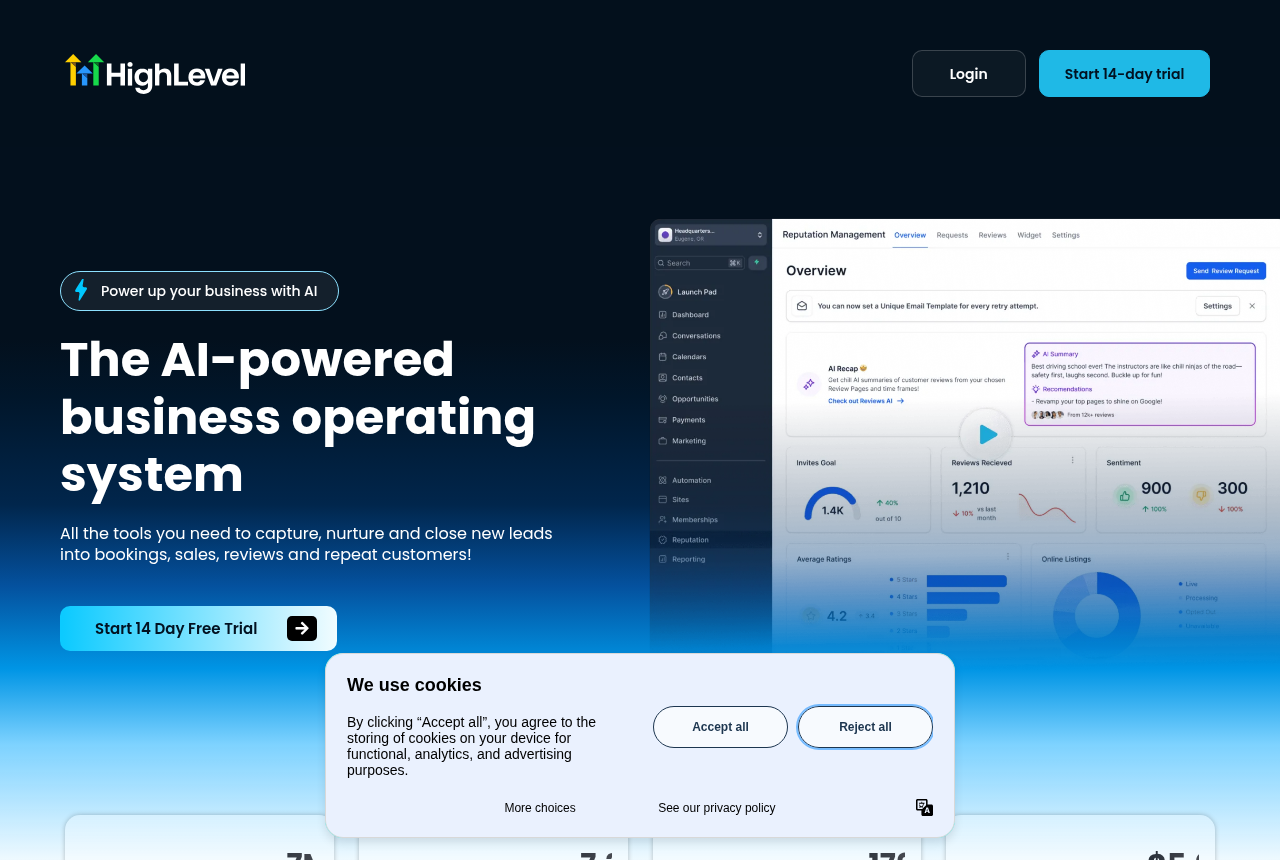
HighLevel is best understood as an operating system for a marketing agency. It bundles a CRM with pipelines, a funnel and website builder, email, SMS and voice, calendars, reputation management, automations, courses and payments, and it runs all of it per client through sub-accounts. It is run by HighLevel LLC out of Dallas, it has been on the market since 2018, and it is one of the larger agency platforms going, so capability is not the risk here.
Two things make it an agency tool. First, consolidation. Long-term users say the value shows up when it retires three to six other subscriptions, even where a single module trails the best tool in its category. Contacts and users are unlimited on every plan, and sub-accounts are unlimited from $297, so the bill does not climb with your client count the way a per-seat CRM does. Second, resale. The $497 Agency Pro plan turns on SaaS Mode, which lets you rebrand the platform as your own software, auto-create client accounts, and rebill phone, SMS and email usage with your own markup. No single-purpose funnel tool offers that.
The honest costs are real, and worth knowing before you put a card down. Email deliverability is fragile on the shared sending pool: users report open rates falling and mail landing in spam even with SPF, DKIM and DMARC set correctly, and serious senders end up moving to a dedicated SMTP or IP. Reliability wobbles across modules, and the vendor's own status page logged repeated 2025 incidents affecting workflows, forms, SMS, email and the Social Planner. The learning curve is steep, with workflows, triggers, snapshots and A2P SMS registration all taking setup time. And the bill runs past the sticker: phone numbers, SMS, email and premium AI are usage-based on top of the $97 to $497 subscription, so the monthly cost is variable and grows with your sending volume.
Systeme.io: the one that costs nothing to start
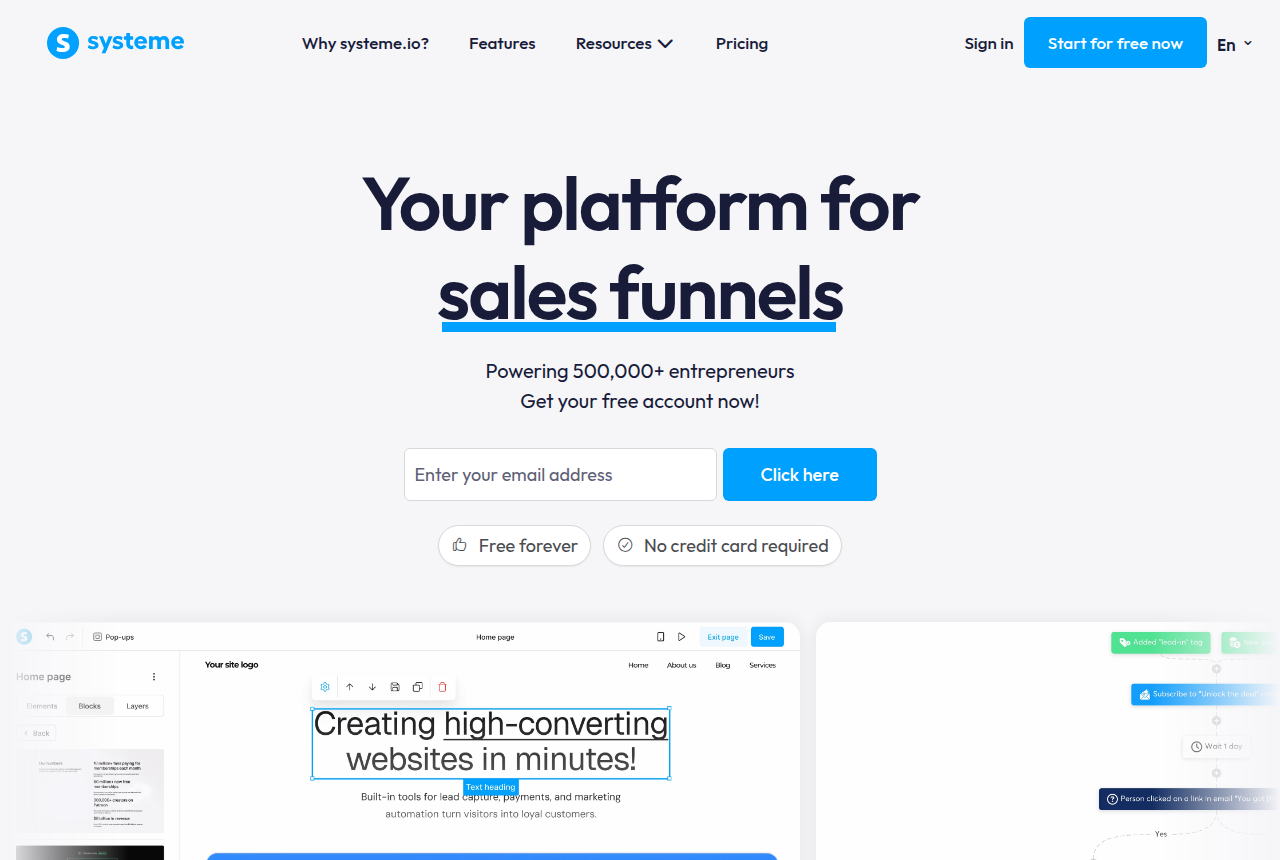
Systeme.io covers a lot of the same ground for a fraction of the money, and it is aimed at a different buyer. Funnels, email, a website and blog, courses, communities and your own affiliate program all run from one login. The company says more than 500,000 entrepreneurs use it, a user base that settles any doubt about whether it will last.
Its real advantage is the free plan, which is generous enough to run a small business on. You get up to 2,000 contacts, three sales funnels, a course, a blog and an affiliate program, with no credit card and no expiry date. You can build a working funnel and take sales on it before paying anything. When you do pay, plans run $17 for Startup, $47 for Webinar and $97 for unlimited contacts, and every tier takes 0% on top of your Stripe or PayPal fees. Nothing about the bill balloons as your list grows. For a beginner who wants fewer moving parts and less setup, that is the whole appeal, and it is a strong one.
It runs short on design and depth. The page builder and templates are fine for a clean, simple funnel and restrictive if you want pixel-level control or a high-end brand look. One long-term user summed it up as "okay, but branding always felt slightly off for higher end offers". The same holds for automation and the CRM: sellers who leave tend to hit a wall on conditional email logic, deeper checkout customization or heavier client workflows, and the courses and communities trail dedicated tools like Skool. The simplicity that makes Systeme.io easy is also where it stops. One more thing to weigh: a lot of its online praise is affiliate-driven, so trust your own free-plan test over the reviews.
The real bill, tier by tier
Systeme.io is far cheaper to start. It begins at nothing, then $17 for Startup, $47 for Webinar and $97 for unlimited contacts. Annual billing knocks off two months, and no tier takes a cut of your sales. Its most expensive plan costs less than half of what HighLevel charges for a middle tier.
HighLevel has no free plan. Starter is $97 a month, the Unlimited plan is $297 with unlimited sub-accounts, and Agency Pro is $497 for the white-label SaaS Mode. On top of that sit usage fees for calls, texts, sending and AI, so two agencies on the same plan can pay very different amounts depending on how much they send. Neither tool takes a revenue share, but HighLevel's monthly cost moves with usage while Systeme.io's stays fixed.
So if budget is the pressure and you are validating an offer or running lean, Systeme.io wins on price outright, and it is the honest pick for anyone watching costs. HighLevel is worth its floor only once the consolidation is paying for itself, meaning it is retiring several other subscriptions and, ideally, earning resale margin from clients.
A third path if you buy your own traffic
Both tools here assume you sell to an audience you can reach: an agency's clients, a creator's list. Neither is built around the cold ad click. If you buy your own paid traffic at volume, two things start to matter that neither is designed for. A normal A/B test splits visitors across separate URLs, which can reset the ad platform's optimization and send a variant back through review. And a single merchant account is a single point of failure once you are processing real volume through it.
ElasticFunnels is a funnel platform built for that reader. It builds the pages, including an AI builder that can clone a page from a URL, and it split-tests variants server-side under one URL, so Meta, Google and TikTok keep their learning and a test never goes back through ad review. It hosts a checkout with order bumps and one-click upsells that routes charges across more than one merchant account you hold, and it keeps the click, the order, the rebill and the refund on one timeline with a CRM and attribution on the same data. The trial is 14 days with no card, and pricing starts at $97 a month, billed by traffic rather than by feature tier.
The honest limit to weigh is proof. ElasticFunnels is newer than either platform on this page, and there is very little independent third-party review coverage to check its claims against, so until you run real volume through it you are largely taking the vendor's word for what it does. That is what you would expect of a platform this young, and the 14-day trial lets you prove same-URL testing and the account routing on your own campaigns before you commit. For the job most readers of this page have, running an agency or selling your own offers to an owned audience, HighLevel and Systeme.io are the direct answers. ElasticFunnels suits a third buyer, the team spending on ads at volume.
Which one for you
You run an agency or a real marketing operation with clients and a team: HighLevel. The CRM at the center, per-client sub-accounts, email, SMS and voice, and the white-label resale on Agency Pro are what you are paying for, and consolidation pays for itself when it retires several other subscriptions. Budget real setup time, test deliverability on a live list before you trust it with a client's audience, and remember the usage fees sit on top of the plan.
You are a lean creator or beginner selling to an audience you already own: Systeme.io. Funnels, email, a course and your own affiliate program run from one login, free until the sales justify paying, with no transaction fees when they do. Accept the design and automation ceiling as the price of that simplicity, and plan your move the day your offers outgrow it.
You buy your own paid traffic and your profit turns on the split test and the checkout: look at ElasticFunnels alongside them, with the newness caveat above in mind.
GoHighLevel
What works
- Consolidation is its biggest advantage. It replaces the separate tools a small agency usually rents: a CRM, a scheduler, a funnel and website builder, email and SMS, pipelines and automations. Long-term users say the payoff is dropping three to six other subscriptions.
- White-label resale is on the Agency Pro plan. SaaS Mode lets you rebrand the platform as your own software, auto-create client accounts, and rebill phone, SMS and email usage with your markup. No single-purpose funnel tool offers that.
- Contacts and users are unlimited on every plan, and sub-accounts are unlimited from the Unlimited plan up, so your bill does not climb with your client count the way a per-seat CRM does.
- Snapshots, an industry template library and a large active community make repeatable client onboarding fast once you have built your own setup.
- After Customer Success steps back, chat, Zoom and tickets are open any hour from the desktop drawer, and billing has a separate phone path and mailbox.
- A Marketplace app, a scoped token and an inbound workflow webhook are each a supported way in, so a bridge for one sub-account can stay off a custom OAuth app.
What to watch
- Email deliverability is fragile on the shared sending pool. Users report open rates falling and mail landing in spam even with SPF, DKIM and DMARC configured correctly, and serious senders end up moving to a dedicated SMTP or IP. Test a real campaign before you trust it with a client's list.
- Reliability wobbles across modules. HighLevel's own status page logged repeated incidents through 2025, across workflows, forms, SMS, email and the Social Planner.
- The learning curve is steep. Workflows, triggers, snapshots and A2P SMS registration take real setup time, and that time can eat the savings if you build everything from scratch instead of starting from a snapshot.
- The listed subscription leaves out phone, SMS, email and AI usage.
- Only an agency admin or an agency user can contact HighLevel's help desk. A client login has no vendor button, so those questions come back to the agency even after the premium add-on.
- Real-time events sit outside a Private Integration Token. Delivery needs a Marketplace OAuth app, or the inbound workflow trigger, and that trigger draws on a premium execution allowance.
- Zapier reaches standard contact fields. Agency-level actions and custom opportunity fields are where people wiring accounts say the connector runs out.
Systeme.io
What works
- The free plan runs a working business: up to 2,000 contacts, 3 sales funnels, a course, a blog and your own affiliate program, with no credit card and no expiry date. You can launch a live funnel before paying a cent.
- One login replaces four subscriptions. Funnels, email, courses, a website and affiliate management run from the same account, so there is no glue code between a page builder, an email tool and a course host.
- Cheap even when you pay. Paid plans start at $17/mo, and the top plan with unlimited contacts costs about what funnel-first rivals charge for their entry tier.
- No transaction fees, ever. Every plan takes 0% on top of your Stripe or PayPal fees, and email sends are unlimited, so the bill does not balloon as your sales and list grow.
- Fast to learn and launch. Long-term users keep it for the same reason they picked it: fewer moving parts and less setup, which is what a first funnel actually needs.
What to watch
- The page builder and templates are basic. Fine for simple funnels and landing pages, but restrictive if you want pixel-level control or a high-end brand look. One long-term user called the editor "okay, but branding always felt slightly off for higher end offers".
- You can outgrow the automation and checkout. Conditional email logic, deeper checkout customization like tax handling, and heavier CRM or multi-brand workflows are where sellers say they leave for a specialist. The simplicity that draws you in is also the limit.
- Courses and communities are good enough, but they trail dedicated tools like Skool, and some niche features, such as natively collecting testimonials, need a third-party workaround.
- Much of the online praise is affiliate-driven. Systeme.io runs a strong affiliate program, and a lot of its glowing coverage, including Reddit "honest review" posts, reads as promotional. Trust your own free-plan trial over the hype.
Pricing
GoHighLevel: from $97/mo. Yearly totals are $970, $2,970 and $4,970. The pricing page offers 14 days on the tier you pick. The subscription starts unless you cancel, and phone, email and AI usage can bill during the trial. A separate page offers 30 days and charges the card on file at the end unless you cancel. LC Email is $0.675 per 1,000. US and Canada SMS is $0.00747 per segment, plus carrier fees. A local number is $1.15 a month and a toll-free number is $2.15. AI products are a separate bill: Growth is $50 a month per location, and AI Unlimited is $97 a month per location.
Systeme.io: from $0 (free plan). No timed trial. Free plan is permanent: 2,000 contacts, 3 funnels, 1 course, 1 blog, 1 affiliate program, 1 custom domain, 1 automation rule, 1 email campaign, 500 students, unlimited email. Lifetime sales cap $10,000 USD (affiliate commissions excluded; dashboard notice near the cap, help article names $8,000; 3 days to upgrade, then payment pages stop; no auto-charge). Startup $17: 5,000 contacts, 10 funnels, 5 courses. Webinar $47: 10,000 contacts, 50 funnels, 20 courses, evergreen webinars. Unlimited $97: unlimited contacts, funnels, courses and automation rules. Annual billing is 2 months free ($170 / $470 / $970). 0% transaction fees. Unlimited sub-accounts, each with its own copy of the plan limits.
Prices as of 24 October 2026
Our pick
GoHighLevel
HighLevel is the pick for an agency that resells marketing to local clients and wants a CRM, funnels, email, SMS and a white-label client portal in one place. It is widely used, and the setup takes significant time. Shared email sending needs monitoring, and phone, SMS, and AI incur usage fees on top of the subscription.
Frequently asked questions
Which is cheaper, GoHighLevel or Systeme.io?
Is HighLevel just a more expensive Systeme.io?
Can I sell courses in both?
Which is right for an agency with several clients?
Does either take a percentage of my sales?
Sources
Other sources
2 discussions and reviews read for this page. Quotes are excerpts; open a link to read the original in context.

Written by
Dana Rourke
Lead Reviewer
Dana Rourke is the lead reviewer at Campaign Buyer. She covers trackers and attribution on this site: she reads what long-term users report about each tool, checks its documentation and pricing, and verifies prices with the vendor before writing the verdict. Keeping the rankings honest mostly means writing down what the top pick gets wrong, so she does that first.
Last checked 2026-09-24
Comments
No comments yet. Questions and your own experience are welcome.
Thank you. Your comment will appear once it has been reviewed.