Agency platform vs a no-fee storemedia buyer software
GoHighLevel vs Gumroad
By Dana Rourke, Lead reviewer. Reviewed by Campaign Buyer Editorial. Updated 29 September 2026.
Quick answer
Pick GoHighLevel if you run a marketing agency or a real operation with clients and want a CRM at the center with funnels, email, SMS and follow-up, plus the option to white-label the platform and rebill it to clients, and you can carry a fee from $97 a month; pick Gumroad if you are launching a first ebook, template or course, want to be selling today with no monthly fee, and want sales tax handled worldwide as merchant of record. Between the two, GoHighLevel is our default pick for a seller building an operation that actively sells and follows up, because its CRM, funnels and email do work a plain store leaves to you. Gumroad wins the true beginner who wants the fastest, cheapest way to list a first product to a warm audience.
Side by side
| GoHighLevel | Gumroad | |
|---|---|---|
| What it is | Agency operating system | Hosted store, sell by link |
| Built for | Agencies, client operations | First product, warm audiences |
| Pricing | $97 to $497 a month | No monthly fee, 10% + $0.50/sale |
| Its cut of sales | None (usage fees apply) | 10% + $0.50 per sale |
| Handles your tax | No, you file | Yes, merchant of record |
| CRM and pipelines | Full CRM, pipelines | None |
| Email, SMS, voice | Email, SMS, voice | Email broadcasts only |
| Checkout | Payments, invoicing | Basic checkout, no upsells |
| White-label resale | Yes, $497 tier | No |
| Track record | Since 2018, large | Since 2011 |
The one question that decides it: are you running an operation, or selling a product?
If you are down to GoHighLevel and Gumroad, the honest first thing to say is that they barely compete. They answer two different questions. GoHighLevel, still officially called HighLevel, is an operating system for a marketing business, built around a CRM. Gumroad is a hosted store a solo creator can be selling from this afternoon, with nothing to pay until money comes in. The gap between them is wide enough that the choice is not feature against feature. It is about which of those two people you are.
So settle this before anything else. Are you running a marketing agency or a real operation with clients, a list to follow up and pipelines to manage? Then you want the machine, and Gumroad will feel like a toy. Are you a creator launching a first ebook, template or course to an audience you already have? Then you want the store, and GoHighLevel is a large, expensive platform you will spend weeks learning and never fill. Most people searching this comparison sit at one of those two ends, not in the middle.
GoHighLevel: the operating system for an agency
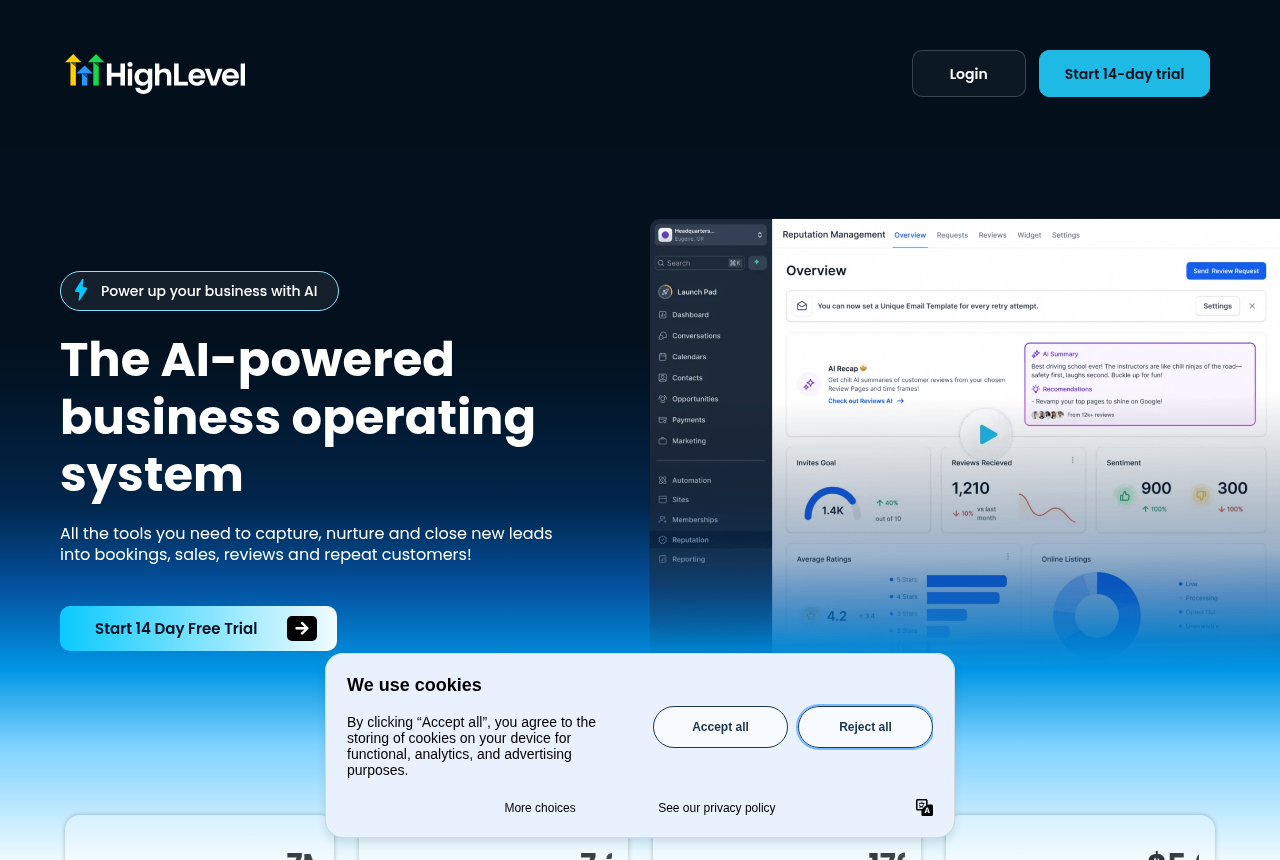
HighLevel is best understood as an operating system for a marketing agency. It bundles a CRM with pipelines, a funnel and website builder, email, SMS and voice, calendars, reputation management, automations, courses and payments, and it runs all of it per client through sub-accounts. It is run by HighLevel LLC out of Dallas, it has been on the market since 2018, and it is one of the larger agency platforms going, so capability is not the risk here.
Two things make it an agency tool rather than a bigger funnel builder. First, consolidation: long-term users say the value shows up when it retires three to six other subscriptions, not in any single feature being the sharpest in its category. Contacts and users are unlimited on every plan, and sub-accounts are unlimited from $297, so the bill does not climb with your client count the way a per-seat CRM does. Second, resale: the $497 Agency Pro plan turns on SaaS Mode, which lets you rebrand the platform as your own software, auto-create client accounts, and rebill phone, SMS and email usage with your own markup. Gumroad has no answer to any of that, because it is not trying to.
The honest costs are worth knowing before you put a card down. Email deliverability is fragile on the shared sending pool, and serious senders end up moving to a dedicated SMTP or IP after watching open rates fall. Reliability wobbles across modules, and the vendor's own status page logged repeated 2025 incidents affecting workflows, forms, SMS, email and the Social Planner. The learning curve is steep. And the sticker is not the whole bill: phone, SMS, email and premium AI are usage-based on top of the $97 to $497 subscription, so the monthly cost is a moving number. The HighLevel review covers how it holds up day to day.
Gumroad: the simplest way to start
Gumroad has run since 2011, which makes it older than most tools it is compared with, and its whole product is simplicity. Upload a file, set a price, share a link or a storefront. There is no monthly fee, so you pay nothing until you make a sale, and G2 reviewers rate it 4.2 out of 5 largely for that ease. It sells more than plain downloads: memberships, subscriptions, pay-what-you-want pricing, software licence keys and multiple file versions all run from one account, and you can point a custom domain at your store or embed the checkout on a site you already run. Its standout is tax. Gumroad has been merchant of record since January 2025, so it is the legal seller on the receipt and collects and remits sales tax and VAT worldwide, and a solo creator never files a tax form for a foreign sale. The Gumroad review goes deeper on the trade-offs.
The catches are real, and they are not about the editor. The flat 10% plus 50 cents is cheap on a first sale and expensive at scale, so past a few thousand dollars a month it quietly becomes the costly model. Getting paid is the loudest complaint: Gumroad rates 1.4 out of 5 on Trustpilot across several hundred reviews and holds a BBB F rating, driven by withheld payouts and sudden account suspensions, with support reported as slow or silent. The gap between that 1.4 and the G2 4.2 is the story: the software is pleasant, and the anger is about payouts and account decisions. PayPal also ended service with Gumroad in October 2024, so most sales are card-only now. And by design it is a store, not a follow-up machine: there is no CRM, no pipeline, and no multi-step funnel behind the product page.
Pricing: a flat monthly fee versus a cut of every sale
These two do not compare on a sticker. GoHighLevel charges a flat monthly fee, from $97 on Starter up to $497 for the white-label Agency Pro plan, and takes nothing of its own on your sales beyond your processor's cut. On top sit usage fees for phone, SMS, email and premium AI, so two agencies on the same plan can pay very different amounts. Gumroad charges no monthly fee and takes 10% plus 50 cents of every direct sale instead, and 30% on sales it sends you from its Discover marketplace, with tax handled for you as merchant of record.
Run both against your real revenue and the answer separates. A creator doing a few hundred dollars a month pays Gumroad almost nothing, and a $97 monthly fee is dead weight before the sales arrive. An operation doing $5,000 a month through a funnel pays Gumroad about $500 every month, where GoHighLevel's fee is fixed and its CRM, email and follow-up are working to bring buyers back. But the flat fee only wins if you actually use the machine you are paying for. Price both on the sales you expect and the operation you will really run, not the first month. We verified these figures with each vendor in September 2026; check the current pages before you buy, because pricing moves.
The paid-traffic seller both of these leave out
There is one reader neither tool serves well, and it is this site's core reader: the media buyer running their own offers on cold, paid traffic. Gumroad's 10% comes straight off ad margins that are already thin, and it is built for warm audiences and organic discovery, not paid acquisition. GoHighLevel builds funnels, but two things bite a paid-traffic team. Its split tests typically run variants on separate URLs, which can send an ad back through review and reset the platform's learning, and its reporting does not tie the ad click to the order and the rebill on one record, so working out which angle actually made money means reconciling exports.
ElasticFunnels is built for that buyer, and it closes the gap on the two fronts that matter here: testing and attribution. Its lead feature is same-URL split testing, where variants rotate server-side under one campaign link, so Meta, Google and TikTok keep their learning and a test never sends the ad back through review. Around it sit an AI page builder that writes a page from a prompt or clones one from a URL, a checkout with order bumps, one-click upsells, subscriptions and dunning that can route charges across more than one merchant account you hold, and a CRM and automations on the same data. It keeps sessions, orders, rebills, refunds and ad spend on one record, so a click, an order and a refund are the same row rather than four exports to reconcile. It is self-serve from $97 a month with a 14-day free trial that takes no card, and it takes 0.5% of revenue through its own hosted checkout and nothing on sales you run through outside networks.
The honest caveat keeps it on its own line rather than as the winner of this head-to-head. ElasticFunnels is newer than either GoHighLevel or Gumroad, and there is very little independent third-party review coverage to check its claims against, so until you run real volume through it you are largely taking the vendor's word for how the testing and reporting hold up. That is what you would expect of a platform this recent, where GoHighLevel has run since 2018 and Gumroad since 2011, and it touches the proof, not the feature set: the pages, the same-URL testing, the checkout and the attribution are all there to use from the first day, and the no-card trial exists so you can prove them on your own funnel before you commit. Scope it, too. A solo creator who only wants to list one ebook to a warm list is buying a funnel platform, a checkout and attribution they may not need yet, and for that seller Gumroad is the smaller, better-fitted tool. See ElasticFunnels vs GoHighLevel for the direct head-to-head.
Which one for you
You run an agency or a real marketing operation with clients: GoHighLevel. The CRM at the center, per-client sub-accounts, email, SMS and voice, and the white-label resale on Agency Pro are the whole reason to buy it, and consolidation pays for itself when it retires several other subscriptions. Budget real setup time, test deliverability on a live list before you trust it with a client's audience, and remember the usage fees sit on top of the plan. If you want the same shape for less, GoHighLevel vs Systeme.io weighs it against a cheaper suite.
You are launching a first product and want to pay nothing until you sell: Gumroad. The fastest, cheapest way to get an ebook, template or course online, with tax handled worldwide as merchant of record and no monthly fee. Accept that the flat 10% gets expensive as you scale, and go in knowing the payout and support complaints so a stuck payout does not surprise you. When you outgrow it, SamCart vs Gumroad and ThriveCart vs Gumroad cover the step up.
You run your own paid traffic and want a funnel you can test and attribute: look at ElasticFunnels alongside these two, with the newness caveat above in mind, because same-URL split testing and one-record attribution are the things neither GoHighLevel nor Gumroad offers.
Between the two you asked about, GoHighLevel takes our default pick, not because Gumroad is a bad product, but because a reader weighing an operating system against a store is usually trying to build something that sells and follows up actively, and that is exactly what a CRM-centered platform delivers where a plain store leaves it to you. Gumroad is plainly the better answer for a creator launching a first product cheap and simple, or selling to a warm audience where a 10% cut off low volume barely registers. Pick on your stage and your ambition, and the full field sits in our head-to-heads.
GoHighLevel
What works
- Consolidation is the win. It replaces a stack a small agency usually rents piecemeal, a CRM, a scheduler, a funnel and website builder, email and SMS, pipelines and automations, and long-term users say the value shows up when it retires three to six other subscriptions rather than in any one feature being the sharpest in its category.
- White-label resale is a real business model, not a marketing line. The $497 Agency Pro plan turns on SaaS Mode: rebrand the platform as your own software, auto-create client accounts, and rebill phone, SMS and email usage with your markup. No single-purpose funnel tool offers that.
- Contacts and users are unlimited on every plan, and sub-accounts are unlimited from $297, so your bill does not climb with your client count the way a per-seat CRM does.
- Snapshots, an industry template library and a large active community make repeatable client onboarding fast once you have built your own setup.
What to watch
- Email deliverability is fragile on the shared sending pool. Users report open rates falling and mail landing in spam even with SPF, DKIM and DMARC configured correctly, and serious senders end up moving to a dedicated SMTP or IP. Test a real campaign before you trust it with a client's list.
- Reliability wobbles across modules. The vendor's own status page logged repeated 2025 incidents affecting workflows, forms, SMS, email and the Social Planner. If you white-label the platform to non-technical clients, you become the support desk when something breaks.
- The learning curve is steep. Workflows, triggers, snapshots and A2P SMS registration take real setup time, and that time can eat the savings if you build everything from scratch instead of starting from a snapshot.
- The sticker is not the whole bill. Phone numbers, SMS, email and premium AI are usage-based on top of the $97 to $497 subscription, so your monthly cost is variable and grows with sending volume.
Gumroad
What works
- The fastest, simplest way to start selling a digital product. Upload a file, set a price, share a link. There is no monthly fee, so you pay nothing until you make a sale, and G2 reviewers rate it 4.2 out of 5 largely for that ease.
- Merchant of record since January 2025: Gumroad is the legal seller on the receipt, so it collects and remits sales tax and VAT worldwide and a solo creator never files a tax form for a foreign sale.
- Sells more than downloads. Memberships, subscriptions, courses, pay-what-you-want pricing, software licence keys and multiple file versions all run from one account.
- Established and durable. Running since 2011, with millions of dollars in creator earnings every week and its code now open source, so it is not a launch-week gamble.
- Works on your own site too. Point a custom domain at your store or embed the checkout on a site you already run, with email broadcasts, an affiliate programme and discounts included.
What to watch
- The flat 10% + $0.50 fee is cheap on a first sale and expensive at scale. At $5,000 a month in sales that is $500 to Gumroad every month, where a flat-monthly cart charges a fixed fee and takes 0% per transaction. Past a few thousand a month, the percentage model quietly becomes the costly one.
- For paid traffic it is rarely the right checkout. A 10% cut comes straight off ad margins that are already thin, so cold-traffic direct response belongs on a fixed-cost cart, not here. Gumroad is built for warm audiences and organic discovery.
- Getting paid is the loudest complaint. Trustpilot rates it 1.4 out of 5 across several hundred reviews and the BBB gives it an F, driven by withheld payouts and sudden suspensions. The G2 score of 4.2 shows the software itself is well-liked, so the anger is about payouts and support, not the editor.
- PayPal ended service with Gumroad in October 2024 with no warning, so most sales are card-only now. That stranded some international buyers and sellers in regions without direct bank transfer.
- It is a simple store, not a conversion machine. There are no deep one-click upsell and order-bump funnels like SamCart, and no built-in CRM or multi-step funnel.
- Support is thin. Complaint records describe slow or silent responses, which is the real problem on the day a payout is stuck.
Pricing
GoHighLevel: from $97/mo. Starter $97/mo (3 sub-accounts), Unlimited $297/mo (unlimited sub-accounts), Agency Pro $497/mo (SaaS Mode). Annual is 10x monthly. Usage-based fees for phone, SMS, email and AI apply on top, plus optional add-ons. 14-day trial on any plan, card required.
Gumroad: from no monthly fee, 10% + $0.50 per sale. No monthly fee. Gumroad takes 10% + $0.50 per transaction on direct sales through your profile or links, and 30% on sales it sources through its Discover marketplace. As merchant of record since January 1, 2025, it collects and remits sales tax and VAT worldwide.
Pricing verified against each vendor on 2026-09-27. Check before you buy.
Our pick
GoHighLevel
HighLevel is the pick if you run an agency that resells marketing to local clients and wants a CRM, funnels, email, SMS and a white-label client portal in one place. It is real and widely used, but it rewards setup time, its shared email sending needs babysitting, and usage fees for phone, SMS and AI sit on top of the subscription.
Frequently asked questions
GoHighLevel or Gumroad: which should I use?
Which is cheaper, GoHighLevel or Gumroad?
Is GoHighLevel overkill for selling a single course?
Which one handles sales tax for me?
Which one is better for running your own paid traffic?
Sources
Other sources
8 discussions and reviews read for this page. Quotes are excerpts; open a link to read the original in context.
- [reddit-ghl-bugs] Anyone else experiencing issues with GHL?
- [reddit-ghl-regret] Anyone here actually regret signing up for GoHighLevel?
- [reddit-ghl-billing] Has anyone else had issues with GoHighLevel billing and support?
- [bbb-ghl] HighLevel Inc. | BBB Complaints
- [reddit-ghl-vs-cf] When does GHL actually beat ClickFunnels for a business funnel?
- [reddit-cf-or-ghl] Clickfunnels or Go High Level (GHL)
- [g2-ghl] HighLevel Products | Read 651 Reviews on G2
- [trustpilot-ghl] HighLevel Reviews | Trustpilot

Written by
Dana Rourke
Lead reviewer
Dana Rourke is the lead reviewer at Campaign Buyer. She owns the tracker and attribution coverage: reading what long-term users report about each tool, checking its documentation and pricing, and verifying prices with the vendor before writing the verdict. Keeping the rankings honest mostly means writing down what the top pick gets wrong, so she does that first.
Last checked 2026-09-29