A conversion checkout against a pay-nothing-to-start storemedia buyer software
SamCart vs Gumroad
By Dana Rourke, Lead reviewer. Reviewed by Campaign Buyer Editorial. Updated 28 September 2026.
Quick answer
Pick SamCart if you already have steady sales and want a checkout that raises the value of each order, with order bumps, one-click upsells, A/B testing and failed-payment recovery, and you are fine paying $79 to $199 a month; pick Gumroad if you are launching a first digital product, want to pay nothing until you make a sale, and would rather it handle sales tax worldwide as merchant of record than build a conversion funnel. Both are real and long-established. The crossover is volume: past a few thousand dollars a month Gumroad's flat 10% cut costs more than SamCart's fixed fee, and below it SamCart's monthly price is hard to justify. SamCart takes our default pick for a seller with traffic and orders to optimise; Gumroad is the better answer for starting cheap and simple.
Side by side
| SamCart | Gumroad | |
|---|---|---|
| What it is | Conversion checkout | Hosted store, sell by link |
| Pricing | $79 or $199/mo | No monthly fee, 10% + $0.50/sale |
| Bumps, upsells | Yes, on Pro | No |
| A/B testing | Yes, on Pro | No |
| Subscriptions | Yes, Subscription Saver on Pro | Yes |
| Handles your tax | No, you file | Yes, merchant of record |
| Sells | Digital, courses, subs, physical | Digital products only |
| Affiliate program | Yes, on Pro | Yes, included |
| High-risk, route your MIDs | No | No |
If you are down to SamCart and Gumroad, you are choosing between two honest tools that answer the same job from opposite ends. Both let you take money for a digital product. One is a hosted store you can be selling from in an afternoon; the other is a checkout built to squeeze more out of every order. Neither is a trick. The decision is about where your business is today and how you want to pay to sell.
The short version is this. Gumroad charges you nothing until you make a sale and then takes a flat cut of it. SamCart charges a monthly fee and hands you the tools to lift the value of each order. Work out which of those matches your volume and your goals, and the rest of this comparison mostly settles itself.
The one question that decides it: how much are you already selling?
Settle this first, because it is where these two actually diverge. Gumroad's model is a percentage: no monthly fee, then 10% plus 50 cents on every direct sale, and 30% on sales it sends you from its own Discover marketplace. SamCart's model is a subscription: $79 a month on Core or $199 a month on Pro, and it takes nothing extra off your sales beyond the payment processor's own fee.
Run the two against your real revenue. On a slow month with a few hundred dollars in sales, Gumroad is nearly free and SamCart's $79 is dead weight. At $5,000 a month, Gumroad's 10% is about $500 every month, while SamCart's fee is fixed no matter how much you sell, and the crossover where the flat fee wins comes sooner than most people expect. The deeper truth is that the two are built for different stages. Gumroad exists to get a first product live with no cost and no setup. SamCart exists to raise conversions once you already have traffic and orders worth optimising.
SamCart: the conversion checkout
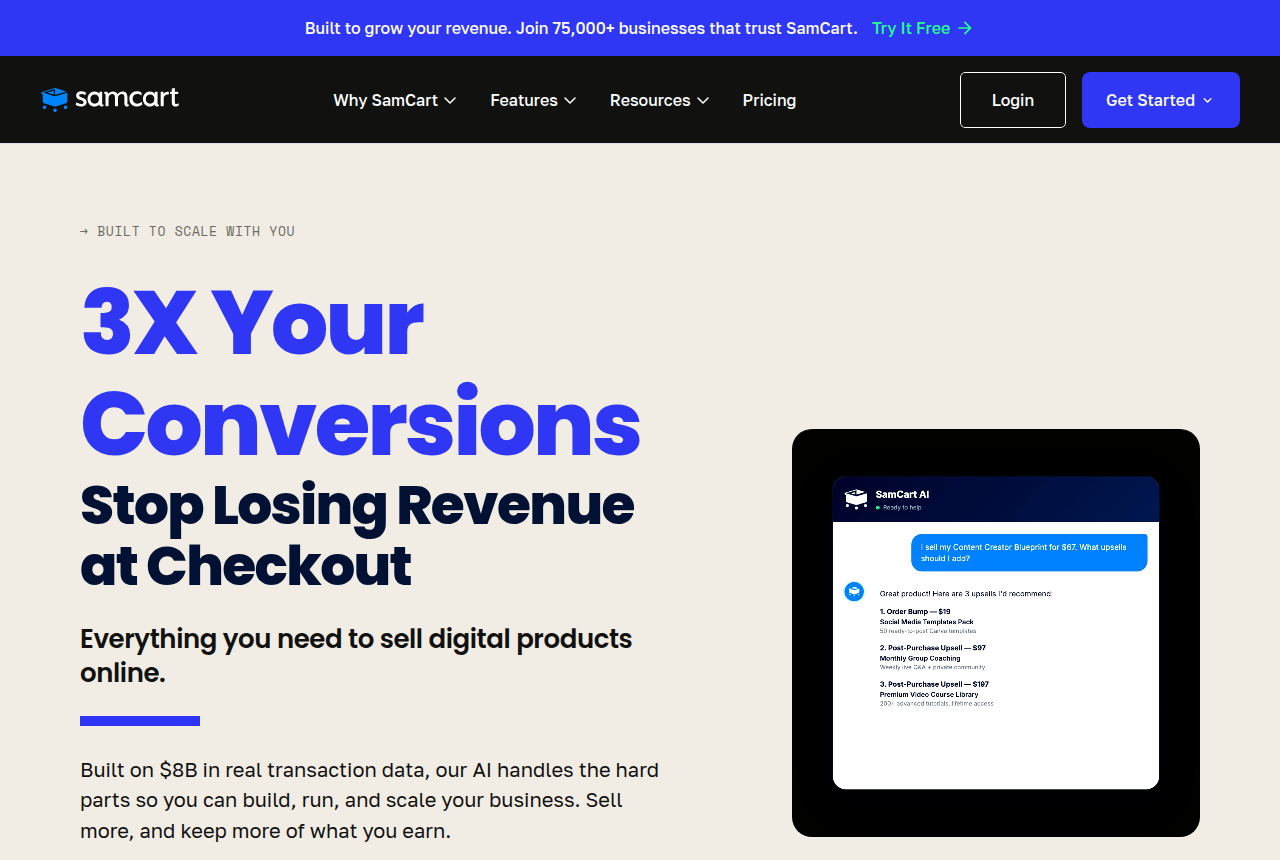
SamCart has sold checkouts since 2014 and says more than 75,000 businesses and over $8 billion in sales have run through it, so capability is not the question. Its whole design points at one goal: raising the value of every order. Order bumps add a companion product with a single checkbox at checkout. One-click upsells charge the same card again after the first purchase, with no card re-entry. A/B testing races two checkout pages against each other. Subscription Saver retries failed renewals and runs dunning, and cart abandonment emails chase stalled carts. SamCart reports up to a 98% lift in average order value when a seller runs bumps and upsells together. It sells more than downloads too: courses, memberships, subscriptions and physical goods all run through one checkout, with a members area and course hosting built in. The SamCart review covers how it holds up day to day.
Two catches matter. First, the price and where the good parts live. Core at $79 a month gives you unlimited pages and products, an AI page builder, a courses app and cart abandonment emails, but order bumps, one-click upsells, A/B testing, Subscription Saver and the Affiliate Center are all on the $199 Pro plan. SamCart as it is usually pitched is realistically a $199 tool. Second, the friction long-term users report is billing, not the software. Unexpected renewals and slow refunds show up across Trustpilot and BBB records, and SamCart's own help docs confirm that cancelling through the customer portal stops future charges but does not refund money already taken. Read the renewal terms before the trial ends. On payments it runs standard processors, SamPay, Stripe and PayPal, so it is not built for the high-risk categories those gateways decline.
Gumroad: the simplest way to start
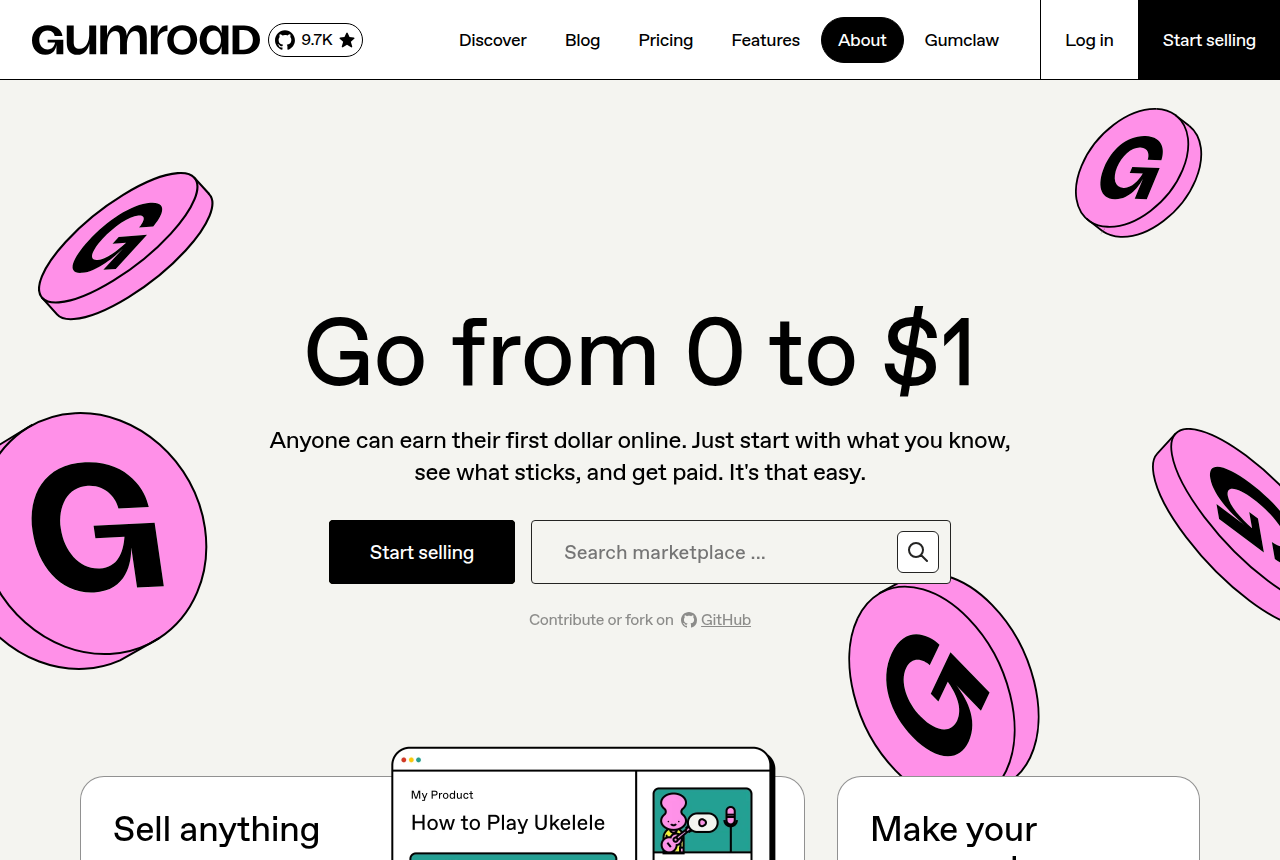
Gumroad has run since 2011, which makes it older than most of the carts it is compared with, and its whole product is simplicity. Upload a file, set a price, share a link or a storefront. There is no monthly fee, so you pay nothing until you make a sale, and G2 reviewers rate it 4.2 out of 5 largely for that ease. It sells more than plain downloads: memberships, subscriptions, pay-what-you-want pricing, software licence keys and multiple file versions all run from one account, and you can point a custom domain at your store or embed the checkout on a site you already run. It is now open source, and the vendor reports millions of dollars in creator earnings every week, so it is not a launch-week gamble. Its standout is tax: Gumroad has been the merchant of record since January 2025, so it is the legal seller on the receipt and collects and remits sales tax and VAT worldwide, and a solo creator never files a tax form for a foreign sale. The Gumroad review goes deeper on the trade-offs.
The catches are real, and they are not about the editor. The flat 10% plus 50 cents is cheap on a first sale and expensive at scale, so past a few thousand dollars a month it quietly becomes the costly model. And getting paid is the loudest complaint against it: Gumroad rates 1.4 out of 5 on Trustpilot across several hundred reviews and holds a BBB F rating, driven by withheld payouts and sudden account suspensions from automated moderation, with support reported as slow or silent. The gap between that 1.4 and the G2 4.2 is the story: the software is pleasant, and the anger is about payouts, support and account decisions. Most sellers never hit that wall, but for a trust question it is the tail risk to know about. One more change to note: PayPal ended service with Gumroad in October 2024 with no warning, so most sales are card-only now, which stranded some international buyers and sellers. And by design it is a simple store, not a conversion machine. There are no deep one-click-upsell and order-bump funnels like SamCart's, and no built-in CRM or multi-step funnel.
Pricing: a monthly plan versus a cut of every sale
These two do not compare on a sticker. SamCart charges a flat monthly fee, $79 on Core or $199 on Pro, and takes nothing of its own on your sales beyond the processor's roughly 2.9% plus 30 cents. Gumroad charges no monthly fee and takes 10% plus 50 cents of every direct sale instead, with tax handled for you as merchant of record. So SamCart leaves the processor fee and the tax filing to you, while Gumroad folds the tax in and takes a larger, revenue-based cut.
Over a year, the answer flips on volume. A creator doing $1,000 a month pays Gumroad about $100 a month and pays SamCart $79 to $199 whether they sell or not, so Gumroad is cheaper and simpler. A seller doing $5,000 a month pays Gumroad about $500 a month, where SamCart's fee stays fixed and the conversion tools it gates behind Pro start to pay for themselves in extra order value. Price both on the sales you actually expect, not the first month. We verified these figures with each vendor in September 2026; check the current pages before you buy, because checkout pricing moves.
The shared limit for a paid-traffic seller
There is one reader both tools quietly rule out, and it is this site's core reader: the direct-response media buyer running their own offers on cold traffic. Gumroad's 10% comes straight off ad margins that are already thin, so for cold-traffic direct response the percentage cut is rarely the right call, and Gumroad is built for warm audiences and organic discovery, not paid acquisition. SamCart is the more serious checkout, but it runs on standard processors that decline high-risk categories, and it cannot route a charge across several high-risk merchant accounts you hold. For a buyer whose margin depends on spreading volume across accounts and catching a soft decline on a second one, that missing routing is the gap that sends them looking past both.
ElasticFunnels is built for that buyer, and it closes the gap both tools leave. It is not a plain store or a standalone cart. It is a funnel platform whose hosted checkout is one part of a larger system: it builds the pages, split-tests variants under one URL so Meta, Google and TikTok never reset their learning, hosts the checkout with order bumps and one-click upsells, and keeps the CRM, the orders, the rebills and the ad-spend reporting on one record. On the payment side, the part that matters against these two, its checkout routes each charge across the NMI and Stripe merchant accounts you connect, including high-risk accounts, and cascades to the next eligible account when one soft-declines, with subscription dunning and save offers built in. That multi-account routing is the thing neither SamCart nor Gumroad can do. It opens with a 14-day free trial that takes no card, on plans from $97 a month, plus 0.5% of revenue processed through its own hosted checkout and nothing on sales you run through outside networks.
The honest caveat keeps it on its own line rather than in the head-to-head. ElasticFunnels is newer than either SamCart or Gumroad, and there is very little independent third-party review coverage to check its claims against, so until you run real volume through it you are largely taking the vendor's word for how the routing and the reporting hold up. That is what you would expect of a platform this recent, where the older two have years of public setups to weigh instead, and it touches the proof, not the feature set: the pages, the same-URL testing, the checkout and the account routing are all there to use from the first day. Scope it honestly, too. It is a full funnel platform priced from $97 a month, not a $0 store or an $79 cart, so a creator who only wants to list one ebook is buying pages, a CRM and attribution they may not need, and for that seller Gumroad or SamCart is the smaller, better-fitted tool. Keep ElasticFunnels on its own line of the decision rather than treating it as a tiebreaker between the two.
Which one for you
You already have steady sales and want the checkout to sell harder: SamCart. Order bumps, one-click upsells, A/B testing, Subscription Saver and the Affiliate Center are the tools that lift order value and defend recurring revenue, and a fixed monthly fee beats a 10% cut once you are selling real volume. Budget for the $199 Pro plan, because that is where those features live, and read the renewal terms before the trial ends.
You are launching a first product and want to pay nothing until you sell: Gumroad. The fastest, cheapest way to get an ebook, template or course online, with tax handled worldwide as merchant of record and no monthly fee. Accept that the flat 10% gets expensive as you scale, and go in knowing the payout and support complaints so a stuck payout does not surprise you.
You run your own paid-traffic offers across merchant accounts you hold: look at ElasticFunnels alongside them, with the newness caveat above in mind, because multi-account routing and same-URL testing are the things neither SamCart nor Gumroad offers.
Between the two you asked about, SamCart takes our default pick, not because Gumroad is the weaker product, but because the reader weighing these two on this site usually has traffic and orders worth optimising, and SamCart is built single-mindedly to raise the value of each one. Gumroad is plainly the better answer for a creator starting cheap and simple, or selling to a warm audience where a 10% cut off a low volume barely registers. Pick on your stage, and revisit it when your revenue crosses a few thousand a month. The full field sits in our head-to-heads.
SamCart
What works
- Built to raise order value, not just take the payment. Order bumps add a companion product with one checkbox at checkout, and one-click upsells charge the same card after the first purchase. SamCart reports up to a 98% lift in average order value when a seller runs both.
- Reliable at its core job. Long-term users describe it as dependable for checkout, one calling it "no frills but fine", which is what you want from the page where the money changes hands.
- Sells more than downloads. Courses, memberships, subscriptions and physical goods all run through one checkout, with a members area and course hosting built in, so there is no second platform to hand customers off to.
- Defends recurring revenue. Subscription Saver retries failed payments and handles dunning, and cart abandonment recovery emails are included, so lapsed cards and stalled carts are chased automatically.
- Flexible payment options. Apple Pay, Google Pay, PayPal, Venmo and Buy Now Pay Later are supported, and Pro adds payment routing across several processors.
What to watch
- Expensive for what it is, and the good parts are gated. Core is $79/mo, well above single-purpose carts, and one-click upsells, order bumps, A/B testing, Subscription Saver and the Affiliate Center are all Pro-only at $199/mo. The tools that make it worth buying are the ones you pay the most for.
- Billing and refunds are the recurring friction, not the software. Unexpected renewals and slow refund resolution turn up across Trustpilot and BBB records, and the vendor's own docs confirm that cancelling through the customer portal stops future billing but does not refund charges already taken. Read the renewal terms before the trial ends.
- Checkout-first, not a full stack. There is no built-in CRM, email automation or multi-step funnel management. Sellers who want lead capture, nurture sequences and funnels in one place report reaching for something broader.
- Runs on standard processors, so it is not built for high-risk categories. Payments move through SamPay, Stripe, PayPal and similar, which means sellers in categories those gateways decline are not served.
Gumroad
What works
- The fastest, simplest way to start selling a digital product. Upload a file, set a price, share a link. There is no monthly fee, so you pay nothing until you make a sale, and G2 reviewers rate it 4.2 out of 5 largely for that ease.
- Merchant of record since January 2025: Gumroad is the legal seller on the receipt, so it collects and remits sales tax and VAT worldwide and a solo creator never files a tax form for a foreign sale.
- Sells more than downloads. Memberships, subscriptions, courses, pay-what-you-want pricing, software licence keys and multiple file versions all run from one account.
- Established and durable. Running since 2011, with millions of dollars in creator earnings every week and its code now open source, so it is not a launch-week gamble.
- Works on your own site too. Point a custom domain at your store or embed the checkout on a site you already run, with email broadcasts, an affiliate programme and discounts included.
What to watch
- The flat 10% + $0.50 fee is cheap on a first sale and expensive at scale. At $5,000 a month in sales that is $500 to Gumroad every month, where a flat-monthly cart charges a fixed fee and takes 0% per transaction. Past a few thousand a month, the percentage model quietly becomes the costly one.
- For paid traffic it is rarely the right checkout. A 10% cut comes straight off ad margins that are already thin, so cold-traffic direct response belongs on a fixed-cost cart, not here. Gumroad is built for warm audiences and organic discovery.
- Getting paid is the loudest complaint. Trustpilot rates it 1.4 out of 5 across several hundred reviews and the BBB gives it an F, driven by withheld payouts and sudden suspensions. The G2 score of 4.2 shows the software itself is well-liked, so the anger is about payouts and support, not the editor.
- PayPal ended service with Gumroad in October 2024 with no warning, so most sales are card-only now. That stranded some international buyers and sellers in regions without direct bank transfer.
- It is a simple store, not a conversion machine. There are no deep one-click upsell and order-bump funnels like SamCart, and no built-in CRM or multi-step funnel.
- Support is thin. Complaint records describe slow or silent responses, which is the real problem on the day a payout is stuck.
Pricing
SamCart: from $79/mo. Core $79/mo, Pro $199/mo (1-click upsells, order bumps, A/B testing, API and 3rd-party processors are Pro-only). SamPay processing 2.9% + 30c; no added platform fee on SamPay.
Gumroad: from no monthly fee, 10% + $0.50 per sale. No monthly fee. Gumroad takes 10% + $0.50 per transaction on direct sales through your profile or links, and 30% on sales it sources through its Discover marketplace. As merchant of record since January 1, 2025, it collects and remits sales tax and VAT worldwide.
Pricing verified against each vendor on 2026-09-27. Check before you buy.
Our pick
SamCart
SamCart is the pick if you sell digital products, courses or coaching and want order bumps, one-click upsells and failed-payment recovery running inside the checkout, without stitching a cart onto a separate platform. It is an established, reliable tool, genuinely built to raise the value of every order. The catch is cost. Pricing opens at $79/mo, and the features that justify buying it sit on the $199 Pro plan.
Frequently asked questions
SamCart or Gumroad: which should I use?
Which is cheaper, SamCart or Gumroad?
Which is cheaper at scale, SamCart or Gumroad?
Does Gumroad handle sales tax for me and SamCart does not?
Can I run order bumps and one-click upsells on both?
Are SamCart and Gumroad both safe to sell on?
Sources
Other sources
3 discussions and reviews read for this page. Quotes are excerpts; open a link to read the original in context.
- [reddit-reliability] Order Upgrades (Thrivecart Alternative?) : r/digital_marketing
- [reddit-cost] 3 month results from selling a $47 ebook using SamCart : r/passive_income
- [samcart-refund-doc] Customer Portal : SamCart Knowledge Base

Written by
Dana Rourke
Lead reviewer
Dana Rourke is the lead reviewer at Campaign Buyer. She owns the tracker and attribution coverage: reading what long-term users report about each tool, checking its documentation and pricing, and verifying prices with the vendor before writing the verdict. Keeping the rankings honest mostly means writing down what the top pick gets wrong, so she does that first.
Last checked 2026-09-28