GoHighLevel or HubSpot for your team
By Dana Rourke, Lead Reviewer. Reviewed by Campaign Buyer Editorial. Updated 14 October 2026.
Quick answer
Pick GoHighLevel if you run client sub-accounts and want native SMS, funnels and automations under one login with flat contact limits; pick HubSpot if you are a sales-led team that needs polished pipeline reporting, seat-based governance and a free CRM entry point.
Side by side
| GoHighLevel | HubSpot | |
|---|---|---|
| What it is | Agency CRM, funnels, SMS | Marketing, sales and service CRM |
| Entry | Starter, 3 sub-accounts | Free CRM for 2 users |
| Contacts | Unlimited on the plan | Marketing-contact tiers |
| SMS and voice | Native, usage-billed | No native SMS marketing |
| Client accounts | Sub-accounts; SaaS Mode on Agency Pro | No white-label resale |
| Funnels | Funnels and payments in the platform | Hubs on one customer record |
| Reporting | People who switched say the reporting is less detailed | More detailed pipeline reports |
| HubSpot import | Contacts, deals, pipelines, notes | The system you export from |
Two different buyers
HubSpot vs GoHighLevel comes down to who the software is for. GoHighLevel is the platform an agency uses for client accounts, SMS and funnels. HubSpot is the CRM a sales team uses for pipeline reports, with access sold by the seat.
I would put the agency on GoHighLevel. I would put the sales team on HubSpot. Compare the two plans in the pricing section. If you buy your own ads, read the paid-traffic section further down. The GoHighLevel review covers the agency platform in more detail.
GoHighLevel for client accounts
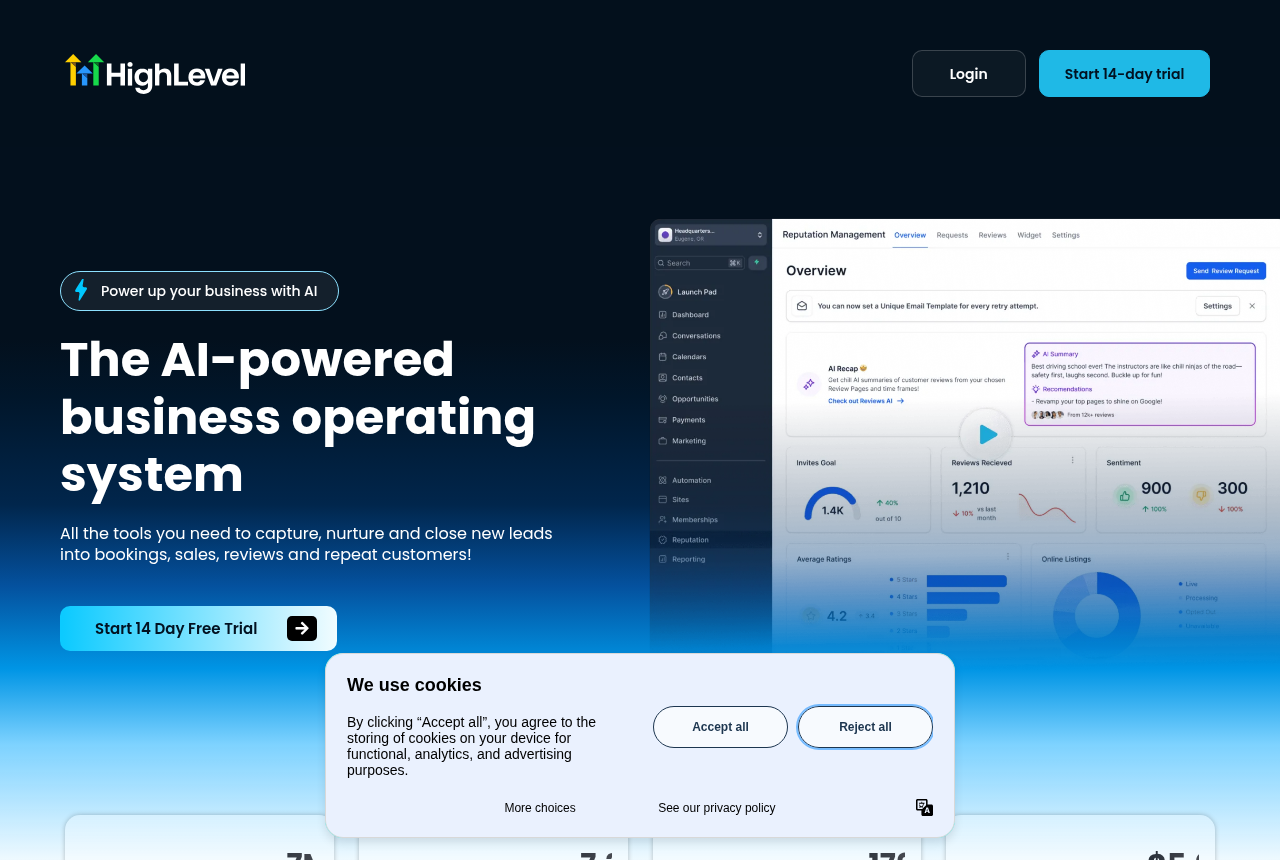
GoHighLevel describes itself as an AI business operating system: a CRM, funnels, email and SMS, calendars, automations, payments and sub-accounts. An agency looks at it when the other option is a seat-priced CRM, plus a separate funnel tool, plus a texting line.
GoHighLevel's pricing page includes unlimited contacts and unlimited users on Starter, with three sub-accounts. The subscription does not rise as the contact list grows. HubSpot's contact tiers are what push that other bill up.
SaaS Mode and automated sub-account creation are listed on Agency Pro, not on every tier. Starter still includes CRM tools, funnels and messaging. White-label resale of the software starts on Agency Pro.
SMS and voice are built into the platform, and they are billed as usage. That pricing page says telecommunications and AI carry usage-based costs on top of the subscription.
In a thread about client work, people who have used both give GoHighLevel the edge on speed and automation.
HubSpot keeps the sales team on one customer record
HubSpot's marketing pages describe a customer platform that aligns marketing, sales and service around shared CRM data. The hubs are sold as seats, with credits attached to AI features.
HubSpot's pricing page offers a free CRM for up to two users, and no credit card is required. Two people can learn the pipeline on those free tools. A trial that turns into a paid plan works differently: this free CRM can stay in place.
The same thread treats HubSpot as the better fit when the business is sales-led, because the CRM and the reporting feel more polished. A CRM thread adds that HubSpot covers more of a sales process, and that running it takes more effort.
HubSpot's Starter page says the bill can change if you upgrade, add seats, buy an add-on or a capacity pack, or pass the contact allowance included in the tier. A migration thread says costs rise once marketing features are added to the account.
GoHighLevel's comparison page says HubSpot has no equivalent to white-label resale. HubSpot's own pricing pages do not list a mode you rebrand and sell as your software. An agency that resells software under its own name uses GoHighLevel Agency Pro for that mode. A sales team that only runs its own pipeline can leave resale out of the decision.
Migrating a HubSpot account
The same GoHighLevel page lists a HubSpot importer. It can import contacts, companies, deals, pipelines, stages, custom fields, emails, notes and tasks. Agencies use that list when they are leaving HubSpot.
Those are the objects the vendor names. The page stops there.
What people say they give up
People who left HubSpot and wrote about it in a recommendation thread name three losses on GoHighLevel: reporting depth, email deliverability, and sales-pipeline polish.
That is the cost of putting funnels, texts and client accounts in one platform. They gave up the reporting depth and the inbox results they say they had on HubSpot. The threads name both, and they never attach a percentage to either.
Which one matches your work
You sell marketing services to local clients and want each client to have their own account, with SMS on the same platform. Choose GoHighLevel. Starter includes three of those accounts. Rebranding the platform and reselling it requires Agency Pro.
You have a sales team, managers want pipeline reports, and you want two people in the CRM before anyone pays for a seat. Choose HubSpot. Expect the invoice to change when marketing contacts and extra seats show up. The Starter page says so.
You buy the traffic yourself, and you need the ad click and the later rebill on one record, with the page test under the same campaign URL. Neither platform above is built for that path. The paid-traffic section after the prices names the platform that is.
Other comparisons
For a landing-page tool compared with GoHighLevel, see Leadpages vs GoHighLevel. For a course platform, see GoHighLevel vs Kajabi. For a low monthly bundle, see GoHighLevel vs Systeme.io. Paid-traffic funnels set against the agency platform are in ElasticFunnels vs GoHighLevel.
For the rest of the funnel tools, see funnel builder alternatives. Every pair is listed on the comparisons page.
GoHighLevel
What works
- Consolidation is its biggest advantage. It replaces the separate tools a small agency usually rents: a CRM, a scheduler, a funnel and website builder, email and SMS, pipelines and automations. Long-term users say the payoff is dropping three to six other subscriptions.
- White-label resale is on the Agency Pro plan. SaaS Mode lets you rebrand the platform as your own software, auto-create client accounts, and rebill phone, SMS and email usage with your markup. No single-purpose funnel tool offers that.
- Contacts and users are unlimited on every plan, and sub-accounts are unlimited from the Unlimited plan up, so your bill does not climb with your client count the way a per-seat CRM does.
- Snapshots, an industry template library and a large active community make repeatable client onboarding fast once you have built your own setup.
- After Customer Success steps back, chat, Zoom and tickets are open any hour from the desktop drawer, and billing has a separate phone path and mailbox.
- A Marketplace app, a scoped token and an inbound workflow webhook are each a supported way in, so a bridge for one sub-account can stay off a custom OAuth app.
What to watch
- Email deliverability is fragile on the shared sending pool. Users report open rates falling and mail landing in spam even with SPF, DKIM and DMARC configured correctly, and serious senders end up moving to a dedicated SMTP or IP. Test a real campaign before you trust it with a client's list.
- Reliability wobbles across modules. HighLevel's own status page logged repeated incidents through 2025, across workflows, forms, SMS, email and the Social Planner.
- The learning curve is steep. Workflows, triggers, snapshots and A2P SMS registration take real setup time, and that time can eat the savings if you build everything from scratch instead of starting from a snapshot.
- The listed subscription leaves out phone, SMS, email and AI usage.
- Only an agency admin or an agency user can contact HighLevel's help desk. A client login has no vendor button, so those questions come back to the agency even after the premium add-on.
- Real-time events sit outside a Private Integration Token. Delivery needs a Marketplace OAuth app, or the inbound workflow trigger, and that trigger draws on a premium execution allowance.
- Zapier reaches standard contact fields. Agency-level actions and custom opportunity fields are where people wiring accounts say the connector runs out.
HubSpot
What works
- HubSpot includes a free CRM for two users, with no credit card required, so a sales team can run the pipeline before paying for a seat.
- People who have used both describe the CRM and the reporting as a better fit for a sales-led business.
- Marketing, sales and service share one customer record, which is the shape HubSpot sells on its own product pages.
- The Starter page points buyers to a marketplace of integrations around that record.
What to watch
- The Starter bill changes when you add seats, buy an add-on or a capacity pack, or pass a marketing-contact tier.
- White-label resale is unavailable. An agency that wants to sell the software under its own name uses a different platform for that, and still has HubSpot's CRM and hubs for its own pipeline.
- People who have used both say it covers more of a sales process and takes more effort to run.
- People who left HubSpot say the bill climbs once marketing automation is turned on.
Pricing
GoHighLevel: from $97/mo. Yearly totals are $970, $2,970 and $4,970. The pricing page offers 14 days on the tier you pick. The subscription starts unless you cancel, and phone, email and AI usage can bill during the trial. A separate page offers 30 days and charges the card on file at the end unless you cancel. LC Email is $0.675 per 1,000. US and Canada SMS is $0.00747 per segment, plus carrier fees. A local number is $1.15 a month and a toll-free number is $2.15. AI products are a separate bill: Growth is $50 a month per location, and AI Unlimited is $97 a month per location.
HubSpot: from $7/mo. The figure above is the annual Starter promo per seat for new customers. Month-to-month billing is $10 per seat, and the list price is $20. Professional is $90 per seat and Enterprise is $175 per seat on the unified pricing page. The free CRM supports up to two users and requires no credit card. Adding seats, an add-on, or a higher marketing-contact tier changes the bill.
Prices as of 24 October 2026
The two bills work differently. GoHighLevel is a flat platform tier, then usage. HubSpot is a seat, then a marketing-contact tier.
Past Starter, GoHighLevel lists Unlimited at $297 a month. Agency Pro is the tier that includes SaaS Mode, on the GoHighLevel price list. Phone, SMS, email and premium AI are the usage charges described in the note above, on every tier.
Marketing Hub is billed separately from the CRM seats in that note. Its product page advertises Starter from $10 a seat. Going over the contact allowance is another way a Starter bill changes, which HubSpot states on the Starter page.
When you are buying the ads yourself
The two platforms above serve an agency and a sales team. A team that buys its own ads, and needs the click, the order, the rebill and the refund on one record, is a third case.
ElasticFunnels is a funnel platform for that team. Same-URL split testing is the part that matches the ad: variants rotate on the server under one campaign link, so Meta, Google and TikTok keep their learning and a test does not send the ad back through review. It also builds pages from a prompt or by cloning a URL, and it hosts the checkout, with order bumps, one-click upsells and subscriptions, charging through Stripe, NMI, PayPal, Klarna or Authorize.net. Sessions, orders, rebills and refunds stay on one timeline with the CRM and the automations. Starter, Growth and Scale each include the full feature set. They differ by page views, brands, domains, seats and automation runs.
When the checkout splits a sale, it divides the first charge across NMI merchant accounts the seller already holds. The split can follow weight, card brand, product, amount and a daily cap. Upsells and rebills stay on the account that took the sale. Stripe, PayPal, Klarna and Authorize.net are one account each, and they sit outside that split.
Starter is $97 a month, Growth is $197 a month, and Scale is $497 a month. The trial lasts 14 days and does not require a credit card. You can set up pages, funnels and a custom domain during the trial. Revenue through ElasticFunnels' own gateways carries a 0.5% fee. Sales that close on ClickBank, BuyGoods, Digistore24, Shopify Checkout or Shop Pay do not incur that fee.
ElasticFunnels is newer than GoHighLevel and HubSpot, and there is very little independent review coverage to check its claims against. Until you run real volume through it, you are largely taking the vendor's word. It launched in 2023, so outside reviews are still scarce. What you cannot check from those reviews is whether the claims hold at your volume. The pages, the checkout and the CRM are on the trial either way, which is how you test the claims before you pay.
GoHighLevel stays the default when you resell to clients. HubSpot stays the default when the sales team owns the pipeline. Look at ElasticFunnels when your revenue depends on the ad and the checkout behind it. More detail is in the ElasticFunnels review.
Our pick
GoHighLevel
HighLevel is the pick for an agency that resells marketing to local clients and wants a CRM, funnels, email, SMS and a white-label client portal in one place. It is widely used, and the setup takes significant time. Shared email sending needs monitoring, and phone, SMS, and AI incur usage fees on top of the subscription.
Frequently asked questions
Which is cheaper, GoHighLevel or HubSpot?
Can GoHighLevel replace HubSpot for an agency?
Does GoHighLevel import HubSpot data?
Which has better email deliverability?
Is white-label included on every GoHighLevel plan?
Sources
Vendor pages
- GoHighLevel pricing
- GoHighLevel compared with HubSpot
- GoHighLevel homepage
- HubSpot pricing
- HubSpot CRM Starter
- HubSpot Marketing Hub
Reader threads
Other sources
28 discussions and reviews read for this page. Quotes are excerpts; open a link to read the original in context.
- [v1] HighLevel Pricing
- [v2] HighLevel Pricing Guide
- [v3] HighLevel 30 day trial
- [v4] HighLevel Pricing FAQ
- [v5] HighLevel Pricing Guide email
- [v6] LC Phone Pricing Guide
- [s1] Has anyone else had issues with GoHighLevel billing and support?
- [s2] Has anyone else had issues with GoHighLevel billing and support?
- [s3] Almost a week, no ticket acknowledgement
- [s4] Anyone else stuck in ticket limbo?
- [s5] Continuous issues with support
- [s6] Anyone else experiencing issues with GHL?
- [s7] Tech support tales from confusion to clarity
- [r1] Some undocumented GoHighLevel API behavior that cost me a week of debugging
- [r2] Some undocumented GoHighLevel API behavior that cost me a week of debugging
- [r3] How to Auto Pause Sub Account with Zapier when Payment Fails
- [r4] Stripe to GHL pipeline detection
- [r5] Webhook to create contact help
- [b1] Forms - How to Setup and Use Order Bumps
- [b2] How to Use Order Upsell in Forms
- [b3] How to Use Order Upsell in Forms
- [c1] Configure Payment Providers by Channel
- [r1] GoHighLevel vs HubSpot — Which one actually wins for real client work
- [r2] GoHighLevel vs HubSpot — Which one actually wins for real client work
- [r3] HubSpot to GoHighLevel: How did you make the transition easier?
- [r4] Coming from HubSpot. Who actually recommends GHL
- [r5] Coming from HubSpot. Who actually recommends GHL
- [r6] Understand marketing contacts billing

Written by
Dana Rourke
Lead Reviewer
Dana Rourke is the lead reviewer at Campaign Buyer. She covers trackers and attribution on this site: she reads what long-term users report about each tool, checks its documentation and pricing, and verifies prices with the vendor before writing the verdict. Keeping the rankings honest mostly means writing down what the top pick gets wrong, so she does that first.
Last checked 2026-10-14
Comments
No comments yet. Questions and your own experience are welcome.
Thank you. Your comment will appear once it has been reviewed.