Agency vs creator platformmedia buyer software
GoHighLevel vs Kajabi
By Dana Rourke, Lead reviewer. Reviewed by Campaign Buyer Editorial. Updated 28 September 2026.
Quick answer
Pick GoHighLevel if you run an agency or a marketing operation and want a CRM at the center with funnels, email, SMS and voice, per-client sub-accounts and the option to white-label the platform and rebill it to clients, all from $97 a month; pick Kajabi if your product is your own knowledge and you want courses, a community, email, pages and checkout under one login, with the strongest delivery in the category and no cut of your sales.
Side by side
| GoHighLevel | Kajabi | |
|---|---|---|
| What it is | Agency operating system | Creator business platform |
| Best for | Agencies, client marketing | Coaches, course creators |
| Core strength | CRM, pipelines, SMS, voice | Course and community delivery |
| Courses, memberships | Included, basic | Deep: cohorts, community, app |
| CRM | Full CRM, pipelines | Basic CRM |
| Messaging | Email, SMS and voice | Email only |
| Manage clients | Per-client sub-accounts | Not its job |
| White-label resale | Yes, on $497 tier | No |
| Usage fees | Phone, SMS, email, AI | None, flat rate |
| Cut of sales | None (usage fees apply) | None |
| Track record | Since 2018, large | Since 2010, large |
| Entry price | $97/mo | $179/mo |
If you have narrowed the whole market to GoHighLevel and Kajabi, you have already agreed on the shape of the tool. You want one account that builds the pages, takes the payment and follows up with the buyer, instead of a page builder wired to a separate CRM and a separate email tool. Both do that. The reason to keep reading is that they were built for two different people, and the wrong pick either charges you for a whole client-management layer you never open or leaves out the delivery your business runs on.
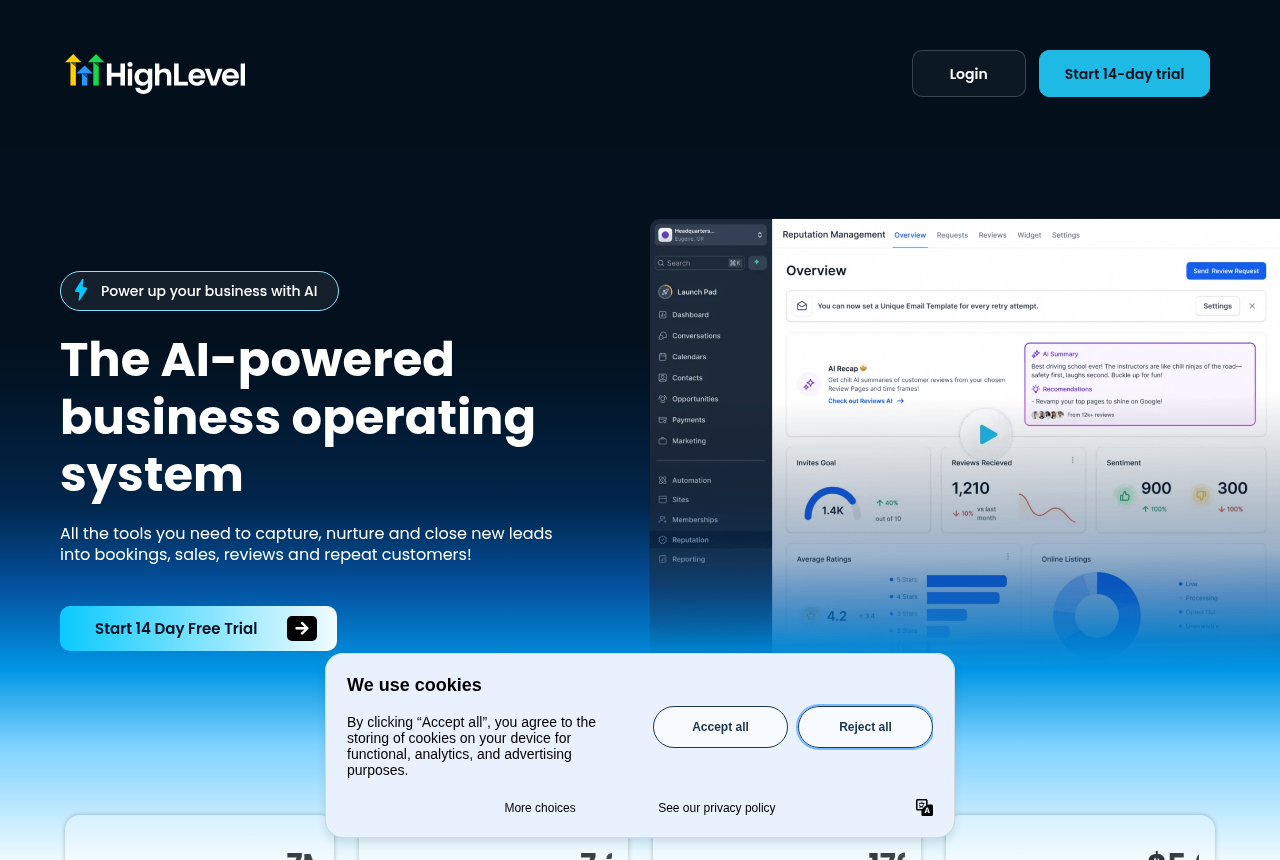
HighLevel, still widely called GoHighLevel, is a marketing operating system for an agency: a CRM at the center, with funnels, email, SMS, voice and per-client sub-accounts around it, and the option to rebrand and resell the whole thing. Kajabi is a creator business platform for someone whose product is their own knowledge, and who cares as much about how a course, membership or community is delivered as about the sale itself. That is the whole decision, and everything below follows from it.
The one question that decides it
Are you running a marketing operation, or delivering a knowledge product?
If the money turns on managing clients or contacts, on pipelines, follow-up by email and text, booking calls and automating the busywork around the sale, that is HighLevel's home ground. If the money turns on what happens after the buy, on a course people finish, a membership they renew and a community they keep opening, that is Kajabi's. Both can technically reach into the other's territory. Neither does it as well as the job it was built for, and paying for the wrong strength is the most common regret with either.
The case for GoHighLevel
HighLevel replaces a stack a small agency usually rents piecemeal: a CRM, a scheduler, a funnel and website builder, email and SMS, pipelines and automations. Long-time users say the value shows up when it retires three to six other subscriptions, not in any single feature being the sharpest in its category. Contacts and users are unlimited on every plan, so the bill does not climb with your client count, and the $497 Agency Pro tier turns on white-label resale: rebrand the platform as your own software, create client accounts and rebill phone, SMS and email usage with your markup. No single-purpose creator tool offers that, and it opens at $97 a month with a 14-day trial.
The trade-offs are specific. Email deliverability on the shared sending pool is fragile: users report open rates falling and mail landing in spam even with SPF, DKIM and DMARC set correctly, and serious senders move to a dedicated SMTP. The learning curve is steep, with workflows, triggers, snapshots and A2P SMS registration to set up. And the sticker is not the whole bill, because phone numbers, SMS, email and premium AI are metered on top of the subscription, so the monthly cost is variable and grows with sending. Its courses and communities are included, but they are a module among many rather than the main event.
The case for Kajabi
Kajabi comes at the buyer from the delivery end. Since 2010 it has grown into one of the most complete homes for a knowledge business, and the consistent praise from long-time users is having everything under one login: courses with cohorts and drip content, communities, memberships, podcasts, email, landing pages, a checkout with subscriptions, order bumps and upsells, and a branded mobile app on the top plan. If your product is a course people should actually finish, or a membership they should renew, Kajabi's delivery is the strongest in this pair, and it takes no revenue share on any plan.
Its weak spot is cost, and it got worse in 2026. A January restructure raised plan prices, cut the entry Basic plan's contact limit to 2,500, and ended grandfathered rates for long-time customers, which drew a visible backlash on review sites. The entry price is now $179 a month, about $143 billed annually, with no free plan and a 30-day money-back window rather than a trial, so Kajabi only pays off once you are genuinely selling. Affiliates and advanced automations are locked to the $249 Growth plan and up. And its marketing side is lighter than a CRM-first platform: no per-client sub-accounts, no white-label resale, and email only, with no built-in SMS or voice.
If your growth is paid traffic, a third option
Both of these assume you are selling to an audience or a client base you already have. Neither is built around the paid ad click, and if your growth comes from buying traffic on Meta, Google or TikTok, there is a gap both leave that is worth naming before you commit.
ElasticFunnels is a funnel platform built for that buyer. What defines it, in order: same-URL split testing, an AI page builder and cloner, a custom checkout with multi-MID routing, analytics and attribution, and a CRM with automations and a call center on the same data. Its lead feature, and the reason most teams switch, is testing without resetting ad learning: weighted variants rotate server-side under one campaign link, so Meta, Google and TikTok keep optimizing the same URL and a test never sends the ad back through review. Around it, the AI builder writes a page from a prompt or clones one from a URL, the hosted checkout carries order bumps and one-click upsells, and the click, the order, the rebill and the refund land on one record, so you can see which ad and which angle actually made money instead of reconciling exports from four tools.
The honest caveat is proof. ElasticFunnels is newer than either of these, and there is very little independent third-party review coverage to check its claims against, so until you run real volume through it you are largely taking the vendor's word for how it holds up. That is what you would expect of a platform this recent next to an agency system running since 2018 and a creator platform going since 2010, and it touches the proof rather than the feature set: the pages, the same-URL testing, the routed checkout and the reporting are all there to use from the first day. Its 14-day trial needs no card, every feature is on every plan from $97 a month, and it adds 0.5% only on revenue through its own hosted checkout, so you can prove the split testing and the checkout on your own campaigns before you pay. One thing to weigh: multi-MID routing only pays off if you already hold more than one merchant account. A seller on a single Stripe account still gets the pages, the testing, the analytics and the CRM, but not that routing advantage.
Which one for you
You run an agency or a marketing operation: GoHighLevel. The CRM, pipelines, email, SMS and voice, per-client sub-accounts and white-label resale are built for managing clients and contacts at scale, and it does more for the money at $97 a month. Budget real setup time, and test email deliverability on a live list before you trust it with a client's audience.
Your product is your own knowledge: Kajabi. The courses, the community, the email, the pages and the checkout sit under one self-serve login, the delivery is the strongest in this pair, and it takes no cut of your sales. Budget for the $179-a-month floor and check the Basic plan's 2,500-contact limit against your list, because the 2026 restructure cut it.
You buy your own paid traffic to a funnel: ElasticFunnels. Same-URL split testing keeps the ad platform's optimization intact through a test, and the click, the order, the rebill and the refund land on one timeline you can read without reconciling exports. Give the 14-day trial real volume first, because its independent review coverage is still thin.
Read our full GoHighLevel review, Kajabi review and ElasticFunnels review, then browse the other head-to-heads and the full ranking before you commit.
GoHighLevel
What works
- Consolidation is the win. It replaces a stack a small agency usually rents piecemeal, a CRM, a scheduler, a funnel and website builder, email and SMS, pipelines and automations, and long-term users say the value shows up when it retires three to six other subscriptions rather than in any one feature being the sharpest in its category.
- White-label resale is a real business model, not a marketing line. The $497 Agency Pro plan turns on SaaS Mode: rebrand the platform as your own software, auto-create client accounts, and rebill phone, SMS and email usage with your markup. No single-purpose funnel tool offers that.
- Contacts and users are unlimited on every plan, and sub-accounts are unlimited from $297, so your bill does not climb with your client count the way a per-seat CRM does.
- Snapshots, an industry template library and a large active community make repeatable client onboarding fast once you have built your own setup.
What to watch
- Email deliverability is fragile on the shared sending pool. Users report open rates falling and mail landing in spam even with SPF, DKIM and DMARC configured correctly, and serious senders end up moving to a dedicated SMTP or IP. Test a real campaign before you trust it with a client's list.
- Reliability wobbles across modules. The vendor's own status page logged repeated 2025 incidents affecting workflows, forms, SMS, email and the Social Planner. If you white-label the platform to non-technical clients, you become the support desk when something breaks.
- The learning curve is steep. Workflows, triggers, snapshots and A2P SMS registration take real setup time, and that time can eat the savings if you build everything from scratch instead of starting from a snapshot.
- The sticker is not the whole bill. Phone numbers, SMS, email and premium AI are usage-based on top of the $97 to $497 subscription, so your monthly cost is variable and grows with sending volume.
Kajabi
What works
- Runs the whole knowledge business from one login: courses, coaching, memberships, a community, email, landing pages, funnels and checkout, so you are not paying for five tools that do not talk to each other
- Built for delivery. The course builder, cohorts, community, podcasts and a branded mobile app make the student experience the strongest part, which is where a pure funnel builder is thin
- Takes no revenue share on any plan. You pay the monthly fee and card processing, and nothing extra per sale
- Well reviewed by long-time users, who most often praise having everything in one place and a builder that is straightforward to set up
- Checkout handles subscriptions, one-time payments, order bumps, upsells and downsells, with automated tax
What to watch
- Expensive, and more so since the January 2026 restructure. The entry Basic plan is now $179 a month (about $143 billed annually), its contact limit was cut to 2,500, and affiliates and advanced automations are locked to the $249 Growth plan and up
- Long-time customers lost grandfathered rates in the 2026 change, and price plus support are the two most common complaints in recent reviews
- If you only need to sell a simple offer through a hard-driving funnel, you are paying for course and community tools you may never open
- Its funnel and checkout are lighter than a dedicated funnel tool, with fewer aggressive upsell and page-testing options than ClickFunnels
- Some users find the initial setup time-consuming, and there is no dedicated tech support for your students
Pricing
GoHighLevel: from $97/mo. Starter $97/mo (3 sub-accounts), Unlimited $297/mo (unlimited sub-accounts), Agency Pro $497/mo (SaaS Mode). Annual is 10x monthly. Usage-based fees for phone, SMS, email and AI apply on top, plus optional add-ons. 14-day trial on any plan, card required.
Kajabi: from $179/mo. Basic is $179/mo (2,500 contacts, 5 products, 1 website), Growth $249/mo (25,000 contacts, 50 products, affiliate program and advanced automations), and Pro $499/mo (100,000 contacts, unlimited products, 3 websites, branded mobile app). Billing annually saves about 20%, bringing Basic to roughly $143/mo. Kajabi takes no revenue share on any plan, but its own payment processing runs 2.7% to 2.9% plus 30 cents per sale, and using a third-party processor adds 0.5% to 2% on top depending on plan. 30-day money-back guarantee.
Pricing verified against each vendor on 2026-09-27. Check before you buy.
Our pick
GoHighLevel
HighLevel is the pick if you run an agency that resells marketing to local clients and wants a CRM, funnels, email, SMS and a white-label client portal in one place. It is real and widely used, but it rewards setup time, its shared email sending needs babysitting, and usage fees for phone, SMS and AI sit on top of the subscription.
Frequently asked questions
GoHighLevel or Kajabi: which should I use?
Which is cheaper, GoHighLevel or Kajabi?
Which is better for building and delivering an online course?
Which is right for an agency serving several clients?
What if your growth comes from paid ads?
Sources
Other sources
8 discussions and reviews read for this page. Quotes are excerpts; open a link to read the original in context.
- [reddit-ghl-bugs] Anyone else experiencing issues with GHL?
- [reddit-ghl-regret] Anyone here actually regret signing up for GoHighLevel?
- [reddit-ghl-billing] Has anyone else had issues with GoHighLevel billing and support?
- [bbb-ghl] HighLevel Inc. | BBB Complaints
- [reddit-ghl-vs-cf] When does GHL actually beat ClickFunnels for a business funnel?
- [reddit-cf-or-ghl] Clickfunnels or Go High Level (GHL)
- [g2-ghl] HighLevel Products | Read 651 Reviews on G2
- [trustpilot-ghl] HighLevel Reviews | Trustpilot

Written by
Dana Rourke
Lead reviewer
Dana Rourke is the lead reviewer at Campaign Buyer. She owns the tracker and attribution coverage: reading what long-term users report about each tool, checking its documentation and pricing, and verifying prices with the vendor before writing the verdict. Keeping the rankings honest mostly means writing down what the top pick gets wrong, so she does that first.
Last checked 2026-09-28