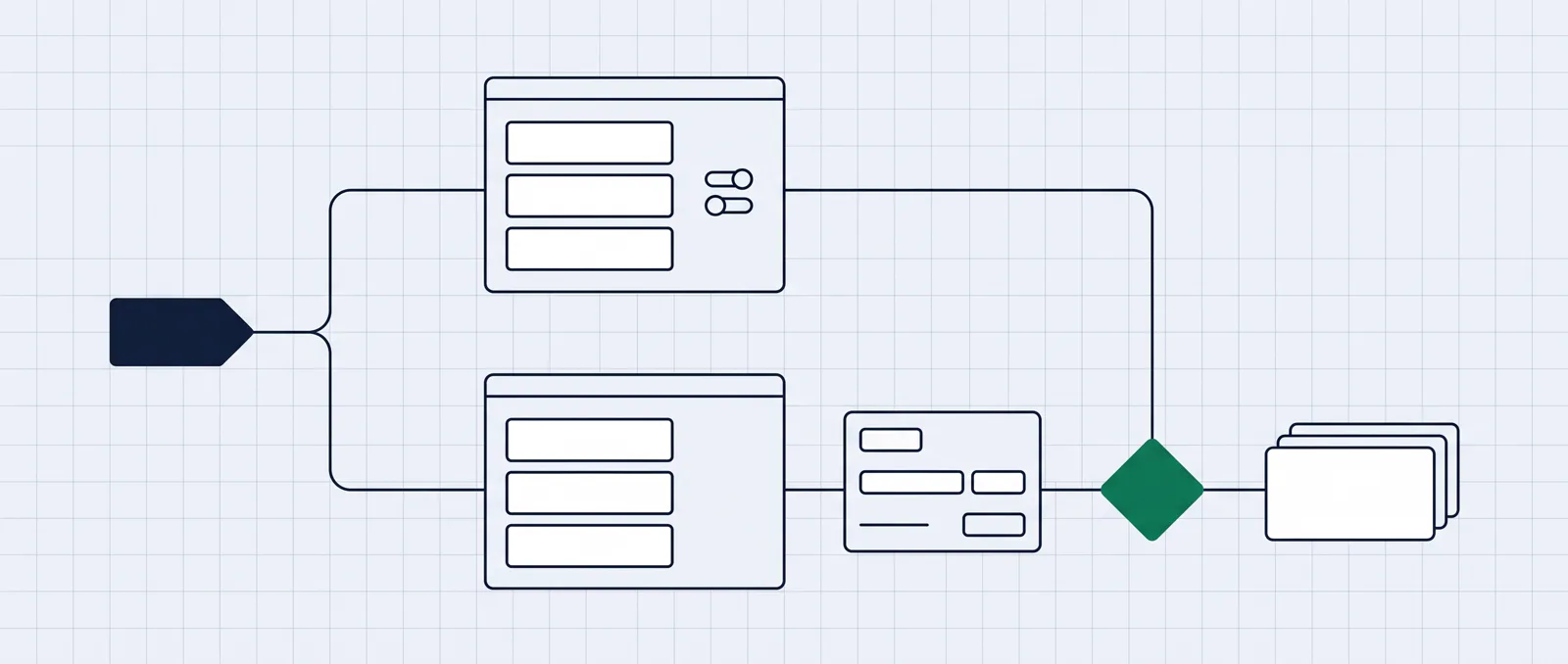
Page specialist vs funnelmedia buyer software
Unbounce vs ElasticFunnels
By Dana Rourke, Lead reviewer. Reviewed by Campaign Buyer Editorial. Updated 29 September 2026.
Quick answer
Pick Unbounce if you need a specialist landing-page platform for message match, page production and testing while your checkout and CRM stay elsewhere; pick ElasticFunnels if you run paid traffic and want the page, same-URL split test, checkout, CRM and attribution on one customer record.
Side by side
| Unbounce | ElasticFunnels | |
|---|---|---|
| What it is | Landing-page and CRO platform | Paid-traffic funnel platform |
| Best for | Page creation and message match | Click-to-sale funnel operations |
| Landing pages | Drag and drop, 100+ templates | AI builder and URL cloner |
| Dynamic text | From Experiment | Not its specialist feature |
| Split testing | A/B from Experiment | Same-URL, server-side |
| Traffic routing | Smart Traffic on Optimize | Weighted variants under one URL |
| Checkout | No native checkout | Order bumps and one-click upsells |
| Subscriptions | No native billing | Billing, dunning and retention |
| Payment routing | None | Multi-MID rules |
| Attribution | Page goals and integrations | Click, order, rebill and refund |
| CRM operations | Connects to external CRMs | CRM, automations and call center |
| Free trial | 14 days, no card | 14 days, no card |
| Entry price | $29/mo ($149 for A/B) | $97/mo, every feature |
If you are down to Unbounce and ElasticFunnels, the deciding question is not which one can build a landing page. Both can. The real choice is whether you want a specialist to improve the page before the conversion, or one platform to own the path from the campaign link through the checkout, rebill and refund.
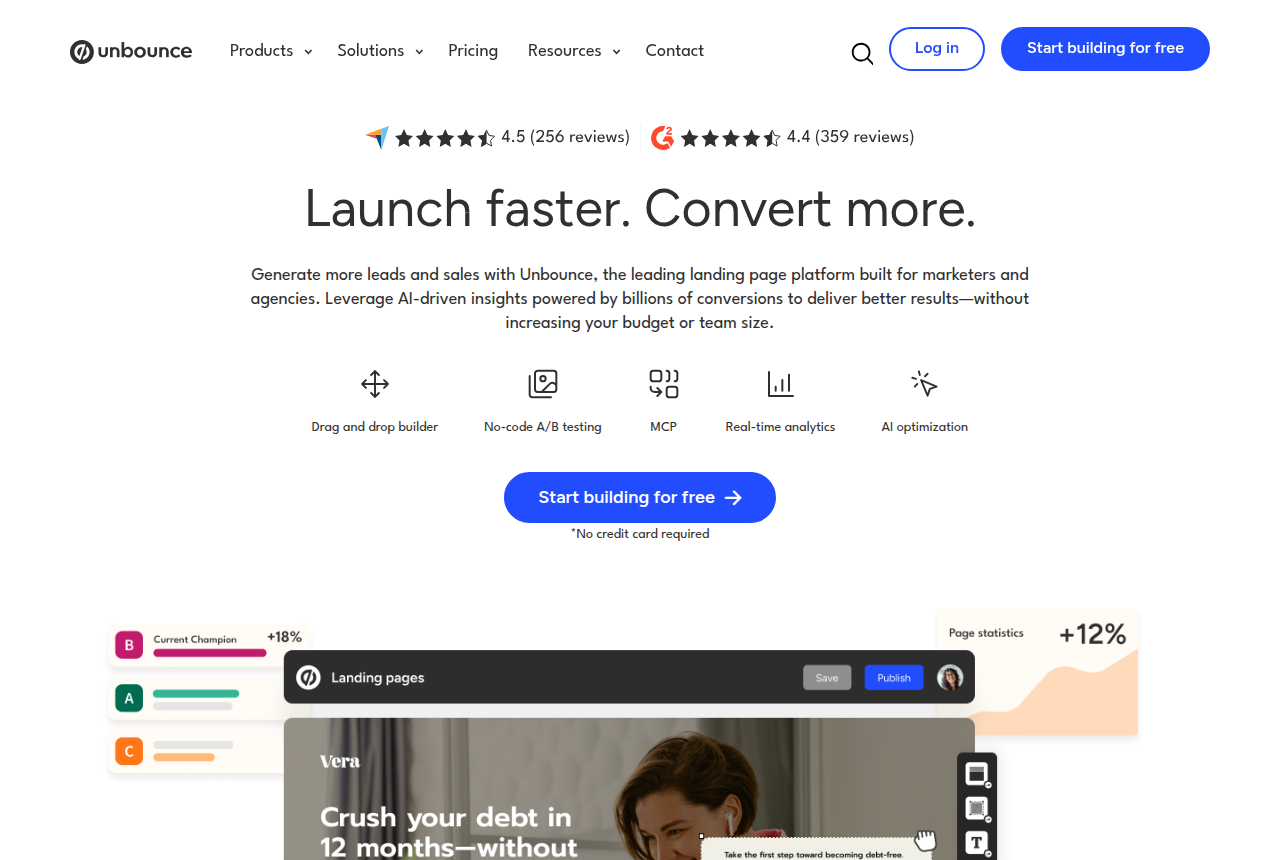
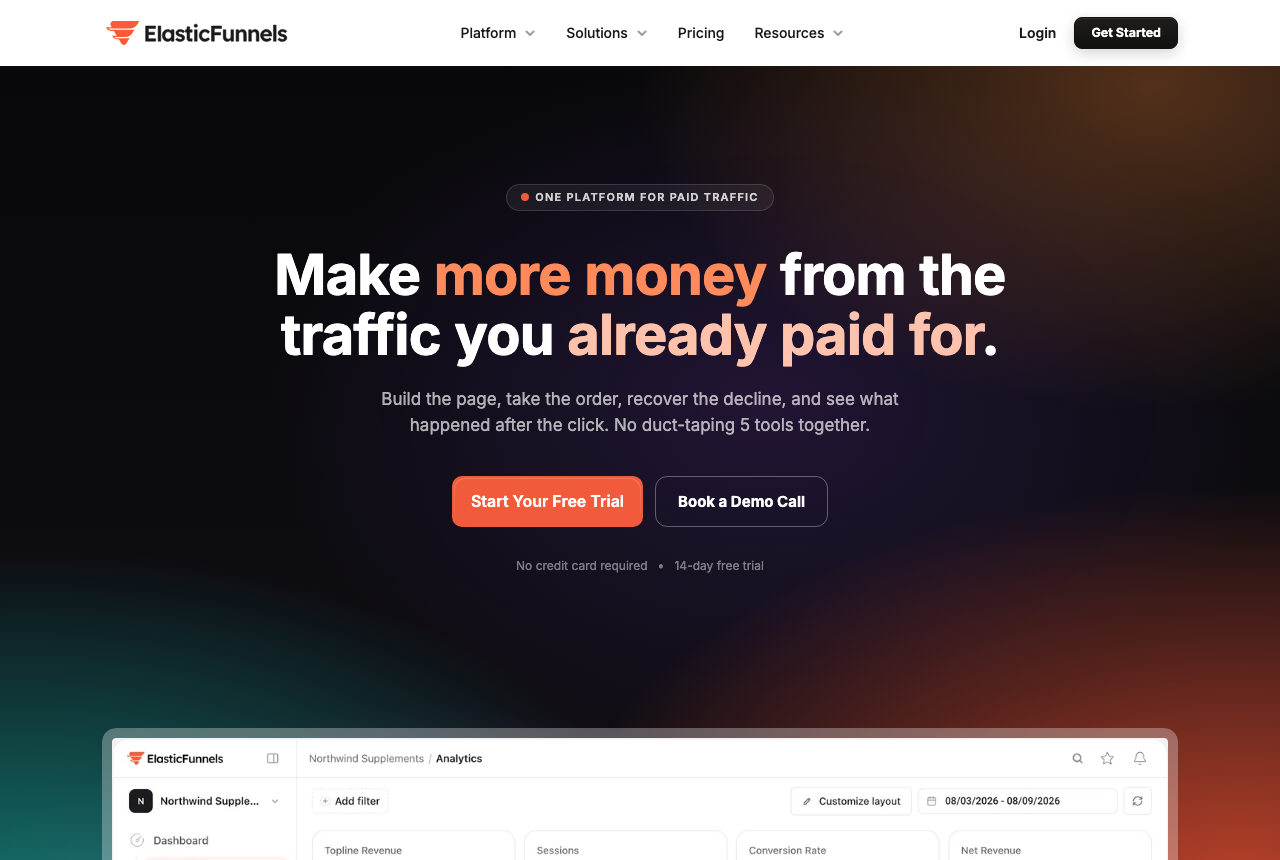
Unbounce is the proven page specialist. Its dynamic text replacement is built for paid-search message match, its A/B testing is mature, and Smart Traffic can route visitors toward the variant most likely to convert. ElasticFunnels overlaps on page building, then goes much further. It tests variants under one URL, hosts the checkout, handles subscriptions and keeps attribution and CRM activity on the same customer record.
ElasticFunnels is our overall pick for a team buying traffic to make sales because it removes the handoffs between page, test, checkout and reporting. Unbounce is the better choice when the checkout already works and the job is narrowly to create, personalize and optimize campaign landing pages.
The question that decides it
Where does your conversion path need to end inside this purchase?
If the tool only needs to publish a page, match its copy to the ad or keyword, capture a lead and pass the visitor into a checkout or CRM you already trust, choose Unbounce. You get a focused page workflow without moving payments, customer records or the rest of your stack.
If the tool needs to carry the visitor beyond the page, choose ElasticFunnels. It is a funnel platform for teams running paid traffic. Pages, same-URL split testing, checkout, CRM and attribution share one data layer. The click, order, rebill and refund stay connected, so the team does not have to reconcile a page report against a cart export and a separate CRM.
The case for Unbounce
Unbounce is a landing-page and conversion optimization platform for marketers and agencies. It is built around the page: a drag-and-drop editor, more than 100 templates, custom code, forms, popups, sticky bars, dynamic text replacement, A/B testing and Smart Traffic. That focus is useful when a campaign manager needs to publish and change pages without waiting for a developer.
Its sharpest paid-search feature is dynamic text replacement. The page can change copy to match the keyword or ad that produced the visit, which keeps the promise in the ad aligned with the page. A/B testing lets the team compare page variants, while Smart Traffic uses visitor attributes to route each person toward the variant it expects to perform better. Those are different tools. Dynamic text and standard A/B testing arrive on the $149-a-month Experiment plan. Smart Traffic arrives on the $249 Optimize plan.
That plan structure is the first catch. The $29 Starter price covers five pages and 500 monthly visitors. It does not include the testing or dynamic text that make Unbounce distinct for paid campaigns. Build is $99 a month for unlimited pages and 20,000 visitors, but it still stops short of those optimization features. Compare the Experiment or Optimize bill if testing is why you are shopping.
The second catch comes from long-term users rather than the feature list. Price increases and visitor limits are recurring complaints, and some users find the editor rigid when a design pushes beyond standard sections or needs careful mobile adjustment. The vendor says pages remain live if traffic exceeds the plan allowance, with a one-time overage fee, but a campaign spike can still change the bill.
Unbounce also stops at the page conversion. It can send a form submission to HubSpot, Salesforce or another connected system, and it can send a buyer onward to a store or checkout. It does not provide the native order bumps, one-click upsells, subscription billing, payment routing, dunning or customer-level revenue timeline that ElasticFunnels provides. That is not a flaw when those jobs already live in a stack you intend to keep. It is the boundary of the product.
The case for ElasticFunnels
ElasticFunnels is a funnel platform for affiliates, product vendors, agencies and ecommerce brands that run paid traffic. It builds the pages, tests them, hosts the checkout and keeps the CRM and reporting on the same data. It is the broader product in this comparison, not simply another landing-page editor.
Same-URL split testing is its lead advantage for media buyers. Variants rotate server-side behind one campaign link. Meta, Google and TikTok continue to see the same creative and URL pair, so a new variant does not reset campaign learning or send the ad through another review. Unbounce can run strong page tests, but it does not present this same-URL, server-side campaign setup as its model.
The builder can generate an editable page from a prompt or clone one from a URL. From there, the hosted checkout can add order bumps, one-click upsells, express checkout, subscriptions, dunning and retention offers. Multi-MID rules can route payments across the merchant accounts a seller connects. That routing matters most to a team that already operates several accounts. A seller with one Stripe or NMI account still gets the builder, same-URL testing, checkout, attribution, CRM, automations and call center. They simply have no second account to route a payment toward.
The shared record is what separates the product from a stitched stack. Sessions, orders, rebills and refunds sit on one timeline and can be broken down by affiliate, geography, device or creative. CRM pipelines, automations and a call center work from the same customer and order history. For a performance team, that means the reported winner can be judged on revenue that survived refunds, not only on the form conversion shown by the page tool.
The evidence limit must be stated plainly. ElasticFunnels is newer than Unbounce and the other platforms it competes with, and there is very little independent third-party review coverage available to check its claims against. Until you run real volume through it, you are largely relying on the vendor's word. That thin public record is expected for a platform this recent, but it still limits how much an outside review can prove about reliability and support. The 14-day trial requires no card and includes every feature, so the sensible response is to validate the page, test, checkout and reporting on your own flow before committing.
A/B testing is not the same buying decision
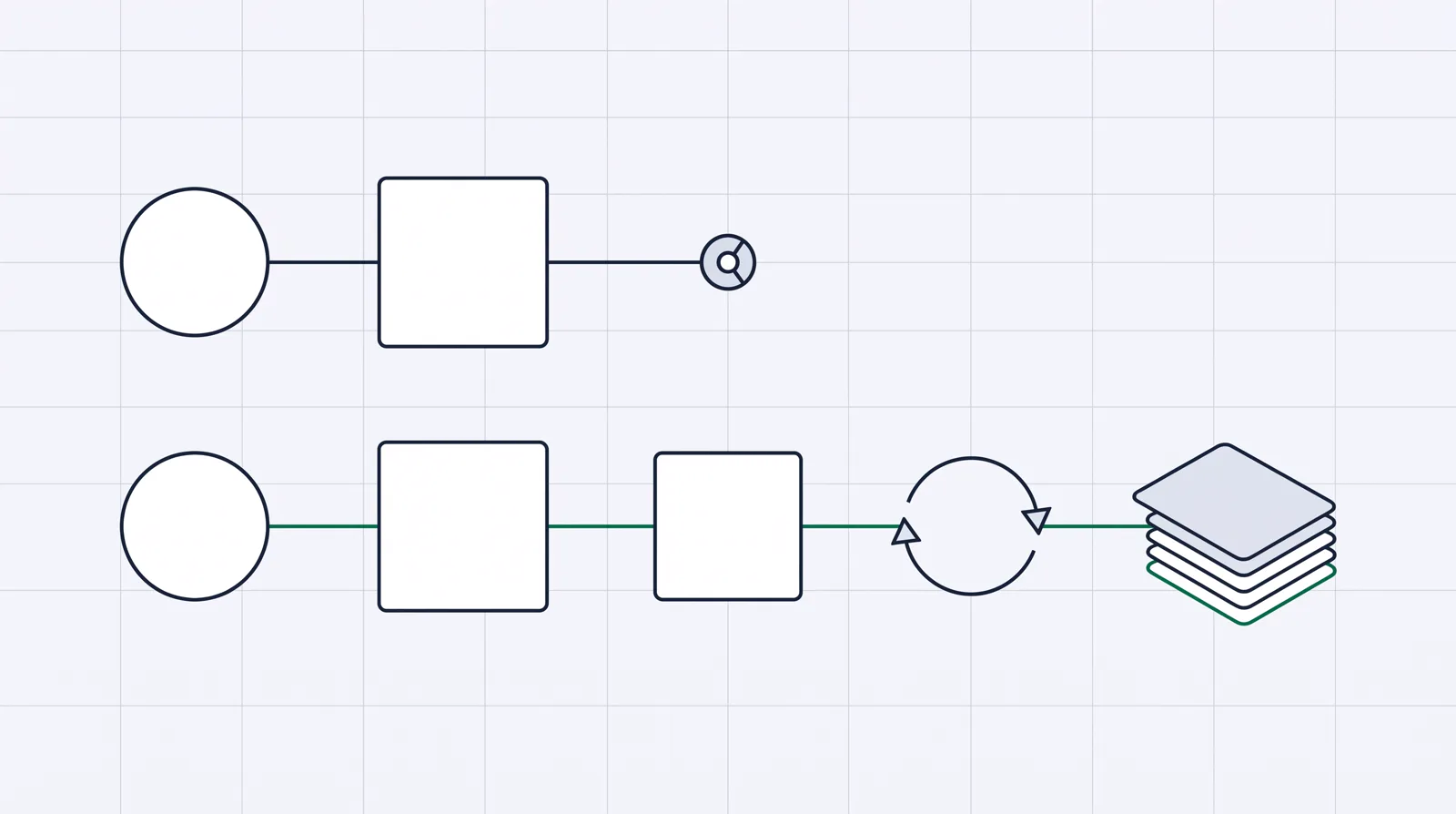
Both products can split traffic between page variants, but the surrounding system changes what the result means. Unbounce is built to improve the page conversion. It shows which landing-page experience drove more of the goal you selected, and Smart Traffic can personalize routing once you reach Optimize.
ElasticFunnels is built to preserve the campaign link and follow the result further. A variant can be judged against the order, the upsell, the rebill and the refund because those events live in the same system. That is more useful when the highest-converting page is not necessarily the page that creates the most retained revenue.
Unbounce remains the stronger specialist when message match, page production and mature landing-page workflow are the whole assignment. ElasticFunnels wins when testing is one step inside a revenue funnel and changing the URL would disturb a paid campaign.
What each choice adds to your operation
Choosing Unbounce usually means keeping the rest of your current stack. The page hands a lead to the CRM or a buyer to the checkout. That is a low-disruption move if those systems already work. It also means the team must maintain integrations and reconcile page performance with order and refund data somewhere else.
Choosing ElasticFunnels is a larger consolidation decision. The value comes from putting pages, tests, checkout, attribution and customer operations on one record. Migration asks more from the team because it touches the purchase path, processor connections and reporting. The payoff is fewer data handoffs and one place to trace an ad click through the later revenue events.
Neither choice removes the need for a measurement plan. Decide the conversion event before the test, keep campaign naming clean, and judge the result on the stage that pays the bills. A lead-generation team may care about qualified submissions. A direct-response seller should care about net revenue after refunds and rebills.
Which one should you choose?
Pick Unbounce if you need a focused landing-page platform, especially for paid search, and your CRM, checkout and revenue reporting already work. Budget for Experiment if dynamic text and A/B testing are the point of the purchase, or Optimize if you want Smart Traffic.
Pick ElasticFunnels if your team buys traffic to sell and wants the landing page, same-URL test, checkout, subscriptions, CRM and attribution on one customer record. It is the stronger overall fit for this site's performance-marketing reader, provided you are comfortable proving a newer platform against your own numbers.
The cleanest dividing line is ownership. Unbounce owns the campaign page. ElasticFunnels owns the post-click funnel around it.
Unbounce
What works
- The page headline updates to match each search query, the core PPC lever
- Smart Traffic routes each visitor to the variant most likely to convert them
- A large template library and a mature builder
What to watch
- DTR and split testing only start at Experiment ($149/mo); Starter is not a PPC tool
- Monthly unique-visitor caps bring overage anxiety at scale
- The builder frustrates on fixed-section layout and mobile, enough that some users call it painful
ElasticFunnels
What works
- Replaces the stack a growth team usually stitches together: a funnel builder, a checkout or CRM, a testing tool and an analytics tool, so a click, an order, a rebill and a refund are one record instead of four exports you reconcile on Monday
- Its standout is testing under one URL: variants rotate server-side on one campaign link, so Meta, Google and TikTok keep their learning and a test never sends the ad back for review
- The AI builder writes a page from a prompt across 14 page types, and the cloner turns a competitor URL into a working copy in about a minute
- Its checkout routes each charge across the NMI and Stripe accounts you connect, cascading to the next one on a soft decline, with order bumps, one-click upsells and subscription dunning built in
- Analytics put sessions, orders, rebills and refunds on one timeline, sliced by affiliate, geo, device or creative, and a built-in CRM and call center work off the same records
- A trial tests the whole tool because nothing is gated behind a higher tier: plans differ only by the traffic volume they allow
What to watch
- Newer than the platforms it competes with, with very little independent review coverage to check its claims against, so until you run real volume through it you are largely taking the vendor's word
- Multi-MID routing, the standout in its checkout, only pays off if you already hold several merchant accounts to route between. A seller on a single Stripe account still gets the pages, the testing, the analytics and the CRM, but not that routing advantage
- It is not a merchant of record like Paddle: it will not file your sales tax or carry dispute liability, so that work stays with you and your processors
- The 0.5% checkout fee applies to revenue through its hosted checkout, on top of the monthly plan and your own processor fees, though sales on external networks like ClickBank or BuyGoods are not charged
Pricing
Unbounce: from $29/mo. Monthly: Starter $29 for 500 visitors; Build $99 for 20K; Experiment $149 adds tests and DTR for 30K; Optimize $249 adds AI routing for 50K. Annual billing reduces each by 25%.
ElasticFunnels: from $97/mo. Every feature is on every plan; plans differ by traffic. Growth is $197 and Scale is $497 a month. A 0.5% fee applies to revenue through EF-hosted checkouts only; external and affiliate-network sales are not charged.
Pricing verified against each vendor on 2026-09-28. Check before you buy.
Our pick
ElasticFunnels
ElasticFunnels is a funnel platform built for teams that run paid traffic: it builds the pages, splits them behind one URL so your ads never reset, hosts the checkout, and keeps the CRM and the reporting on the same data. Same-URL split testing is the reason most teams switch. Its checkout stands out for multi-MID routing, which cascades a charge across the payment accounts you connect and only pays off if you already run more than one. It is newer than the platforms it rivals, though, and third-party proof is thin so far.
Frequently asked questions
Unbounce or ElasticFunnels: which should I use?
Which is cheaper, Unbounce or ElasticFunnels?
Can ElasticFunnels replace Unbounce?
Is Unbounce cheaper than ElasticFunnels?
Which is better for Google Ads landing pages?
Which is better for selling subscriptions or using upsells?
Sources
Vendor pages
Sources
Other sources
3 discussions and reviews read for this page. Quotes are excerpts; open a link to read the original in context.
- [ppc-price-2024] Unbounce 121.54% price increase in 2024 : r/PPC
- [ppc-nightmare] Unbounce is a nightmare : r/PPC
- [capterra] Unbounce Reviews 2026, Pros & Cons | Capterra

Written by
Dana Rourke
Lead reviewer
Dana Rourke is the lead reviewer at Campaign Buyer. She owns the tracker and attribution coverage: reading what long-term users report about each tool, checking its documentation and pricing, and verifying prices with the vendor before writing the verdict. Keeping the rankings honest mostly means writing down what the top pick gets wrong, so she does that first.
Last checked 2026-09-29