A budget cloud tracker against an enterprise measurement platform
BeMob vs Rockerbox
By Dana Rourke, Lead reviewer. Reviewed by Campaign Buyer Editorial. Updated 24 September 2026.
Quick answer
Pick BeMob if you buy affiliate or paid traffic hands-on and want click-level tracking of which source, campaign and offer converted, on a free tier or a cheap flat plan you can start today; pick Rockerbox if you are a mid-market or enterprise brand spending across many channels, including offline like connected TV, direct mail and podcasts, and you have a data owner to run a modeled measurement platform.
Side by side
| BeMob | Rockerbox | |
|---|---|---|
| What it is | Cloud click tracker | Unified measurement |
| Built for | Budget media buyers | Enterprise brands |
| Measures | Clicks, conversions | Modeled contribution |
| Methods | Click tracking | MTA, MMM, lift tests |
| Offline channels | No | TV, mail, podcasts |
| Free plan | Yes: 100K events | No, demo only |
| Setup | Self-serve, minutes | 6-8 week build |
| Pricing | Free, then $49/mo | Custom quote |
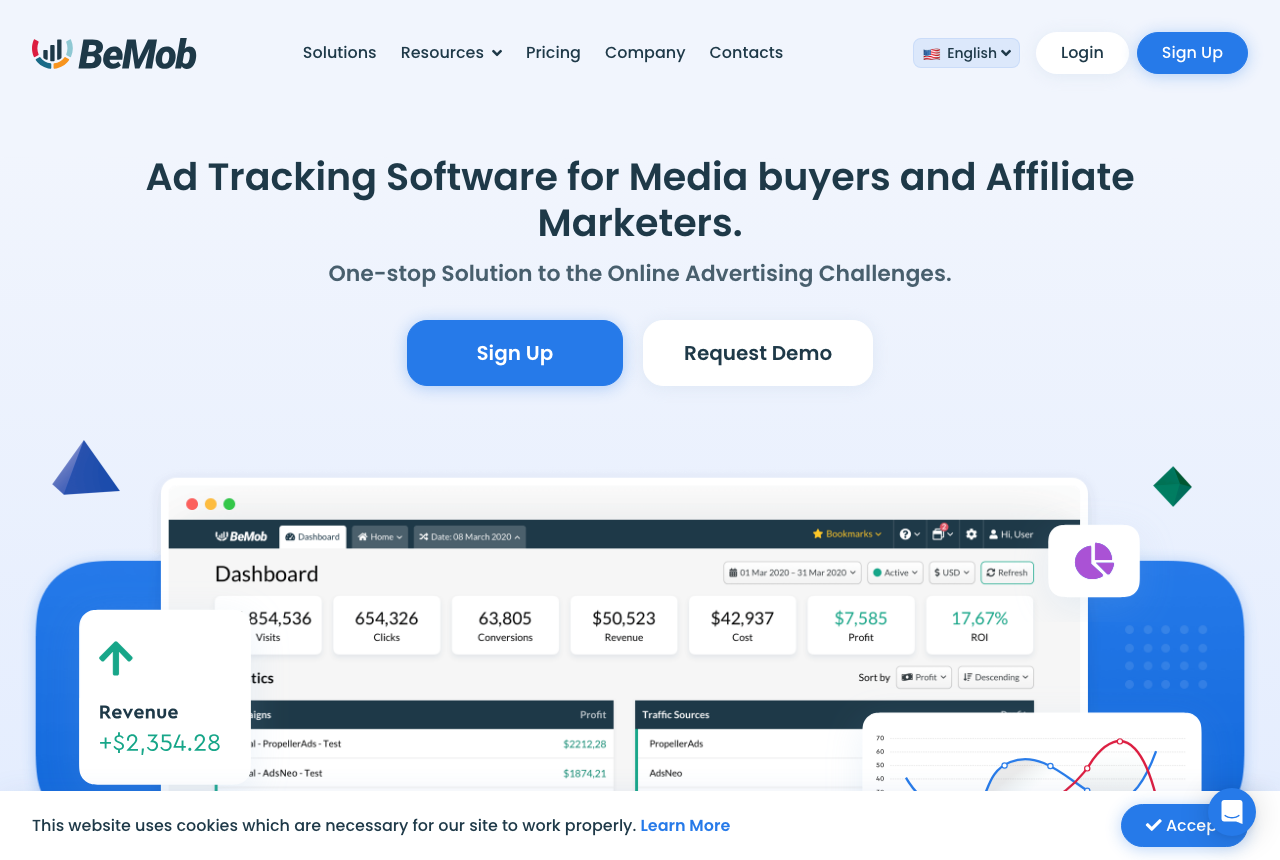
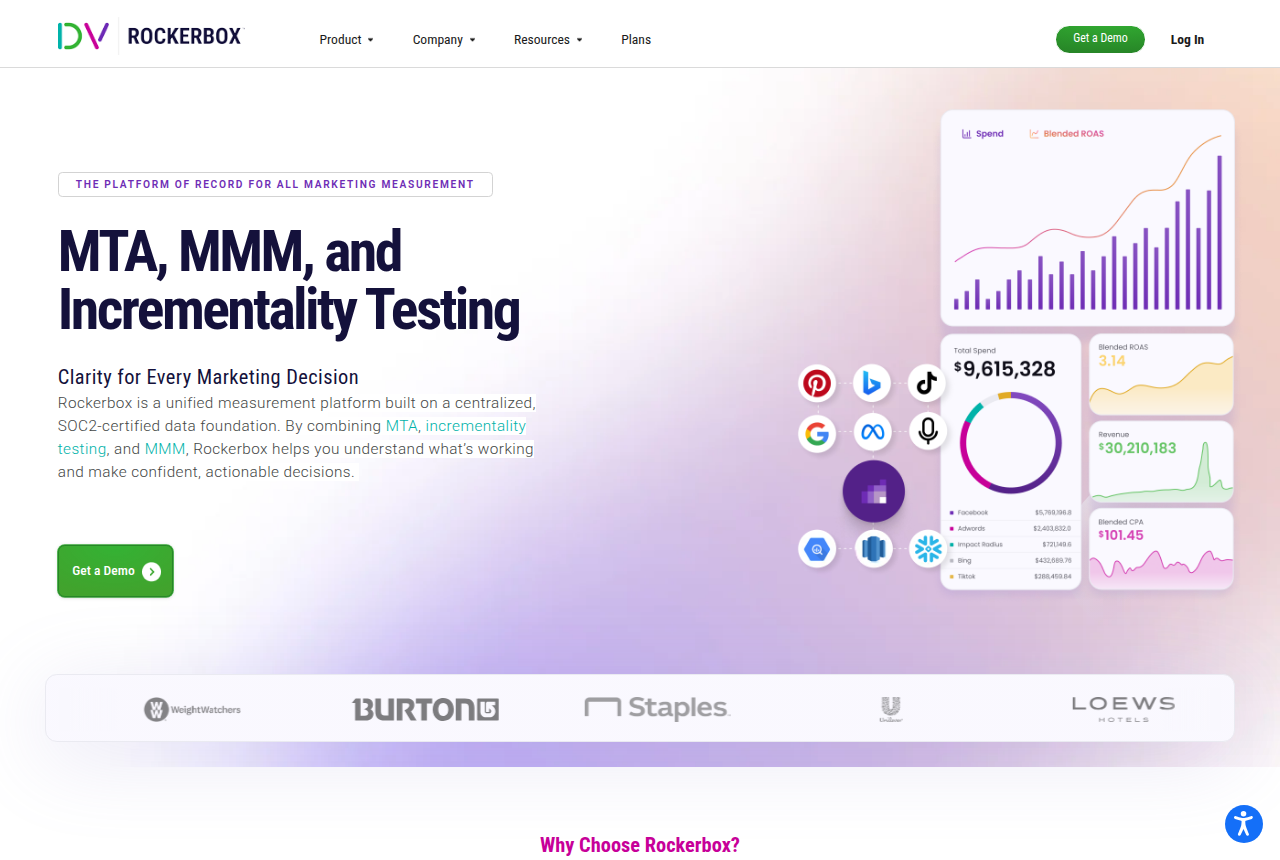
If your shortlist is down to BeMob and Rockerbox, the first thing worth saying is that these two are not two versions of the same tool. They get filed together because both live in the tracking and measurement world, but they were built for different people to answer different questions. BeMob is a cheap, cloud-hosted click tracker for the buyer running campaigns hands-on who wants to know which source, campaign and offer made money right now. Rockerbox is an enterprise measurement platform that models how every channel, including offline ones, contributed to revenue. The decision is less which is better and more which question you are actually asking.
The one question that decides it
Answer this before you compare a single feature. If you need to know which click, campaign and offer produced a conversion, right now, so you can fire postbacks to your affiliate networks and cut the placements that lose money, BeMob is built for that and Rockerbox is not. If you need to know how much your connected TV, your direct mail, your podcasts and your paid social each contributed to a sale, estimated three different ways so you can cross-check the number, Rockerbox is built for that and BeMob cannot do it at all.
That is why price is a poor way to choose here. BeMob's free tier and $49 plan look almost free next to an enterprise quote, but a brand that needs offline measurement will not get it from BeMob at any price. And Rockerbox's platform, however capable, is wasted money for a buyer who just needs fast, click-level tracking and network postbacks. Match the question first, and the rest is detail.
BeMob: a budget tracker for hands-on buyers
BeMob is the tracker for the person doing the buying, and it is the cheapest honest way onto that ladder. It is fully cloud-hosted, so there is nothing to install: you connect your traffic sources and offers, it stamps every click, catches the conversion server-side, and tells you which source, lander and offer actually made money. The free plan is not a crippled demo. You get 100,000 events a month, 10 campaigns and real reporting, which is enough to wire up postbacks and learn how tracking works before you pay a cent. Paid entry is $49 a month for a million events, which is inexpensive for a cloud tracker.
The honest costs are real but small for this buyer. Everything counts as an event, so every impression, visit, click and conversion draws down one limit, and 100,000 free events vanish fast on impression-heavy pop or push traffic. Custom tracking domains, which you want for clean links and deliverability, only start on the $249 Business plan. And once you scale past testing, BeMob has less depth than Voluum or RedTrack, so heavy operations tend to outgrow it. None of that stops it doing the job it is built for, which is deterministic, click-level tracking on a budget with postbacks to your networks.
Rockerbox: modeled measurement for brands
Rockerbox is a different animal. It is a unified measurement platform that runs multi-touch attribution, marketing mix modeling and incrementality testing on one first-party data foundation, so you cross-check three methods instead of trusting a single number. Its real edge over the other measurement tools on this site is breadth, including offline: connected TV, linear TV, direct mail, podcasts, influencers and billboards, reconciled next to your digital spend. It exports its cleaned dataset to your own warehouse in BigQuery, Redshift or Snowflake, it holds SOC2 certification, and since March 2025 it has the backing of a public parent in DoubleVerify, which acquired it for around $82 million. This is a real, established platform, not a startup taking a swing.
The regret risk with Rockerbox is not whether it works. It is fit and cost. There is no public pricing and no self-serve: you book a demo and get a custom quote pitched at mid-market and enterprise budgets, so a small store cannot even price it before a sales call. Setup is heavy, with MTA or MMM taking roughly six to eight weeks and needing developer time plus Rockerbox's own team, and it becomes shelfware without a data owner to run it. Reviewers also report reporting bugs, especially on view-through channels like TikTok and YouTube where the platforms share less data. And the output is still a model, not the truth, so someone has to read directional numbers as directional. For the brand it is built for, none of that is a dealbreaker. For a hands-on buyer on a budget, all of it is.
Tracking versus measurement: the real split
The cleanest way to tell these two apart is the difference between tracking and measurement. BeMob does tracking: it logs a click, catches the conversion at the end, and fires a postback to your affiliate network so the offer owner and the ad account both know that this exact click converted. It is deterministic, fast and precise about individual events, and it stops at the edge of the funnels you run. Rockerbox does measurement: it takes data it cannot observe click by click, especially offline and view-through media, and estimates each channel's contribution with models. It is broad, cross-channel and directional, and it is honest that the numbers are educated estimates rather than logged facts.
Neither approach is better in the abstract. A hands-on buyer needs the deterministic click record and the postbacks, and would find modeled contribution useless for optimizing a campaign this afternoon. A brand spending across TV, mail and social needs the modeled view and would find click-level tracking blind to most of where its money goes. This is the whole decision in one sentence: are you optimizing individual campaigns you can see, or measuring a media mix you mostly cannot.
Pricing: free-to-cheap versus an enterprise quote
BeMob meters events and starts at nothing: a free plan of 100,000 events, then $49 a month for a million, climbing with volume, with custom domains held back to the $249 tier. You can start today and prove the tracking on your own traffic before you spend anything. Rockerbox has no published price. You request a demo and receive a custom quote scoped to your channels, your data and the modules you turn on, sized for mid-market and enterprise budgets. That means you cannot compare the two on a number, because one is a free-or-cheap line item you can start this week and the other is a negotiated enterprise contract you only see after a sales process.
What neither tool builds
Both of these tools tell you something about your traffic. Neither one builds the funnel that traffic runs through. BeMob tracks clicks and Rockerbox measures channels, but the pages, the checkout and the offers are a separate job on a separate bill. ElasticFunnels is a funnel platform for teams running paid traffic that covers that part: it builds and hosts the pages, splits variants under one URL so the ad platforms keep their learning, hosts the checkout with order bumps and one-click upsells, and keeps sessions, orders, rebills and refunds on one timeline with ad-spend and conversion reporting and affiliate postbacks attached. Its reporting layer is lighter than BeMob's dedicated click-level tracking, and it is not a cross-channel measurement platform like Rockerbox, so it does not replace either for its core job. It fits a smaller paid-traffic team that wants the funnel and its own spend-to-sale reporting in one place, and it runs a 14-day trial with no card. The honest limit is that it is newer than both tools on this page, with very little independent third-party review coverage to check its claims against, which is what you would expect of a platform this new, so until you run real volume through it you are largely taking the vendor's word for how the reporting holds up. Keep it out of your tracking-versus-measurement decision rather than letting it sway one.
Which one for you
You buy affiliate or paid traffic hands-on and want to know which campaign made money: BeMob. The click-level tracking, the free tier and the network postbacks are exactly what a hands-on buyer is paying for, and Rockerbox has nothing to offer that workflow. Start on the free plan against your own traffic before you upgrade.
You are a brand measuring offline and digital together: Rockerbox. Multi-touch attribution, mix modeling and incrementality on one foundation, with real offline coverage, is a job BeMob cannot do at any price. Budget for the quote and the six-to-eight-week setup, and assign a data owner before you sign.
You are a small store on Meta and Google with no data person: BeMob first. It gives you the campaign-level tracking you can act on today, while Rockerbox is more platform than your spend justifies. Revisit Rockerbox when your channel mix grows into offline and view-through media and you have someone to own the models.
BeMob takes our default pick because far more of this site's readers buy paid traffic hands-on and need cheap, click-level tracking than are enterprise brands with the budget and offline mix that justify a modeled measurement platform. That is a statement about who is reading, not about which product is built better. For the brand Rockerbox is built for, it is plainly the better fit, and BeMob is not in the running.
BeMob
What works
- A genuinely usable free plan: 100K events, 10 campaigns and real reporting
- Cheap paid entry at $49/mo for 1M events
- Cloud-hosted, so there is nothing to install or maintain
What to watch
- 100K free events disappear fast once you log impressions or run any volume
- Custom tracking domains only start on the $249 Business plan
- Less depth than Voluum or RedTrack once you scale past testing
Rockerbox
What works
- Runs multi-touch attribution, marketing mix modeling and incrementality testing on one data foundation, so you cross-check three methods instead of trusting a single number
- Measures the offline and view-through channels most tools ignore: connected TV, linear TV, direct mail, podcasts and billboards, reconciled next to digital
- Exports its cleaned first-party dataset to your own warehouse (BigQuery, Redshift, Snowflake), so the numbers feed your BI stack rather than locking you into its dashboards
- SOC2-certified data foundation, and since March 2025 the backing of a public parent in DoubleVerify
What to watch
- No public pricing and no self-serve. You book a demo and get a custom quote pitched at mid-market and enterprise budgets, so a small store cannot price it before a sales call
- Setup is heavy: MTA or MMM take about six to eight weeks and need developer time plus Rockerbox's own team, and it becomes shelfware without a data owner to run it
- Reviewers report reporting bugs and dashboards that break, especially on view-through channels like TikTok and YouTube where platforms share less data
- The output is still a model, not the truth. Even paired with incrementality it needs someone who can read directional numbers rather than treat them as exact
Pricing
BeMob: from $49/mo, or free. Free $0 (100K events, no custom domain), Professional $49/mo (1M), Business $249/mo (10M, with custom and cloaking domains), Enterprise $499/mo (30M). Every impression, visit, click and conversion counts as one event.
Rockerbox: from a custom quote. Rockerbox does not publish pricing. It is sold through a demo and quoted per company based on your channel mix and measurement needs, and is pitched at mid-market and enterprise budgets. You choose which products you take (Data Foundation, MTA, MMM, Testing). Implementation runs about 1 to 2 weeks for testing and 6 to 8 weeks for MTA or MMM, depending on data readiness.
Pricing verified against each vendor on 2026-09-08. Check before you buy.
Our pick
BeMob
BeMob is the pick if you are new to tracking or spending lightly and want a real free tier before you commit.
Frequently asked questions
BeMob or Rockerbox: which should I use?
Which is cheaper, BeMob or Rockerbox?
Do BeMob and Rockerbox do the same thing?
Can BeMob measure offline channels like TV and direct mail?
Is BeMob's free plan enough to run real campaigns?
Which should a small store on Meta and Google choose?
Sources
Other sources
2 discussions and reviews read for this page. Quotes are excerpts; open a link to read the original in context.

Written by
Dana Rourke
Lead reviewer
Dana Rourke is the lead reviewer at Campaign Buyer. She owns the tracker and attribution coverage: reading what long-term users report about each tool, checking its documentation and pricing, and verifying prices with the vendor before writing the verdict. Keeping the rankings honest mostly means writing down what the top pick gets wrong, so she does that first.
Last checked 2026-09-24