A first-party ad tracker against B2B SaaS revenue attribution
ClickMagick vs Cometly
By Dana Rourke, Lead reviewer. Reviewed by Campaign Buyer Editorial. Updated 23 September 2026.
Quick answer
Pick ClickMagick if you buy your own Meta, Google or YouTube traffic as a solo advertiser, affiliate or info-product seller and want first-party conversion data fed back to the ad platforms, plus a daily email that names what to scale or cut; pick Cometly if you sell B2B SaaS or a subscription and need ad spend tied to Stripe revenue and CRM pipeline, from first click to closed-won. ClickMagick is the flat-priced tracker for a buyer optimizing their own campaigns. Cometly is the revenue-attribution layer for a software company whose sale closes in a CRM weeks after the click.
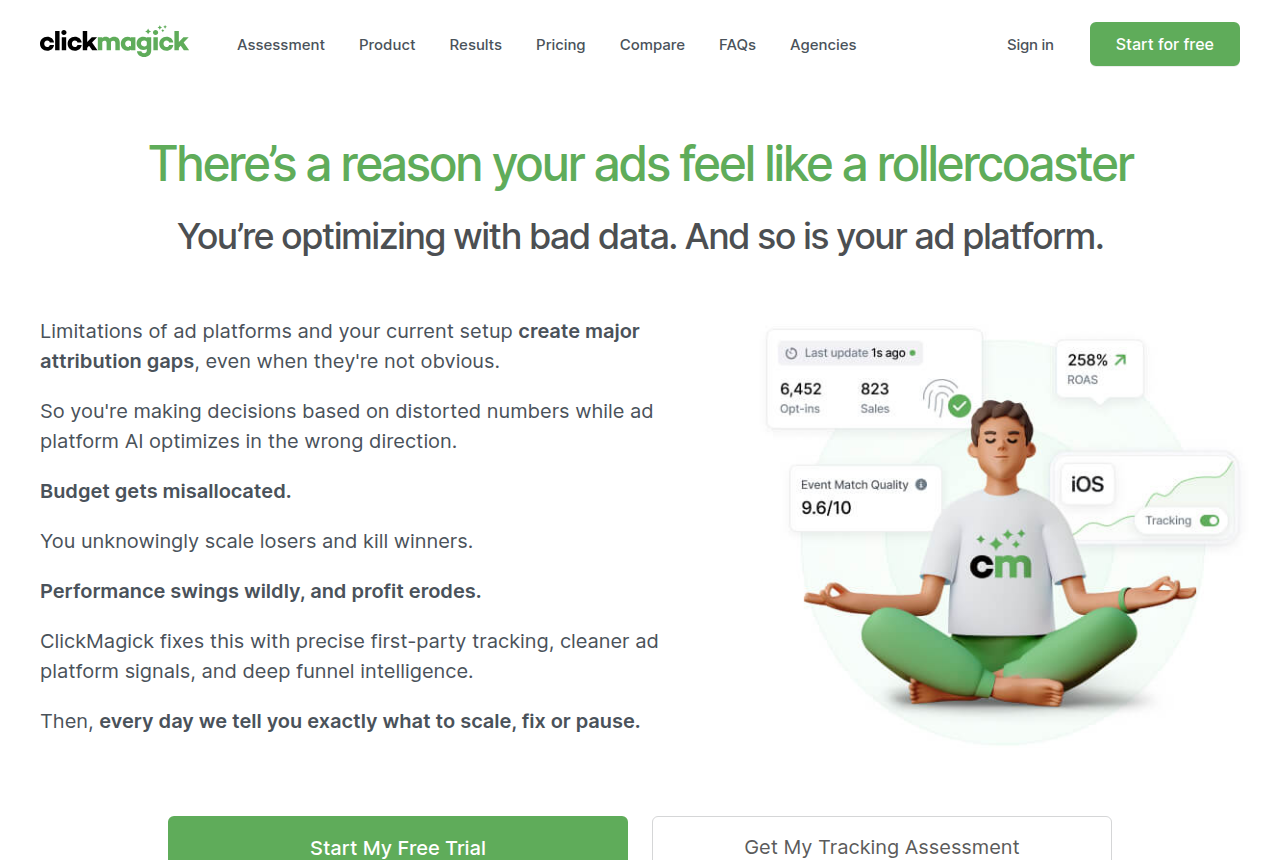
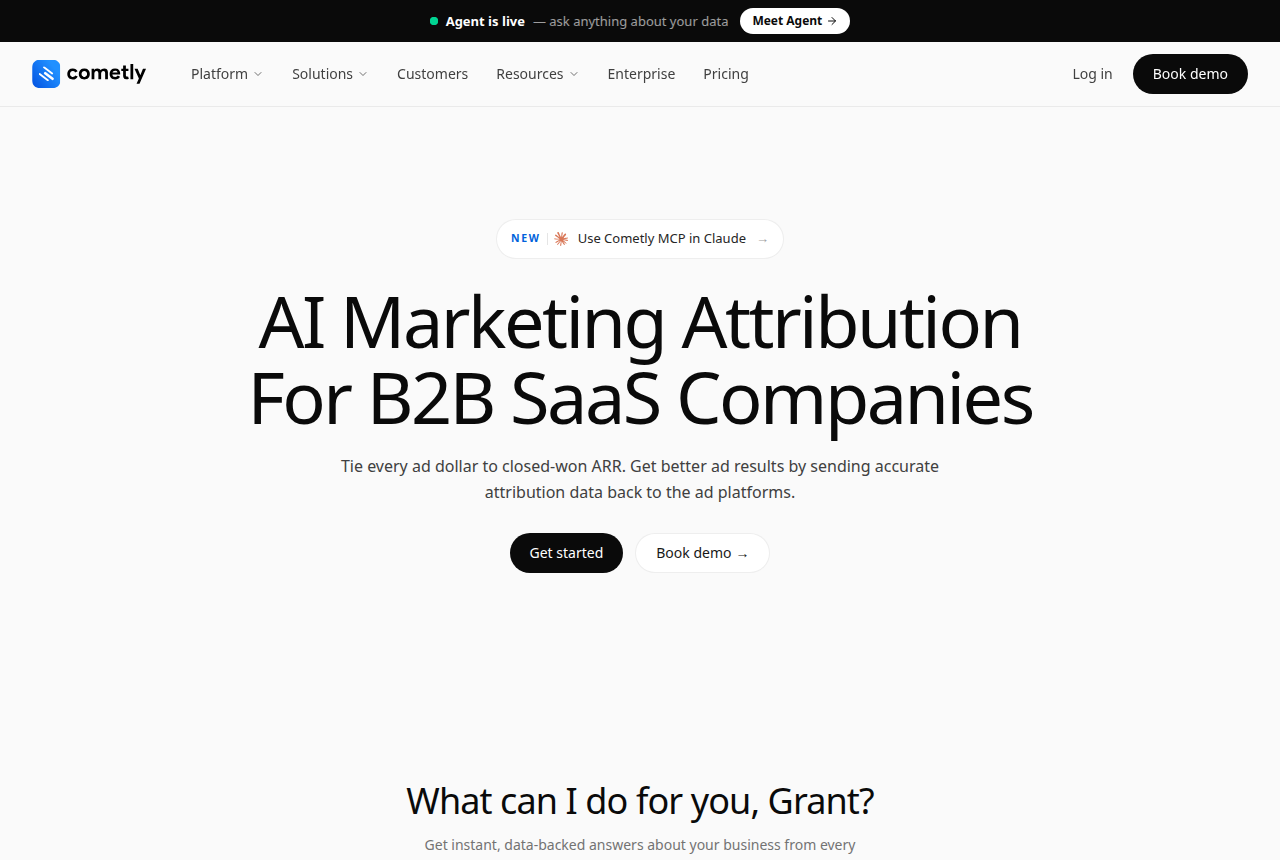
Side by side
| ClickMagick | Cometly | |
|---|---|---|
| What it is | First-party ad tracker | B2B SaaS revenue attribution |
| Built for | Solo advertisers, affiliates | B2B SaaS and subscription teams |
| What it measures | Which click and offer converted | Ad spend to Stripe and CRM revenue |
| The sale it follows | A click to a conversion | First click to closed-won, weeks later |
| Ad-platform feedback | CAPI to Meta, Google, YouTube | Server-side CAPI to 7 platforms |
| Revenue and CRM link | No | Stripe, HubSpot, Salesforce |
| Free way in | 14-day trial, no free tier | No trial, no public price |
| Pricing | $79 to $349/mo, by visitors | Quoted, on monthly pageviews |
| Decision help | Morning Magick daily email | Multi-touch models on each deal |
| Outside proof | Thin, disputed | 4.8 on G2 (36), thin elsewhere |
If you are down to ClickMagick and Cometly, the honest starting point is that these two were built for two different jobs, and for two different kinds of company. Both sit somewhere under the word attribution, but they answer completely different questions. ClickMagick is a first-party ad tracker for solo advertisers, affiliates and info-product sellers: it stamps every click, records which offer converted, and sends a cleaner signal back to the ad platforms. Cometly is a B2B SaaS revenue attribution tool: it ties ad spend to money that arrived in Stripe and to deals in a CRM. The reader stuck between them is really deciding what they buy traffic for, not which product is better made.
ClickMagick has tracked links since 2014 and now bills itself as an attribution platform it calls TrueTracking, aimed at the buyer running their own Meta, Google or YouTube campaigns. Cometly is a newer tool aimed at software companies, feeding Stripe revenue and CRM deal stages into its attribution through a pixel and server-side events. The pricing points the same way the products do: ClickMagick charges a flat monthly rate by the visitors you track and lets you read every number up front, while Cometly quotes a usage-based fee on a sales call. One is a self-serve tracker for someone optimizing their own ad accounts, the other a metered fee for a company that wants its pipeline tied to ad spend.
The one question that decides it: what you buy traffic for
Answer this before you compare a single feature. Do you buy your own paid traffic as a solo advertiser, affiliate or info-product seller, sending clicks to landers and offers and wanting the ad platform to see clean conversion data? Or do you sell B2B SaaS or a subscription through a longer, sales-assisted funnel that closes in a CRM weeks after the click? If your problem is knowing which click, campaign and offer produced a profit today, and feeding that back so Meta and Google stop optimizing toward the wrong people, that is ClickMagick's problem to solve. If your problem is knowing which campaign produced a trial that became a paying customer weeks later, with MRR and LTV attached, that is what Cometly is for.
The business model is not a detail here, it is the decision. ClickMagick assumes you run your own managed campaigns and want a first-party record plus a decision layer you do not have to build, which is why it leads with CAPI feedback and a daily email. Cometly assumes a Stripe subscription or a CRM pipeline and a sale that takes weeks, which is why it writes pre- and post-form touch history onto each deal in HubSpot or Salesforce, the part a CRM's own tracking usually cannot see across a long journey. Put a B2B software closed-won question into ClickMagick and it has no Stripe connection or pipeline to read. Point high-volume affiliate traffic at Cometly and you are metering a revenue-attribution tool on a job a click tracker does more cheaply. Knowing which of those two sentences describes you settles most of the choice.
ClickMagick: the first-party tracker for your own paid traffic
ClickMagick comes at measurement from the managed-platform side. The pitch is that your ad account grades its own homework and gets it wrong, so you keep a first-party record of what converted and send a cleaner signal back to Meta, Google and YouTube through their conversion APIs so their AI stops optimizing toward the wrong people. On top of that sits Morning Magick, a daily email that reads your stats and names what to scale, pause or fix. For a solo buyer with no analyst, that decision layer is often the draw as much as the tracking itself.
Who it suits is narrower than the marketing suggests: a solo advertiser, an affiliate, or someone selling their own course or info-product who runs paid traffic on Meta, Google or YouTube and wants that conversion feedback loop without building it. It bills by tracked visitors, from $79 a month for 10,000 up to $349 for a million, plus $40 a month for each extra site, so anyone buying real volume moves off the Starter plan fast. Its limit worth naming plainly is proof: there is no meaningful G2 or Capterra presence, and the vendor stopped maintaining its Trustpilot page after a fake-review dispute, so you lean on its own case studies more than you would like. Its most-praised trait in public threads is support, which replies fast and often the same day. The full ClickMagick review covers how far the tracking and the morning email reach.
Cometly: ad spend tied to Stripe and CRM revenue
Cometly does a narrower and, for a software company, more useful thing: it ties ad spend to money that actually arrived. Its Comet Pixel and server-side events feed Stripe revenue and CRM deal stages into the attribution, so you see which campaign produced pipeline and closed-won revenue, with MRR and LTV attached, instead of trusting Meta to grade its own homework. It runs first, last, linear, U-shaped and data-driven models across a long journey, and it sends deal-stage-aware events back to Meta, Google, LinkedIn, TikTok, Microsoft, Reddit and Snapchat through a server-side conversion API on both plans, so bidding optimizes toward paying customers rather than raw leads. Its G2 record is strong and consistent, 4.8 out of 5 across 36 reviews, with praise clustering on tracking accuracy and fast, human support, and one reviewer reported accurate tracking on over $100,000 a month in ad spend.
The two real caveats are commercial, not technical. Cometly publishes no price and offers no free trial: the Core and Enterprise plans are quoted on a sales call, usage-based on your monthly pageviews, and you commit, or at least pay for onboarding, before you see it run on your own traffic. Some buyers report the quote feels high. The honest workaround is to make the live demo prove the tracking on your real numbers first, because that is the only up-front proof you get, and it is a sharper trade against ClickMagick, which at least lets you test on a 14-day trial. Outside its solid but small G2 record the proof thins out, with Trustpilot at 3.6 and no clear Capterra listing. The full Cometly review walks through the setup and the sentiment in detail.
Different jobs, not a better and a worse tool
Underneath the surface, this is not one tool beating another, it is two answers to two different businesses. ClickMagick answers which click and offer made money, for a buyer optimizing their own ad accounts, and fires that back to the platforms as first-party conversions. Cometly answers which campaign produced recurring revenue for a software company, and writes it onto the deal in the CRM. Put a solo affiliate into Cometly and they get a pageview-metered attribution tool built around a Stripe and CRM connection they may not have. Point a B2B founder at ClickMagick and they get a click tracker with no revenue layer to tell them which ad produced a paying subscriber.
So the honest tie-break is not features, it is your operation. If you buy your own paid traffic and live or die by clean conversion data and a flat, readable bill, the SaaS-first attribution tool was never going to serve you. If you sell software or a subscription and need a weeks-long sale tied to the deal in your CRM, the click tracker has no pipeline to read and no revenue layer to attach. Match the tool to how your revenue actually arrives and the rest of the comparison mostly answers itself.
Where the pricing diverges
Neither of these prices on the same axis, so you are not modeling a crossover point, you are comparing two shapes. ClickMagick charges a flat monthly rate by the visitors you track, from $79 a month for 10,000 up to $349 for a million, plus $40 a month per extra site, and you can read every number on the pricing page and test it on a 14-day trial before you pay. Just remember the Starter plan tracks only 10,000 visitors, so anyone buying real volume is on the $199 tier quickly. Cometly does not publish a price at all: its plans are usage-based on monthly pageviews and quoted on a call, so you cannot line its cost up against a competitor before you talk to sales, and there is no free trial to test it first. If a readable bill and a trial fit how you work, that points to ClickMagick. If you can accept a quote you only see after a demo, that is the friction you take on with Cometly, and the reason to make that demo run on your own data.
Verify both on your real situation. Count your true tracked-visitor volume before you trust ClickMagick's entry figure, and factor in the per-site fee if you run several domains. Push Cometly for a written quote against your actual monthly pageviews, because usage-based pricing climbs quietly as your traffic grows, and confirm what the paid onboarding includes before you commit.
A third path if you host the funnel yourself
Both of these tools measure traffic to pages and offers that live somewhere else. ClickMagick stamps a click and follows it to a lander and a checkout you host on another platform, and Cometly reads revenue out of a Stripe account and a CRM that sit elsewhere too. There is a different way to close the same gap, worth naming because it changes where the data lives. ElasticFunnels is a funnel platform for teams running paid traffic: it builds the pages and hosts the checkout itself, and keeps its ad-spend and conversion reporting on the same data layer as those pages, the CRM and the sale. Because a sale closes in a checkout it hosts, that conversion is a first-party event it records directly rather than a signal it has to catch after the fact, and it fires server-side postbacks to your affiliate networks on purchase, refund, chargeback and renewal. It also split-tests page variants under one campaign URL, so a test never resets the ad platform's learning. It starts with a 14-day free trial that takes no card, on plans from $97 a month, plus 0.5% of revenue processed through its hosted checkout.
The honest limit that keeps it on its own line rather than in the table: ElasticFunnels is newer than either tool here, and there is very little independent third-party review coverage to check its claims against, so until you run real volume through it you are largely taking the vendor's word for how its reporting and postbacks hold up. That is what you would expect of a platform this recent, where ClickMagick has a decade of history and Cometly a consistent G2 record you can read before you buy. And its reporting covers the funnels it hosts, so a buyer tracking clicks across offers on domains they do not own still needs a dedicated tracker like ClickMagick for that traffic, and a B2B SaaS team attributing a sales-led motion that closes in a CRM it runs elsewhere still needs a tool like Cometly. It is an option for the seller who runs their own pages and checkout end to end, not a replacement for either tool.
Which one for you
You buy your own Meta, Google or YouTube traffic as a solo advertiser, affiliate or info-product seller: ClickMagick. First-party conversion tracking fed back to the ad platforms, a flat bill you can read up front, and a daily email that does the reading for you are the right call, as long as you accept the thin outside proof and price it on your real visitor volume.
You sell B2B SaaS or a subscription and need ad spend tied to revenue: Cometly. Stripe and CRM revenue attribution, long-journey multi-touch models and server-side conversion feeds to seven ad platforms are the right fit, as long as you can commit without a public price and you make the demo prove the tracking on your own numbers first.
You host your own pages and checkout end to end: look at ElasticFunnels alongside them, with the newness caveat above in mind, and keep a tracker like ClickMagick for any traffic that closes on domains you do not host, or Cometly for a software sale that closes in your CRM.
ClickMagick takes our default pick here, not because it out-measures Cometly at Cometly's own job, but because more readers who reach this comparison buy their own paid traffic than sell B2B software. On its own turf, a B2B SaaS or subscription company tying ad spend to Stripe revenue and a CRM pipeline, Cometly is plainly the better tool, and we would pick it every time over a click tracker with no pipeline to read. If you are actually weighing attribution tools for a software business, our Northbeam vs Cometly comparison takes the next step. If you want a self-hosted tracker that holds its price as your click volume climbs, Binom vs ClickMagick runs that split, and our ad tracker ranking places both against the trackers a scaled buyer graduates to.
ClickMagick
What works
- Flat monthly price based on the visitors you track, not a cut of your revenue, so the bill does not climb every time a campaign wins.
- First-party TrueTracking with a custom domain and CAPI feeds cleaner conversion data back to Meta, Google and YouTube, which users credit for better ad optimization.
- The Morning Magick email reads your stats each morning and names what to scale, pause or fix, which suits a solo buyer with no analyst.
- Support is the most-praised part in public reviews: fast replies, often the same day, sometimes with screen recordings.
What to watch
- The Starter plan tracks just 10,000 visitors for $79, so anyone buying real volume is pushed to the $199 Standard tier fast.
- Independent proof is thin. There is no meaningful G2 or Capterra presence, and ClickMagick stopped maintaining its Trustpilot page after disputing fake reviews, so you lean on the vendor's own case studies more than you would like.
- It is a decision layer, not the truth. The numbers still need reconciling against the ad network, GA4 and your backend before you move budget.
- Setup rewards patience. Postbacks, cross-domain tracking and CAPI all need wiring, and a botched setup is behind most of the accuracy complaints.
Cometly
What works
- It ties ad spend to money that actually arrived, not to platform-reported conversions. The Comet Pixel and server-side events feed Stripe revenue and CRM deal stages into the attribution, so you see which campaign produced pipeline and closed-won revenue, with MRR and LTV attached, instead of trusting Meta to grade its own homework.
- Server-side Conversion API to seven ad platforms, on both plans. It sends deal-stage-aware events to Meta, Google, LinkedIn, TikTok, Microsoft, Reddit and Snapchat, so the bidding optimizes toward paying customers rather than raw form fills. The vendor claims Meta event match quality up to 9.3 out of 10.
- Multi-touch models built for long B2B journeys. First, last, linear, U-shaped and data-driven attribution, with the full pre- and post-form touch history written onto each deal in HubSpot or Salesforce, which is the part a CRM's own tracking usually cannot see across a weeks-long sale.
- A strong, consistent G2 record. 4.8 out of 5 from 36 reviews, 34 of them five-star, with praise clustering on attribution accuracy, custom-event tracking and fast, human support. One reviewer reported accurate tracking on over $100,000 a month in ad spend.
- 70-plus native integrations and done-for-you onboarding. Stripe, HubSpot, Salesforce, Close, HighLevel and the major ad platforms connect in minutes, and a specialist wires your stack up, which matters because attribution is only ever as good as its setup.
What to watch
- No public pricing. The two plans, Core and Enterprise, carry no numbers; pricing is usage-based on your monthly pageviews and quoted on a sales call. You cannot line its cost up against a competitor before you talk to sales, and some buyers report the quote feels high, one G2 review titled bluntly "Not worth of it's price."
- No free trial. Cometly does not offer one, arguing that attribution needs your CRM and ad platforms wired up first, and sells a paid onboarding instead. So you commit, or at least pay to get set up, before you see it run on your own traffic. Make the live demo show your real numbers, because that is the only proof you get up front.
- Thin proof outside G2. Trustpilot sits at 3.6 from 92 reviews and flags that only a handful are recent and the sample may not be representative, and there is no clear Capterra listing. The G2 record is good but small, so the trial you cannot take is exactly the due diligence you would most want.
- It is attribution, so it is directional, not truth. Like every tool in the category, its models will not perfectly match Meta, Google, GA4 and your bank at once, and it is only as accurate as your UTMs and CRM hygiene. Treat its numbers as a better basis for decisions, not a precise ledger.
- Some rough edges reviewers name. A couple report documentation that lags the actual app, one flags pricing changing after they signed, and a Trustpilot reviewer found it "just another tool with a bunch of complicated options." None is disqualifying, but budget setup time and expect to lean on support early.
Pricing
ClickMagick: from $79/mo. Starter is $79/mo (10,000 tracked visitors); Standard $199/mo (100,000); Pro $349/mo (1,000,000). Billed yearly it is $66/$166/$291 a month (two months free). Priced on tracked visitors, not a share of revenue. Extra sites/stores are +$40/mo on Standard and Pro.
Cometly: from a quoted, usage-based fee. Usage-based, quote-only. Two plans, Core and Enterprise, both priced on your monthly pageviews (estimated at ~1.5x sessions), quoted on a sales call. No numeric pricing is published. Monthly or annual billing; annual saves 20%. No free trial; paid Professional Onboarding instead. One buyer publicly reported a $600/mo quote.
Pricing verified against each vendor on 2026-09-23. Check before you buy.
Our pick
ClickMagick
ClickMagick is the pick if you are an affiliate, a solo advertiser or an info-product seller who wants a flat monthly bill and a morning email telling you what to scale or cut, and you can live with an entry plan that tracks only 10,000 visitors.
Frequently asked questions
ClickMagick or Cometly: which should I use?
Which is cheaper, ClickMagick or Cometly?
Do ClickMagick and Cometly do the same thing?
Can ClickMagick track a B2B SaaS sale that closes in a CRM weeks later?
Can Cometly track high-volume affiliate or paid traffic to offers?
Which one can I try before I pay?
Sources
Other sources
6 discussions and reviews read for this page. Quotes are excerpts; open a link to read the original in context.
- [ppc-advice] Looking for some advice regarding my campaigns
- [ppc-toogood] Anyone have experience with ClickMagick or similar?
- [ppc-expert] Anyone have experience with ClickMagick or similar?
- [sideproject-price] I got tired of paying 79/mo for ClickMagick so I built my own for 15/mo
- [vendor-mattcox] ClickMagick pricing page customer testimonial
- [vendor-hyros] ClickMagick home page customer testimonial

Written by
Dana Rourke
Lead reviewer
Dana Rourke is the lead reviewer at Campaign Buyer. She owns the tracker and attribution coverage: reading what long-term users report about each tool, checking its documentation and pricing, and verifying prices with the vendor before writing the verdict. Keeping the rankings honest mostly means writing down what the top pick gets wrong, so she does that first.
Last checked 2026-09-23