Profit dashboard vs managed MMMmedia buyer software
Triple Whale vs Fospha
By Dana Rourke, Lead reviewer. Reviewed by Campaign Buyer Editorial. Updated 29 September 2026.

Quick answer
Pick Triple Whale if you run a Shopify or DTC brand under roughly $100k a month in ad spend and want blended profit, MER and CAC in one affordable operator dashboard you run yourself; pick Fospha if you spend at least $100k a month across DTC and marketplaces like Amazon and TikTok Shop and want a dedicated team to run a platform-independent, full-funnel measurement model for you.
Side by side
| Triple Whale | Fospha | |
|---|---|---|
| What it is | Shopify profit dashboard | Managed MMM measurement platform |
| Best-fit brand | Growing Shopify or DTC brand | Scaling brand spending $100k+/mo |
| What it measures | Blended store profit, MER, CAC | Platform-independent channel contribution |
| How it tracks | First-party Shopify pixel | Pixel-free, modeled, platform-independent |
| Marketplace sales | Shopify-centric | Yes, Amazon and TikTok Shop via Halo |
| Who runs the model | You and your team | Fospha's measurement team |
| Onboarding | Self-serve; needs clean UTMs | Light; live under 28 days, no pixel |
| Granularity | Blended and channel-level | Campaign-level on the entry tier |
| Pricing | From $219/mo, GMV-scaled | From $1,500/mo + % of spend, $100k floor |
| Outside proof | Widely used and reviewed | Case studies, fewer independent reviews |
If you are down to Triple Whale and Fospha, the first thing worth saying is that these two rarely serve the same brand. Both exist to give you one honest read of where your paid media actually worked, instead of trusting each ad platform's inflated numbers. But they answer that question at two very different scales, at two prices that sit roughly seven times apart, and with a very different amount of work landing on your own team. The reader stuck between them is usually deciding how big their operation is and how much of the measurement they want to run themselves, not which product is better built.
The same question, two very different scales
Triple Whale is a Shopify-native profit dashboard. A first-party pixel feeds MER, blended CAC and contribution margin into one operator screen that a founder opens every morning, and it enters at $219 a month, far below the serious measurement platforms it is often shortlisted against. Fospha is a managed measurement platform. It runs a platform-independent, glass-box media-mix model for you, refreshes the outputs daily, and floors at $1,500 a month with a hard requirement that you spend at least $100,000 a month on media before it will take you on.
So the split is less about accuracy and more about size and staffing. Triple Whale is a tool you run. Fospha is a service that runs the model for you. If your spend is not yet six figures a month, one of these is not really an option, and that alone settles the choice for a lot of readers.
Triple Whale: the operator's dashboard
Triple Whale earns the top spot in our ranking because it is the most practical way for a growing Shopify or DTC brand to see attribution and profit together. The first-party pixel feeds MER, blended CAC and contribution margin into a dashboard that an operator, not just an analyst, will actually open. It costs less to enter than Fospha or Northbeam, which is why most brands under roughly $10M in GMV should start here, and the whole team can read it without a data owner translating.
The honest catch is that the first dashboard is rarely right. Users report early inaccuracies, and the usual cause is missing or messy UTMs, because attribution is only as clean as the parameters feeding it. Budget time to get the tagging disciplined and reconcile against your Shopify backend before you trust the numbers. The paid plans are 12-month commitments priced on your GMV, and users have flagged data quirks such as VAT counted inside revenue, so the tool rewards a brand willing to do the setup work and punishes one that expects a correct read on day one.
Fospha: measurement run for you
Fospha starts from the opposite assumption: that you spend real money, do not have a data team, and do not want to build one to answer a budget question. It is pixel-free and platform-independent, and reviewers say its read comes out truer than the numbers each ad platform reports about itself. A dedicated measurement team runs the glass-box model, refreshes the outputs daily, and helps you defend the numbers in a budget meeting. Onboarding is light for a platform at this level: live in under 28 days, with 24 months of history and no pixel to install. And unusually, its Halo product models how paid media drives marketplace sales on Amazon and TikTok Shop, which a Shopify-centric dashboard like Triple Whale does not see at all.
The trade-offs are real and worth naming. The entry tier reports at campaign level, not deeper, and the outputs are directional model estimates, not ground truth, so they will not reconcile exactly with any ad platform or your finance team. There is no free tier and no self-serve trial, so you commit through a demo before you can validate it on your own data. And there is a genuine independence question: Fospha is the endorsed measurement partner of the same platforms it grades, and a competitor argues its impression-weighted model can flatter high-volume upper-funnel channels. Read as a decision aid by a brand at scale, it is a strong, low-effort platform. Read as a cheap operator dashboard, it is priced and built for a different buyer entirely.
Pricing is not the fork. Spend is
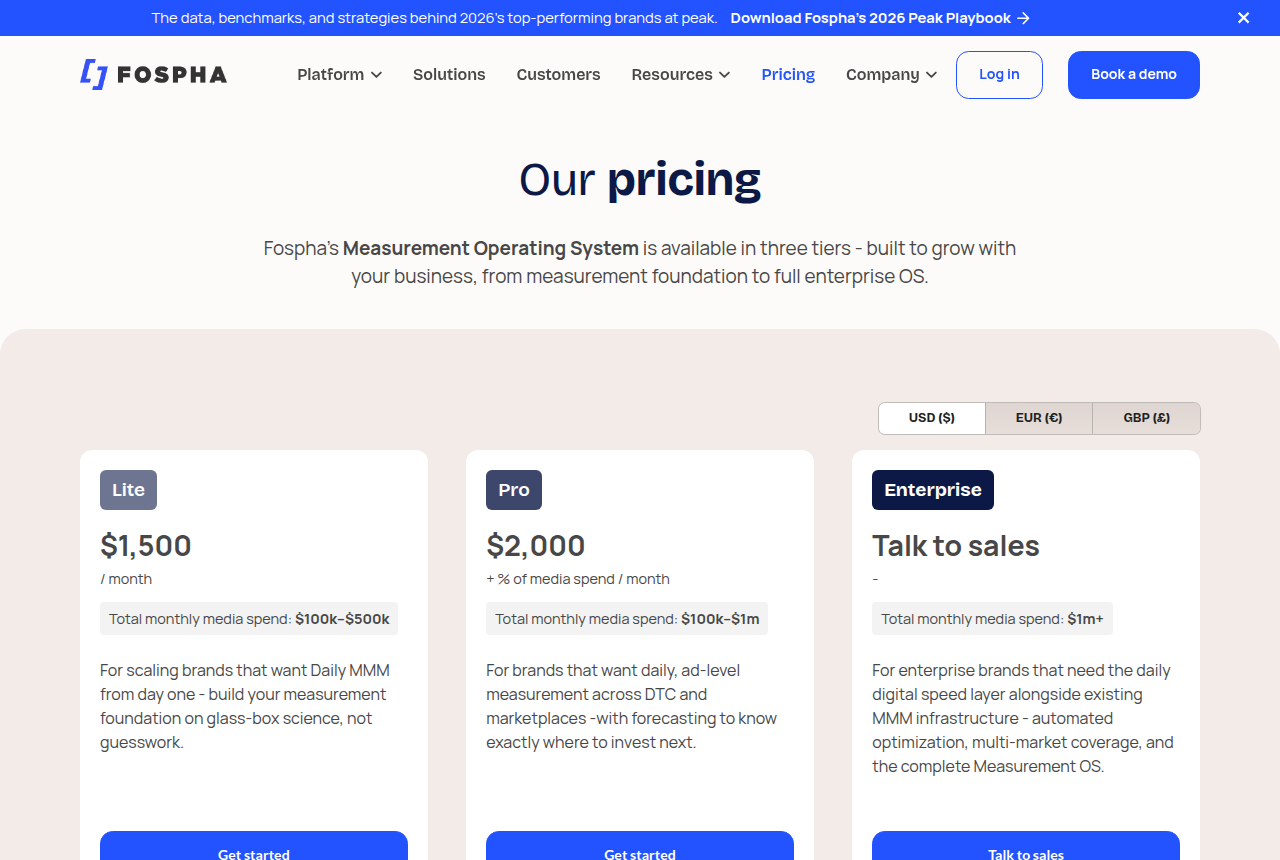
The two do not price on the same axis, so a straight sticker comparison misleads. Triple Whale opens at $219 a month on a 12-month, GMV-scaled commitment. Fospha is $1,500 for Lite and $2,000 for Pro plus a percentage of spend, and it will not onboard a brand spending under $100,000 a month on media. That floor is the real deciding line. Below it, Fospha is not available and Triple Whale is the obvious tool; above it, both are in play and the question becomes whether you want to own the dashboard or hand the modeling to a team. If you have the spend but no analyst, Fospha's managed model is often cheaper than the hire a self-run platform would demand. If you are a leaner brand that just wants to see profit by channel every morning, Triple Whale answers that at a tenth of the entry price.
The build layer neither of these touches
Both of these measure. Neither builds or hosts the funnel the traffic lands on, and neither keeps the click, the order, the rebill and the refund on one record. A team that wants the page, the split test, the checkout and the reporting on one data layer is shopping for a funnel platform, and ElasticFunnels is worth a look for that job. Its lead feature is same-URL split testing: variants rotate server-side under one campaign link, so Meta, Google and TikTok keep their learning and a test never sends the ad back through review. Because a click, an order, a rebill and a refund are one record, nobody reconciles four exports to work out which angle really made money. It builds the pages, including an AI builder that can clone one from a URL, hosts the checkout with order bumps and one-click upsells, and runs a CRM and automations on the same data. It starts at $97 a month with a 14-day trial that needs no card, and every feature is on every plan.
The honest caveat is age. ElasticFunnels is newer than either Triple Whale or Fospha, and there is very little independent third-party review coverage to check its claims against, so until you run real volume through it you are largely taking the vendor's word on the reporting. That is what you would expect of a platform this recent next to two established tools, and it matters less if you use the free trial to prove the split testing and the attribution on your own campaigns first. It is not a measurement platform in the Fospha sense, and it does not run media-mix models or incrementality. It is the build-and-sell layer that sits under both, so weigh it only when building and hosting the funnel is part of what you are actually buying.
Which one for you
Do you run a Shopify or DTC brand, spend under roughly $100,000 a month, and want blended profit, MER and CAC in one affordable screen your whole team reads? That is Triple Whale, and its number one ranking reflects how much practical value it delivers at that stage, provided you keep your UTMs clean. Do you spend at least six figures a month, sell across DTC and marketplaces like Amazon and TikTok Shop, and would rather a dedicated team run a platform-independent, full-funnel model than build one in-house? That is Fospha, and its light onboarding and marketplace coverage are the whole reason to pay for a managed service at that scale. And if the real job is to build, split-test, sell and report on one platform rather than to measure a mature media mix, that is a funnel tool like ElasticFunnels, not either of these.
Triple Whale
What works
- Built for Shopify: first-party pixel, MER, blended CAC and profit in one dashboard
- Lower entry cost than the other serious attribution tools here
- Fast, operator-friendly dashboards the whole team will actually open
What to watch
- Accuracy depends on disciplined UTMs; the first dashboard is rarely right out of the box
- Paid plans are 12-month commitments priced by GMV
- Users report data quirks such as VAT counted in revenue, so reconcile against the backend
Fospha
What works
- Platform-independent, pixel-free measurement that reviewers say reads truer than the numbers each ad platform reports about itself
- Measures the full funnel and, unusually, marketplaces: its Halo product models how paid media drives Amazon and TikTok Shop sales, which most DTC dashboards cannot see
- Glass-box modeling with daily outputs and a dedicated measurement team, so the numbers refresh every day and someone helps you defend them in the budget meeting
- Light onboarding for a platform at this level: live in under 28 days with 24 months of history, no pixel install and no dev team required
- Publishes its pricing openly (Lite $1,500, Pro $2,000 plus a percentage of spend), which is rare in a category that mostly hides behind a demo
What to watch
- High floor: every plan needs at least $100k a month in media spend and starts at $1,500/mo, so it is out of reach for small or pre-scale brands
- No free tier and no self-serve trial. You commit through a demo before you can validate it on your own data
- The independence question: Fospha is the endorsed measurement partner of the same platforms it grades, and critics argue its impression-weighted model can flatter high-volume upper-funnel channels
- It is a model, not the truth. Outputs are directional MMM estimates that will not reconcile exactly with each ad platform or your finance team, so someone has to read them as a decision aid
- Dashboard limits reported by users: only campaign-level granularity on the entry tier, filtering that needs manual handling, no direct BI-tool connections without exports, and extra cost for older historical data
- Measurement only: it tells you where to spend but does not execute the changes, so it sits alongside your ad platforms rather than replacing them
Pricing
Triple Whale: from $219/mo. Free plan with no credit card, including Moby AI. The paid tiers (Foundation, Automate and Enterprise) are quoted after a walkthrough rather than publicly priced and scale with your store revenue; as of 23 September 2026 the vendor lists no dollar figure for them.
Fospha: from $1,500/mo. Three published tiers. Lite $1,500/mo for brands spending $100k-$500k/mo on media (one market, daily MMM, channel/campaign granularity). Pro $2,000/mo plus a percentage of media spend for $100k-$1m/mo (ad-level granularity, post-purchase attribution, Beam forecasting, up to three markets, Amazon and TikTok Shop via Halo). Enterprise is quote-based for $1m+/mo (incrementality and offline calibration, Brand Impact, five markets, automation via Smartly). No free tier and no self-serve trial; every plan requires at least $100k/mo in media spend. Prices also listed in EUR and GBP.
Pricing verified against each vendor on 2026-09-23. Check before you buy.
Our pick
Triple Whale
It is the pick if you run a Shopify or DTC brand and want attribution and profit dashboards in one place, and you will keep your UTMs clean.
Frequently asked questions
Triple Whale or Fospha: which should I use?
Which is cheaper, Triple Whale or Fospha?
Do Triple Whale and Fospha do the same thing?
Which one needs more spend to be worth it?
What if you also need to build and host the funnel, not just measure it?
Sources
Other sources
9 discussions and reviews read for this page. Quotes are excerpts; open a link to read the original in context.
- [reddit-must-4yr] Is triple whale a must?
- [reddit-must-50k] Is triple whale a must?
- [reddit-must-overlap] Is triple whale a must?
- [reddit-vsmeta-unprofitable] Triple Whale vs Meta Reporting?
- [reddit-vsmeta-confused] Triple Whale vs Meta Reporting?
- [reddit-ecom-convoluted] Triple Whale?
- [reddit-ecom-repeats] Triple Whale?
- [reddit-ecom-amazing] Triple Whale?
- [reddit-ecom-sonar-100k] Triple Whale?

Written by
Dana Rourke
Lead reviewer
Dana Rourke is the lead reviewer at Campaign Buyer. She owns the tracker and attribution coverage: reading what long-term users report about each tool, checking its documentation and pricing, and verifying prices with the vendor before writing the verdict. Keeping the rankings honest mostly means writing down what the top pick gets wrong, so she does that first.
Last checked 2026-09-29