Hyros vs ClickMagick
By Dana Rourke, Lead reviewer. Reviewed by Campaign Buyer Editorial. Updated 23 September 2026.
Quick answer
Pick Hyros if your sale closes after a sales call, a webinar or a long email sequence and you are already spending real money, because its server-side attribution follows that journey across your CRM and payment processor; pick ClickMagick if you run your own Meta, Google or YouTube paid traffic as a solo advertiser, affiliate or info-product seller and want first-party tracking, a flat published price and a morning email that names what to scale or cut. For most readers who reach this page, ClickMagick is the default, because it fits the traffic they actually run at a bill they can predict, while Hyros earns its quote only once your spend and funnel complexity are genuinely high.
Side by side
| Hyros | ClickMagick | |
|---|---|---|
| What it is | Long-funnel attribution | First-party CAPI tracker |
| Best-fit funnel | High-ticket, call, webinar | Own paid-traffic funnel |
| What it tracks | A buyer across tools | Clicks and conversions |
| Platform feedback | Server-side to platforms | CAPI to Meta, Google |
| Pricing model | Custom quote, spend-based | $79 to $349/mo flat |
| Best-fit spend | ~$50k/mo and up | Any budget |
| Outside proof | Mixed, quote-gated | Thin, disputed |
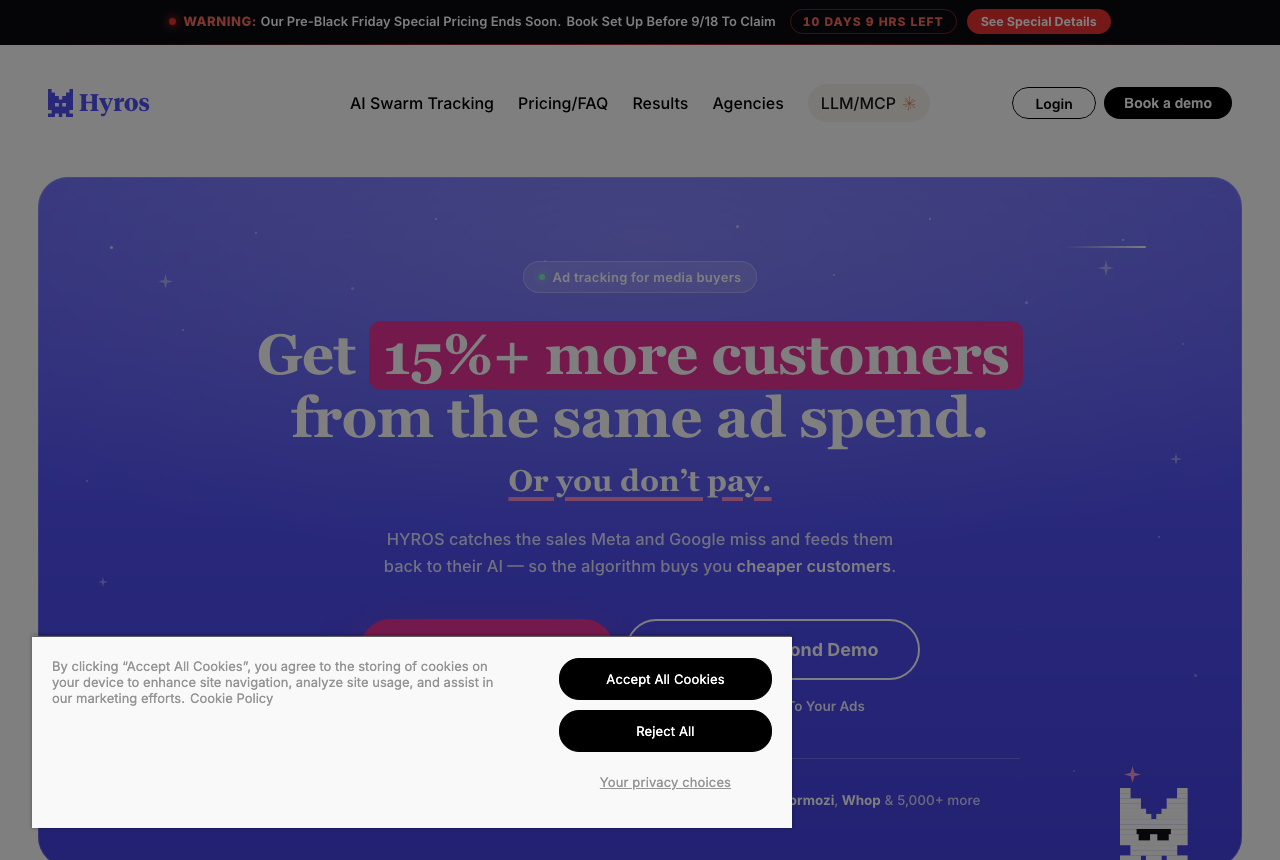
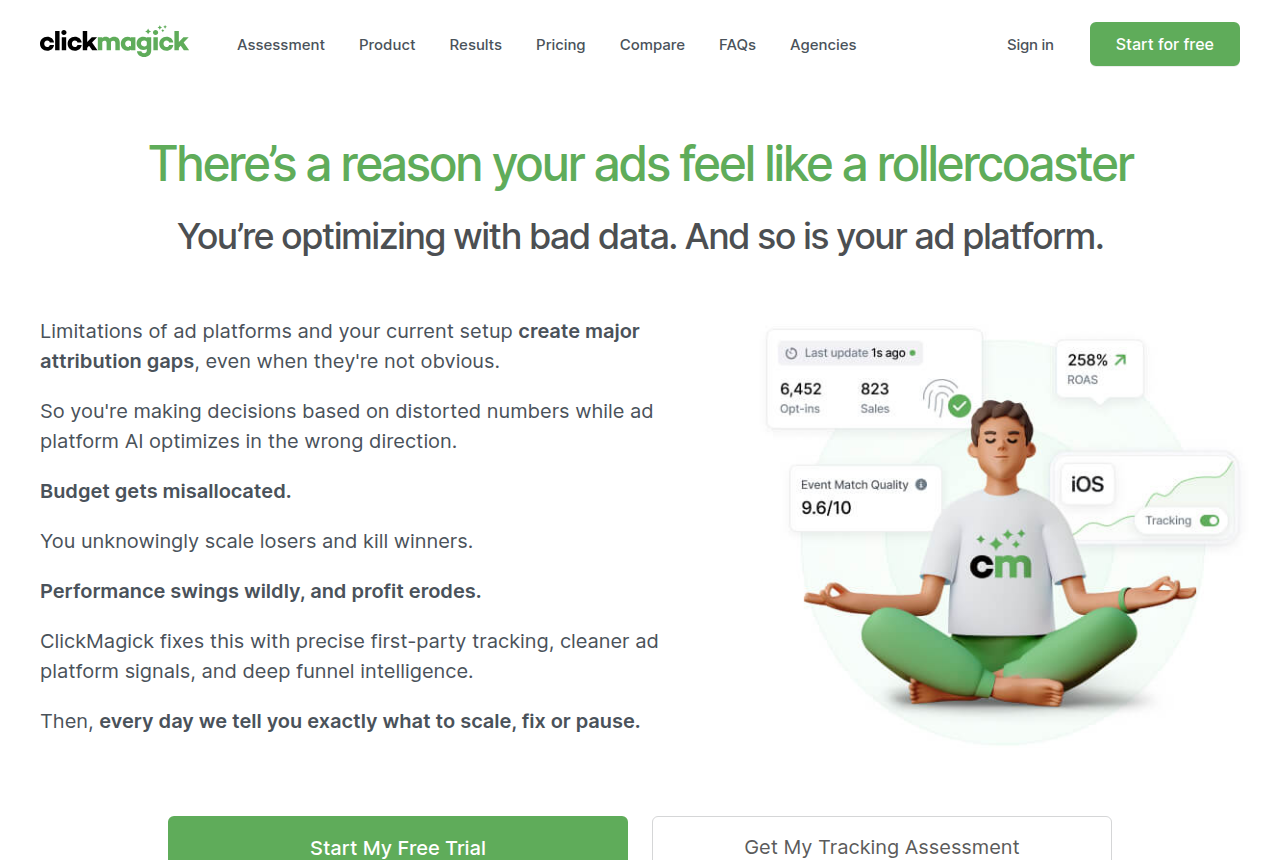
If you are down to Hyros and ClickMagick, you are choosing between two tools that both promise numbers you can trust more than platform-reported ROAS, but that watch very different funnels. Hyros is a server-side attribution platform: it stitches a long buyer's journey across your CRM, your email tool and your payment processor, so a sale that closes weeks after the click still traces back to the ad that started it. ClickMagick is a first-party tracker for your own paid traffic: it records the click-to-conversion path under your own domain and feeds a cleaner signal back to Meta, Google and YouTube so their algorithms chase real buyers. ClickMagick even markets itself as the cheaper Hyros alternative. The reader stuck between them is really deciding what kind of funnel they run and how much they spend, not which brand is better made.
Hyros watches a person move through your whole business and makes a long, high-ticket funnel measurable. ClickMagick watches your ad traffic move through a page and a checkout and makes a self-served, flat-priced decision layer out of it. One is a managed platform priced on a quote. The other is a login you pay a fixed tier for. Work out which of those describes you before you compare a single feature.
The two questions that decide it
Answer these before you look at a feature list. First: where does your sale actually close? If it closes fast, in one session or a short window as a visitor moves from your ad to a page and a checkout, your problem is reading and optimizing that traffic, and that is what ClickMagick is for. If it closes after a lead opt-in, an email sequence, a sales call or a webinar, standard pixels lose the thread long before the money changes hands, and stitching that journey across your tools is exactly what Hyros does. ClickMagick can send a conversion back to the platform, but it cannot reconstruct a human close that happens weeks later across a CRM.
Second: how much are you spending? ClickMagick has a published entry price and works at any budget, which is why a solo advertiser or an affiliate can run it from day one. Hyros is a managed platform sold on a quote, and buyers put the honest threshold around $50k a month in spend with genuinely complex funnels before it pays off. Point Hyros at a simple funnel below that and most of its journey-stitching machinery sits idle while you pay for it. If you know which of those two sentences fits you, you already know which tool this is, and most of the detail below only confirms it.
Hyros: attribution for the long funnel
Hyros targets the funnel that does not end at a checkout. If your sale happens after an opt-in, an email sequence, a sales call or a webinar, standard pixels lose the thread. Hyros tracks server-side and stitches the journey across payment processors and CRMs, which is why info-product sellers, coaches and high-ticket advertisers credit it with finding revenue Meta and Google never attributed. For a media buyer pouring spend into a funnel whose payoff is weeks and several touchpoints away, that is the whole reason to run it, and it is a job ClickMagick's click-to-conversion tracking is not built to do.
Two honest cautions. Pricing on the main site is quote-driven and opaque, so you talk to sales rather than read a number, and buyers put the honest threshold around $50k a month in spend with genuinely complex funnels before it earns its keep. Below that, the machinery is wasted and a cheaper, simpler tool does the job. And like every tool in this category, Hyros is an attribution model, not the truth. It will diverge from platform reporting, and it is not a cure for post-iOS tracking loss. Use it to make better allocation calls on a long funnel, not to win an argument about whose number is right. You can read the full Hyros review for how it holds up over time.
ClickMagick: first-party tracking and a morning to-do list
ClickMagick has been tracking links and conversions since 2014, and it now bills itself as an attribution layer it calls TrueTracking. The pitch suits the solo Meta or Google buyer: your ad account optimizes toward whoever it thinks converted, so if you feed it a clean first-party record of who actually bought, it spends your budget on better people. ClickMagick sets a tracking domain of your own, catches conversions server-side, and pushes them back through the platforms' conversion APIs. For a buyer whose sale closes on their own traffic in a short window, that is the whole draw, and it costs a fraction of a Hyros quote.
Its most-praised touches are the ones a solo operator with no analyst needs. The Morning Magick email reads your numbers overnight and names what to scale, pause or fix. Support draws the warmest reviews of anything in this category, with same-day replies and the occasional screen recording. For an affiliate or an info-product seller who wants direction rather than a data warehouse, that is the reason to pick it over a heavier platform.
The limits are just as clear. The Starter plan tracks only 10,000 visitors for $79 a month, so anyone buying real volume is pushed onto the $199 Standard tier quickly, and the bill grows with the visitors you count. Independent proof is thin: there is no meaningful G2 or Capterra presence, and ClickMagick stopped maintaining its Trustpilot page after disputing what it called fake reviews, so you lean on the vendor's own case studies more than you would like. And like Hyros, it is a decision layer, not the truth. The numbers still want reconciling against the network, GA4 and your backend before you move budget. Our full ClickMagick review goes deeper on the accuracy complaints and the setup that avoids them.
Where the pricing diverges
The two price on opposite principles, and that itself tells you who each is for. ClickMagick publishes its tiers: $79 a month for 10,000 tracked visitors, $199 for 100,000, and $349 for one million, with yearly billing knocking those to roughly $66, $166 and $291, plus $40 a month per extra site. You can size it from a pricing page against your real traffic. Hyros publishes nothing. It is a sales quote you negotiate, usually from a few hundred a month up depending on your spend and funnel complexity, so you cannot comparison-shop it.
Read both on your real situation. ClickMagick's cost is low to start and scales with the visitors you track, which suits a buyer who wants to know the bill in advance. Hyros's quote scales with the value of the attribution to a high-ticket funnel, where recovering a handful of misattributed high-ticket sales pays for the tool many times over. Get Hyros's number in writing before you commit, and price ClickMagick on the visitor count your traffic actually generates.
A third path if you host the funnel yourself
There is a third answer worth naming, because neither Hyros nor ClickMagick builds or hosts the funnel it measures. Both watch a journey that happens on pages and checkouts living somewhere else, and both feed a signal back to the ad networks after the fact. ElasticFunnels owns that middle instead. It is a funnel platform for teams running paid traffic: it builds the pages, split-tests variants under one URL so the ad platform keeps its learning, hosts the checkout with order bumps and upsells, and keeps a CRM, automations and a call center on the same data layer as the pages and the sale. Because a purchase closes in a checkout it hosts, that conversion is a deterministic first-party event it records directly rather than a click it has to model, and it reports ad spend against those conversions without a separate tracker bolted on. For a funnel that closes on a call it keeps that call-and-CRM timeline in one place, which is the kind of journey Hyros is hired to reconstruct after the fact, and it fires server-side postbacks to your networks on purchase, refund, chargeback and renewal. It starts with a 14-day free trial that takes no card, on plans from $97 a month, plus 0.5% of revenue processed through its hosted checkout.
Two honest limits keep it on its own line rather than in the head-to-head. ElasticFunnels is newer than either tool here, and there is very little independent third-party review coverage to check its claims against, so until you run real volume through it you are largely taking the vendor's word for how its attribution holds up. That is what you would expect of a platform this young, and the no-card trial is there to test it before you commit. Hyros and ClickMagick both have years of public setups and threads to check against. And its reporting covers the funnels it hosts, so a high-ticket seller whose sale closes across tools ElasticFunnels does not host still needs a stitching platform like Hyros, and a buyer sending paid clicks to pages that live elsewhere still needs a first-party tracker like ClickMagick for that traffic. It is an option for the seller who runs their own pages and checkout end to end, not a replacement for either.
Which one for you
Your sale closes after a call, a webinar or a long email sequence: Hyros. Server-side attribution that stitches the journey across your CRM and payment processor is the only one of the two that can follow that sale, and it earns its quote once your spend and funnel complexity are real, roughly $50k a month and up.
You run your own Meta, Google or YouTube paid traffic as a solo advertiser, affiliate or info-product seller: ClickMagick. First-party tracking that feeds the networks a cleaner signal, a flat published price and a morning email that tells you what to do are worth more to you than a managed attribution platform you cannot fully use. Watch the visitor tiers as you grow.
You host your own pages and checkout end to end: look at ElasticFunnels alongside them, with the newness caveat above in mind, and keep a dedicated tracker for any click traffic that lands on domains it does not host.
ClickMagick takes our default pick here, not because it out-attributes Hyros on a long funnel, but because more readers who reach this site run their own paid traffic on a budget they need to predict than run the high-ticket call funnel at $50k a month and up that Hyros requires. That is a statement about who is reading this site, not about which product is better built. On its own turf, a funnel that closes after a call or a webinar, Hyros is plainly the better fit, and we rank it fourth in our ad tracker ranking for exactly that buyer, while ClickMagick sits sixth for the solo advertiser it serves. If you want to weigh Hyros against a self-hosted click tracker instead, our RedTrack vs Hyros page does that, and if you want to see ClickMagick against a self-hosted tracker for volume, our Binom vs ClickMagick page weighs it.
Hyros
What works
- Server-side tracking that follows long journeys through calls, webinars and CRMs
- Finds sales that Meta and Google miss on multi-step funnels
- Integrates with payment processors and CRMs, not just web analytics
What to watch
- Overkill below roughly $50k/mo in ad spend
- Pricing is opaque and quote-driven on the main site
- It is still an attribution model, not truth; expect it to diverge from platform numbers
ClickMagick
What works
- Flat monthly price based on the visitors you track, not a cut of your revenue, so the bill does not climb every time a campaign wins.
- First-party TrueTracking with a custom domain and CAPI feeds cleaner conversion data back to Meta, Google and YouTube, which users credit for better ad optimization.
- The Morning Magick email reads your stats each morning and names what to scale, pause or fix, which suits a solo buyer with no analyst.
- Support is the most-praised part in public reviews: fast replies, often the same day, sometimes with screen recordings.
What to watch
- The Starter plan tracks just 10,000 visitors for $79, so anyone buying real volume is pushed to the $199 Standard tier fast.
- Independent proof is thin. There is no meaningful G2 or Capterra presence, and ClickMagick stopped maintaining its Trustpilot page after disputing fake reviews, so you lean on the vendor's own case studies more than you would like.
- It is a decision layer, not the truth. The numbers still need reconciling against the ad network, GA4 and your backend before you move budget.
- Setup rewards patience. Postbacks, cross-domain tracking and CAPI all need wiring, and a botched setup is behind most of the accuracy complaints.
Pricing
Hyros: from a custom quote. Hyros does not publish plan prices; cost is quoted after a setup/demo call and is aimed at higher-spend accounts.
ClickMagick: from $79/mo. Three flat-rate plans, priced on how much traffic you track rather than a share of your revenue. Starter is $79/mo for 10,000 tracked visitors, Standard $199/mo for 100,000, and Pro $349/mo for a million. Yearly billing drops those to $66, $166 and $291 monthly, with two months free. Every tier runs a 14-day free trial. Extra sites or stores add $40/mo each beyond the one or two a plan includes.
Pricing verified against each vendor on 2026-09-14. Check before you buy.
Our pick
ClickMagick
ClickMagick is the pick if you are an affiliate, a solo advertiser or an info-product seller who wants a flat monthly bill and a morning email telling you what to scale or cut, and you can live with an entry plan that tracks only 10,000 visitors.
Frequently asked questions
Hyros or ClickMagick: which should I use?
Which is cheaper, Hyros or ClickMagick?
Is ClickMagick really a cheaper Hyros alternative?
Which is better for a high-ticket coaching or webinar funnel?
Do either of them replace the ad platform's own numbers?
Sources
Other sources
5 discussions and reviews read for this page. Quotes are excerpts; open a link to read the original in context.
- [tp-tracking] ClickMagick reviews on Trustpilot
- [tp-support] ClickMagick reviews on Trustpilot
- [rd-fit] Is ClickMagick the best for Affiliate Marketing?
- [tp-accuracy] ClickMagick reviews on Trustpilot (vendor disputed this account)
- [tp-support-neg] ClickMagick reviews on Trustpilot (vendor replied disputing it)

Written by
Dana Rourke
Lead reviewer
Dana Rourke is the lead reviewer at Campaign Buyer. She owns the tracker and attribution coverage: reading what long-term users report about each tool, checking its documentation and pricing, and verifying prices with the vendor before writing the verdict. Keeping the rankings honest mostly means writing down what the top pick gets wrong, so she does that first.
Last checked 2026-09-23