RedTrack vs Hyros
By Dana Rourke, Lead reviewer. Reviewed by Campaign Buyer Editorial. Updated 24 September 2026.
Quick answer
Pick RedTrack if you buy paid traffic to a short funnel that closes on a web checkout you control and need deterministic conversions fed back to Meta and TikTok at a published, low entry price; pick Hyros if you sell high-ticket or info products through long webinar, email and call journeys and need attribution that follows a lead from the first click to a sale that closes weeks later.
Side by side
| RedTrack | Hyros | |
|---|---|---|
| What it is | Click-level ad tracker | Long-journey attribution platform |
| How it measures | Deterministic click IDs | Multi-touch across calls and CRM |
| Feeds conversions to ad platforms | Yes, via CAPI | Yes, server-side |
| Best-fit funnel | Short, any source | Long high-ticket, call funnels |
| Best-fit ad spend | Any, from first dollar | Roughly $50k a month and up |
| Pricing | $69/mo, published | Quote after a demo call |
| Entry effort | An afternoon of setup | Sales call, then onboarding |
If you are down to RedTrack and Hyros, the first thing to correct is the premise. These are not two versions of the same tracker with one plainly better. RedTrack is a click-level ad tracker. Hyros is an attribution platform built for long, high-ticket buying journeys. They fight the same enemy, the conversions the browser pixel now drops, but they are built for funnels of very different lengths, and the reader genuinely stuck between them is really deciding how long their own funnel is.
RedTrack stamps every click with an ID, records the conversion on its own servers, and sends it back to Meta, TikTok and Google through their conversion APIs, so the ad platforms keep optimizing on data the pixel leaks. Hyros does the server-side part too, but its reason to exist is stitching a single buyer across a long path: an opt-in, an email sequence, a webinar, a sales call booked days later, a payment that clears on a CRM rather than a web checkout. One keeps your pixels honest on any traffic at a published price. The other follows a lead through a months-long, multi-step sale most trackers lose halfway through.
The one question that decides it: how long is your funnel?
Answer this before you compare a feature. If your sale closes on the same visit, or within a short window, on a web checkout you control, RedTrack sees the whole thing and its deterministic click-to-conversion record is all you need. If your sale closes after a lead form, a nurture sequence and a human on a call, sometimes weeks after the ad was clicked, that is the journey Hyros was built to hold together, and a click tracker will struggle to connect the ad to a payment that lands on your CRM long after.
The second half of the same question is what you sell and how much you spend. Hyros is aimed at high-ticket info products, coaching, webinars and call funnels doing real multi-platform ad spend. Buyers put the honest threshold around $50k a month in spend with a genuinely complex funnel. Below that, its machinery is wasted and its private quote will feel steep. RedTrack works from the first dollar and never asks how big your funnel is. Name your funnel length and your monthly spend, and the choice is mostly made.
RedTrack: deterministic tracking that feeds the platforms
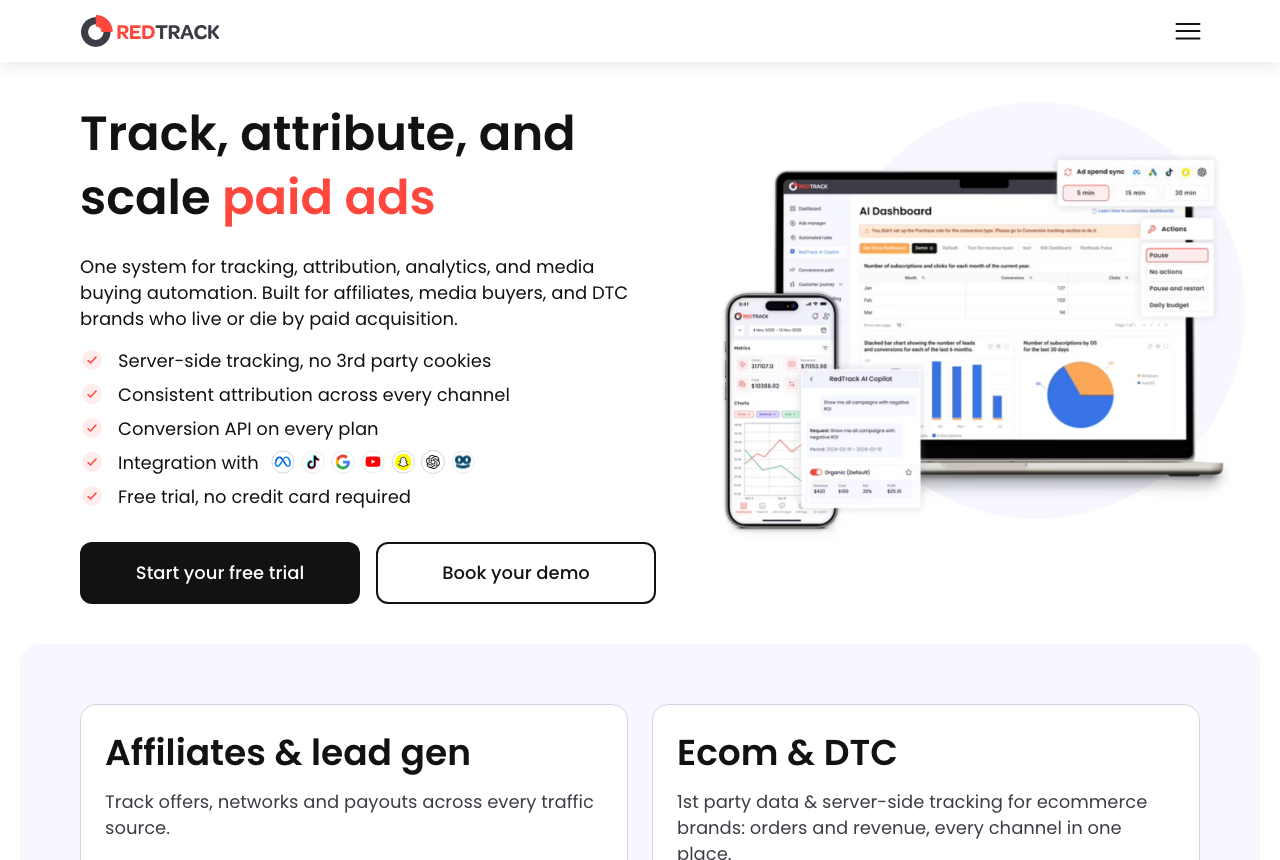
RedTrack answers the problem most media buyers hit first. The browser pixel keeps losing conversions, the ad platform keeps over-reporting ROAS, and you cannot optimize on numbers you do not trust. RedTrack tracks the click deterministically with its own ID, records the conversion on its servers, and pushes it back through CAPI so Meta and TikTok keep learning. Cost is pulled from the ad platforms automatically, so the dashboard shows tracked profit rather than a number you assemble by hand. One account covers affiliate offers, lead-gen forms and ecommerce checkouts, on any domain.
The economics are half the case. The Builder plan is $69 a month billed annually and already includes 2M events and CAPI, the same core job Voluum charges $119 for, and the price is published so you can size it before you talk to anyone. The honest catch is the on-ramp: postbacks, conversion mapping and traffic-source tokens take real time to wire up, and buyers arriving from a pixel-only world underestimate it. The interface is dense and looks dated next to newer dashboards. Budget an afternoon, and know the first numbers will not reconcile until the mapping is right. Once it does, it largely runs itself. Where it strains is the long human-touch funnel: a sale that closes on a call weeks later, off a web checkout, is exactly the path a click tracker has the hardest time closing.
Hyros: attribution built for the long, high-ticket journey
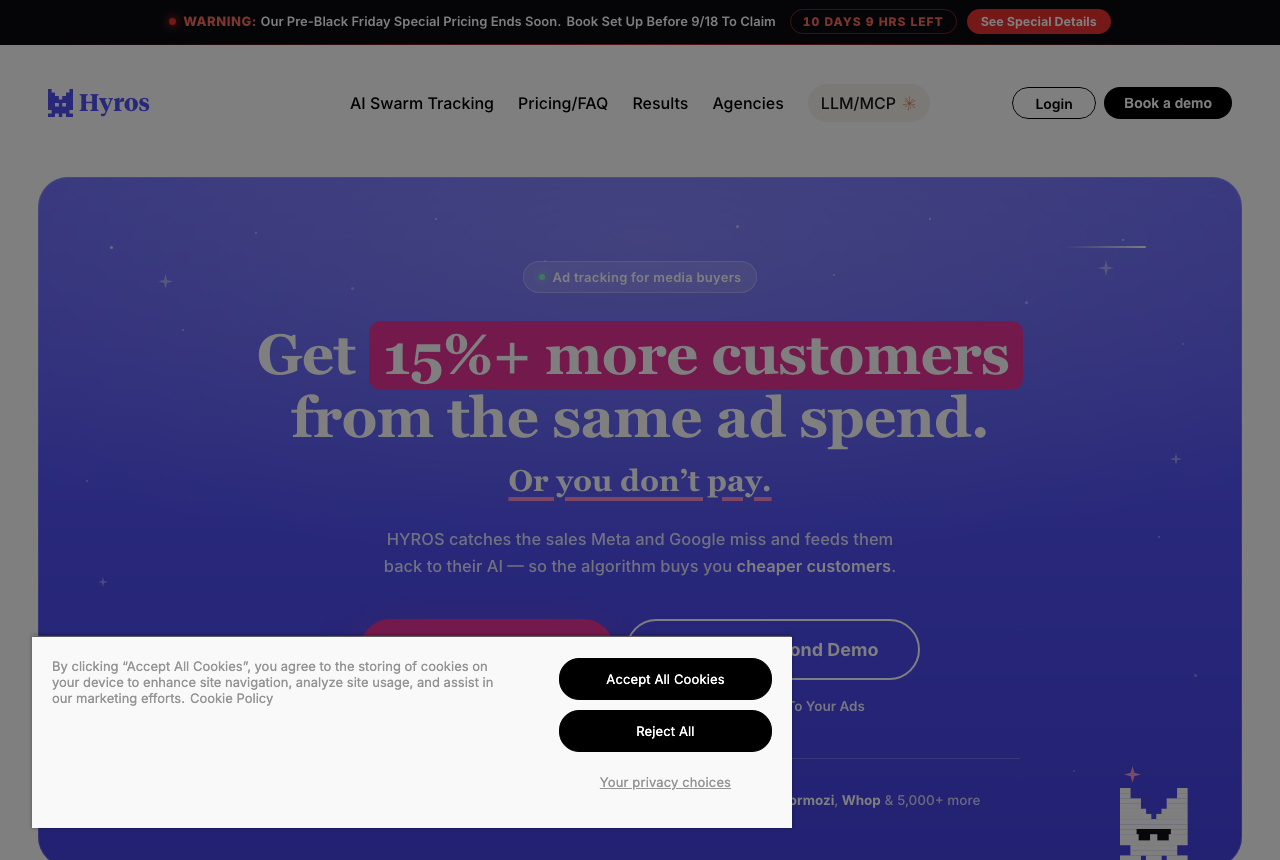
Hyros targets the funnel that does not end at a checkout. If your sale happens after a lead opt-in, an email sequence, a webinar or a sales call, standard pixels lose the thread. Hyros tracks server-side and stitches the journey across payment processors and CRMs, adding call tracking and multi-touch attribution so a lead can be followed from the first ad click to a payment that clears days or weeks later. That is why info-product sellers, coaches and high-ticket advertisers credit it with surfacing revenue Meta and Google never attributed, and it feeds conversions back to the platforms server-side so they keep optimizing on the fuller picture.
Two cautions come with it, and both are real. Pricing is quote-driven and opaque: Hyros does not publish plan prices, so you book a setup or demo call and are quoted a number aimed at higher-spend accounts. And like every tool in this category, Hyros is an attribution model, not the truth. It will diverge from platform reporting, and it is not a cure for post-iOS tracking loss; it is a better-informed estimate, not a receipt. For a simple, low-AOV store with a short buying cycle, that machinery is wasted, and a Shopify-first dashboard is the cheaper, better fit.
Pricing: a published number versus a private quote
The pricing models are as different as the products. RedTrack publishes its plans: $69 a month billed annually for the Builder tier with 2M events and CAPI, climbing through Solo, Team and Enterprise as your events and seats grow, with ad-spend-sync speed and the Ads Manager sold as paid add-ons. You can size the bill yourself before you commit. Hyros publishes nothing. Its cost is quoted after a call and pitched at higher-spend accounts, which is a signal in itself: it is priced for a funnel where a point of attribution accuracy moves five or six figures of ad budget, not for a buyer testing a first offer.
Read both on your real situation. RedTrack is event-based, so a traffic spike can push you into the next tier mid-month. Hyros's quote scales with your spend and the complexity of your setup. Neither number should be trusted from the sticker; verify each against the vendor, and for Hyros expect the conversation before the price.
The decision is funnel length and spend, not features
Line the two up and the fork is clear. If you buy paid traffic to a short funnel that closes on a web checkout you control, and your pain is conversions drifting from the platform's numbers, that is RedTrack, and it does the job from your first dollar at a price you can read off the site. If you sell high-ticket or info products through opt-ins, webinars, email and sales calls, and you are spending enough that missed attribution costs you real money, that is Hyros, and it is built to hold a journey a click tracker drops.
The two are not strictly exclusive. Some high-ticket operations run RedTrack for clean click-level tracking on cold traffic and Hyros for the long-journey attribution, because they answer different questions. If a budget forces one choice, the deciding facts are your funnel length and your monthly spend. Short funnel, or under roughly $50k a month, RedTrack is the practical answer and Hyros is overkill. Long, human-touch funnel above that threshold, Hyros earns its quote. Both reward discipline: RedTrack's numbers do not reconcile until the postbacks and tokens are mapped, and Hyros's model is only as good as the clean CRM and processor data feeding it. No tool rescues messy tracking.
A third path if you host the funnel yourself
There is a third answer worth naming, because neither of these tools builds the funnel whose numbers they report. RedTrack tracks the clicks and Hyros models the journey, but both assume the pages, the checkout and the CRM already live somewhere else and their job is to measure across them. ElasticFunnels is a funnel platform that keeps that middle on one data layer. Its analytics and attribution sit on the same records as the pages and the checkout it hosts: it builds the landing pages, hosts the checkout with order bumps and one-click upsells, runs same-URL split tests, and carries a CRM, automations and a call center on the same timeline, so a click, an order, a rebill and a refund are one record rather than four exports to reconcile. For a seller who runs their own offer end to end, including the calls, and wants the spend-to-sale number to live where the sale happens, that first-party reporting is a real alternative to bolting a tracker onto pages and a CRM hosted elsewhere. It starts with a 14-day free trial and takes no card.
The honest limit is that it is newer than RedTrack or Hyros, and there is very little independent third-party review coverage to check its claims against, so until you run real volume through it you are largely taking the vendor's word for how its attribution holds up. That newness touches the proof, not the feature set: the reporting, the checkout and the split testing are all there to use from day one. And its reporting covers the funnels it hosts, so a buyer measuring traffic that closes on other people's domains, or on a CRM they already run, still needs a dedicated tracker for that part. Keep it on its own line of the decision rather than treating it as a tiebreaker between the two here.
Which one for you
You buy paid traffic to a short funnel and your conversions are drifting from the platform's numbers: RedTrack. Deterministic tracking plus CAPI is the fix, it covers affiliate, lead-gen and ecommerce from one account, and at $69 a month billed annually you can size the bill before you buy.
You sell high-ticket or info products through webinars, email and sales calls: Hyros. Following a lead from the first click to a payment that clears weeks later on your CRM is exactly what it is built for, and above roughly $50k a month in spend that attribution is worth the private quote.
You host your own offer end to end and want the spend and the sale in one place: look at ElasticFunnels alongside them, with the newness caveat above in mind, then add a dedicated tracker later if your traffic ever closes off your own domains.
RedTrack takes our default pick because more of this site's readers buy paid traffic to shorter funnels than run six-figure high-ticket call funnels, so it is the tool the larger group actually needs, and its published price fits a buyer still sizing the problem. That is a statement about who is reading, not a verdict that Hyros is the lesser product. On its own high-ticket, long-journey turf, Hyros is plainly the better fit.
RedTrack
What works
- CAPI and server-side postbacks are built in, so conversions reach Meta and TikTok even after the pixel drops them
- Pulls ad spend from the platforms automatically, so ROI is calculated for you
- Mid-market pricing: 2M events at $69/mo on annual billing undercuts Voluum for the same job
- Handles affiliate, lead-gen and ecommerce tracking from one account
What to watch
- The setup rewards patience. First-time users spend real time wiring postbacks and mapping conversions
- The interface is dense and looks dated next to newer dashboards
- Event-based pricing means a traffic spike can push you into the next tier mid-month
Hyros
What works
- Server-side tracking that follows long journeys through calls, webinars and CRMs
- Finds sales that Meta and Google miss on multi-step funnels
- Integrates with payment processors and CRMs, not just web analytics
What to watch
- Overkill below roughly $50k/mo in ad spend
- Pricing is opaque and quote-driven on the main site
- It is still an attribution model, not truth; expect it to diverge from platform numbers
Pricing
RedTrack: from $69/mo, billed annually. Builder plan $69/mo. Solo $141, Team $333, Enterprise $833; ecom Brand plan from $83. Ad-spend-sync speed and Ads Manager are paid add-ons.
Hyros: from a custom quote. Hyros does not publish plan prices; cost is quoted after a setup/demo call and is aimed at higher-spend accounts.
Pricing verified against each vendor on 2026-09-14. Check before you buy.
Our pick
RedTrack
RedTrack is the pick if you buy paid social or run ecommerce and need server-side conversions flowing back to the platform without stitching three tools together.
Frequently asked questions
RedTrack or Hyros: which should I use?
Which is cheaper, RedTrack or Hyros?
Do RedTrack and Hyros do the same thing?
Which should a high-ticket coaching or webinar funnel use?
Does RedTrack track sales that close on a phone call?
Is Hyros worth it under $50k a month in ad spend?
Sources
Other sources
2 discussions and reviews read for this page. Quotes are excerpts; open a link to read the original in context.

Written by
Dana Rourke
Lead reviewer
Dana Rourke is the lead reviewer at Campaign Buyer. She owns the tracker and attribution coverage: reading what long-term users report about each tool, checking its documentation and pricing, and verifying prices with the vendor before writing the verdict. Keeping the rankings honest mostly means writing down what the top pick gets wrong, so she does that first.
Last checked 2026-09-24