Cloud tracker with pages against first-party CAPImedia buyer software
AdsBridge vs ClickMagick
By Dana Rourke, Lead reviewer. Reviewed by Campaign Buyer Editorial. Updated 27 September 2026.
Quick answer
Pick AdsBridge if you run affiliate or network offers across several traffic sources and want cloud tracking, a landing page builder and split testing bundled into one cheap subscription; pick ClickMagick if you run your own Meta, Google or YouTube traffic and need first-party CAPI that feeds clean conversions back to the ad platforms, a flat bill, and a morning email that names what to scale or cut. For most buyers weighing these two, AdsBridge is the stronger default: it tracks, builds your pages and syncs your ad cost in one cheaper tool. ClickMagick wins the narrower case where you run your own paid traffic and native CAPI is the capability you are buying.
Side by side
| AdsBridge | ClickMagick | |
|---|---|---|
| What it is | Cloud tracker with a page builder | First-party CAPI tracker |
| Best-fit user | Affiliate & network media buyers | Solo own-traffic advertisers |
| CAPI to ad platforms | No native CAPI | Meta, Google, YouTube |
| Landing page builder | Yes, drag-and-drop, built in | No, tracking only |
| Automatic ad-cost sync | Yes | Not native |
| How you optimize | Campaign & split-test reports | Daily Morning Magick email |
| Priced by | Visits, from $29/mo | Tracked visitors, from $79/mo |
| Free trial | 14-day, no refund | 14-day |
| Outside proof | Thin, affiliate blogs | Thin, disputed |
If AdsBridge and ClickMagick are your final two, you have narrowed to two cloud trackers a paid-traffic buyer can run with nothing to install. Both promise conversion numbers you can trust more than the ad account's own ROAS, and both live in a browser rather than on a server you maintain. The split is not hosting. It is who you are and what you run traffic to.
AdsBridge is a tracker for affiliates and network media buyers, and it bundles a landing page builder and split testing into the same subscription. ClickMagick is a first-party tracker for someone running their own Meta, Google or YouTube ads, and its whole reason to exist is feeding a cleaner conversion signal back to those platforms. Once you know which of those two people you are, most of this comparison is already settled.
What each one actually is
AdsBridge has been running since 2013, on AWS, serving buyers in 160-plus countries with more than 100 one-click affiliate-network integrations. You point it at your networks, it stamps every click, catches the conversion through a server-to-server postback, and reports which source, lander and offer made money. What sets it apart from a plain tracker is the drag-and-drop page builder and split testing baked in, so a beginner does not pay for a separate page tool. It starts at $29 a month for 100,000 visits, and every plan carries the full feature set.
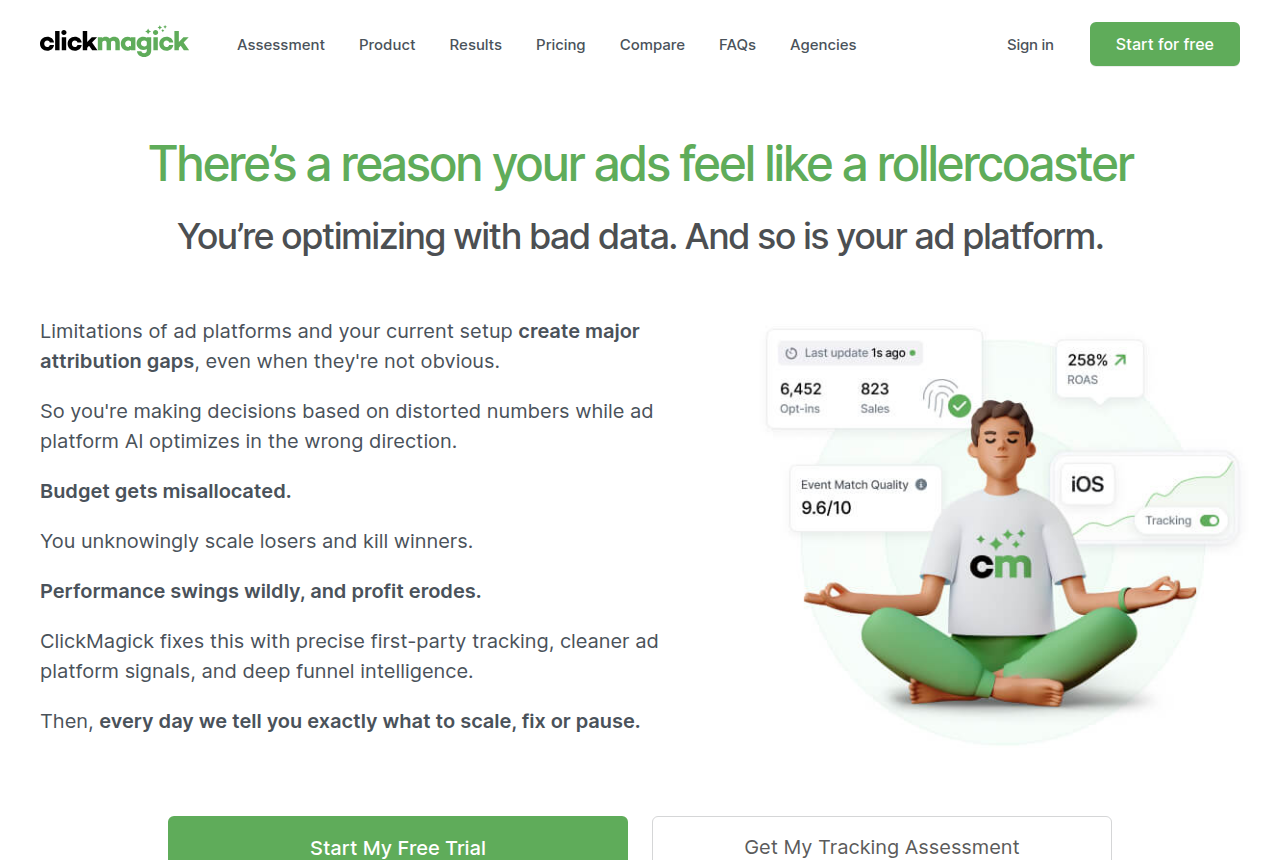
ClickMagick started as a link tracker in 2014 and now sells itself as a first-party attribution layer it calls TrueTracking. The pitch is narrower and sharper: your ad platform grades its own homework and gets it wrong, so you keep a first-party record of what converted and send a cleaner signal back through the conversion API. It tracks your own traffic on a custom domain, ships native CAPI for Meta, Google and YouTube, and every morning emails you a read of your stats that names what to scale, pause or fix. It starts at $79 a month, but Starter tracks only 10,000 visitors before the $199 Standard tier.
The line that decides it: the conversion API
Since iOS privacy changes gutted the browser pixel, the most important thing a tracker does for a paid-social or search buyer is push clean, server-side conversions back into the ad platform so its algorithm optimizes toward real buyers. That is native to ClickMagick. It is not native to AdsBridge, which is built around server-to-server postbacks and, by its own account, is a weak fit for a buyer who needs CAPI events in Meta. If you run your own Meta, Google or TikTok traffic, that gap is the whole decision, and it points at ClickMagick.
If instead you run affiliate or network offers where postbacks are the native currency, the CAPI gap barely matters. Networks speak postback, AdsBridge speaks postback fluently across 100-plus of them, and you get the page builder and split testing in the same bill. For that buyer the decision points the other way.
Where AdsBridge is the better buy
Three things. It is cheaper to start, at $29 against $79. It builds and hosts your landing pages, so an affiliate testing a dozen angles does not pay for a separate page tool or wire a second product into the tracker. And it syncs your ad cost automatically, so profit and ROI land in the report without a manual upload. For an affiliate running network offers across several sources on a budget, that bundle is hard to beat at the price.
The costs are real and worth naming. Redirect speed is the recurring complaint, and it bites hardest on mobile traffic where every hop costs conversions. Reviewers report the dashboard slowing and stability wobbling once daily volume gets extreme. There is no native CAPI. Independent proof is thin, mostly affiliate blogs rather than a deep buyer record. And the 14-day trial is the only free look, with no refund on cancellation, so decide inside the window.
Where ClickMagick is the better buy
ClickMagick fits one person running their own paid traffic who wants accuracy and a nudge rather than a full media desk. First-party TrueTracking on a custom domain plus native CAPI feeds cleaner data back to Meta, Google and YouTube, which users credit for better optimization. The flat, visitor-based bill does not take a cut of your revenue, so a winning campaign does not inflate the invoice. The Morning Magick email that reads your numbers and names what to scale or cut has no direct equal here. And support is the most-praised part of the product in public reviews, with same-day replies and screen recordings.
The catches: Starter tracks only 10,000 visitors, so real volume pushes you to the $199 Standard tier fast, and each extra site adds $40 a month. There is no landing page builder, so you build pages elsewhere. Outside proof is thin and contested, since ClickMagick has no meaningful G2 or Capterra presence and stopped maintaining its Trustpilot page after disputing a batch of reviews. And it is a decision layer, not the final truth: its numbers still need reconciling against the network, GA4 and your backend before you move budget.
Neither one builds the funnel the click lands on
Both tools stop at the edge of the page. AdsBridge builds a landing page; neither hosts the checkout, the upsell or the record of what happened after the sale. If the reason you are shopping is that your pages, your split tests, your checkout and your reporting live in four disconnected tools, a funnel platform is a different answer than a tracker. ElasticFunnels is one: it builds the pages, split-tests variants under one URL so Meta or Google never resets its learning mid-test, hosts the checkout with order bumps and one-click upsells, and keeps the click, the order, the rebill and the refund on a single record, so nobody reconciles four exports to see which angle made money. The honest caveat is that ElasticFunnels is newer than the trackers here and has very little independent third-party review coverage yet, so until you run real volume through it you are largely taking the vendor's word for its claims. That is what you would expect of a platform this new, and it matters less if you use the 14-day free trial, which needs no card, to test it on your own campaigns first. It is a heavier commitment than either tracker and a different category; reach for it when the problem is the whole funnel, not the measurement.
Which one for you
Pick AdsBridge if you run affiliate or network offers, want the page builder and split testing in the bill, and count postbacks rather than CAPI. Pick ClickMagick if you run your own Meta, Google or YouTube traffic, need first-party CAPI and a flat bill, and want a daily read on what to change. Both take a 14-day trial. Run each on your real traffic for two weeks and trust that over any score, because the outside proof on both is thinner than you would like.
AdsBridge
What works
- Tracking, a drag-and-drop landing page builder and split testing come in one subscription, so a beginner does not pay for a separate page tool.
- Cheaper entry than Voluum or RedTrack: $29/mo for 100,000 visits, and every plan carries the full feature set with no features gated to higher tiers.
- Prices by monthly visits rather than events, which is easier to predict than event-based billing when a campaign scales.
- Established since 2013 on AWS infrastructure, with 100-plus one-click network integrations, an anti-fraud filter and a redirectless tracking mode.
What to watch
- Redirect speed is the recurring complaint. A community speed test clocked its redirects slower than several rivals, which matters most on mobile traffic.
- Reviewers report stability flaws once daily volume gets extreme, and the dashboard can feel slow at times.
- No native Meta or Google conversion API. It leans on server-to-server postbacks, so paid-social buyers who want CAPI are better served elsewhere.
- Thin independent proof. Its G2 profile has too few reviews to be useful, so most write-ups are affiliate blogs rather than heavy buyer feedback.
- No permanent free tier, only a 14-day trial, and AdsBridge states it issues no refund on cancellation.
ClickMagick
What works
- Flat monthly price based on the visitors you track, not a cut of your revenue, so the bill does not climb every time a campaign wins.
- First-party TrueTracking with a custom domain and CAPI feeds cleaner conversion data back to Meta, Google and YouTube, which users credit for better ad optimization.
- The Morning Magick email reads your stats each morning and names what to scale, pause or fix, which suits a solo buyer with no analyst.
- Support is the most-praised part in public reviews: fast replies, often the same day, sometimes with screen recordings.
What to watch
- The Starter plan tracks just 10,000 visitors for $79, so anyone buying real volume is pushed to the $199 Standard tier fast.
- Independent proof is thin. There is no meaningful G2 or Capterra presence, and ClickMagick stopped maintaining its Trustpilot page after disputing fake reviews, so you lean on the vendor's own case studies more than you would like.
- It is a decision layer, not the truth. The numbers still need reconciling against the ad network, GA4 and your backend before you move budget.
- Setup rewards patience. Postbacks, cross-domain tracking and CAPI all need wiring, and a botched setup is behind most of the accuracy complaints.
Pricing
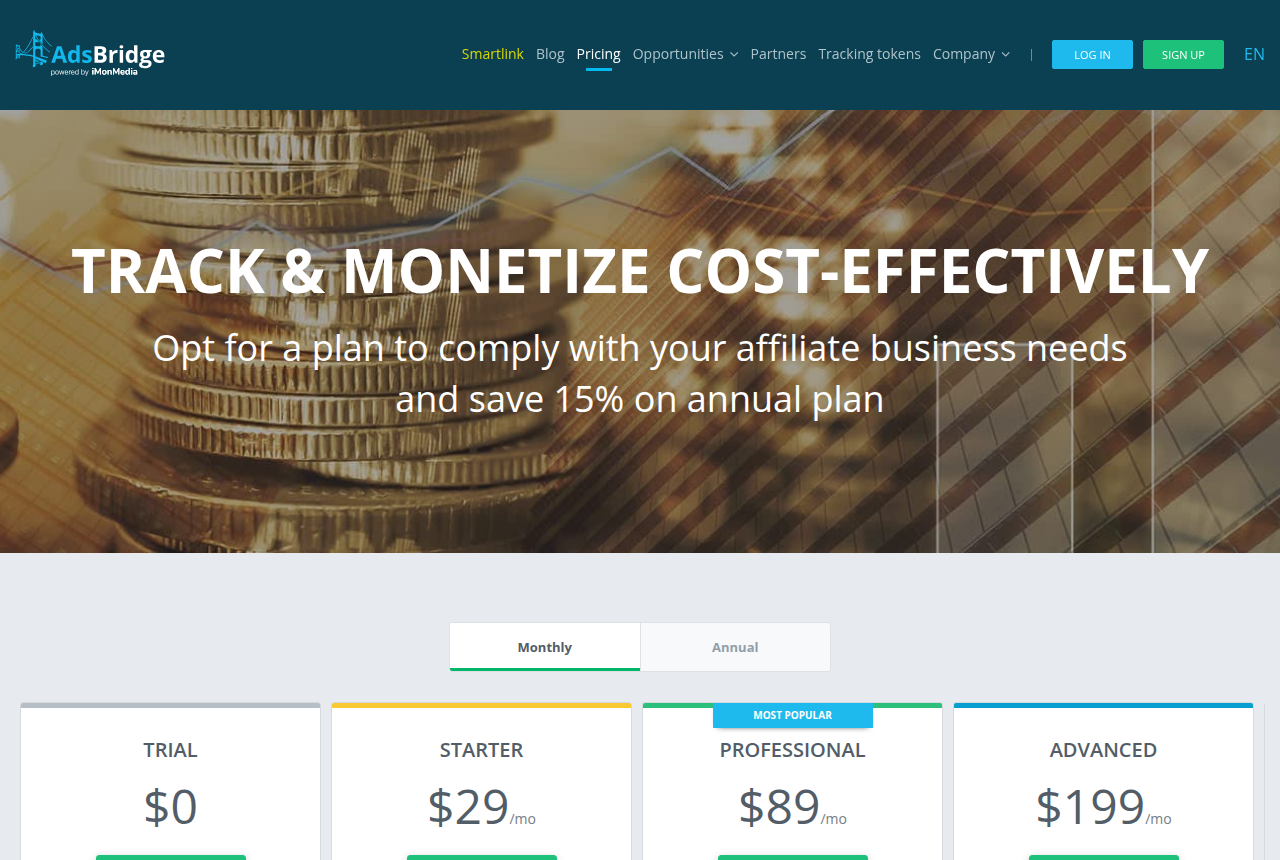
AdsBridge: from $29/mo. AdsBridge prices by monthly visits, not events. Starter is $29/mo for 100,000 visits; Professional, marked most popular, is $89/mo for 3,000,000 visits, then Advanced $199, Business $379, Agency $499 and Enterprise $799 up to 31M visits, with an Exclusive custom tier above 50M. Every plan carries the full feature set, including the landing page builder. Overage is billed per 1,000 visits above the plan limit, from $0.07 on Starter down to $0.029 on Enterprise. Annual billing saves about 15%, and there is a 14-day free trial. AdsBridge states no refund is provided on cancellation.
ClickMagick: from $79/mo, 10K visitors. Starter is $79/mo (10,000 tracked visitors); Standard $199/mo (100,000); Pro $349/mo (1,000,000). Billed yearly it is $66/$166/$291 a month (two months free). Priced on tracked visitors, not a share of revenue. Extra sites/stores are +$40/mo on Standard and Pro.
Pricing verified against each vendor on 2026-09-27. Check before you buy.
Our pick
AdsBridge
AdsBridge is a real, long-running cloud tracker that bundles a landing page builder and split testing for less than Voluum or RedTrack, so it fits an affiliate who wants tracking and pages in one low-cost tool. Skip it if fast redirects at high volume or a native Meta conversion API are what you are paying for, because that is where buyers report it trailing the leaders.
Frequently asked questions
AdsBridge or ClickMagick: which should I use?
Which is cheaper, AdsBridge or ClickMagick?
Does AdsBridge or ClickMagick send conversions to Meta's conversion API?
Which one includes a landing page builder?
Which is better for an affiliate running network offers?
Sources
Other sources
7 discussions and reviews read for this page. Quotes are excerpts; open a link to read the original in context.
- [statsdrone] AdsBridge Review: Overview, Features, Pros & Cons, Pricing
- [statsdrone-features] AdsBridge Review: Overview, Features, Pros & Cons, Pricing
- [affmaven] Real AdsBridge Review 2026: Better Than Voluum?
- [affmaven-opt] Real AdsBridge Review 2026: Better Than Voluum?
- [affiliatefix-speed] Honest redirect speed test
- [affiliatefix-support] AdsBridge reviews
- [g2] AdsBridge Reviews

Written by
Dana Rourke
Lead reviewer
Dana Rourke is the lead reviewer at Campaign Buyer. She owns the tracker and attribution coverage: reading what long-term users report about each tool, checking its documentation and pricing, and verifying prices with the vendor before writing the verdict. Keeping the rankings honest mostly means writing down what the top pick gets wrong, so she does that first.
Last checked 2026-09-27