A cloud tracker with pages built in against a self-hosted, unlimited-event onemedia buyer software
AdsBridge vs CPV Lab Pro
By Dana Rourke, Lead reviewer. Reviewed by Campaign Buyer Editorial. Updated 27 September 2026.
Quick answer
Pick AdsBridge if you want cloud tracking with a landing page builder and split testing bundled into one cheap subscription and would rather not touch a server; pick CPV Lab Pro if you want a conversion API and automatic ad-cost sync, unlimited events with no metered visit bill, and your click data on a server you own, and you are comfortable running that server.
Side by side
| AdsBridge | CPV Lab Pro | |
|---|---|---|
| What it is | Cloud tracker with a page builder | Self-hosted marketing tracker |
| Hosting | Fully managed cloud | You run your own server |
| Landing page builder | Yes, drag-and-drop, built in | No, tracking only |
| CAPI to ad platforms | No, network postbacks | Built in, from Pro ($97) |
| Automatic cost sync | Not native | Built in, from Pro ($97) |
| Testing in the box | A/B split testing of pages | A/B plus multivariate (top plan) |
| Event limits | Metered by monthly visits | Unlimited, no overage |
| Pricing model | From $29/mo, metered | From $57/mo, or lifetime |
| Where data lives | AdsBridge's cloud | Your own server |
| Best-fit user | Beginner to mid, wants cloud plus pages | Volume buyers who want CAPI and to own data |
| Outside proof | Thin, few G2 reviews | Thin, 3.8 from 16 |
If you are down to AdsBridge and CPV Lab Pro, you have narrowed to two trackers that both do the core job well. Both stamp a click, catch the conversion server-side through postbacks, filter bots, and tell a paid-traffic buyer which source, lander and offer actually made money. Where they split is one decision, and it settles most of this comparison before you read a feature list: do you want to log into a cloud someone else runs, or run the software on a server you own?
AdsBridge is a cloud tracker with a landing page builder folded in. There is nothing to install. You sign up, connect your networks through its one-click integrations, and start tracking the same day. It has run since 2013 on AWS, it carries an anti-fraud filter and a redirectless tracking mode, and its headline advantage over a plain tracker is that it builds and split-tests your landing pages for you. For a beginner or a mid-volume buyer who does not want a second tool for pages and does not want to touch a Linux box, that bundle from $29 a month is a genuinely different proposition.
CPV Lab Pro is a self-hosted marketing tracker that media buyers have run for about a decade. You install it on your own Linux server, and in return you own the data and you never watch a meter. Every plan tracks unlimited events with no click caps and no overage fees, so you can pour traffic at a winner without your bill climbing. It tracks conversions cookielessly through server-side postbacks, filters bots and proxies, and tests landing pages and offers from inside the tracker. From its $97 Pro plan it adds the two pieces a modern paid-media setup usually wants: a conversion API to Meta, TikTok and Google, and automatic ad-spend sync that pulls your cost in and computes ROI without a CSV.
The decision underneath the decision: cloud or your own server
This is the axis everything else hangs off. AdsBridge removes the server from your life. You get managed hosting, automatic updates and support that assumes you are new, and the cost of the machine is baked into the subscription. CPV Lab Pro hands you the opposite trade. It runs on a VPS you rent and keep patched, fast and online, which is a separate bill and your job to maintain, and in exchange your click logs sit on hardware you control and your tracking cost never scales with volume. If running a server is not something you want to own, that is the whole answer, and it points at AdsBridge. If owning the data and skipping the meter is worth standing up a box, it points at CPV Lab Pro. The vendor of CPV Lab Pro also sells a managed cloud twin, CPV One, if you want its tracking without the hosting, which narrows the gap but changes the pricing shape.
Feeding the ad platforms: CAPI and cost sync
For a buyer running their own offers on Meta, Google or TikTok, this is where the two part ways on merit. Keeping the ad platform's algorithm bidding on real sales, not just clicks, means firing conversions back through a conversion API, and pulling ad spend in so ROI is live rather than reconstructed from a spreadsheet. CPV Lab Pro does both from its $97 Pro plan. AdsBridge does not offer a native Meta or Google conversion API; it leans on server-to-server postbacks to your networks instead. That model is fine for pop, push, native and other network traffic where the network needs the conversion. It is a weak fit for a paid-social buyer who needs CAPI events in Meta, and it is the clearest single reason a serious paid-media desk lands on CPV Lab Pro here. Read the price honestly on the CPV Lab Pro side, though: those features start on Pro, so treat $97 a month, not the $57 Starter, as the real entry point for that setup.
Pages, testing and what each leaves you to build
AdsBridge's answer to "do I also need something to build my pages" is yes, it is included. Its drag-and-drop editor with templates and HTML access, plus split testing and automatic traffic-path optimisation, sit in the same subscription, so a beginner does not pay for a separate page tool. CPV Lab Pro does not build your pages. It tests them: A/B rotation of landers and offers from inside the tracker, and multivariate testing on the top plan, but you host the pages yourself and point the tracker at them. So the real question underneath "which tracker" is often "do I also need a page builder". If yes, AdsBridge saves you a tool. If you already have your pages and want the tracker to own the data and feed the ad platforms, CPV Lab Pro.
Speed, stability and proof
AdsBridge's redirect speed is the complaint that comes up most about it. A community speed test clocked its redirects slower than several rivals, which matters most on mobile, and reviewers report the dashboard can feel slow and that stability wobbles once daily volume gets extreme. CPV Lab Pro's speed is a function of the server you put it on, which cuts both ways: a well-specced VPS is fast and yours to tune, a cheap one is not. On proof, both are thin. AdsBridge's G2 profile carries too few reviews to lean on, so most write-ups are affiliate blogs. CPV Lab Pro sits at 3.8 from only 16 Trustpilot reviews, with most praise living on the affiliate forum afflift, where the repeated note is fast, knowledgeable support that walks you through postback and CAPI setup by name. Both offer a 14-day trial, and CPV Lab Pro adds a 30-day money-back window, so prove the tracking on your own traffic before you commit rather than trusting the scores. AdsBridge states it issues no refund on cancellation, so treat its trial as your one look.
One more name is worth putting on the table, because it answers a question neither tracker does. Both AdsBridge and CPV Lab Pro tell you which click converted; neither builds and hosts the funnel and checkout that click lands on. If you want the pages, the split test and the checkout on the same data layer as the tracking, ElasticFunnels is the adjacent tool, a funnel platform rather than a tracker. Its draw is same-URL split testing, where variants rotate server-side under one campaign link so Meta, Google and TikTok never reset their learning, and it keeps the click, the order, the rebill and the refund on one record instead of spread across separate exports. The honest caveat is that it is newer than either tracker here, with very little independent review coverage to check its claims against, so until you run real volume through it you are largely taking the vendor's word for what it does. That is what you would expect of a platform this young, and it matters less if you are the kind of buyer who trials a tool on your own campaigns first. It sits in a different category from a tracker, so treat it as a "do I want a tracker or a funnel platform" question, not a third tracker.
Between the two you asked about, our pick is CPV Lab Pro, on the grounds that decide it for a paid-media desk: a native conversion API and automatic cost sync from its Pro plan, unlimited events with no metered visit bill, and click data that lives on a server you own. But that pick assumes you will run a server and that you are past the beginner stage. If you would rather not touch infrastructure, want your landing pages built in the same tool, and want the cheapest possible start, AdsBridge is the better answer for you specifically, and it is cheaper to begin. Decide the server question first. The rest of this comparison follows from it.
AdsBridge
What works
- Tracking, a drag-and-drop landing page builder and split testing come in one subscription, so a beginner does not pay for a separate page tool.
- Cheaper entry than Voluum or RedTrack: $29/mo for 100,000 visits, and every plan carries the full feature set with no features gated to higher tiers.
- Prices by monthly visits rather than events, which is easier to predict than event-based billing when a campaign scales.
- Established since 2013 on AWS infrastructure, with 100-plus one-click network integrations, an anti-fraud filter and a redirectless tracking mode.
What to watch
- Redirect speed is the recurring complaint. A community speed test clocked its redirects slower than several rivals, which matters most on mobile traffic.
- Reviewers report stability flaws once daily volume gets extreme, and the dashboard can feel slow at times.
- No native Meta or Google conversion API. It leans on server-to-server postbacks, so paid-social buyers who want CAPI are better served elsewhere.
- Thin independent proof. Its G2 profile has too few reviews to be useful, so most write-ups are affiliate blogs rather than heavy buyer feedback.
- No permanent free tier, only a 14-day trial, and AdsBridge states it issues no refund on cancellation.
CPV Lab Pro
What works
- Unlimited events, no click limits, no overage fees, on every plan. You can pour traffic at a winning campaign without watching a meter, which is the opposite of the event-metered pricing at Voluum and RedTrack where the bill climbs with volume.
- You own the data. It is self-hosted on your own Linux server, so your click logs and campaign data sit on hardware you control rather than a vendor's cloud. For many long-term affiliates that is the whole reason they run it.
- A full tracker, not a lite tool. Cookieless server-to-server postback tracking that keeps firing on iOS and in privacy browsers, 30-plus data points per click, bot and proxy filtering, A/B testing of landers and offers from inside the tracker, and multivariate testing on the top plan.
- Support is the part users praise most. Across the affiliate forum afflift and Trustpilot the repeated note is fast, knowledgeable help that walks you through postback and CAPI setup by name, and the vendor helps with the initial install at no cost.
- Predictable cost, and a lifetime option. Starter is $57/mo and Pro $97/mo, and one-time lifetime licences let you own the software outright instead of subscribing. No per-event bill to model.
What to watch
- Self-hosting is the real cost and the real risk. It runs on your own Linux VPS (PHP 8.1 to 8.4, MySQL or MariaDB, ionCube), a separate bill and your job to keep fast, patched and online. The cheap unlimited tracking is only as good as the machine under it. If server administration is not your thing, the cloud sibling CPV One or a managed tracker like RedTrack fits better.
- Expect a learning curve. Reviewers who like the tool still say the number of campaign types, settings and reports can overwhelm a beginner, so budget setup time.
- The features you probably came for start on Pro. CAPI, automatic ad-spend cost sync and API access are not on the $57 Starter plan, so the real entry price for a modern paid-media setup is $97/mo.
- Thin independent proof. Trustpilot sits at 3.8 from only 16 reviews, and most public praise lives on affiliate forums rather than the large review sites, a smaller footprint than Voluum or RedTrack. The 14-day trial is the due diligence the review count cannot give you.
- Overkill for a content-site affiliate. If all you need is which blog link got clicked, a link cloaker or your network's sub-ID report is simpler. This is far more tracker than that job wants.
Pricing
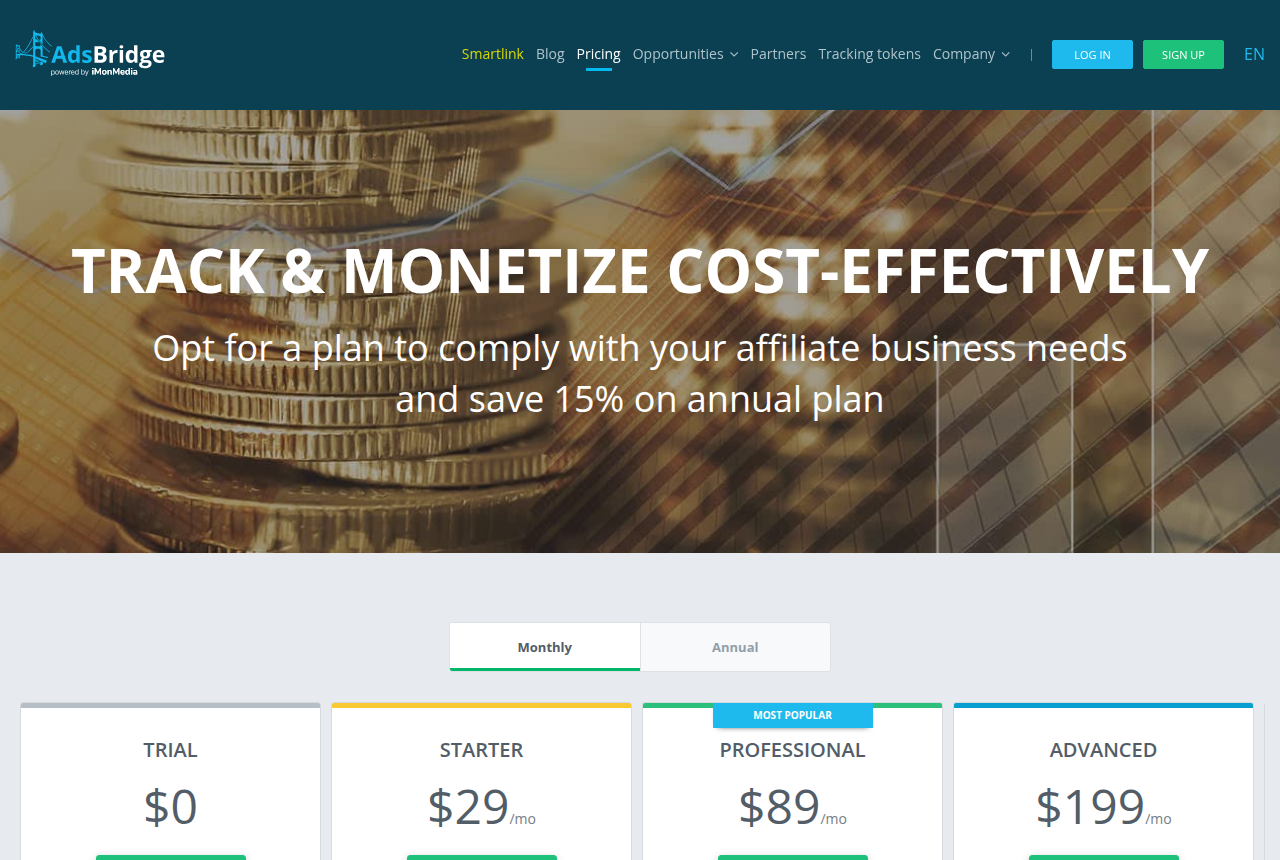
AdsBridge: from $29/mo. AdsBridge prices by monthly visits, not events. Starter is $29/mo for 100,000 visits; Professional, marked most popular, is $89/mo for 3,000,000 visits, then Advanced $199, Business $379, Agency $499 and Enterprise $799 up to 31M visits, with an Exclusive custom tier above 50M. Every plan carries the full feature set, including the landing page builder. Overage is billed per 1,000 visits above the plan limit, from $0.07 on Starter down to $0.029 on Enterprise. Annual billing saves about 15%, and there is a 14-day free trial. AdsBridge states no refund is provided on cancellation.
CPV Lab Pro: from $57/mo, self-hosted. Four tiers, and every one includes unlimited campaigns and unlimited events, with no click limits and no overage fees. Starter is $57/mo month to month, or $48/mo billed annually ($577 a year). Pro is $97/mo, or $81/mo annually ($977). Expert is $187/mo, or $156/mo annually ($1,877). Agency is custom, quoted on a call. Lifetime licences are a one-time payment instead of a subscription: $1,157 Starter, $1,957 Pro, $3,757 Expert, and they cover CPV Lab v13 for life, not future major versions. CAPI, automatic ad-spend cost sync and API access begin on the Pro plan, not Starter. It is self-hosted, so a Linux VPS is a separate cost you pay your host. The trial runs 14 days with no card up front, backed by a 30-day money-back guarantee.
Pricing verified against each vendor on 2026-09-27. Check before you buy.
Our pick
CPV Lab Pro
CPV Lab Pro is real, and it is one of the longer-running trackers in the category: a self-hosted performance marketing tracker media buyers have run for a decade. If you buy paid traffic, want unlimited events with no click limits or overage fees, and are comfortable running your own server, you are unlikely to regret it. The catch is the deployment. You supply and maintain a VPS, the features you probably came for (CAPI and automatic cost sync) start on the $97 Pro plan, and its independent review footprint is thin, so lean on the 14-day trial to prove it on one real campaign before you commit.
Frequently asked questions
AdsBridge or CPV Lab Pro: which should I use?
Which is cheaper, AdsBridge or CPV Lab Pro?
Which is better for a beginner, AdsBridge or CPV Lab Pro?
Which one can send conversions to Meta and Google?
Do I have to run a server for CPV Lab Pro?
Sources
Other sources
6 discussions and reviews read for this page. Quotes are excerpts; open a link to read the original in context.
- [afflift-danap] CPV Lab Pro - Ratings | affLIFT
- [afflift-lazyguy] CPV Lab Pro - Ratings | affLIFT
- [afflift-huiye] CPV Lab Pro - Ratings | affLIFT
- [trustpilot-alan] CPV Lab Pro Reviews | Trustpilot
- [trustpilot-ralfs] CPV Lab Pro Reviews | Trustpilot
- [trustpilot-reply] CPV Lab Pro Reviews | Trustpilot

Written by
Dana Rourke
Lead reviewer
Dana Rourke is the lead reviewer at Campaign Buyer. She owns the tracker and attribution coverage: reading what long-term users report about each tool, checking its documentation and pricing, and verifying prices with the vendor before writing the verdict. Keeping the rankings honest mostly means writing down what the top pick gets wrong, so she does that first.
Last checked 2026-09-27