Swipe tool vs ad librarymedia buyer software
Foreplay vs BigSpy
By Dana Rourke, Lead reviewer. Reviewed by Campaign Buyer Editorial. Updated 28 September 2026.
Quick answer
Pick Foreplay if you run a creative team producing Meta and TikTok ads and need to save competitor ads into organized swipe files and turn them into briefs your designers build from; pick BigSpy if you want the cheapest, widest ad library across many channels for creative inspiration and can treat its metrics as directional and set a reminder before the renewal.
Side by side
| Foreplay | BigSpy | |
|---|---|---|
| What it is | Creative swipe and brief tool | Cheap, broad ad library |
| Ad platforms | Meta, TikTok, LinkedIn, YouTube | Up to 11 channels |
| Best at | Organizing ads into briefs | Creative inspiration |
| Swipe files and briefs | Yes, its main draw | Save boards only |
| Competitor tracking | Yes, via Spyder | Basic |
| Free entry | 7-day trial | Free plan |
| Entry price | $59/mo; $175 Workflow | $69/mo, FB and IG only |
Foreplay and BigSpy both point you at other people's ads, so a buyer down to these two often assumes it is one product against another at two prices. It is not. One is a system you save into and produce from. The other is a library you scroll for ideas. Foreplay is built for a creative team that needs to turn competitor research into briefs. BigSpy is the cheap, wide option for a buyer who just wants to see a lot of what is running. The decision is less about which is better in the abstract and more about what you are actually trying to do.
The one question that decides it: do you have a creative team to feed?
If you run creative, with a designer or an editor turning out ads every week, Foreplay is built for your workflow. You save competitor ads into organized boards, track the advertisers you care about over time, and hand your designers briefs built from real references instead of a Slack link and a vague note. That production loop is the whole point of the tool, and it is what the price buys.
If you are one person hunting for hooks and formats on a budget, that machinery is overhead you will not use. BigSpy gives you a huge, cross-platform library for less than a streaming bundle, with a free plan to start. You are not briefing anyone. You want to see what is running, grab the good bits, and move on. For that job, the cheaper and wider tool is the sensible buy.
What Foreplay is built to do
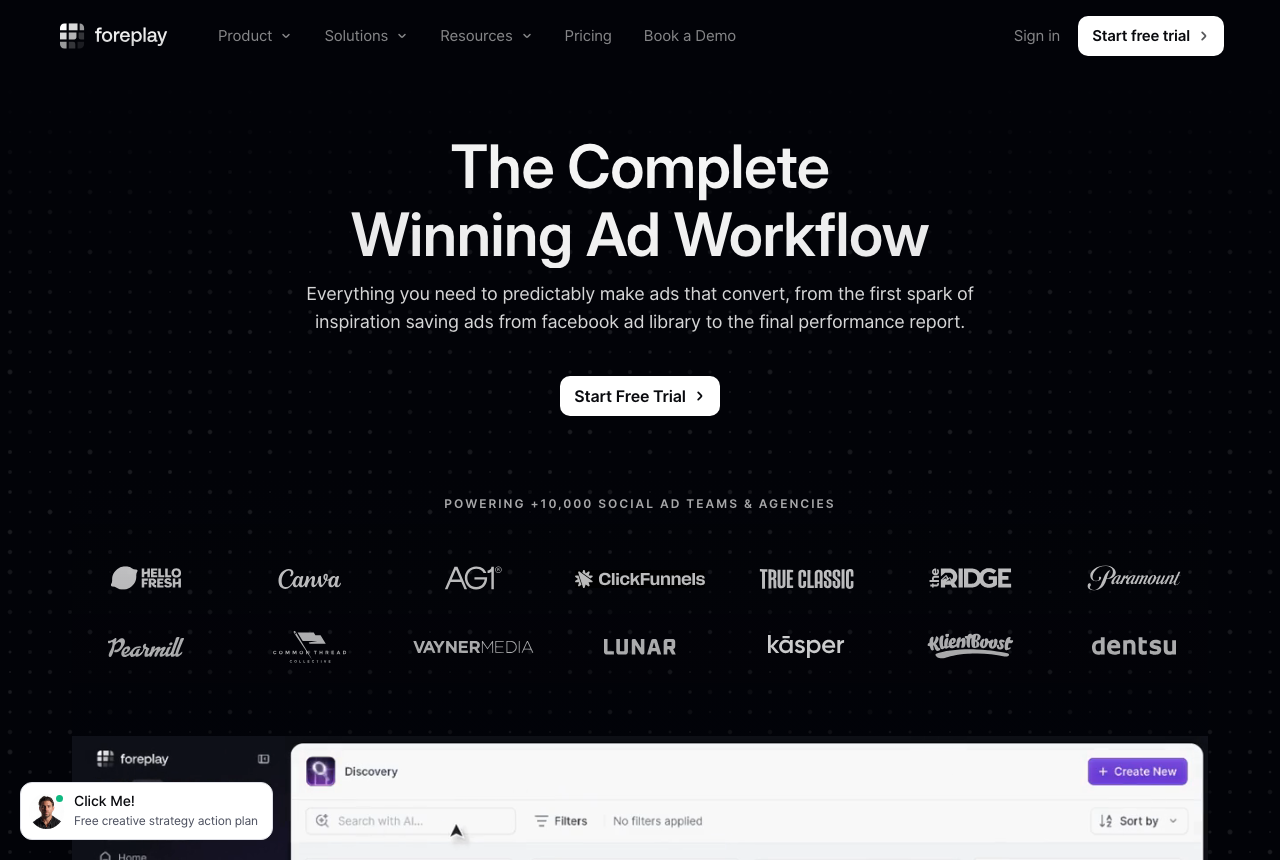
Foreplay is a creative operations tool. It pulls ads from Meta, TikTok, Instagram, LinkedIn, YouTube Shorts and Google's Transparency Center into one searchable library, then lets you save them into swipe files, tag them, and sort them by angle or campaign. Its Spyder feature watches specific competitors so their new ads land in your board on their own, rather than needing you to go looking. Briefs are the part teams actually pay for: you turn a saved ad into a production-ready reference a designer can build from, with the hook, the format and the notes attached.
DTC teams rate it for the organization, not just the discovery. It carries a 4.8 out of 5 across 127 G2 reviews, unusually strong for this category. The catch is value at the entry tier. The Basic plan is a lighter saved-ads library; the competitor tracking and team briefing most buyers come for sit on the $175 a month Workflow tier, and extra seats bill per user, so the real cost climbs with the size of your team. It is worth the money once more than one person is building creative, and hard to justify if you are working alone.
What BigSpy is built to do
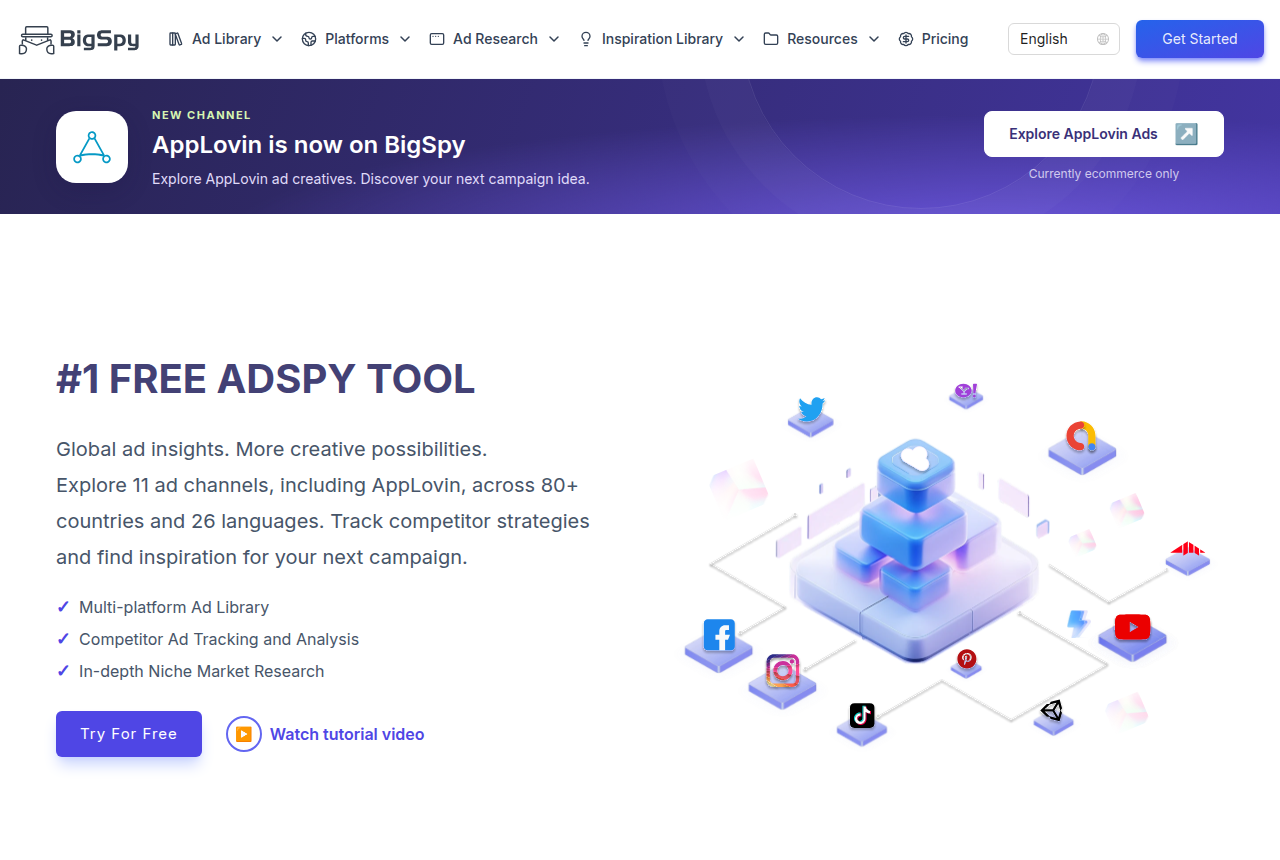
BigSpy is a cross-platform ad library. It has cataloged more than a billion creatives since 2018 and advertises coverage across as many as 11 ad channels, from Facebook and TikTok to YouTube, Pinterest and in-app networks like AppLovin. Its draw is breadth and price: a genuine free plan to start, and a $69 a month entry tier, which makes it the cheapest way to get a wide window on what is running.
Two things temper that. The breadth is tiered, so the advertised number is not the number you get at the entry price. The $69 Starter plan is Facebook, Instagram and AppLovin only, TikTok starts at $159, and the full 11-channel coverage needs the $499 Ultimate plan. And the data is directional. Buyers report impression figures that repeat suspiciously across different ads, so BigSpy is good for finding hooks and formats but is not proof that a given ad is scaling. The interface also feels dated and search is hit or miss, so you sort through low-quality results to reach the good ones.
Where they overlap, and where they don't
Both watch paid social, and both will show you Meta and TikTok creative, so on pure discovery they genuinely overlap. Past that they diverge. Foreplay keeps and produces: swipe files, competitor tracking, briefs, a team workflow. BigSpy discovers wide and cheap: more channels, a free tier, no production layer beyond a save board. Neither indexes native or push networks like Taboola, Outbrain or MGID, so a buyer running that traffic needs a native specialist such as Anstrex instead.
The other real difference is what you can trust. Foreplay does not report scale metrics, so there is nothing to distrust; it is a swipe tool. BigSpy does put numbers on ads, and those are the numbers to treat with care. If your reason for buying is hard competitive proof, neither is the right shape of tool, and a Meta-focused research archive like AdSpy is closer to what you want.
What neither tool does
Both tools stop at the ad. They help you find or organize the creative, but the page the click lands on and the checkout behind it are still your problem. If that is where your time goes, a funnel platform like ElasticFunnels covers the other half. It builds the pages, with an AI page builder that generates a landing page from a prompt or clones one from a URL, hosts the checkout, and reports ad spend against conversions on one timeline, so you can see which angle actually made money rather than only which one got saved. Its plans run $97 to $497 a month, every feature on every plan, with a 14-day trial and no card required. It is newer than most tools a media buyer runs, and there is very little independent third-party review coverage to check its claims against, so until you push real volume through it you are largely taking the vendor's word for it, which is what you would expect of a platform this young. The trial is the honest way around that: build a page or two and test it on your own traffic before you commit.
Which should you pick?
Pick Foreplay if you run a creative team and the bottleneck is producing a steady stream of ads. The swipe files, competitor tracking and briefs earn the Workflow price once more than one person is building creative, and the quality of the tool shows in how DTC teams talk about it. It is the better tool if you will use the production layer.
Pick BigSpy if you are a solo buyer or a small team who wants the widest, cheapest view of what is running, and you are comfortable treating its metrics as directional. Start on the free plan, confirm the channels you need are on the tier you are buying, and set a calendar reminder before the renewal, because auto-renewal and a 24-hour refund window are its loudest complaint. It is the better buy if you only want the library.
They are not really substitutes. Foreplay produces creative; BigSpy finds it. Match the tool to which half of that job is actually slowing you down.
Foreplay
What works
- Saves and organizes competitor ads from every major ad library
- Briefs and Spyder turn inspiration into production-ready references
- A 4.8/5 rating across 127 G2 reviews, strong for the category
What to watch
- Not a native ad spy tool in the Taboola or Outbrain sense
- Best value only at the $175/mo Workflow tier, not Basic
- Per-user pricing on extra seats
BigSpy
What works
- A genuine free plan and a $69 entry price make it the cheapest way to get a wide ad library.
- Covers 11 ad channels, from Facebook and TikTok to YouTube, Pinterest and in-app networks like AppLovin.
- More than a billion creatives cataloged since 2018, deep enough to build real swipe files across platforms.
- Fast for finding hooks, angles and creative formats that single-network tools miss.
What to watch
- The 11-channel coverage it advertises needs the $499 Ultimate plan. Starter at $69 is Facebook, Instagram and AppLovin only, and TikTok starts at $159.
- Users report impression numbers that repeat suspiciously, so treat the data as directional, not proof of a winner.
- Search is hit or miss and the interface feels dated, so you sort through low-quality results to find the good ones.
- Billing is the loudest complaint. It auto-renews, refunds are limited to the first 24 hours, and there is no refund on cancellation.
Pricing
Foreplay: from $59/mo. Basic at $59, Workflow at $175 and Agency at $459 a month (annual $49/$149/$389). Additional seats cost $20. Covers Meta, TikTok, Instagram, LinkedIn, YouTube Shorts and Google's Transparency Center.
BigSpy: from $69/mo. Free plan (5 searches/day, 20 downloads/day, no card). Paid: Starter $69/mo (Facebook, Instagram, AppLovin only), Growth $159/mo (adds TikTok, Twitter, Pangle, Google, YouTube), Scale $399/mo (5 seats), Ultimate $499/mo (all 11 channels incl. Pinterest, Yahoo, Unity). Annual 20-30% off. Auto-renews; no downgrade without cancelling first. Pays via card or Alipay.
Pricing verified against each vendor on 2026-09-08. Check before you buy.
Our pick
Foreplay
Foreplay is the pick if you are a DTC creative team that needs to turn competitor research into swipe files and briefs your designers can use.
Frequently asked questions
Foreplay or BigSpy: which should I use?
Which is cheaper, Foreplay or BigSpy?
Do Foreplay and BigSpy do the same thing?
Is BigSpy's data accurate?
Which is better for building swipe files and briefs?
Is there a free trial for Foreplay or BigSpy?
Sources
Other sources
2 discussions and reviews read for this page. Quotes are excerpts; open a link to read the original in context.

Written by
Dana Rourke
Lead reviewer
Dana Rourke is the lead reviewer at Campaign Buyer. She owns the tracker and attribution coverage: reading what long-term users report about each tool, checking its documentation and pricing, and verifying prices with the vendor before writing the verdict. Keeping the rankings honest mostly means writing down what the top pick gets wrong, so she does that first.
Last checked 2026-09-28