The page vs the whole suitemedia buyer software
Leadpages vs Systeme.io
By Dana Rourke, Lead reviewer. Reviewed by Campaign Buyer Editorial. Updated 1 October 2026.
Quick answer
Pick Leadpages if you buy paid traffic and your main lever is a fast, uncapped landing page with real on-page optimization, A/B testing, Smart Traffic routing and dynamic text, while your email, CRM and checkout already live somewhere else; pick Systeme.io if you are a beginner or solo creator who wants funnels, email, a course and your own affiliate program in one cheap login you can run free until the sales justify paying.
Side by side
| Leadpages | Systeme.io | |
|---|---|---|
| What it is | Landing pages + CRO | One-login funnel suite |
| Best for | Paid-traffic pages | Budget beginners |
| Entry price | $67/mo | Free, then $17 |
| Landing pages | Templates, fast editor | Basic templates |
| A/B testing | Manual + Smart Traffic | Basic, per URL |
| Lead capture | Forms, pop-ups, bars | Forms in funnels |
| Email marketing | None, hands off | Unlimited sends |
| Courses | None | Included, free plan |
| Checkout | Basic Stripe embed | Bumps + 1-click upsells |
| Affiliate program | None | Built in |
| Traffic limits | None, unlimited | Contact limits by plan |
| Track record | 14 yrs | 500k+ users |
The question that actually decides it
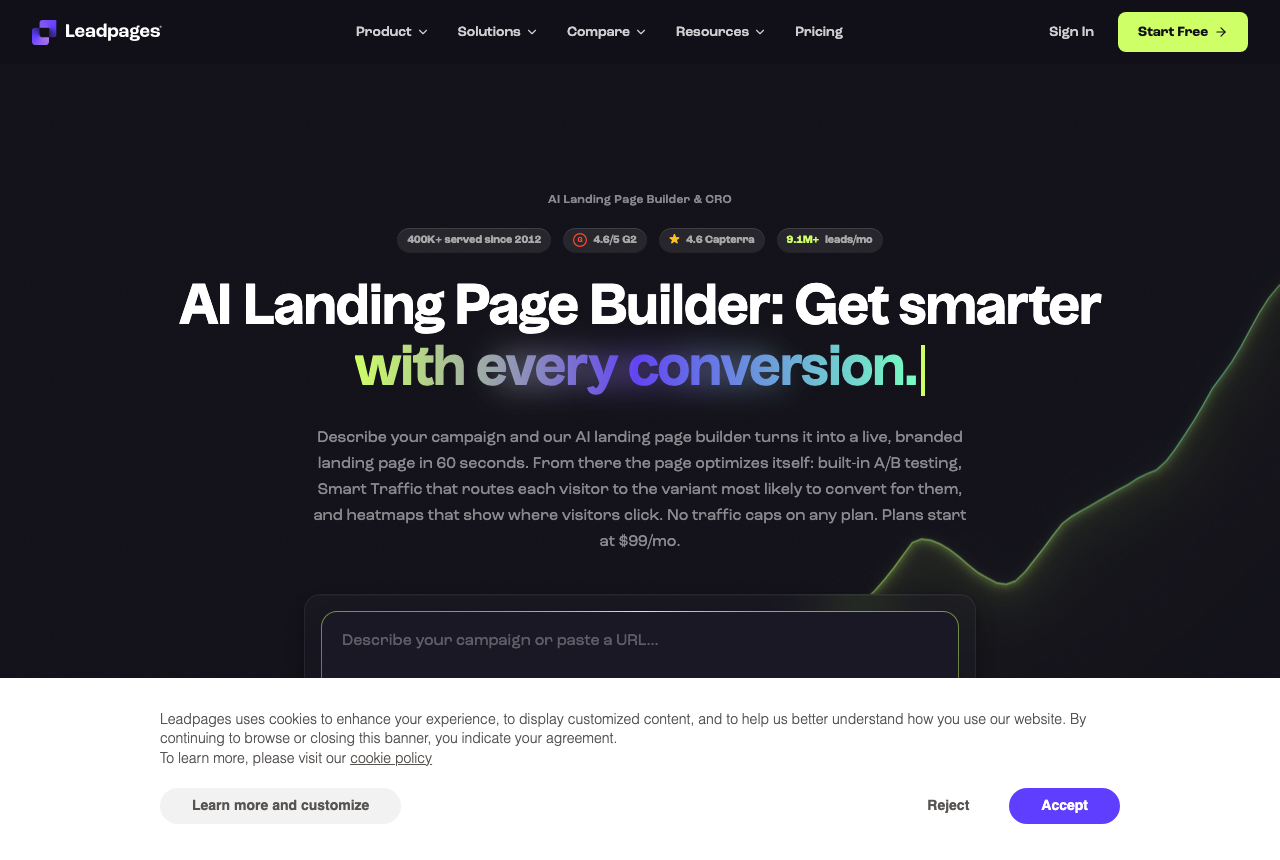
If you are down to Leadpages and Systeme.io, the first thing to say is that they are not the same shape of tool, even though both put a page in front of a visitor. Leadpages builds and hosts landing pages and captures leads, and it wraps a strong page-optimization layer around that: A/B testing, AI visitor routing and dynamic text. Systeme.io is a one-login suite that runs a whole small business: funnels, email, courses, communities, a checkout and your own affiliate program, from a free plan up.
So the choice is not feature against feature, because on paper their lists overlap. It comes down to one question: do you need the single best page and on-page testing for traffic you buy, with your email and CRM already living elsewhere, or do you need one cheap account that runs the funnel, the email and the course end to end, even if each part is only good enough? Answer that and the rest of this page is detail.
Leadpages: the page and the optimization layer
Leadpages is a hosted landing page builder aimed at lead generation and conversion. Its strength is capture and testing: forms, pop-ups, alert bars and lead-magnet delivery, a large template library, and a simple editor a non-technical marketer can get live in an afternoon. Pages are unlimited, and there are no visitor caps or overage fees at any tier, so a page that suddenly takes off never triggers a surprise bill.
The part that matters for paid traffic is the CRO layer, and Leadpages rebuilt it. Manual A/B testing and dynamic text replacement, which matches the page headline to the ad that sent the click, are included from the $67 Grow plan up rather than gated behind a $149-plus tier. Smart Traffic, its AI routing that sends each visitor to the variant most likely to convert, and click and scroll heatmaps sit on the $135 Optimize plan. For a media buyer whose gains come from message match and a faster page, that is the toolkit that moves the number.
What Leadpages does not do is everything after the page. There is no CRM, no native email or SMS sending, no automations and no course hosting. Its checkout is a basic Stripe embed, enough to sell one product, not a funnel cart with order bumps and one-click upsells. Its analytics stop at the page. The recurring gripes in user threads are older price jumps against a WordPress page builder, fewer deep controls than a specialist like Unbounce, and support quality. It is a focused tool, and it hands the lead to whatever you use to nurture and sell.
Systeme.io: the one that costs nothing to start
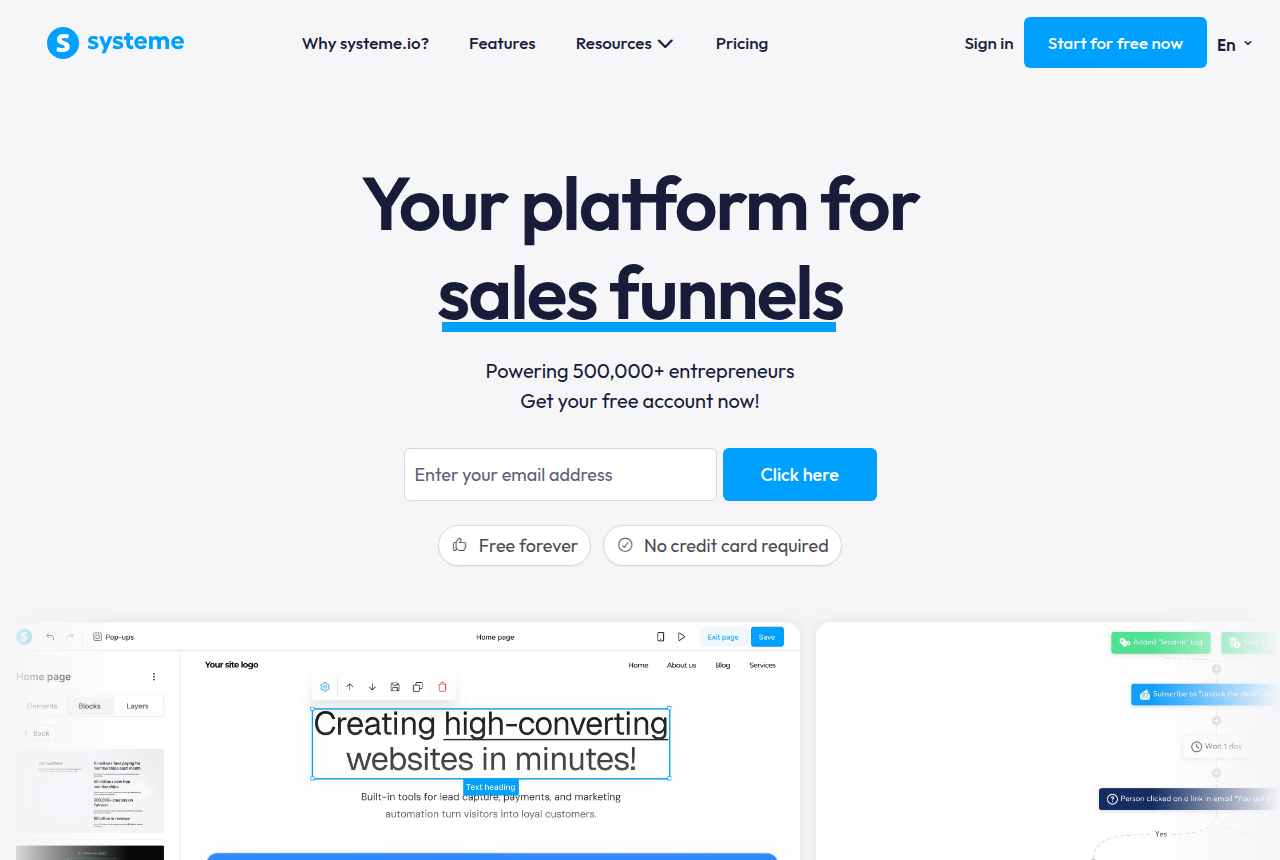
Systeme.io covers far more ground for far less money, aimed at a different reader. Funnels, email marketing with unlimited sends, a website and blog, courses, communities, a booking calendar, a checkout with order bumps and one-click upsells, and your own affiliate program all run from one login. The company says more than 500,000 people use it, so this is an established product, not a launch-week gamble.
Its real advantage is the free plan, and it is not a teaser. You get up to 2,000 contacts, three sales funnels, a course, a blog and an affiliate program, with no credit card and no expiry. You can build a working funnel and take sales on it before paying anything. When you do pay, plans run $17 for Startup, $47 for Webinar and $97 for unlimited contacts, and every tier takes 0% on top of your Stripe or PayPal fees. Notice that its checkout is actually the more capable of the two here: order bumps and one-click upsells come standard, which Leadpages does not match.
The ceiling is design and depth, not trust. The page builder and templates are basic. They are fine for a clean, simple funnel and restrictive if you want pixel-level control or a high-end brand look. One long-term user put it as "okay, but branding always felt slightly off for higher end offers". The same holds for automation: sellers who leave tend to hit a wall on conditional email logic or deeper checkout customization. Its A/B tests split visitors across separate URLs like most builders, so it is not built to protect an ad platform's learning through a test. And weight the online praise carefully, because Systeme.io runs a strong affiliate program and a lot of its glowing coverage is affiliate-driven.
Where they overlap, and where they don't
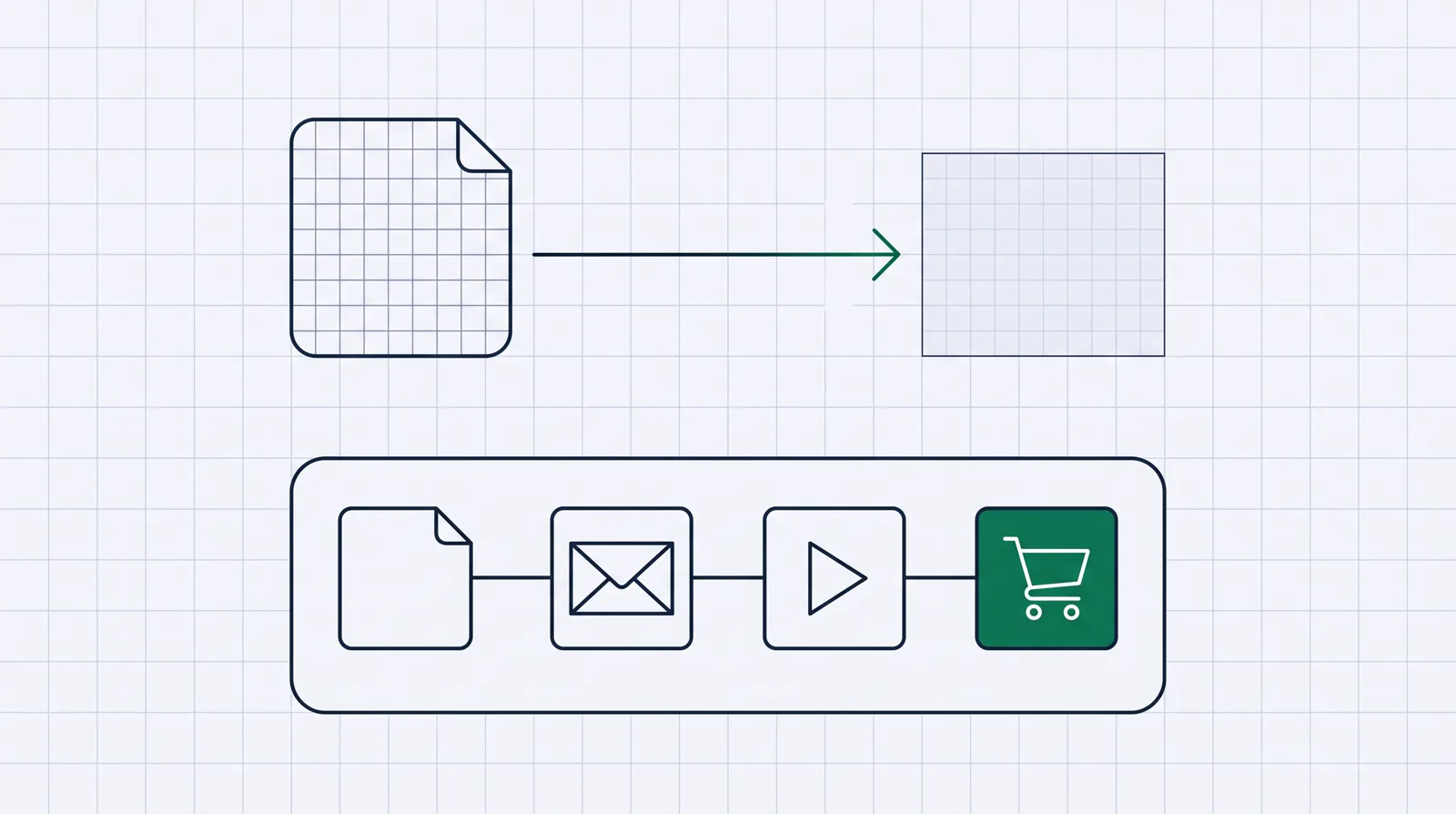
The overlap is a landing page with a form and a basic split test. For that single job either one works, and Systeme.io does it for free. Past the page the two split hard, and in opposite directions.
Leadpages goes deeper on the page and shallower after it: better editor, real Smart Traffic routing, dynamic text and heatmaps, then a handoff to your email tool, your CRM and your checkout. Systeme.io goes wider and shallower everywhere: it keeps the email, the course, the affiliate program and a fuller checkout in one account, but the page and the testing are only good enough. So the honest way to read the choice is not which builds a better page. It is whether you want the sharpest page-and-testing layer for bought traffic, or one cheap login that runs the whole funnel without stitching four tools together.
If your profit turns on the ad click
Both of these assume the hard part is either the page or the breadth of the suite. If you buy your own paid traffic at volume, the hard part is usually somewhere neither of them looks: the split test that must not reset the ad platform's learning, and the checkout that turns a click into a tracked sale. ElasticFunnels is a funnel platform built for that reader, the affiliate, product vendor, agency or ecommerce brand running campaigns on Meta, Google and TikTok. It puts the pages, the checkout, the follow-up and the reporting on one data layer instead of four.
Its defining feature is same-URL split testing. Variants rotate server-side under one campaign link, so the ad platform keeps its optimization and a test never sends the ad back through review. That is the break from both tools here, which split A/B traffic across separate URLs. Around it sit the rest of the platform: an AI page builder that writes a page from a prompt or clones one from a URL; a hosted checkout with order bumps, one-click upsells and native subscriptions; and click-to-sale attribution where the click, the order, the rebill and the refund land on one record, with a CRM, automations and a call center on the same data. For a seller running several merchant accounts, its checkout can route each charge across more than one and cascade to the next on a soft decline. A seller on a single Stripe account still gets the pages, the same-URL testing, the checkout and the one-record attribution, just not that particular routing edge.
The honest caveat is proof. ElasticFunnels is newer than both tools on this page, and there is very little independent third-party review coverage to check its claims against, so until you run real volume through it you are largely taking the vendor's word for how it holds up. That is what you would expect of a platform this young next to a 14-year-old page tool and a suite with half a million users, and it weighs most if you lean on years of public reviews before trusting a tool. The answer is the trial: 14 days, no card, with pages, funnels and a custom domain you can set up and prove on your own campaign before you decide. Scope it against the two here honestly. It is not the free-to-start creator suite Systeme.io is, and it goes further than the page-and-lead layer Leadpages is. It is the build-and-sell layer a performance team lives in after the click.
Pricing: two different axes
On price the two are not close, and not close in the same direction. Systeme.io starts at nothing, then $17 for Startup, $47 for Webinar and $97 for unlimited contacts. Annual billing knocks off two months, every plan takes 0% on top of your payment processor, and email sends are unlimited. Its limits are on contacts, and on the free plan on the number of funnels and courses, not on time.
Leadpages prices by plan and stays flat. Grow opens at $67 a month, about $54 a month billed annually, and carries A/B testing, dynamic text, lead enrichment and unlimited uncapped traffic. Optimize is $135 and adds Smart Traffic and heatmaps; Scale is $271. A publishing-only HTML Pub tier starts at $7 a month if all you need is to host a page. There is a 7-day trial, card required, and no visitor caps or overage fees at any tier.
So if budget is the pressure and you are validating an offer, Systeme.io wins on price outright, and it is hard to beat free. Leadpages costs more because you are paying for the page-optimization layer, not for breadth. Price each on the tier that carries what you actually need, and check both vendors' current pages before you buy.
Which one for you
You buy paid traffic and your lever is the page: Leadpages. The fast editor, A/B testing, Smart Traffic routing, dynamic text and heatmaps, on a flat, uncapped bill, are the toolkit that lifts a paid-traffic landing page, and it is fine that your email, CRM and checkout live elsewhere.
You are a beginner or solo creator selling to an owned audience on a budget: Systeme.io. Funnels, email, a course and an affiliate program in one login, free until the sales justify paying, with no transaction fees when they do. Accept the design and automation ceiling as the price of that simplicity, and plan your move the day your offers outgrow it.
You buy paid traffic and your profit turns on the split test and the checkout: look at ElasticFunnels alongside them, with the newness caveat above in mind, and prove it on the free trial first.
Leadpages
What works
- No visitor caps or overage fees, so cost stays predictable as you scale
- A/B testing and dynamic text replacement included from the $67 Grow plan up, not gated behind an expensive tier
- Unlimited pages and a fast, simple builder
What to watch
- Fewer advanced page-optimization controls than a specialist like Unbounce, and no CRM or native email, so follow-up lives in another tool
- Older complaints about price jumps versus a WordPress page builder
- Support quality is a recurring gripe
Systeme.io
What works
- A free plan that is actually usable, not a teaser. Up to 2,000 contacts, 3 sales funnels, a course, a blog and your own affiliate program, with no credit card and no expiry date. You can build and launch a real funnel before paying a cent.
- One login instead of four subscriptions. Funnels, email, courses, a website and affiliate management run from the same account, so there is no glue code between a page builder, an email tool and a course host.
- Cheap even when you pay. Paid plans start at $17/mo and top out at $97/mo for unlimited contacts, well below funnel-first rivals that open near $97 and climb from there.
- No transaction fees, ever. Every plan takes 0% on top of your Stripe or PayPal fees, and email sends are unlimited, so the bill does not balloon as your sales and list grow.
- Fast to learn and launch. Long-term users keep it for the same reason they picked it: fewer moving parts and less setup, which is what a first funnel actually needs.
What to watch
- The page builder and templates are basic. Fine for simple funnels and landing pages, but restrictive if you want pixel-level control or a high-end brand look. One long-term user called the editor "okay, but branding always felt slightly off for higher end offers".
- You can outgrow the automation and checkout. Conditional email logic, deeper checkout customization like tax handling, and heavier CRM or multi-brand workflows are where sellers say they leave for a specialist. The simplicity that draws you in is also the limit.
- Courses and communities are good enough, but they trail dedicated tools like Skool, and some niche features, such as natively collecting testimonials, need a third-party workaround.
- Much of the online praise is affiliate-driven. Systeme.io runs a strong affiliate program, and a lot of its glowing coverage, including Reddit "honest review" posts, reads as promotional. Weight your own free-plan trial over the hype.
Pricing
Leadpages: from $67/mo. Grow $67/mo (about $54/mo billed annually) includes manual A/B testing, dynamic text replacement, lead enrichment and unlimited uncapped traffic; Optimize $135 adds Smart Traffic AI routing and heatmaps; Scale $271. A publishing-only HTML Pub tier starts at $7/mo. 7-day free trial, card required.
Systeme.io: from $0 (free plan). Free plan is permanent (2,000 contacts, 3 funnels, 1 course). Paid: Startup $17/mo, Webinar $47/mo, Unlimited $97/mo. Annual billing is 2 months free. 0% transaction fees on all plans.
Pricing verified against each vendor on 2026-09-30. Check before you buy.
Our pick
Leadpages
Leadpages is the pick if you want predictable cost, no surprise caps, and experiments without paying enterprise money.
Frequently asked questions
Leadpages or Systeme.io: which should I use?
Which is cheaper, Leadpages or Systeme.io?
Can Leadpages send email or host a course like Systeme.io?
Is Systeme.io's free plan enough to launch a paid-traffic funnel?
What if your money is made on the checkout after the ad click?
Sources
Vendor pages
- Leadpages pricing (vendor page)
- Leadpages home (vendor page)
- Systeme.io pricing (vendor page)
- Systeme.io home (vendor page)
Sources
Other sources
8 discussions and reviews read for this page. Quotes are excerpts; open a link to read the original in context.
- [lp-un-g2] https://www.g2.com/compare/leadpages-vs-unbounce-unbounce-landing-pages
- [lp-un-findstack] https://findstack.com/compare/unbounce-vs-leadpages
- [g2-ease] Systeme.io Reviews | G2
- [g2-value] Systeme.io Reviews | G2
- [cap-free] Systeme.io Reviews | Capterra
- [sb-templates] Systeme.io Review: 7 Brutal Truths You Must Know
- [br-builder] Systeme.io Review 2026: The Budget All-in-One That Works
- [ff-verdict] Systeme.io Review 2025 - Too good to be true?

Written by
Dana Rourke
Lead reviewer
Dana Rourke is the lead reviewer at Campaign Buyer. She owns the tracker and attribution coverage: reading what long-term users report about each tool, checking its documentation and pricing, and verifying prices with the vendor before writing the verdict. Keeping the rankings honest mostly means writing down what the top pick gets wrong, so she does that first.
Last checked 2026-10-01