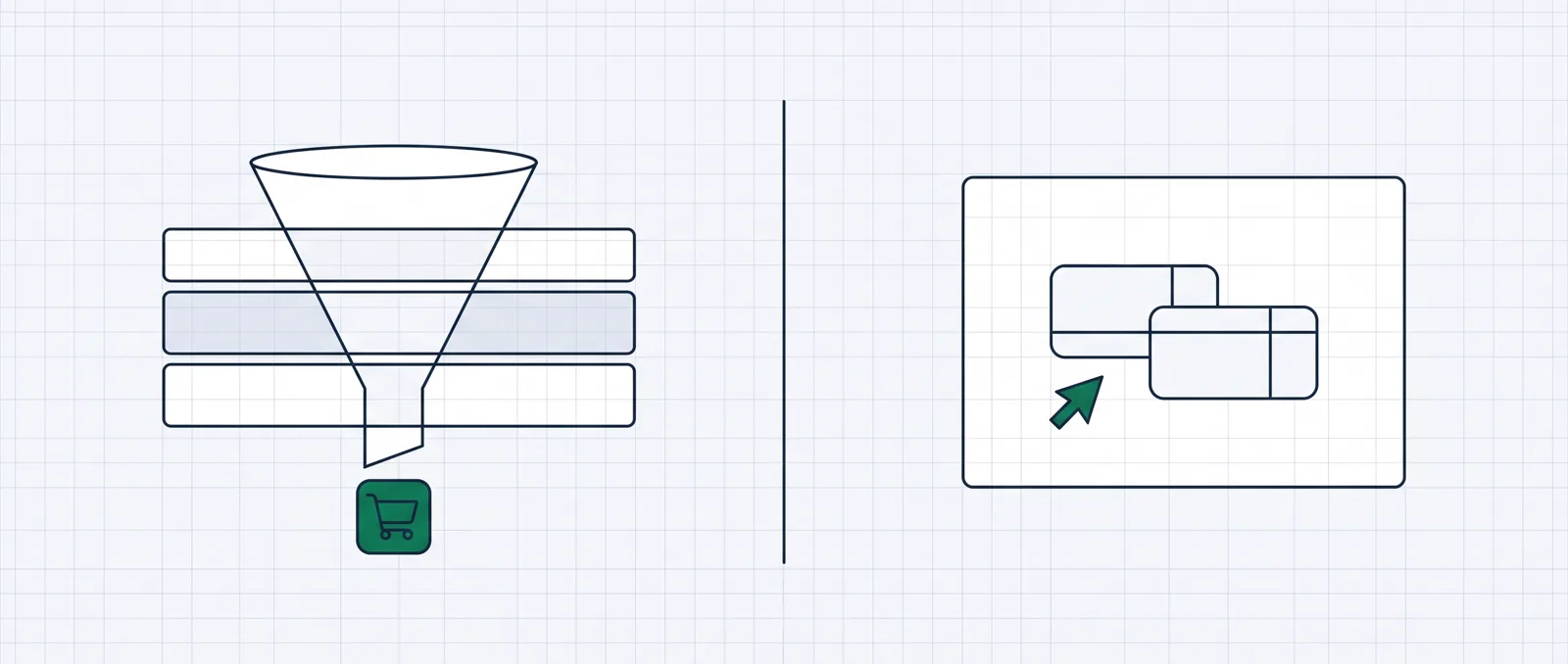
Funnel vs landing pagemedia buyer software
ClickFunnels vs Instapage
By Dana Rourke, Lead reviewer. Reviewed by Campaign Buyer Editorial. Updated 29 September 2026.
Quick answer
Pick ClickFunnels if you want one platform to build the page, take the payment and run the whole funnel, upsells and follow-up included, without stitching a separate checkout on; pick Instapage if the landing page itself is the job, ad-to-page message match, server-side testing and team approvals, and your checkout already lives somewhere else.
Side by side
| ClickFunnels | Instapage | |
|---|---|---|
| What it is | Funnel builder with checkout | Landing-page platform, no cart |
| Best for | Selling your own offers end to end | Agency and enterprise page teams |
| Landing pages | Yes, funnel-oriented | Yes, its whole focus |
| Take a payment | Built in, bumps and upsells | None, checkout lives elsewhere |
| Split testing | A/B testing | Server-side A/B, Optimize tier |
| Ad-to-page match | No | Dynamic text and AdMap, top tiers |
| Email and CRM | Built in, light CRM | None |
| Courses, community | Built in | No |
| Team collaboration | Basic | Its main strength |
| Visitor caps | None | 15k Create, 30k Optimize |
| Cut of sales | None | N/A, no checkout |
| Entry price | $97/mo | $99/mo |
If you have narrowed the whole market to ClickFunnels and Instapage, the first thing to say is that you may be comparing two different jobs without realising it. Both build a page a visitor lands on after clicking an ad, and both are premium, hosted tools you pay a real monthly fee for. But one of them takes the money and one of them does not, and that single fact settles most of this decision before any feature comparison starts.
The one question that decides it
Do you need the page to take the payment? ClickFunnels does. Its checkout, order bumps and one-click upsells are part of the platform, so the page, the cart and the follow-up email all live in one account. Instapage does not. It builds and optimises the landing page and then hands the visitor off to whatever checkout you run elsewhere, a cart, a store, or a separate funnel tool. If you answer yes, that you want to collect the sale on the page itself, ClickFunnels is the shorter path and Instapage is only half of your stack. If you answer no, that the checkout is settled and staying put, then the question becomes which tool builds and tests the page better, and that is a fairer fight.
ClickFunnels: the whole funnel in one account
ClickFunnels is one of the names that made "sales funnel" a category, and after more than a decade it is still one of the most recognised funnel builders online. It runs the whole path from click to customer in one place: landing and sales pages, a checkout with order bumps and one-click upsells, email follow-up, a light CRM, courses and a community. For a creator or a direct-response seller pushing their own offer, that is genuinely fewer tools to wire together, and the drag-and-drop editor with its prebuilt funnel templates is the most-praised part, especially for non-technical sellers. Aggregate scores back this up, around 4.6 out of 5 across more than 400 G2 reviews.
The trade-offs are real and worth knowing before you commit. It sits at the top of the market on price, $97 to $297 a month, and users say the cost adds up fast if you only need part of it. Billing and cancellation draw the loudest complaints, along with confusion between the older Classic accounts and the newer 2.0 platform. Course and membership delivery is weaker than a dedicated platform. It takes no cut of your sales, though, and includes hosting, which keeps the running cost predictable once you are on a plan.
Instapage: the best page, and only the page
Instapage is built for the team whose whole job is the landing page. Its strengths are collaboration and approval workflows, server-side A/B testing, multi-step forms and ad-to-page personalisation through AdMap and dynamic text replacement, which swaps the page headline to match the ad or keyword a visitor clicked. For an agency shipping pages for many clients, or an enterprise media team that needs governance and review, that stack is hard to match, and the editor has long been rated one of the most intuitive in the category.
What it will not do is take a payment. There is no cart, no order bump, no one-click upsell and no subscription billing, so a seller has to run a checkout on another tool and connect the two. The price has also drifted firmly upmarket: $99 to start on Create, but the server-side testing and personalisation most paid-traffic buyers actually want start on Optimize at $199, and Convert above that is custom-quoted. The Create and Optimize plans cap visitors, so a high-traffic campaign climbs the tiers quickly. For a solo buyer or a small lead-gen shop, it is more platform, and more bill, than the work needs.
If you buy cold traffic to your own offers
Neither of these was built around the ad click. ClickFunnels is tuned for selling to an audience you build, and its testing is standard A/B, which can send an ad back through review when you swap the destination. Instapage optimises the page beautifully but stops before the cart. A team that buys its own paid traffic, an affiliate, a product vendor, an agency or a DTC brand, often wants the page, a split test that does not reset the ad platform's learning, the checkout and the reporting on one record. That is the segment ElasticFunnels is built for. It builds and hosts the pages, including an AI builder that clones one from a URL, rotates variants server-side under one campaign link so Meta, Google and TikTok keep their optimisation, hosts the checkout with order bumps, one-click upsells and multi-account payment routing, and keeps a click, an order, a rebill and a refund on one timeline with a CRM and automations on the same data. It starts at $97 a month with every feature on every plan, and charges 0.5% only on revenue through its own hosted checkout.
The honest catch is proof. ElasticFunnels is newer than both tools here, and there is very little independent third-party review coverage to check its claims against, so until you run real volume through it you are largely taking the vendor's word for it. That is what you would expect of a platform this recent sitting next to a builder with more than a decade of reviews, and it matters most to a buyer who chooses on outside evidence rather than a trial. The counter is a 14-day trial with no card, which lets you build a page, wire a checkout and prove the split testing on your own funnel before you move anything real onto it. It does not replace Instapage's agency approval workflow, and if your checkout is settled elsewhere you may not need its cart, but for owning the whole path on one record it is the option worth a look alongside these two.
Which one for you
Sell your own offer and want it live fast: ClickFunnels. The page, the checkout, the upsells and the email are one account, and you are not connecting a separate cart.
An agency or enterprise team optimising pages at scale: Instapage. Collaboration, approvals, server-side testing and ad-to-page personalisation are its whole point, as long as your checkout lives elsewhere and the budget clears Optimize.
Buying cold traffic to offers you own: look at ElasticFunnels alongside these, for the page, the same-URL test, the checkout and the attribution on one record. Prove it on the free trial first, because the independent evidence is still thin.
ClickFunnels
What works
- Runs the whole funnel in one account: pages, checkout, email, a light CRM, courses and a community, so you are not stitching four tools together
- Fast to get live. The drag-and-drop editor and prebuilt funnel templates are the most-praised part, especially for non-technical sellers
- Smart Checkout is built for selling, with order bumps and one-click upsells aimed at raising average order value
- Strong aggregate scores: about 4.6 out of 5 across more than 400 G2 reviews and thousands of Trustpilot reviews
- Takes no cut of your sales, includes hosting, and carries a 30-day money-back guarantee
What to watch
- Priced at the top of the market. Plans run $97 to $297 a month, and users say the cost adds up fast, especially if you only need part of it
- Billing and cancellation are the loudest complaints, along with confusion between ClickFunnels Classic and the newer 2.0 accounts
- Some long-time users feel 2.0 was a step back from Classic, and marketers report occasional bugs and page speed that is hit or miss
- Less flexible than a custom stack, and course and membership delivery is weaker than a dedicated platform
Instapage
What works
- Strong collaboration and approval workflows for teams and clients
- Server-side A/B testing and multi-step forms from the Optimize tier
- Ad-to-page personalization (AdMap) at the top tier
What to watch
- Priced for enterprise: the $99 entry rises fast and Convert is custom-quoted
- Visitor caps on the Create and Optimize plans
- Overkill for a solo buyer or a small lead-gen shop
Pricing
ClickFunnels: from $97/mo. Monthly: Launch $97, Scale $197 (most popular), Optimize $297; Dominate $5,997/yr, annual only. Annual billing on the lower tiers is ~15-17% off (Launch $81, Scale $164, Optimize $248/mo). 30-day money-back guarantee. ClickFunnels takes no cut of your sales. Free trial via the signup flow is currently 7 days.
Instapage: from $99/mo. Create $99/mo with 15,000 monthly visitors; Optimize $199/mo with server-side A/B testing and 30,000 monthly visitors; Convert is custom. Annual billing lowers the monthly equivalent.
Pricing verified against each vendor on 2026-09-29. Check before you buy.
Our pick
ClickFunnels
ClickFunnels is the pick if you sell coaching, courses or info products and want the pages, checkout, upsells and email running as one funnel instead of four separate tools. It is fast to launch and covers the whole sales process end to end. The trade-offs are real: it sits at the top of the market on price, the bill climbs as you scale, and billing and cancellation draw the most complaints.
Frequently asked questions
ClickFunnels or Instapage: which should I use?
Which is cheaper, ClickFunnels or Instapage?
Can Instapage take payments or run a checkout?
Which is better for Google Ads message match?
I buy cold traffic to my own offers. Which fits?
Sources
Other sources
8 discussions and reviews read for this page. Quotes are excerpts; open a link to read the original in context.
- [capterra-learn] ClickFunnels Reviews 2026 - Capterra
- [g2-threemonths] ClickFunnels Reviews - G2
- [g2-editor] ClickFunnels Pros and Cons - G2
- [trustpilot-steep] ClickFunnels Reviews - Trustpilot
- [bbb-billing] ClickFunnels BBB Complaints
- [getyourhelper-glitches] ClickFunnels Review 2025 (After Spending $20K+ on It)
- [supplygem-quirks] ClickFunnels Review: Why You'll Love or Hate It (2026)
- [marketingagency-migration] Honest ClickFunnels Review for 2026

Written by
Dana Rourke
Lead reviewer
Dana Rourke is the lead reviewer at Campaign Buyer. She owns the tracker and attribution coverage: reading what long-term users report about each tool, checking its documentation and pricing, and verifying prices with the vendor before writing the verdict. Keeping the rankings honest mostly means writing down what the top pick gets wrong, so she does that first.
Last checked 2026-09-29