Foreplay vs Minea
By Dana Rourke, Lead reviewer. Reviewed by Campaign Buyer Editorial. Updated 25 September 2026.
Quick answer
Pick Foreplay if you run a creative team producing Meta and TikTok ads and need to save competitor ads into organized swipe files and turn them into briefs your designers build from; pick Minea if you sell physical products and want Meta, TikTok and Pinterest ad spy plus winning-product and competitor-store research in one dashboard, as long as you treat what it finds as leads to validate.
Side by side
| Foreplay | Minea | |
|---|---|---|
| What it is | Creative swipe and brief tool | Ecommerce ad + product research |
| Ad platforms | Meta, TikTok, LinkedIn, YouTube | Meta, TikTok, Pinterest |
| Product research | No | Yes, products and stores |
| Built for | Creative teams | Dropshippers and sellers |
| Swipe and briefs | Yes, its main draw | Save boards only |
| Competitor tracking | Yes, via Spyder | Brand tracker |
| Native and push | No | No |
| Free entry | 7-day trial | Free Lite plan |
| Entry price | $59/mo; $175 Workflow | $49/mo, credit-metered |
Foreplay and Minea both help you learn from other people's ads, so a buyer down to these two often assumes they are two versions of the same tool at two prices. They are not. Foreplay is a system you save into and brief from, built for a team producing its own brand's creative. Minea is a research dashboard you hunt in, built for a seller looking for a product to run and the stores already running it. Both watch paid social, but they solve opposite halves of the job. The decision is less about which is better and more about what you are actually trying to do.
The one question that decides it: are you producing creative, or hunting a product?
Answer this before you compare a single feature. If you already have an offer or a brand and your bottleneck is shipping enough good ads, you need a way to collect inspiration and turn it into briefs a designer can build from. That is Foreplay, and Minea barely touches it. If you do not yet have the product and your bottleneck is finding one that sells and seeing who else is selling it, you need product research sitting beside the ad spy. That is Minea, and Foreplay does not do it at all.
This is why sticker price is a poor way to choose here. A dropshipper who saves money on Foreplay has bought a swipe-and-brief system for a workflow they do not have yet, and no product-research at all. A creative team that pays for Minea has bought winning-product lists they will never open, and a save board that is thinner than the briefing loop they actually need. Match the job first, and the rest of this comparison is detail.
Foreplay: the creative operations system
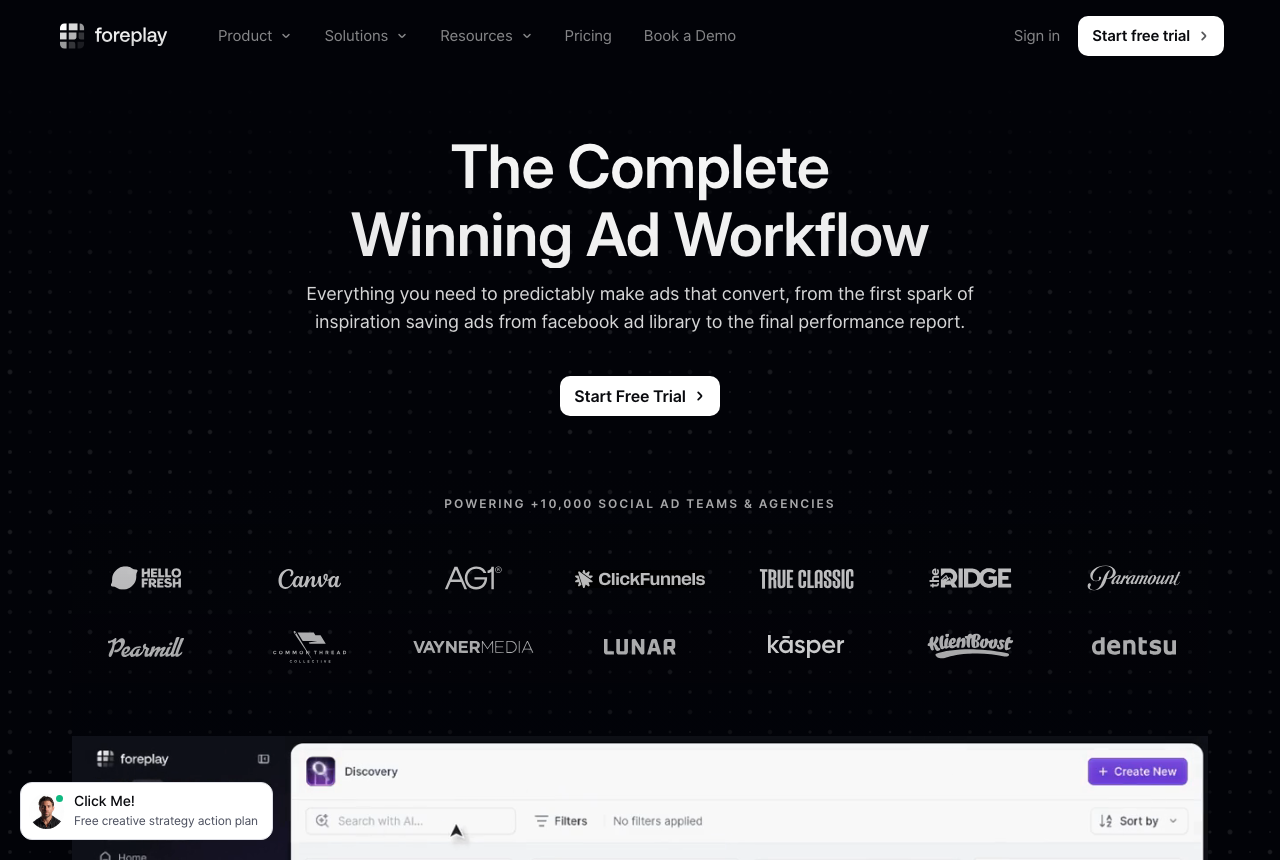
Foreplay works less like a spy tool and more like a creative operations system. Instead of searching a database and closing the tab, you save ads into organized swipe files, track competitors over time, and turn what you find into briefs your designers actually build from. It pulls inspiration from Meta, TikTok, Instagram, LinkedIn, YouTube Shorts and Google's Transparency Center, so on the paid-social side its coverage is wide. DTC teams consistently praise it for the organization, not just the discovery, and its 4.8 out of 5 across 127 G2 reviews is unusually strong for this category.
It is built for the team, not the lone researcher. Its Spyder feature watches competitors so their new ads surface as they run, and Briefs turns a board of references into a production-ready spec a designer works from. Two limits are worth stating. It is not a native ad spy tool, so a Taboola or Outbrain affiliate should look at Anstrex instead. And the value lives in the $175 a month Workflow tier, where competitor tracking and the team features become available. Basic at $59 is a lighter saved-ads library, and extra seats are billed per user, so a growing team's bill climbs faster than the headline number suggests.
Minea: ad spy plus product research for sellers
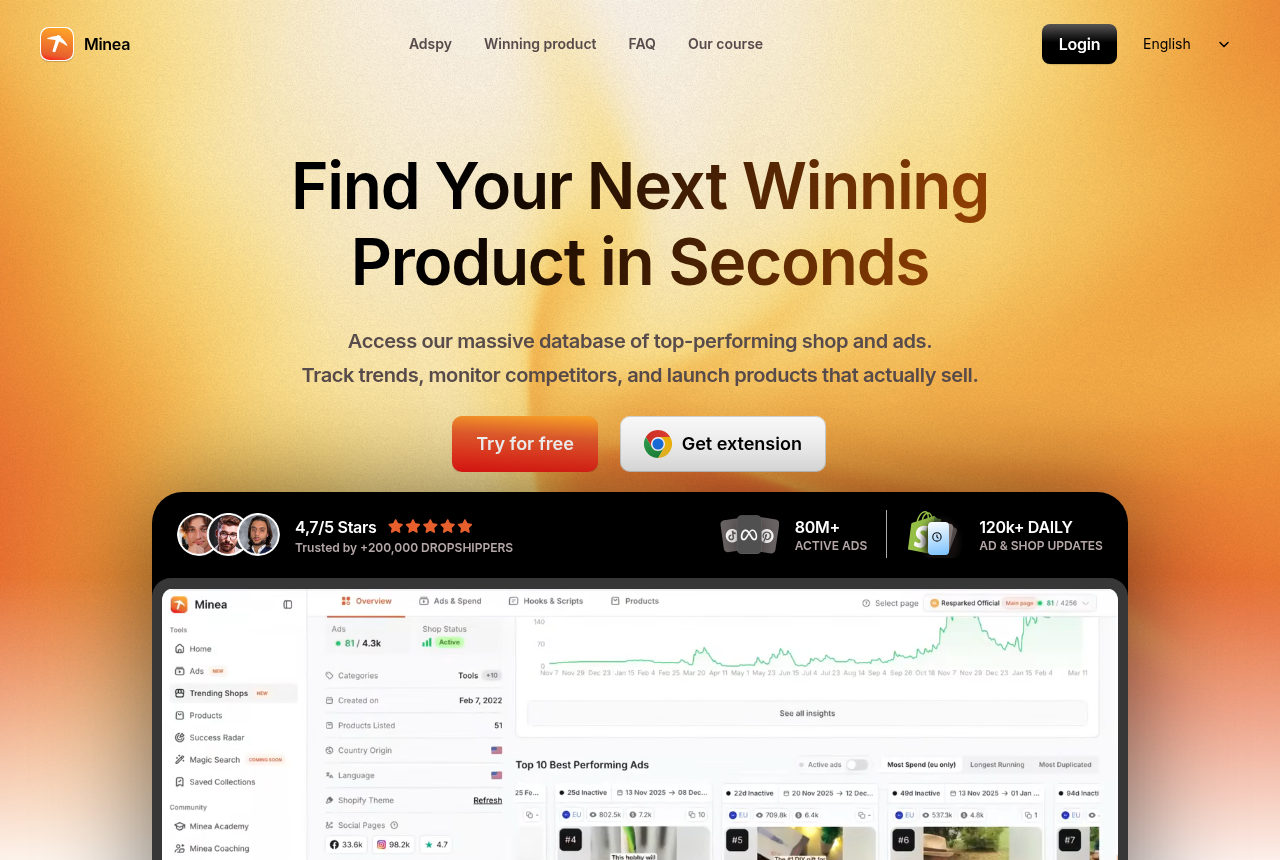
Minea is built for one buyer: someone selling physical products who wants ad spy and product research in the same place. It is a real product, built by a Swiss company, with a library above 80 million ads updated daily and a large paying dropshipping audience. It covers Facebook, TikTok and Pinterest, and around the ads it stacks winning-product lists, shop revenue estimates, a brand tracker and an image search for finding where a product is running. For a seller, that combination is the appeal: find a product and see who else is on it without leaving the dashboard.
The regret with Minea is rarely capability. It is expecting it to hand you a guaranteed winner. Users report ads that feel recycled and engagement numbers that do not prove a product is profitable, so its finds are leads to validate rather than answers. It also does not touch native or push, and every plan is metered by credits you spend as you search and scroll, with credit costs the vendor can change. It auto-renews every 30 or 365 days with no refund on unused days, so you cancel at least 24 hours ahead or you keep the month. On its own turf, though, for a seller doing multi-platform product research, Minea is the better tool of the two, and we would pick it every time over a creative swipe system for that job.
What each one is really for: making creative, or finding a product
This is where the two split most cleanly, and it maps straight onto the question above. Foreplay is a production tool. Its whole design assumes you know what you sell and need to make more, better ads for it: save, organize, track, brief, repeat. It has no product research because its user is not looking for a product. Minea is a discovery tool. Its whole design assumes you are still looking, so it puts product lists, store revenue estimates and cross-platform ad spy in one view and expects you to sift. It has no briefing workflow because its user is validating an idea, not shipping a creative calendar. Neither gap is a flaw. Each is a tool declining to be the other.
The capability each has that the other lacks
Strip the platforms away and each still does something the other does not attempt. Foreplay briefs. Spyder tracks a competitor over time and Briefs turns a swipe board into a spec a designer builds from, a loop Minea does not carry because its user is one seller hunting a product, not a team shipping creative on a schedule. Minea, in turn, researches products and stores. It estimates a shop's revenue, surfaces daily winning-product lists and lets you reverse-search an image to find where a product is running, none of which Foreplay attempts because its users already know what they sell. If your work is producing paid-social ads at volume with a team, Foreplay's briefing loop decides it. If your work is finding a product and the stores behind it, Minea's research decides it.
Pricing: a tiered workflow versus metered credits
On price the two are not really comparable, because they charge for different things. Foreplay starts at $59 a month for Basic, but the tier that carries competitor tracking and the team workflow is Workflow at $175, with extra seats billed per user on top. So a solo buyer who only needs the saved-ads library pays least, while a team that wants the features Foreplay is known for pays the higher tier and more per seat. Minea starts lower, with a free Lite plan and paid plans from $49 a month, but every plan is metered by credits you burn as you search, scroll and open ad detail, and the vendor can change what those credits cost. On the headline number Minea is cheaper, and for a light or occasional user it stays cheaper. Search and scroll all day and the credit meter climbs. Neither runs a long open-ended trial: Foreplay offers a short 7-day trial and Minea a free Lite plan, so try each on your real workflow before you commit. Compare on your team size and how hard you actually search, not the entry price.
What neither tool does
A swipe tool briefs an ad and a research tool finds a product, but neither builds the page and checkout behind the ad, and neither tells you which angle actually made money after the click. Once Foreplay hands your designer a brief or Minea hands you a product to test, the next steps are yours: building the landing page and checkout, testing the variant that converts, and measuring spend against sales. That is a separate tool on a separate bill. ElasticFunnels is one platform that covers that part. It is a funnel platform for teams running paid traffic, and the piece that fits here is its page builder: an AI builder writes a page from a prompt or clones a competitor URL into an editable copy, which sits neatly after a teardown, and it reports ad spend against conversions on one timeline with affiliate postbacks attached, so the spend-to-sale numbers live in one place instead of across separate exports. It runs a 14-day free trial with no card. The honest limit is that it is newer than the tools on this page, and there is very little independent third-party review coverage to check its claims against, so until you run real volume through it you are largely taking the vendor's word for how the reporting holds up. That newness touches the proof, not the feature set: the page builder, the cloner and the reporting are all there to use from day one. It answers a different part of the workflow than these two, the building and measuring rather than the finding, so keep it on its own line of the decision rather than letting it sway your research-tool pick.
Which one for you
You run a creative team producing Meta and TikTok ads: Foreplay. Swipe files, competitor tracking through Spyder and Briefs are built for exactly that workflow, and its coverage spans the paid-social channels a modern creative team runs. Start on the 7-day trial, but price the $175 Workflow tier, since that is where the features you want live.
You sell physical products and want product research too: Minea. It covers the platforms a modern seller actually runs, TikTok and Pinterest included, and puts product and store research beside the ads. Start on the free Lite plan, and treat the winning-product lists as leads to test, not proof.
You are both hunting products and producing creative at volume: you are choosing by which half is your day job, because neither tool does the other's half well. Minea for the product hunt, Foreplay for the creative production, and a shop that does both heavily ends up running both.
You have the angle and now need to build and measure the funnel: look at ElasticFunnels alongside them, with the newness caveat above in mind, but keep it separate from this decision, because it does a different job.
Foreplay takes our default pick because more of this site's readers run paid-social creative for an offer they already have than are hunting dropshipping products, so it is the tool the larger group here actually needs. That is a statement about who is reading, not a verdict that Minea is the lesser product. On its own turf, finding a product to sell, Minea is plainly the better fit.
Foreplay
What works
- Saves and organizes competitor ads from every major ad library
- Briefs and Spyder turn inspiration into production-ready references
- A 4.8/5 rating across 127 G2 reviews, strong for the category
What to watch
- Not a native ad spy tool in the Taboola or Outbrain sense
- Best value only at the $175/mo Workflow tier, not Basic
- Per-user pricing on extra seats
Minea
What works
- Covers Meta, TikTok and Pinterest ads plus product and shop data in one ecommerce-focused dashboard
- A free Lite plan lets you test the interface before paying, and paid plans start at $49 a month
- Brand tracker, daily niche lists and a Magic image search speed up finding and organising angles
- 80M+ ads with daily updates, deep enough for competitor and store research
What to watch
- No native or push networks, so Taboola, Outbrain and MGID buyers still need Anstrex
- Users report ads that feel recycled or stale, and engagement numbers that do not prove a product is profitable
- Every plan is metered by credits you spend as you search and scroll, and Minea can change credit costs at will
- Auto-renews every 30 or 365 days with no refund on unused days, so you have to cancel at least 24 hours before renewal
Pricing
Foreplay: from $59/mo. Basic at $59, Workflow at $175 and Agency at $459 a month (annual $49/$149/$389). Additional seats cost $20. Covers Meta, TikTok, Instagram, LinkedIn, YouTube Shorts and Google's Transparency Center.
Minea: from $49/mo. Starter $49/mo, Premium $99/mo, Business $199/mo, each about 20% cheaper billed quarterly and lower again billed annually. A free Lite plan gives limited access. Every plan is metered by credits that you spend as you search and scroll ads. Subscriptions auto-renew every 30 or 365 days; cancel at least 24 hours before renewal. Minea does not refund unused days or credits, and paid plans are otherwise non-refundable except for new users within 24 hours of a first purchase.
Pricing verified against each vendor on 2026-09-08. Check before you buy.
Our pick
Foreplay
Foreplay is the pick if you are a DTC creative team that needs to turn competitor research into swipe files and briefs your designers can use.
Frequently asked questions
Foreplay or Minea: which should I use?
Which is cheaper, Foreplay or Minea?
Are Foreplay and Minea the same kind of tool?
Is Minea or Foreplay better for dropshipping?
Do either tool cover native or push ads?
Do Foreplay and Minea offer a free trial?
Sources
Other sources
2 discussions and reviews read for this page. Quotes are excerpts; open a link to read the original in context.

Written by
Dana Rourke
Lead reviewer
Dana Rourke is the lead reviewer at Campaign Buyer. She owns the tracker and attribution coverage: reading what long-term users report about each tool, checking its documentation and pricing, and verifying prices with the vendor before writing the verdict. Keeping the rankings honest mostly means writing down what the top pick gets wrong, so she does that first.
Last checked 2026-09-25