FunnelFlux Pro vs ClickMagick
By Dana Rourke, Lead reviewer. Reviewed by Campaign Buyer Editorial. Updated 23 September 2026.
Quick answer
Pick FunnelFlux Pro if you run multi-step funnels with landers, advertorials and offer rotations and want to see the whole journey as a visual map that shows exactly where it leaks, on predictable per-event pricing; pick ClickMagick if you run your own Meta, Google or YouTube traffic as a solo advertiser or info-product seller and want first-party CAPI feeding cleaner conversions back to the platforms, plus a morning email that names what to scale or cut. FunnelFlux is the mapmaker for complex flows. ClickMagick is the feedback loop and the daily decision layer for your own paid traffic.
Side by side
| FunnelFlux Pro | ClickMagick | |
|---|---|---|
| What it is | Visual funnel tracker | First-party CAPI tracker |
| Best for | Multi-step funnels | Your own ad traffic |
| How you optimize | Visual funnel map | Daily decision email |
| Priced by | Events | Tracked visitors |
| Entry price | $99/mo, 2M events | $79/mo, 10K visits |
| Platform feedback | S2S postbacks | CAPI to platforms |
| Outside proof | Smaller community | Thin, disputed |
If you are down to FunnelFlux Pro and ClickMagick, you have narrowed the field to two cloud trackers that answer the same core job in two very different shapes. Both stamp the click, catch the conversion server-side, and hand you a record of what actually made money that you trust more than the ad account's own ROAS. Neither asks you to run a server. What splits them is the kind of buyer they are built around, and what they want you to do with the numbers once they have them.
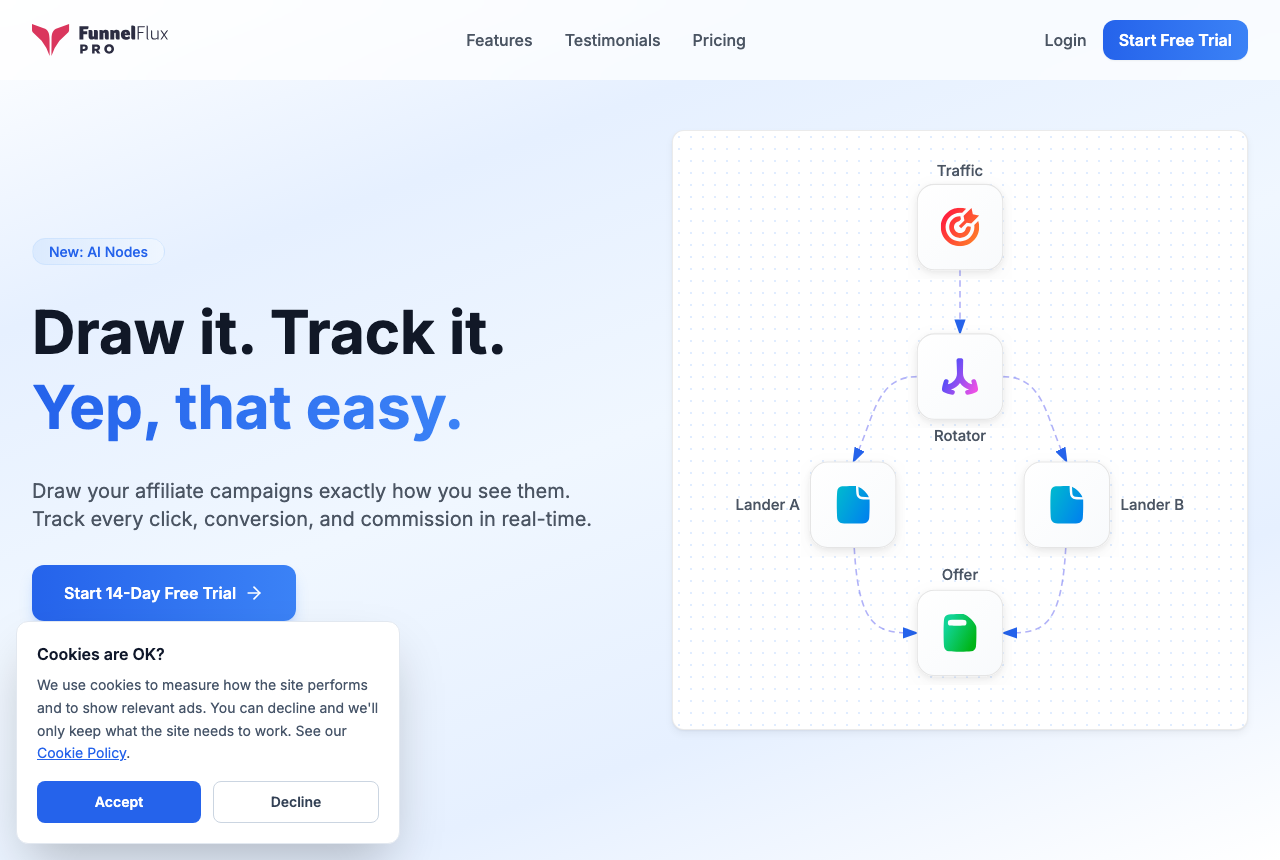
FunnelFlux Pro is a visual funnel tracker. You draw landers, advertorials, offers, rotators and conditional routing on one canvas, and because the reporting is per node, a leak between the advertorial and the offer is obvious instead of buried in a table of clicks. ClickMagick comes at tracking from the managed-platform side. It keeps a first-party record of what converted, feeds that clean signal back to Meta, Google and YouTube so their AI optimizes toward the right people, and every morning it emails you a read of your stats that names what to scale, pause or fix. One maps a complex journey. The other sharpens a feedback loop and hands you a daily decision.
The two questions that decide it
Answer these before you compare a single feature. First: what does your funnel actually look like? If your money comes from multi-step flows with rotating landers and offers, and your problem is knowing which step leaks, that points one way. If your funnel is a page and a checkout and your problem is that the ad platform keeps optimizing toward the wrong buyers, that points the other. Second: whose traffic is it? FunnelFlux is at home following affiliate and media-buy funnels wherever the offer lives. ClickMagick is built for the advertiser running their own accounts who wants those accounts to see clean conversion data.
Get those two answers straight and the rest of this page mostly confirms them. The feature lists overlap more than the tools do, so the deciding factors are the shape of your funnel and whose ad accounts you are optimizing.
FunnelFlux Pro: the visual tracker for multi-step funnels
Most trackers show you a table of campaigns. FunnelFlux shows you a map. Landers, offers, rotators and conditional routing are drawn on one canvas, and because the reporting is per node you can see exactly where a funnel leaks rather than inferring it from a spreadsheet. For a buyer whose profit comes from complex, multi-step flows, that view is the whole reason to switch, and it is genuinely hard to get from a link-based tracker.
It is cloud-hosted, so there is nothing to install or patch, and its S2S integrations pass conversions server-side to TikTok, Facebook, Microsoft and Google Ads, with cookieless JavaScript tracking that survives browser privacy changes. Pricing is clear and predictable: $99 a month for 2 million events, then $10 per additional million, and the first two custom domains are free. Data retention is unlimited while your subscription is active. The full FunnelFlux Pro review covers how the canvas holds up on a real funnel.
The costs are real and worth naming. The flexibility of the visual builder comes with a learning curve the docs do not hide, so plan setup time. Automatic ad-cost sync is not native: you either pass cost in the URL or add Argosync, FunnelFlux's separate cost-sync product, which is its own subscription and trial. The community is smaller than Voluum's or RedTrack's, so you will find fewer third-party walkthroughs when you hit an edge case. And the 14-day trial requires a valid payment method up front, so it is free to try but not card-free.
ClickMagick: the feedback loop and a daily decision
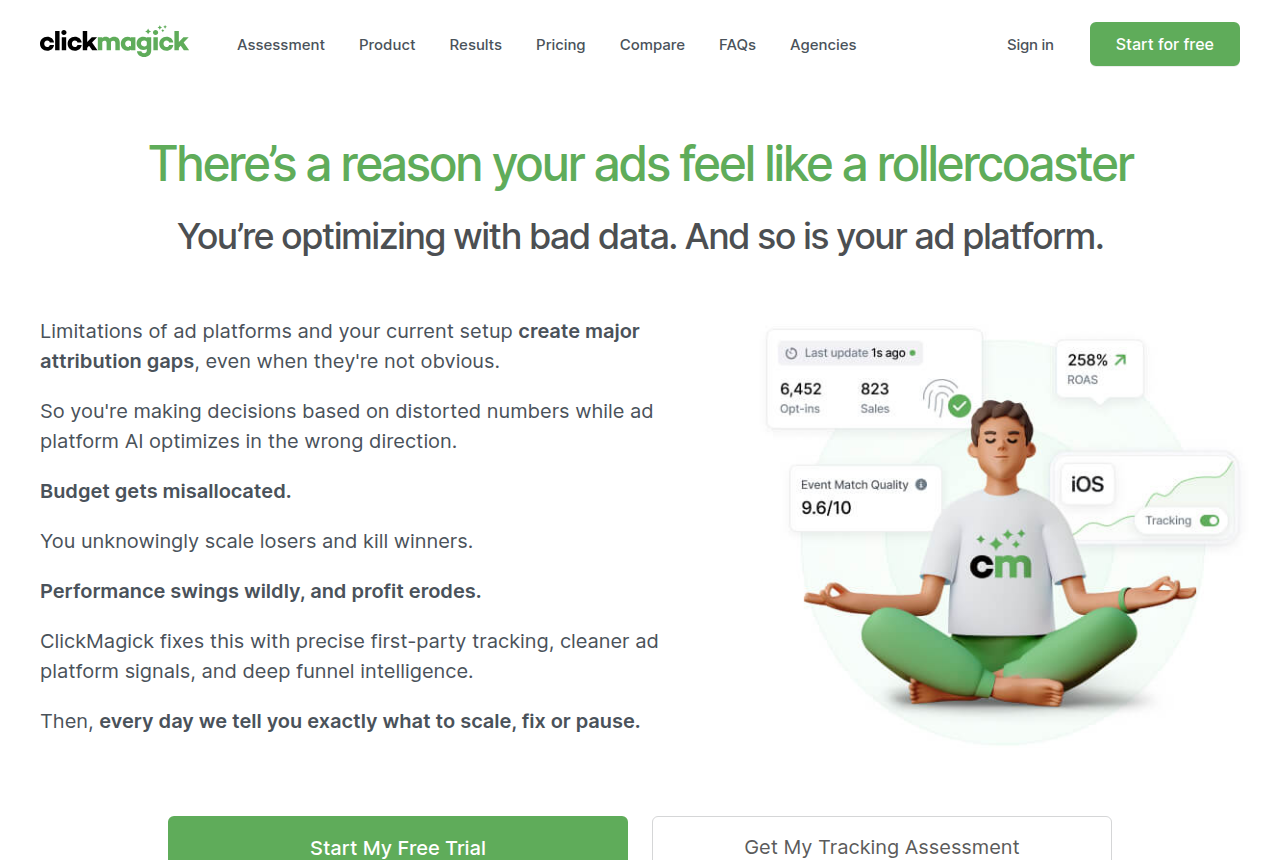
ClickMagick has tracked links since 2014 and now bills itself as an attribution platform it calls TrueTracking. The pitch: your ad platform grades its own homework and gets it wrong, so you keep a first-party record of what converted and send a cleaner signal back to Meta, Google and YouTube so their AI stops optimizing toward the wrong people. First-party tracking with a custom domain and CAPI is what users credit for the better ad optimization, and it is the core reason to pick it over a link-based tracker. The full ClickMagick review covers how far that reaches.
On top of that sits Morning Magick, a daily email that reads your stats and names what to scale, pause or fix. For a solo buyer with no analyst, that decision layer is a real draw: the tool does the morning reading for you. Support is the most-praised part in public reviews, with fast replies, often the same day and sometimes with screen recordings.
Two costs shape the picture. ClickMagick bills by tracked visitors, and the Starter plan tracks just 10,000 for $79, so anyone buying real volume is pushed to the $199 Standard tier fast, with $40 a month on top for each extra site. And the outside proof is thin: unlike most tools this old, there is no meaningful G2 or Capterra presence, and the vendor stopped maintaining its Trustpilot page after disputing what it called fake reviews, so you lean on its own case studies more than you would like. It is also a decision layer, not the final truth. The numbers still want reconciling against the ad network, GA4 and your backend before you move budget.
Where the pricing actually diverges
The entry prices look close, but the two tools do not even count the same thing. FunnelFlux meters events, and an event is every impression, visit, click and conversion: $99 a month covers 2 million, then $10 per additional million, billed monthly with no annual contract. ClickMagick meters tracked visitors, from $79 a month for 10,000 up to $349 for a million, plus $40 a month for each extra site.
Because the units differ, the only honest comparison is on your own traffic. Count your monthly impressions and visits, not your budget. An impression-heavy pop or push buy burns through FunnelFlux events quickly, which is where a metered plan climbs. A low-traffic, high-value funnel run on your own ad accounts is cheap on ClickMagick until you add sites. Work the crossover out on real numbers before you decide, because the two meters pull in opposite directions depending on how many impressions your traffic throws off.
A third path if you also build the funnel
Both of these track traffic that lands on pages and checkouts you host somewhere else. Neither builds the funnel whose clicks it follows. If you are still deciding where the pages and checkout live, one option changes the tracking question rather than answering it. ElasticFunnels is a funnel platform for teams that buy paid traffic: it builds the pages, split-tests variants under one URL so the ad platform never resets its learning, and hosts the checkout with order bumps, upsells and subscriptions. Because the checkout runs on the same platform as the pages, a purchase is a deterministic first-party event on the same record as the click, so it can fire affiliate postbacks on the sale and report ad spend against conversions without a separate tracker stitching two systems together.
That only helps if you want to move the pages and checkout too. If your pages already live elsewhere and you just need a tracker on top, FunnelFlux or ClickMagick is the smaller, cheaper answer, and this comparison is the one that matters. ElasticFunnels is also newer than either tracker here, and there is very little independent third-party review coverage to check its claims against, so until you run real volume through it you are largely taking the vendor's word for how its attribution holds up, which is what you would expect of a platform this young. Its 14-day trial takes no card, so proving it out costs only time. Plans start at $97 a month, and it charges 0.5% only on revenue that runs through a checkout it hosts.
Which one for you
Three quick reads:
- You run multi-step funnels with landers, advertorials and offer rotations: FunnelFlux Pro. The visual canvas and per-node reporting show you where the flow leaks, the cloud hosting means nothing to maintain, and $99 for 2 million events is a fair entry for that view. Budget setup time and add Argosync if you want automatic cost sync.
- You run your own Meta, Google or YouTube traffic as a solo advertiser or info-product seller: ClickMagick. The first-party CAPI loop and the morning decision email earn the higher per-visitor price, if you accept the thin outside proof and keep reconciling against your backend.
- You are still choosing where the pages and checkout live: look at ElasticFunnels alongside them, with the newness caveat above in mind, and keep a dedicated tracker for any traffic that closes on other people's domains.
FunnelFlux Pro takes our default pick, not because it out-optimizes ClickMagick on your own ad accounts, but because more readers who reach this comparison run the kind of multi-step funnels FunnelFlux was built to map than run pure own-platform traffic wanting a CAPI feedback loop and a daily email. On its own turf, the solo advertiser sharpening their own campaigns, ClickMagick is genuinely the better tool, and we say so on the ad tracker ranking. If your two questions above landed on that side, buy ClickMagick without hesitation. For the wider field, the Binom vs ClickMagick and BeMob vs FunnelFlux pages weigh each against a cheaper alternative.
FunnelFlux Pro
What works
- A visual funnel canvas: landers, offers, rotators and conditional routing wired together on one screen
- Node-level reporting shows exactly where a funnel leaks
- Predictable pricing: a $99/mo base plus $10 per extra million events
What to watch
- The learning curve is real; the flexibility costs you setup time
- Automatic cost sync needs a separate product, Argosync
- A smaller community than Voluum or RedTrack, so fewer guides when you get stuck
ClickMagick
What works
- Flat monthly price based on the visitors you track, not a cut of your revenue, so the bill does not climb every time a campaign wins.
- First-party TrueTracking with a custom domain and CAPI feeds cleaner conversion data back to Meta, Google and YouTube, which users credit for better ad optimization.
- The Morning Magick email reads your stats each morning and names what to scale, pause or fix, which suits a solo buyer with no analyst.
- Support is the most-praised part in public reviews: fast replies, often the same day, sometimes with screen recordings.
What to watch
- The Starter plan tracks just 10,000 visitors for $79, so anyone buying real volume is pushed to the $199 Standard tier fast.
- Independent proof is thin. There is no meaningful G2 or Capterra presence, and ClickMagick stopped maintaining its Trustpilot page after disputing fake reviews, so you lean on the vendor's own case studies more than you would like.
- It is a decision layer, not the truth. The numbers still need reconciling against the ad network, GA4 and your backend before you move budget.
- Setup rewards patience. Postbacks, cross-domain tracking and CAPI all need wiring, and a botched setup is behind most of the accuracy complaints.
Pricing
FunnelFlux Pro: from $99/mo for 2M events. One base plan at $99/month including 2 million tracked events; events beyond that are billed at $10 per million. The first two custom domains are free, then $2/month each. Monthly billing, no annual contract, cancel anytime. A valid payment method is required to start the 14-day trial.
ClickMagick: from $79/mo, 10K visits. Three flat-rate plans, priced on how much traffic you track rather than a share of your revenue. Starter is $79/mo for 10,000 tracked visitors, Standard $199/mo for 100,000, and Pro $349/mo for a million. Yearly billing drops those to $66, $166 and $291 monthly, with two months free. Every tier runs a 14-day free trial. Extra sites or stores add $40/mo each beyond the one or two a plan includes.
Pricing verified against each vendor on 2026-09-23. Check before you buy.
Our pick
FunnelFlux Pro
FunnelFlux Pro is the pick if you run multi-step funnels and want to see the whole journey as a map instead of a table of clicks.
Frequently asked questions
FunnelFlux Pro or ClickMagick: which should I use?
Which is cheaper, FunnelFlux Pro or ClickMagick?
Does FunnelFlux or ClickMagick send conversions back to Meta and Google?
Can FunnelFlux Pro track my own paid traffic, or is it only for affiliate funnels?
Why is ClickMagick's outside proof described as thin?
Sources
Other sources
5 discussions and reviews read for this page. Quotes are excerpts; open a link to read the original in context.
- [ff-home-visual] FunnelFlux Pro homepage
- [ff-home-s2s] FunnelFlux Pro homepage
- [ff-home-pricing] FunnelFlux Pro pricing notes
- [reddit-affmkt] Need software that links ad data with affiliate network data
- [reddit-ppc] Best FB ad tracking software?

Written by
Dana Rourke
Lead reviewer
Dana Rourke is the lead reviewer at Campaign Buyer. She owns the tracker and attribution coverage: reading what long-term users report about each tool, checking its documentation and pricing, and verifying prices with the vendor before writing the verdict. Keeping the rankings honest mostly means writing down what the top pick gets wrong, so she does that first.
Last checked 2026-09-23