A high-ticket attribution model against a self-hosted click tracker
Hyros vs CPV Lab Pro
By Dana Rourke, Lead reviewer. Reviewed by Campaign Buyer Editorial. Updated 24 September 2026.
Quick answer
Pick Hyros if you sell high-ticket info, coaching or courses that close on calls and webinars weeks after the click, run real spend across complex CRM and payment-processor journeys, and need attribution that credits the ad behind a sale standard pixels lose; pick CPV Lab Pro if you buy paid traffic at volume to landers and offers, want click-level tracking of which source and offer converted with unlimited events and no per-event bill, and are comfortable owning the server it runs on.
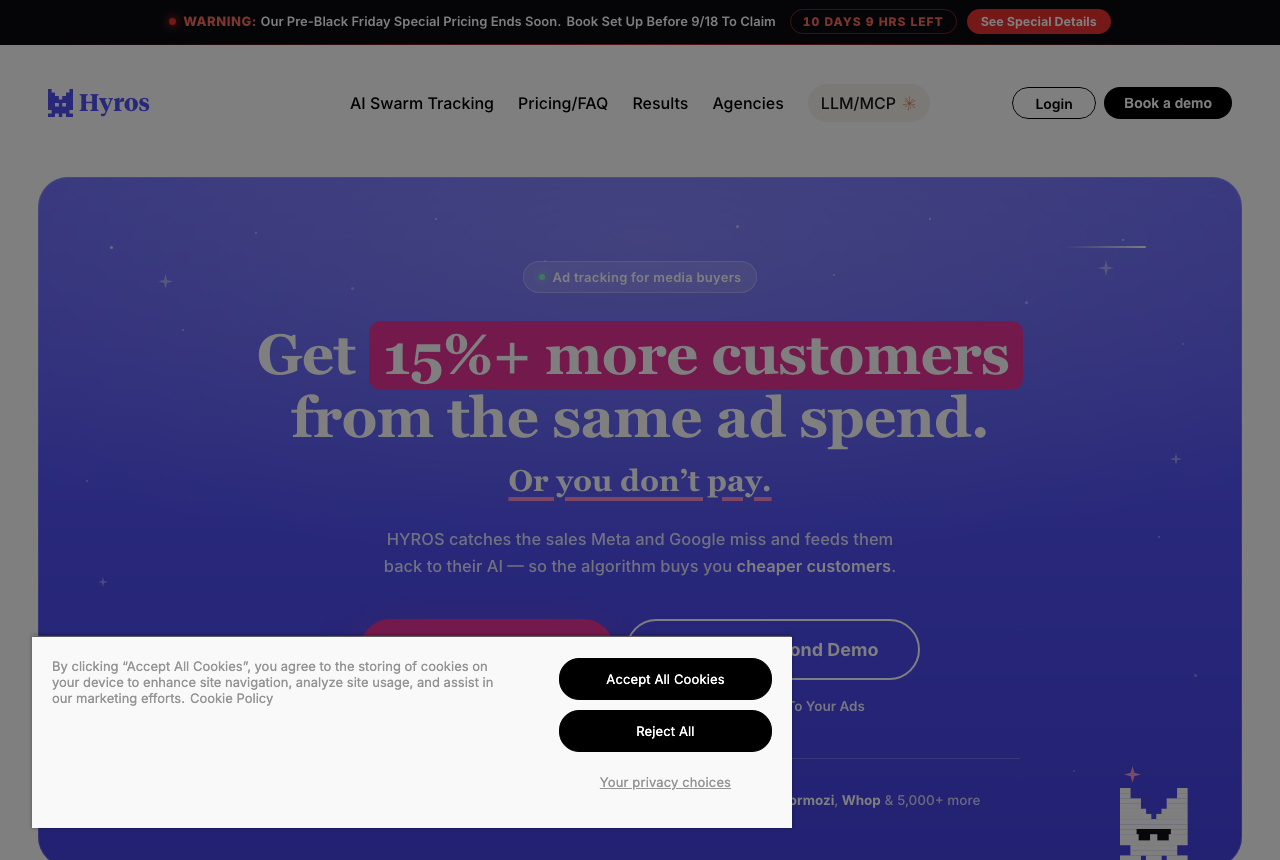
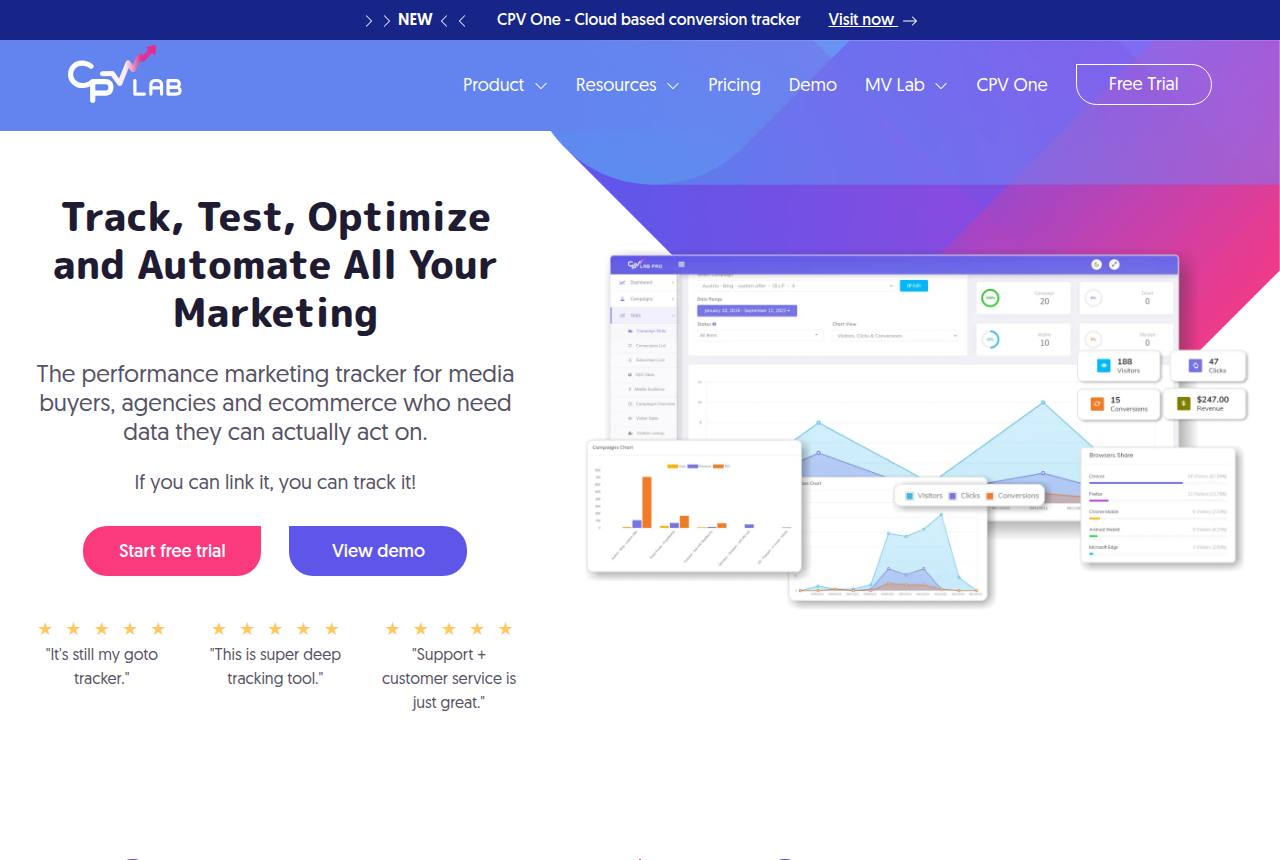
Side by side
| Hyros | CPV Lab Pro | |
|---|---|---|
| What it is | Server-side attribution model | Self-hosted click tracker |
| Best-fit user | High-ticket and coaching sellers | Paid-traffic and CPA affiliates |
| What it answers | Which ad drove a later sale | Which click and offer converted |
| Where the sale closes | A call, webinar or CRM | A lander or offer page |
| Hosting | Managed by the vendor | You run the server |
| Where data lives | Hyros's platform | Your own server |
| Ad-platform feedback | Server-side, to the platforms | CAPI and cost sync, from Pro |
| Event limits | Scaled to your ad spend | Unlimited, no overage |
| Pricing model | Custom quote, scaled to spend | Flat per tier, or lifetime |
| Outside proof | Deep high-ticket record | Thin, 3.8 from 16 |
If you are down to Hyros and CPV Lab Pro, the useful thing to say first is that these two are not two versions of one product. They both help you see which of your ads actually made money, and they turn up in the same searches for that reason, but they were built for two different jobs. Hyros is a server-side attribution model for the high-ticket, info-product and coaching world, where the sale closes on a call, a webinar or the tail of a long email sequence and the money runs through a payment processor. CPV Lab Pro is a self-hosted click tracker for the paid-traffic buyer or CPA affiliate who needs to know which source, lander and offer converted, at volume, on any domain. The reader stuck between them is really deciding what they sell, not which brand is better made.
Hyros tracks server-side and stitches a buyer's journey across your website, your CRM, your email tool and your payment processor, so a sale that happens several touchpoints after the click still traces back to the ad that started it. CPV Lab Pro stamps every click, follows it from source to lander to offer, catches the conversion with server-to-server postbacks, and reports which campaign made money without charging you by the event. One follows a person through a long, human-touch funnel to a purchase. The other follows a click through a campaign you run yourself to a conversion. Knowing which of those two sentences describes your work settles most of the choice.
The honest short version. Hyros finds high-ticket sales that Meta and Google never attributed, and it earns its quote once your spend and funnel are genuinely complex, roughly $50,000 a month and up. CPV Lab Pro tracks your campaigns at any volume for a flat price, never meters your clicks, and lets you own the data outright, as long as you are willing to run the server it lives on. Which of those descriptions fits your situation is most of the answer.
The question that decides it: what you sell
Answer this before you compare a single feature. Is your revenue a high-ticket offer, a coaching package, a course or a mastermind that closes on a call or after a webinar and runs through a payment processor? Or do you buy paid traffic at volume to landers and offers, and need to know click by click which source and creative converted so you can cut losers and scale winners? If your problem is crediting the ad behind a sale that closed weeks later across your CRM and processor, that is Hyros's problem to solve. If your problem is which campaign, source, lander and offer made money on traffic you drive yourself, that is what CPV Lab Pro is for.
The gap is the funnel, not the accuracy. Hyros assumes a long journey whose payoff is a purchase after several touchpoints, and its machinery is tuned to reconstruct that path. CPV Lab Pro assumes campaigns you run at scale and want to optimize at the click level, which is why it prices on unlimited events and builds A/B and multivariate testing into the tracker. Point a high-ticket call funnel at CPV Lab Pro and it tells you which ad started the journey but not which ad closed the sale through your CRM. Point a high-volume media-buying operation at Hyros and you are paying for journey-stitching you will barely use. Match the tool to how your revenue actually arrives and the rest of the comparison mostly answers itself.
Hyros: attribution for the high-ticket, call-driven funnel
Hyros targets the funnel that does not end at a checkout. If your sale happens after a lead opt-in, an email sequence, a sales call or a webinar, standard pixels lose the thread long before the money changes hands. Hyros tracks server-side and stitches the journey across payment processors and CRMs, which is why info-product sellers, coaches and high-ticket advertisers credit it with finding revenue that Meta and Google never attributed. For a media buyer pouring spend into a funnel whose payoff is weeks and several touchpoints away, that is the whole reason to run it, and it is the part a click tracker is not shaped to do. Our Hyros review covers where it earns its keep.
Two honest cautions. Pricing on the main site is quote-driven and opaque, so you talk to sales rather than read a number, and buyers put the honest threshold around $50,000 a month in spend with genuinely complex funnels before it pays for itself. Below that, most of the journey-stitching goes unused while you pay for it. And like every tool in this category, Hyros is an attribution model, not the truth. It will diverge from platform reporting, and it is not a cure for post-iOS tracking loss. Use it to make better allocation calls on a long funnel, not to win an argument about whose number is right. It sits fourth in our ecommerce attribution ranking for exactly the high-ticket buyer it fits.
CPV Lab Pro: own the data, unlimited events, run the box
CPV Lab Pro is one of the longer-running trackers in the category, run by media buyers for about a decade, with the vendor putting its user base past 3,000 marketers. It is self-hosted on your own Linux server, so your click logs sit on hardware you control, and it prices on unlimited events with no click limits or overage on any plan. It is a full tracker, not a lite tool: cookieless server-to-server postbacks that keep firing on iOS and in privacy browsers, more than thirty data points per click, bot and proxy filtering, and A/B and multivariate testing of landers and offers from inside the tracker. On the $97 Pro plan it adds conversion API to Meta, TikTok, Google and more, plus automatic ad-spend cost sync. Support is the part users praise most, and the vendor helps with the initial install at no cost. The CPV Lab Pro review has the detail.
Two honest cautions here too. The self-hosting is the real cost and the real risk: the VPS is a separate bill and your job to keep patched and online, so the cheap unlimited tracking is only as good as the machine under it. If server administration is not your thing, the vendor's cloud sibling CPV One or a managed tracker fits better. And its independent proof is thin, at 3.8 from only 16 Trustpilot reviews, with most public praise on the affiliate forum afflift rather than the large review sites. Reviewers who like it also warn that the number of settings and reports can overwhelm a beginner, so budget setup time. The 14-day trial and a 30-day money-back window are the due diligence the review count cannot give you.
Different tools, not a better and a worse one
Underneath the surface, this is not one product beating another, it is two answers to two different operations. Hyros answers which ad produced a high-ticket sale that closed on a call, for a seller whose revenue lands in a payment processor after a long journey. CPV Lab Pro answers which source, lander and offer converted, for a media buyer who runs campaigns at volume and wants to own the data and skip per-event billing. Put a solo coach with a webinar funnel into CPV Lab Pro and they get a fast click tracker that cannot follow the sale to the call where it closed. Point a high-volume affiliate's traffic at Hyros and they are paying a spend-scaled quote to stitch a journey that ends at a checkout a click tracker already caught. So the honest tie-break is your operation, not a feature checklist. Match the tool to how your revenue arrives and the choice mostly makes itself.
Where the pricing diverges
These do not price on the same axis, so you are not modeling a crossover point, you are comparing two shapes. Hyros is a managed platform quoted on a sales call and scaled to your ad spend and funnel complexity, with buyers putting the honest threshold near $50,000 a month in spend before it earns that quote. CPV Lab Pro is flat per tier with unlimited events: $57 a month starts you, but the CAPI and automatic cost sync most paid-media buyers want begin on the $97 Pro plan, so treat $97 as the real entry price for a modern setup, and its one-time lifetime licences are the lever that lets you stop subscribing.
One number sits under only one side. CPV Lab Pro runs on a Linux VPS you rent and keep patched, a separate bill Hyros does not carry because it hosts everything for you. Fold that server cost, and the time to run it, into the CPV Lab Pro column before you call it the cheaper option. With Hyros, get the quote in writing and weigh it against the value of recovering a handful of misattributed high-ticket sales, which is where the number is meant to pay for itself. Read both against your own real situation, not a sticker.
A third path if you host the funnel yourself
Both of these tools measure a funnel that lives somewhere else. Hyros stitches a journey across pages, a CRM and a processor you run on other platforms, and CPV Lab Pro stamps clicks on their way to landers and offers you host elsewhere. There is a different way to close the same gap, worth naming because it changes where the data lives. ElasticFunnels is a funnel platform for teams running paid traffic that builds the pages and hosts the checkout itself, then keeps its ad-spend and conversion reporting on the same data layer as those pages, the CRM and the sale. Because a purchase closes in a checkout it hosts, that sale is a first-party event it records directly rather than a click it has to match back later, and it keeps a CRM, automations and a call center on that same timeline, which is the kind of call-and-CRM journey Hyros is hired to reconstruct after the fact. It reports ad spend against conversions from that one record and fires server-side postbacks to your affiliate networks on purchase, refund, chargeback and renewal, and it split-tests page variants under one campaign URL so a test never resets the ad platform's learning. It starts with a 14-day free trial that takes no card, on plans from $97 a month, plus 0.5% of revenue processed through its hosted checkout and nothing on sales you run through outside networks.
The honest limit that keeps it on its own line rather than in the table: ElasticFunnels is newer than either tool here, and there is very little independent third-party review coverage to check its claims against, so until you run real volume through it you are largely taking the vendor's word for how its attribution and postbacks hold up. That is what you would expect of a platform this recent, where Hyros has a deep public record among high-ticket sellers and CPV Lab Pro has run for about a decade, each with a track record to check against. The limit is in the outside proof, not the feature set: the pages, the hosted checkout and the reporting are usable on day one. And that reporting covers the funnels it hosts, so a high-ticket seller whose journey closes across tools ElasticFunnels does not host still needs a stitching platform like Hyros, and a media buyer tracking clicks across offers on domains they do not own still needs a dedicated tracker like CPV Lab Pro. It is an option for the seller who runs their own pages and checkout end to end, not a replacement for either.
Which one for you
You sell high-ticket info, coaching or courses that close on calls and webinars: Hyros. Server-side tracking that stitches the journey across your CRM and payment processor is the only one of these two built to follow that sale, and it earns its quote once your spend and funnel complexity are real, roughly $50,000 a month and up. Get the number in writing and make the demo prove it on your funnel first.
You buy paid traffic at volume and want to own your tracking: CPV Lab Pro. Flat-per-tier pricing never punishes a winning campaign, the data sits on a server you control, and a lifetime licence lets you stop subscribing. Budget the VPS and the setup time, and reach the modern CAPI-and-cost-sync setup on the $97 Pro plan. If you want unlimited events but not the server, look at its cloud sibling CPV One instead.
You host your own pages and checkout end to end: look at ElasticFunnels alongside them, with the newness caveat above in mind, and keep Hyros for a high-ticket journey that closes across tools it does not host, or CPV Lab Pro for campaign traffic that lands on offers you do not host.
CPV Lab Pro takes our default pick here, and not because it out-attributes Hyros. It cannot follow a high-ticket sale to the call where it closes, and for the seller whose revenue arrives that way, Hyros is plainly the better tool and really the only one of these two built for the job, which we would pick every time. CPV Lab Pro wins the default because more readers who reach this comparison buy paid traffic at volume to offers than run $50,000-a-month high-ticket call funnels, and for that broader group a flat-priced tracker they can start today, own the data on, and never pay by the event beats a spend-scaled attribution model whose machinery they would barely use. If your funnel is high-ticket and closes on calls, Hyros is the one to run. You can read our full Hyros review and CPV Lab Pro review for the detail, weigh Hyros against a full cloud campaign tracker on ClickFlare vs Hyros, see how CPV Lab Pro fares against a hosted tracker on ClickFlare vs CPV Lab Pro, or see where both land in our ad tracker ranking.
Hyros
What works
- Server-side tracking that follows long journeys through calls, webinars and CRMs
- Finds sales that Meta and Google miss on multi-step funnels
- Integrates with payment processors and CRMs, not just web analytics
What to watch
- Overkill below roughly $50k/mo in ad spend
- Pricing is opaque and quote-driven on the main site
- It is still an attribution model, not truth; expect it to diverge from platform numbers
CPV Lab Pro
What works
- Unlimited events, no click limits, no overage fees, on every plan. You can pour traffic at a winning campaign without watching a meter, which is the opposite of the event-metered pricing at Voluum and RedTrack where the bill climbs with volume.
- You own the data. It is self-hosted on your own Linux server, so your click logs and campaign data sit on hardware you control rather than a vendor's cloud. For many long-term affiliates that is the whole reason they run it.
- A full tracker, not a lite tool. Cookieless server-to-server postback tracking that keeps firing on iOS and in privacy browsers, 30-plus data points per click, bot and proxy filtering, A/B testing of landers and offers from inside the tracker, and multivariate testing on the top plan.
- Support is the part users praise most. Across the affiliate forum afflift and Trustpilot the repeated note is fast, knowledgeable help that walks you through postback and CAPI setup by name, and the vendor helps with the initial install at no cost.
- Predictable cost, and a lifetime option. Starter is $57/mo and Pro $97/mo, and one-time lifetime licences let you own the software outright instead of subscribing. No per-event bill to model.
What to watch
- Self-hosting is the real cost and the real risk. It runs on your own Linux VPS (PHP 8.1 to 8.4, MySQL or MariaDB, ionCube), a separate bill and your job to keep fast, patched and online. The cheap unlimited tracking is only as good as the machine under it. If server administration is not your thing, the cloud sibling CPV One or a managed tracker like RedTrack fits better.
- Expect a learning curve. Reviewers who like the tool still say the number of campaign types, settings and reports can overwhelm a beginner, so budget setup time.
- The features you probably came for start on Pro. CAPI, automatic ad-spend cost sync and API access are not on the $57 Starter plan, so the real entry price for a modern paid-media setup is $97/mo.
- Thin independent proof. Trustpilot sits at 3.8 from only 16 reviews, and most public praise lives on affiliate forums rather than the large review sites, a smaller footprint than Voluum or RedTrack. The 14-day trial is the due diligence the review count cannot give you.
- Overkill for a content-site affiliate. If all you need is which blog link got clicked, a link cloaker or your network's sub-ID report is simpler. This is far more tracker than that job wants.
Pricing
Hyros: from a custom quote. Hyros does not publish plan prices; cost is quoted after a setup/demo call and is aimed at higher-spend accounts.
CPV Lab Pro: from $57/mo, self-hosted. Four tiers, and every one includes unlimited campaigns and unlimited events, with no click limits and no overage fees. Starter is $57/mo month to month, or $48/mo billed annually ($577 a year). Pro is $97/mo, or $81/mo annually ($977). Expert is $187/mo, or $156/mo annually ($1,877). Agency is custom, quoted on a call. Lifetime licences are a one-time payment instead of a subscription: $1,157 Starter, $1,957 Pro, $3,757 Expert, and they cover CPV Lab v13 for life, not future major versions. CAPI, automatic ad-spend cost sync and API access begin on the Pro plan, not Starter. It is self-hosted, so a Linux VPS is a separate cost you pay your host. The trial runs 14 days with no card up front, backed by a 30-day money-back guarantee.
Pricing verified against each vendor on 2026-09-14. Check before you buy.
Our pick
CPV Lab Pro
CPV Lab Pro is real, and it is one of the longer-running trackers in the category: a self-hosted performance marketing tracker media buyers have run for a decade. If you buy paid traffic, want unlimited events with no click limits or overage fees, and are comfortable running your own server, you are unlikely to regret it. The catch is the deployment. You supply and maintain a VPS, the features you probably came for (CAPI and automatic cost sync) start on the $97 Pro plan, and its independent review footprint is thin, so lean on the 14-day trial to prove it on one real campaign before you commit.
Frequently asked questions
Hyros or CPV Lab Pro: which should I use?
Which is cheaper, Hyros or CPV Lab Pro?
Do Hyros and CPV Lab Pro do the same thing?
Which one do I need if I sell high-ticket coaching or courses?
Do I have to run a server for either one?
Is Hyros worth the price for a smaller advertiser?
Sources
Other sources
6 discussions and reviews read for this page. Quotes are excerpts; open a link to read the original in context.
- [afflift-danap] CPV Lab Pro - Ratings | affLIFT
- [afflift-lazyguy] CPV Lab Pro - Ratings | affLIFT
- [afflift-huiye] CPV Lab Pro - Ratings | affLIFT
- [trustpilot-alan] CPV Lab Pro Reviews | Trustpilot
- [trustpilot-ralfs] CPV Lab Pro Reviews | Trustpilot
- [trustpilot-reply] CPV Lab Pro Reviews | Trustpilot

Written by
Dana Rourke
Lead reviewer
Dana Rourke is the lead reviewer at Campaign Buyer. She owns the tracker and attribution coverage: reading what long-term users report about each tool, checking its documentation and pricing, and verifying prices with the vendor before writing the verdict. Keeping the rankings honest mostly means writing down what the top pick gets wrong, so she does that first.
Last checked 2026-09-24