Selling vs deliverymedia buyer software
Kartra vs Kajabi
By Dana Rourke, Lead reviewer. Reviewed by Campaign Buyer Editorial. Updated 29 September 2026.
Quick answer
Pick Kartra if you want the selling machine to do the heavy lifting: funnels, a checkout tuned to lift order value, behavioral email and built-in affiliates under one login at a lower entry price; pick Kajabi if your product is your own knowledge and the course, community and branded-app experience your buyers keep coming back to matters more than an aggressive funnel.
Side by side
| Kartra | Kajabi | |
|---|---|---|
| What it is | Marketing and funnel platform | Creator business platform |
| Best for | Selling: funnels, checkout, email | Delivering: courses, community |
| Core strength | Funnels, checkout, automation | Course and community delivery |
| Checkout | Bumps, upsells, Klarna | Bumps, upsells, subscriptions |
| Email and automation | Included, behavioral | Included |
| Courses and community | Included, basic | Deep: cohorts, community, app |
| Affiliate management | Yes, Growth plan up | Yes, Growth plan up |
| Branded mobile app | No | Yes, Pro plan |
| Cut of sales | 5% on entry, 0% above | None (processing fees) |
| Track record | Since 2018, 60k+ users | Since 2010, 100k+ built |
| Entry price | $59/mo | $179/mo |
If you are down to Kartra and Kajabi, you have already made the big decision. You want one login that builds the pages, sends the email, takes the payment and delivers the course, not five separate subscriptions wired together. Both do that. Both host funnels, a checkout, email, memberships and courses under one roof, and both take the coach, the consultant and the course creator as their core buyer. So this is not a fight between a bundled platform and a point tool. It is a choice between two bundled platforms that lean in opposite directions.
Kartra leans toward selling. Kajabi leans toward delivery. Get that backwards and you either pay for a course experience you never use, or you outgrow a funnel that was never built to push hard. Everything below follows from which side of your business is the bottleneck.
The one question that decides it
Is the hard part getting the sale, or keeping the customer?
If the money turns on the point of sale, on a funnel that converts cold or warm traffic, an order bump, a one-click upsell, a behavioral email sequence and an affiliate army promoting you, that is Kartra's home ground. If the money turns on what happens after the buy, on a course people actually finish, a community they log back into and a membership they renew, that is Kajabi's. Both can technically do the other job. Neither does it as well as the one it was built for, and paying for the wrong strength is the most common regret with either.
The case for Kartra
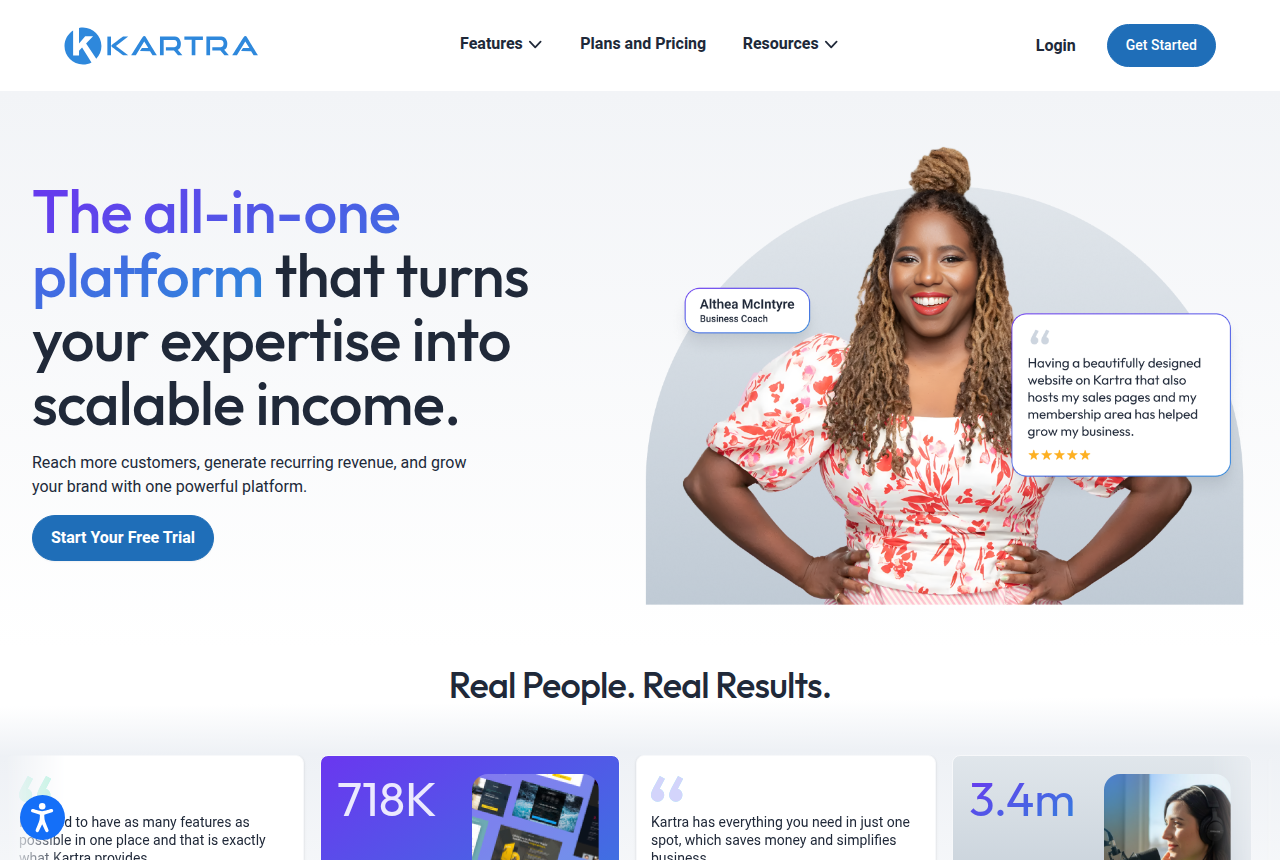
Kartra, run by Genesis Digital since 2018 and used by more than 60,000 creators, is the more complete marketing machine of the two. The funnel mapper lets you plan and simulate a multi-page journey before you build it, the checkout is designed to sell with order bumps, one-click upsells and Klarna installments, and more than 100 done-for-you campaign templates mean you rarely start from a blank page. Behavioral automation, a form builder, a built-in helpdesk and affiliate management round out a stack that genuinely replaces four or five separate tools, and billing is flat-rate with no usage fees stacked on top.
The trade-offs are real and worth knowing before you commit. Support speed is the loudest complaint from long-term users, with 2025 reviewers reporting waits of up to a week, which stings most during a launch when something breaks. The editor is capable but lags, and simple edits can take too many steps, so stress-test it on the trial before you build anything real. And the pricing is tiered against you at the bottom: the $59 Essentials plan takes 5% of every sale and caps you at 500 contacts, five pages and one product, so most real businesses need Starter at $119 a month, and affiliates, automation and the helpdesk only arrive on Growth at $229.
The case for Kajabi
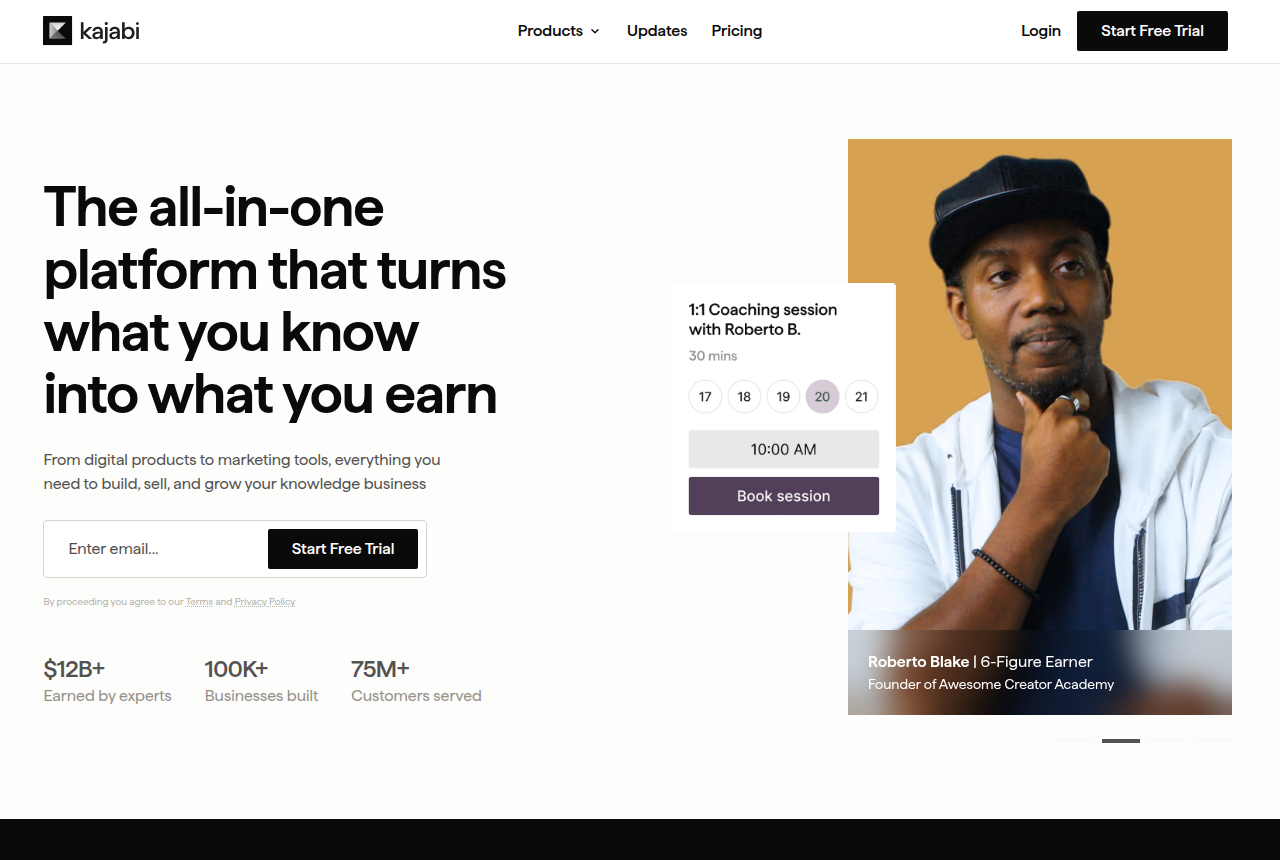
Kajabi comes at the same buyer from the delivery end. Since 2010 it has become one of the most complete homes for a knowledge business, and the consistent praise from long-time users is having everything in one place done well: courses with cohorts and drip content, a community, memberships, podcasts, email, landing pages, a checkout with subscriptions and upsells, and a branded mobile app on the top plan. If your product is a course people should finish or a membership they should renew, Kajabi's delivery is the strongest in this pair, and it takes no revenue share on any plan.
Its weak spot is cost, and it got worse in 2026. A January restructure raised plan prices, cut the entry Basic plan's contact limit to 2,500, and ended grandfathered rates for long-time customers, which drew a visible backlash. The entry price is now $179 a month with no free plan, so Kajabi only pays off once you are genuinely selling. Its funnel and checkout are also lighter than Kartra's, with fewer aggressive upsell and page-testing options, because that is not where Kajabi puts its energy.
If your growth is paid traffic, a third option
Both of these assume you are selling to an audience you build: a list, a following, a community. Neither is built around the paid ad click, and if your growth comes from buying traffic on Meta, Google or TikTok, there is a gap both leave that is worth naming before you commit.
ElasticFunnels is a funnel platform built for that buyer. Its lead feature is same-URL split testing: variants rotate server-side under one campaign link, so the ad platform keeps its optimization and a test never sends the ad back through review. Around that it builds the pages, with an AI builder that can generate a page from a prompt or clone one from a URL, hosts a checkout with order bumps, one-click upsells and subscriptions, and routes payments across more than one merchant account. It keeps the click, the order, the rebill and the refund on one record, with a CRM and attribution on the same data, so a media buyer can see which ad and which angle actually made money without reconciling exports from four tools.
Set against these two, it is narrower in one direction and wider in another. It is not a course-and-community home the way Kajabi is, so if delivering a membership experience is your product, Kajabi stays the better-fitted tool. Its multi-account payment routing only pays off if you already run more than one merchant account; a creator on a single Stripe account still gets the pages, the split testing, the checkout, the CRM and the attribution, just not that routing. What it adds over both Kartra and Kajabi is testing that does not reset ad learning and one source of truth for paid campaigns. The honest caveat is proof: ElasticFunnels is newer than either of these, and there is very little independent third-party review coverage to check its claims against, so until you run real volume through it you are largely taking the vendor's word for it. That is what you would expect of a platform this recent next to one running since 2018 and another since 2010. Its 14-day trial needs no card, every feature is on every plan from $97 a month, and it adds 0.5% only on revenue through its own hosted checkout, so you can prove the split testing and the checkout on your own campaigns first.
Which one for you
Pick Kartra if the selling machine is the bottleneck and you want the funnel, the checkout, the behavioral email and the affiliates doing the work, at a lower entry price. Pick Kajabi if the product is your own knowledge and the course, the community and the branded-app experience are what you want people to keep. And if the engine is paid traffic rather than an audience you already own, weigh a funnel platform like ElasticFunnels alongside both, then read our full Kartra review and Kajabi review before you commit. Still deciding? Browse our other head-to-heads and the full ranking.
Kartra
What works
- Genuinely covers the whole creator business under one roof: pages and funnels, email and SMS, a checkout, memberships and courses, calendars, affiliates and a helpdesk, so you stop paying for and wiring together five separate tools.
- Checkout is designed for selling, not just collecting money. You get branded order forms, coupons, buy-now-pay-later through Klarna, and one-click upsells aimed at lifting average order value.
- The funnel mapper lets you plan and simulate a multi-page journey before you build it, and more than 100 done-for-you campaign templates mean you rarely start from a blank page.
- Established and widely used. Kartra Inc. (Genesis Digital) has run it since 2018, with 60,000-plus customers, and billing is flat-rate with no surprise usage fees stacked on top.
- Plans above the entry tier take 0% of your sales, and a 30-day money-back guarantee lets you build a real funnel before you commit.
What to watch
- Support speed is the loudest complaint from long-term users. Trustpilot reviewers in 2025 report waits of up to a week for simple questions, which hurts most during a launch when something breaks.
- The editor is capable but slow. Reviewers describe lag and glitches, and simple edits taking too many steps. Stress-test it on the trial before you build anything real.
- It is expensive unless you use the whole suite. Buy it for one job, a landing page or email alone, and cheaper single-purpose tools win on price.
- The entry Essentials plan takes 5% of every transaction and caps you at 500 contacts, 5 pages and one product, so most real businesses need Starter at $119/mo or higher.
- It is not a full CRM: it tracks contacts, tags and purchases but has no deal stages, forecasting or task management if a sales team lives in a pipeline. And building everything inside one platform means lock-in, since the work does not transfer cleanly if you leave.
Kajabi
What works
- Runs the whole knowledge business from one login: courses, coaching, memberships, a community, email, landing pages, funnels and checkout, so you are not paying for five tools that do not talk to each other
- Built for delivery. The course builder, cohorts, community, podcasts and a branded mobile app make the student experience the strongest part, which is where a pure funnel builder is thin
- Takes no revenue share on any plan. You pay the monthly fee and card processing, and nothing extra per sale
- Well reviewed by long-time users, who most often praise having everything in one place and a builder that is straightforward to set up
- Checkout handles subscriptions, one-time payments, order bumps, upsells and downsells, with automated tax
What to watch
- Expensive, and more so since the January 2026 restructure. The entry Basic plan is now $179 a month (about $143 billed annually), its contact limit was cut to 2,500, and affiliates and advanced automations are locked to the $249 Growth plan and up
- Long-time customers lost grandfathered rates in the 2026 change, and price plus support are the two most common complaints in recent reviews
- If you only need to sell a simple offer through a hard-driving funnel, you are paying for course and community tools you may never open
- Its funnel and checkout are lighter than a dedicated funnel tool, with fewer aggressive upsell and page-testing options than ClickFunnels
- Some users find the initial setup time-consuming, and there is no dedicated tech support for your students
Pricing
Kartra: from $59/mo. Kartra has four plans, billed monthly or annually (annual saves up to 22%). Annual rates: Essentials $52/mo (500 contacts, 5 pages, 1 product, 1 course, and a 5% transaction fee on your sales), Starter $99/mo (2,500 contacts, unlimited pages and products, 0% transaction fees, webinars), Growth $189/mo (12,500 contacts, automations, affiliate management, surveys and quizzes), Professional $429/mo (25,000 contacts, real-time funnel analytics, API access). Paid monthly the same plans are $59, $119, $229 and $549. There is a 14-day free trial and a 30-day money-back guarantee.
Kajabi: from $179/mo. Basic is $179/mo (2,500 contacts, 5 products, 1 website), Growth $249/mo (25,000 contacts, 50 products, affiliate program and advanced automations), and Pro $499/mo (100,000 contacts, unlimited products, 3 websites, branded mobile app). Billing annually saves about 20%, bringing Basic to roughly $143/mo. Kajabi takes no revenue share on any plan, but its own payment processing runs 2.7% to 2.9% plus 30 cents per sale, and using a third-party processor adds 0.5% to 2% on top depending on plan. 30-day money-back guarantee.
Pricing verified against each vendor on 2026-09-28. Check before you buy.
Our pick
Kartra
Kartra is the pick if you sell courses, coaching or memberships and want funnels, checkout, email and a member area running under one login instead of a stack of separate tools. It is a real, established platform used by tens of thousands of creators. The catch is that it earns its price only when you use most of it: support is slow, the editor lags, and the cheapest plan skims 5% off the top.
Frequently asked questions
Kartra or Kajabi: which should I use?
Which is cheaper, Kartra or Kajabi?
Which is better for delivering an online course or membership?
Does Kartra or Kajabi take a cut of my sales?
What if your growth comes from paid ads?
Sources
Other sources
6 discussions and reviews read for this page. Quotes are excerpts; open a link to read the original in context.
- [tp-cache] https://www.trustpilot.com/review/kartra.com
- [tp-price] https://www.trustpilot.com/review/kartra.com?page=2
- [tp-mixed] https://www.trustpilot.com/review/kartra.com?page=4
- [cap-save] https://www.capterra.com/p/184946/Kartra/reviews/
- [cap-infusion] https://www.capterra.com/p/184946/Kartra/reviews/?page=3
- [sa-ui] https://www.softwareadvice.com/marketing/kartra-profile/reviews/

Written by
Dana Rourke
Lead reviewer
Dana Rourke is the lead reviewer at Campaign Buyer. She owns the tracker and attribution coverage: reading what long-term users report about each tool, checking its documentation and pricing, and verifying prices with the vendor before writing the verdict. Keeping the rankings honest mostly means writing down what the top pick gets wrong, so she does that first.
Last checked 2026-09-29