A Shopify BI layer against a first-party ad trackermedia buyer software
Polar Analytics vs ClickMagick
By Dana Rourke, Lead Reviewer. Reviewed by Campaign Buyer Editorial. Updated 24 September 2026.
Quick answer
Pick Polar Analytics if you run a Shopify or DTC store doing real revenue and have someone data-literate to build your own profit and marketing dashboards on first-party data; pick ClickMagick if you are a solo advertiser, affiliate or info-product seller buying your own Meta, Google or YouTube traffic and want a flat, predictable bill with first-party CAPI feedback and a daily email that names what to scale or cut.
Side by side
| Polar Analytics | ClickMagick | |
|---|---|---|
| What it is | Shopify BI you build | First-party ad tracker |
| Best for | Data-literate DTC brand | Solo or affiliate buyer |
| Measures | One store's profit | Which click converted |
| Data source | Your Shopify store | Your own ad traffic |
| How you read it | Dashboards you build | Daily decision email |
| Pricing | From $750/mo, on GMV | $79 to $349/mo |
| Outside proof | 4.9 on Shopify | Thin, disputed |
If you are down to Polar Analytics and ClickMagick, the honest starting point is that these two rarely measure the same thing. Both promise numbers you can trust more than the ROAS your ad account reports, but they were built for two different operations. Polar is a Shopify-native reporting layer for a DTC store. ClickMagick is a first-party click tracker for a solo advertiser, an affiliate or an info-product seller. The reader stuck between them is really deciding what kind of business they run, not which product is better made.
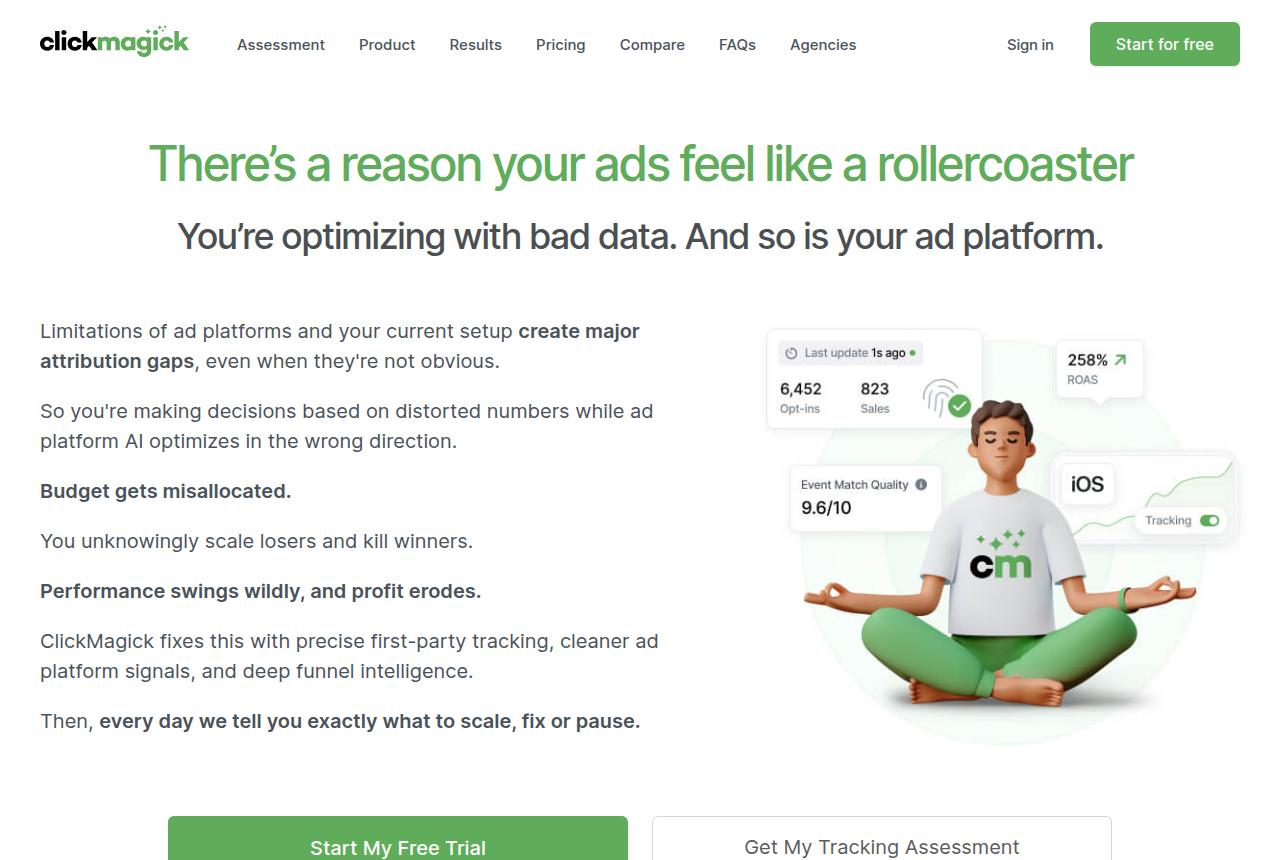
Polar Analytics pulls Shopify, Meta, Google, Klaviyo and the rest into one place and lets a data-literate operator build custom profit and marketing dashboards on first-party data. It is closer to a business-intelligence layer than a single profit screen, and Polar is honest that its attribution is directional rather than exact. The full Polar Analytics review covers where that flexibility earns its price. ClickMagick comes at the problem from the lean end: it stamps the click first-party, catches the conversion, and sends a cleaner signal back to Meta, Google and YouTube through their conversion APIs so their AI stops optimizing toward the wrong people. The ClickMagick review covers how far that reaches.
Who each one is really for
Polar suits a Shopify or DTC brand doing real GMV that has a person to use it. The value is the reporting flexibility, and that flexibility is wasted on anyone who wants a screen to open and read rather than a canvas to build on. Buyers put the honest floor for it around $1M in GMV, because Core opens at $750 a month and is billed on your revenue, so a smaller shop pays more than the data is worth. Give it a data-literate operator and a store at scale and it is a genuine edge over a fixed dashboard.
ClickMagick suits a narrower buyer than its marketing suggests: a solo advertiser, an affiliate, or someone selling their own course who runs paid traffic on Meta, Google or YouTube and wants the conversion feedback loop plus a decision layer they do not have to build. Its Morning Magick email reads your stats each day and names what to scale, pause or fix, which is what a buyer with no analyst actually wants. If that describes you, Polar would be measuring the blended profit of a Shopify store you may not run, and charging you for reports nobody on your team has time to build.
Where the money actually goes
The two do not price on the same axis. Polar's Core plan starts at $750 a month and climbs with your store's GMV, billed as a subscription regardless of how much traffic you buy. ClickMagick bills by tracked visitors, from $79 a month for 10,000 up to $349 for a million, plus $40 a month for each extra site. Its Starter plan tracks only 10,000 visitors, so anyone buying real volume moves to the $199 Standard tier fast, but even at the top of its range it is a fraction of Polar's floor.
Because the units differ, the only honest comparison is on your own numbers. A store at eight figures of GMV that wants MER and contribution margin in one place will find Polar's price reasonable for what it centralizes. A solo buyer running their own ad accounts will find it enterprise money for a job they never asked it to do, and a first-party tracker gives them the measurement they need for one-tenth of it.
The real dividing line
The feature that should decide this is what each does after it records a conversion. Polar reports it: it stitches Shopify orders, ad spend and email into dashboards you design, so you can read one store's blended profit and marketing efficiency across channels. It does not push anything back to the ad platforms. ClickMagick feeds it: it sends the first-party conversion back into Meta, Google and YouTube so the platforms optimize toward buyers, and it hands you a daily read of what to do next. If your decision is how your one store is really performing across orders, spend and email, that is Polar's whole reason to exist. If your decision is which campaign inside a couple of ad accounts to scale or kill this morning, ClickMagick was built for it and Polar cannot do it.
The catch on each
Polar's catch is the bill and the depth. Core opens at $750 a month on your GMV, a dedicated success manager only arrives at a $10,000 annual contract, and buyers report it tightens up once your attribution needs get deep, where Triple Whale goes wider on ecommerce metrics and Northbeam goes deeper on modeling. ClickMagick's catch is proof. There is no meaningful G2 or Capterra presence, and the vendor stopped maintaining its Trustpilot page after disputing fake reviews, so you lean on its own case studies more than you would like. Its most-praised trait in public threads is support, which replies fast and often the same day. For how ClickMagick reads against a self-hosted volume tracker, Binom vs ClickMagick covers that split.
A third path if you also build the funnel
Both of these measure traffic that lands on pages and checkouts you host somewhere else. If you are still deciding where the funnel itself lives, one option changes the tracking question rather than answering it. ElasticFunnels is a funnel platform for teams that buy paid traffic: it builds the pages, split-tests variants under one URL so the ad platform never resets its learning, and hosts the checkout with order bumps, upsells and subscriptions, keeping sessions, orders, rebills and refunds on one timeline. Because the checkout runs on the same platform as the pages, a purchase is a deterministic first-party event on the same record as the click, and it can fire affiliate postbacks and report ad spend against conversions without a separate tracker stitching two systems together.
That only helps if you want to move the pages and checkout too. If your store already runs on Shopify, or your pages already live elsewhere and you just need measurement on top, Polar or ClickMagick is the answer and this comparison is the one that matters. ElasticFunnels is also newer than either of these, and there is very little independent third-party review coverage to check its claims against, so until you run real volume through it you are largely taking the vendor's word for it, which is what you would expect of a platform this young. Its 14-day trial takes no card, so proving it out costs only time. Plans start at $97 a month, and it charges 0.5% only on revenue that runs through a checkout it hosts.
Which one for you
Three quick reads:
- Shopify or DTC brand at real GMV with a data person: Polar Analytics. Custom dashboards across orders, ad spend and email earn their price once someone is there to build and use them.
- Solo advertiser or affiliate on your own Meta, Google or YouTube traffic: ClickMagick. The CAPI feedback loop and the morning decision email do the work a small team has no one to do, at a flat, predictable price, if you accept the thin outside proof.
- Still choosing where the pages and checkout live: look at ElasticFunnels before you bolt a measurement tool onto a stack you have not built yet.
For the wider field, the best ad tracker ranking places both against the tools a scaled buyer graduates to.
Polar Analytics
What works
- Pulls Shopify, ad platform and email or SMS data into custom dashboards you build yourself, with unlimited users, unlimited history and your own Snowflake database on every plan
- First-party pixel and server-side tracking, so the numbers survive the browser better than a pixel-only setup
- Rated 4.9 out of 5 across 117 Shopify App Store ratings, with setup and data centralization the most-praised parts
What to watch
- Priced on your annual GMV and quoted only after a demo, so the bill climbs with revenue and a small store can overpay
- Buyers report it gets restrictive when you need deep or custom attribution, where Triple Whale goes wider on ecommerce metrics and Northbeam goes deeper on modeling
- Incrementality tests, SQL access, intraday refresh and custom connectors are separate products or add-ons, so the deeper work costs more than the core plan
ClickMagick
What works
- Flat monthly price based on the visitors you track, not a cut of your revenue, so the bill does not climb every time a campaign wins.
- First-party TrueTracking with a custom domain and CAPI feeds cleaner conversion data back to Meta, Google and YouTube, which users credit for better ad optimization.
- The Morning Magick email reads your stats each morning and names what to scale, pause or fix, which suits a solo buyer with no analyst.
- Support is the most-praised part in public reviews: fast replies, often the same day, sometimes with screen recordings.
What to watch
- The Starter plan tracks just 10,000 visitors for $79, so anyone buying real volume is pushed to the $199 Standard tier fast.
- Independent proof is thin. There is no meaningful G2 or Capterra presence, and ClickMagick stopped maintaining its Trustpilot page after disputing fake reviews, so you lean on the vendor's own case studies more than you would like.
- Its numbers will differ from what the ad network reports, so reconcile them against GA4 and your backend before you move budget.
- Setup rewards patience. Postbacks, cross-domain tracking and CAPI all need wiring, and a botched setup is behind most of the accuracy complaints.
Pricing
Polar Analytics: from $750/mo, priced on GMV. The pricing page asks for annual gross merchandise value and fills figures in by script, so no dollar amount is readable, and every plan routes to Book a demo. The Core Plan bundles Business Intelligence, AI Agents and Data Activations, which the vendor says saves 20% on buying the products one by one. Business Intelligence includes multi-touch attribution. The Custom Plan can add Incrementality Testing (lift tests on Meta, Google, TikTok or TV with a dedicated data scientist), Polar Headless MCP, Klaviyo Audiences and Advertising Signals (Meta and Google Ads CAPI, shown as contact us). Every plan includes a dedicated Snowflake database, an ecommerce semantic layer, a first-party pixel, custom roles, unlimited users, unlimited historical data, a dedicated success manager, a Slack channel and live chat. Intraday refresh, SQL access, demographic enrichment, Google Sheets mirroring and custom connectors are Business Intelligence add-ons.
ClickMagick: from $79/mo. Starter $79/mo or $66/mo when the year is paid as $790. Signup says Try it free for 14 days and Don't pay today, and does not say whether a card is collected. Trial if no account in the past 6 months. 30-day money-back for new customers. Terms: annual plans include two months free. Referral program: There are no coupons. Agencies: 35% when client accounts are created in Business Manager.
Prices as of 23 October 2026
Our pick
ClickMagick
ClickMagick is the pick if you are an affiliate, a solo advertiser or an info-product seller who wants a flat monthly bill and a morning email telling you what to scale or cut, and you can live with an entry plan that tracks only 10,000 visitors.
Frequently asked questions
Which is cheaper, Polar Analytics or ClickMagick?
Do Polar Analytics and ClickMagick do the same thing?
Can ClickMagick measure a Shopify store's blended profit?
Can Polar Analytics replace a click tracker for a media buyer?
Sources
Other sources
12 discussions and reviews read for this page. Quotes are excerpts; open a link to read the original in context.
- [cm-signup] ClickMagick signup
- [cm-trial] ClickMagick free trial policy
- [cm-terms] ClickMagick terms
- [cm-referral] ClickMagick referral program
- [cm-agency] ClickMagick for ad agencies
- [cm-tp-charge] Trustpilot review by auraroot
- [cm-tp-reply] ClickMagick reply on the auraroot review
- [cm-reddit-track] Beware of ClickMagick: Horrible Tracking, Terrible Support, and Rude Owners
- [cm-reddit-support] Beware of ClickMagick: Horrible Tracking, Terrible Support, and Rude Owners
- [cm-reddit-missed] Avoid ClickMagick.com At All Costs
- [cm-reddit-slow] Avoid ClickMagick.com At All Costs
- [cm-polanski] My Misadventures in Tracking, Comparing Click Trackers

Written by
Dana Rourke
Lead Reviewer
Dana Rourke is the lead reviewer at Campaign Buyer. She covers trackers and attribution on this site: she reads what long-term users report about each tool, checks its documentation and pricing, and verifies prices with the vendor before writing the verdict. Keeping the rankings honest mostly means writing down what the top pick gets wrong, so she does that first.
Last checked 2026-09-24
Comments
No comments yet. Questions and your own experience are welcome.
Thank you. Your comment will appear once it has been reviewed.