Polar Analytics vs Rockerbox
By Dana Rourke, Lead reviewer. Reviewed by Campaign Buyer Editorial. Updated 25 September 2026.
Quick answer
Pick Polar Analytics if you run a Shopify or DTC store doing real revenue and want to build your own profit and marketing dashboards on first-party data, with a data-literate operator to own them; pick Rockerbox if your media mix includes offline channels like connected TV, direct mail and podcasts and you have a data team to run an enterprise measurement platform.
Side by side
| Polar Analytics | Rockerbox | |
|---|---|---|
| What it is | Shopify BI you build | Unified measurement |
| Built for | Shopify or DTC brand | Mid-market, enterprise |
| Media mix | Digital paid media | Digital plus offline |
| Offline channels | Not the focus | CTV, mail, podcasts |
| What it measures | Blended store profit | Whole mix, 3 methods |
| Data export | Dashboards you build | Your own warehouse |
| Setup | Connect, then build | 6-8 week build |
| Pricing | $750/mo, GMV-scaled | Custom quote |
| Outside proof | 4.9 App Store (117) | 4.6 G2 (47), DV-owned |
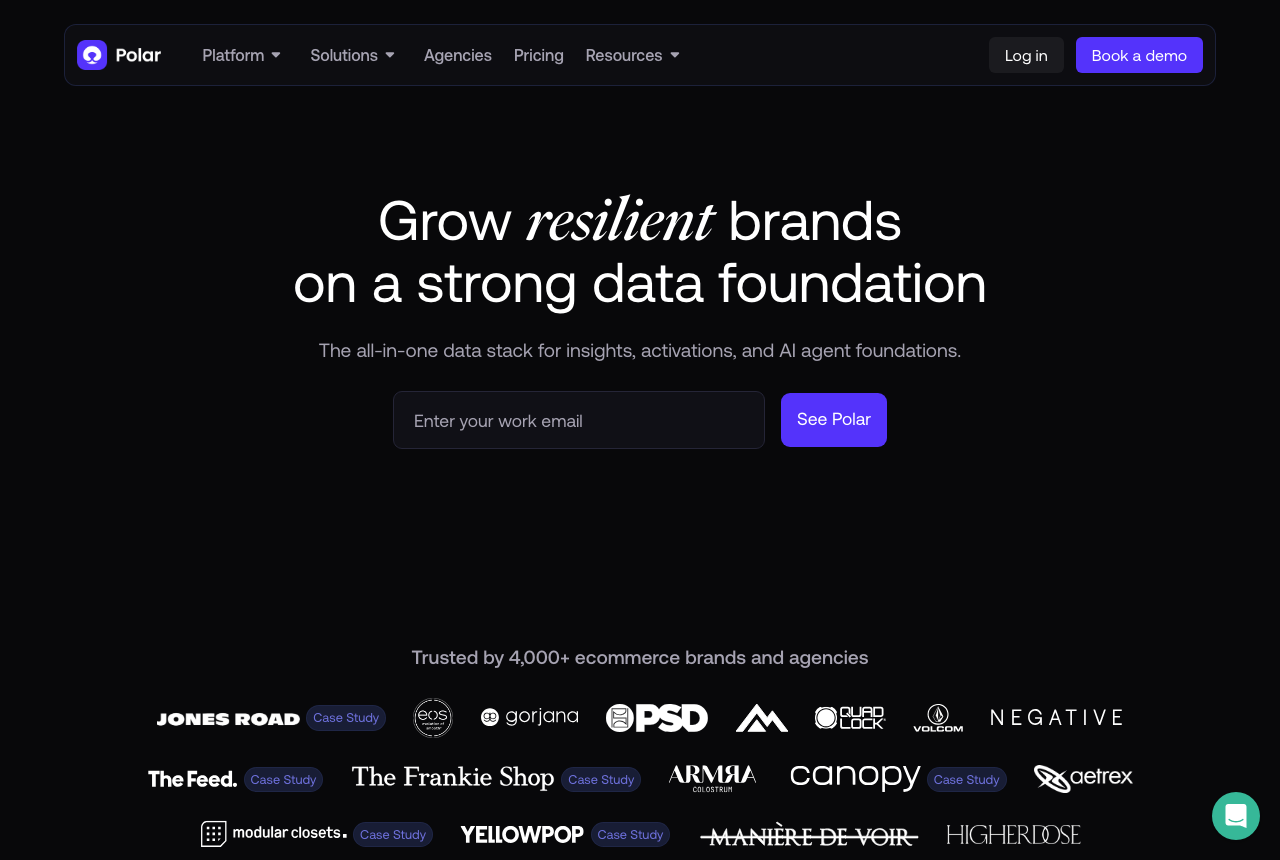
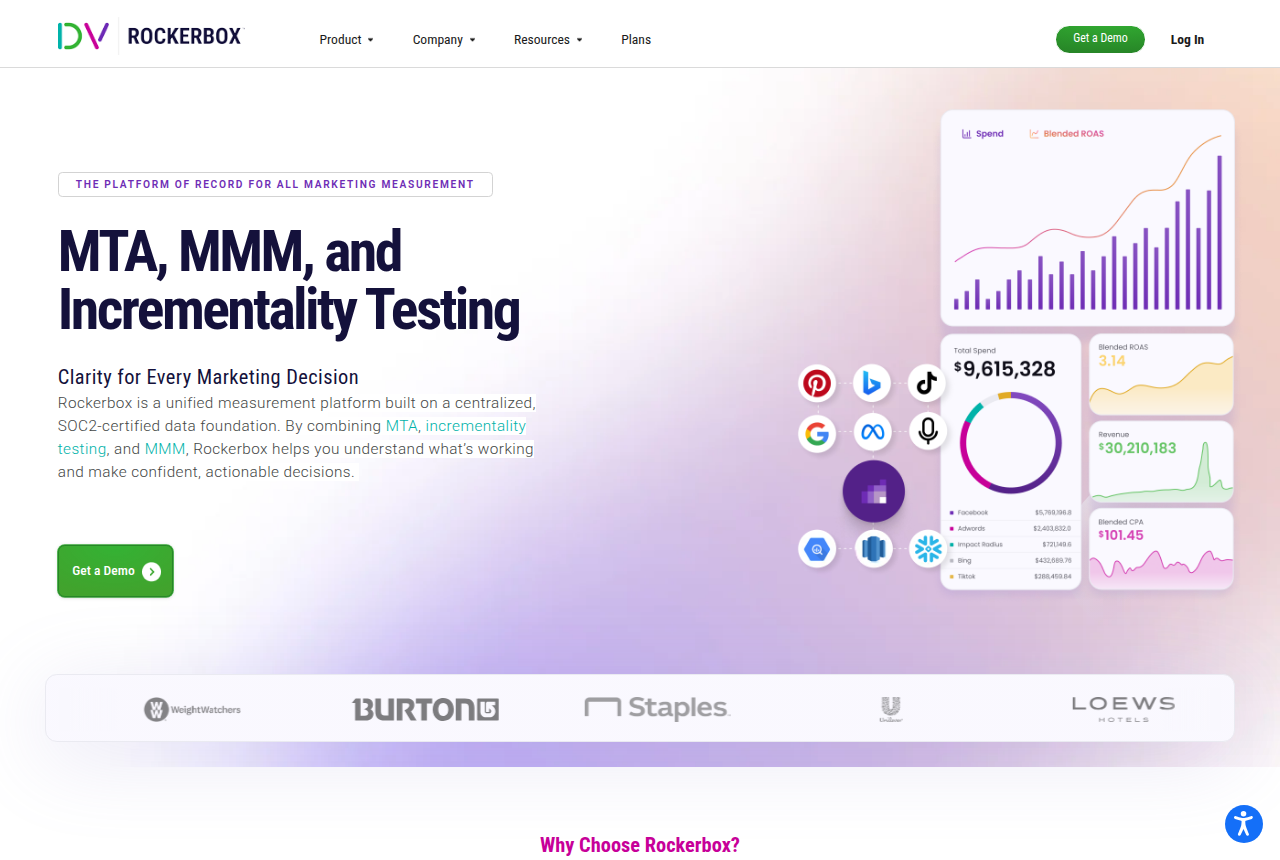
If you are down to Polar Analytics and Rockerbox, you are not choosing between a tracker and a spreadsheet. You are choosing between two ways of answering the same question, which of your marketing actually made money, built for two different sizes of company. Polar Analytics is a Shopify-native business-intelligence layer for a DTC brand: it centralizes a store's data so a data-literate operator can build the profit and marketing reports they want. Rockerbox is an enterprise measurement platform that reconciles offline and digital media into one model and pipes the cleaned data into your warehouse. Both are honest that the numbers are directional rather than exact. The reader stuck between them is really deciding how big their operation is and what is in their media mix, not which product is better made.
Polar pulls Shopify, Meta, Google, Klaviyo and the rest into one place and lets you assemble custom dashboards on first-party attribution, closer to a business-intelligence layer than a single profit screen. Rockerbox runs three modeled methods, multi-touch attribution, marketing mix modeling and incrementality, on one first-party foundation, and its edge is that it measures the offline channels most tools ignore. The prices point the same way as the ambitions: Polar opens at $750 a month priced on your GMV, and Rockerbox quotes an enterprise contract it does not publish.
The one question that decides it
Answer this before you compare a single feature: is your spend almost all digital and routed through a Shopify or DTC store, or does a real share of your budget go to offline and upper-funnel channels a pixel cannot see? If your problem is centralizing a store's orders, ad spend and email so someone can build the profit and marketing reports your team needs, that is Polar's problem to solve. If your problem is reconciling connected TV, linear TV, direct mail and podcasts next to your paid social and search, cross-checked three ways and fed into your own data warehouse, that is what Rockerbox is for, and Polar was never built to see those channels.
The second half of the question matters as much as the first: who runs the numbers? Both produce models and reports, not logged facts, and a report nobody reads is shelfware at four or five figures a month. Polar's value lives in the dashboards you build, so it assumes a data-literate operator to build them. Rockerbox needs a data owner too, plus a six to eight week setup. Neither is a tool you switch on and walk away from. If you do not have someone whose job is to act on the output, that is a reason to wait, not a reason to pick one over the other.
Polar Analytics: a Shopify BI layer you build yourself
Polar is the attribution tool for the brand that has outgrown a fixed dashboard and wants to build its own. It pulls Shopify, Meta, Google, Klaviyo and the rest into one place and lets a data-literate operator assemble custom reports, with unlimited users and historical data on the Core plan. Its attribution runs off a first-party pixel fed server-side, so the numbers survive the browser better than a pixel-only setup, and Polar is honest that they are directional rather than exact, which is the right way to read anything in this category. For a Shopify brand doing real GMV that wants reporting flexibility and a team that will use it, that is a fuller picture than a prebuilt profit screen gives you. It rates 4.9 out of 5 across 117 Shopify App Store ratings, with setup and data centralization the most-praised parts, and we rank it in our ecommerce attribution ranking for exactly that buyer.
The honest caveats are the bill and who has to drive it. Core opens at $750 a month priced on your GMV, so the figure climbs with revenue and a smaller shop pays more than the data is worth. Buyers report it gets restrictive once your attribution needs go deep or custom, and a dedicated success manager only arrives at a $10,000 annual contract, with some reviewers below that flagging slow support and connector delays. And because the value is in the reports you build, a team without a data-literate operator buys a canvas nobody paints on. The full Polar Analytics review covers how it holds up in practice.
Rockerbox: measurement across the whole mix
Rockerbox runs the same three methods as any serious measurement platform, multi-touch attribution, marketing mix modeling and incrementality, on one first-party data foundation, so you cross-check three readings instead of trusting one. Its real advantage over Polar is breadth. It measures the offline and view-through channels a Shopify-first tool ignores: connected TV, linear TV, direct mail, podcasts, influencers and billboards, reconciled next to your paid social and search. It exports its cleaned dataset to your own warehouse in BigQuery, Redshift or Snowflake, so the numbers feed your BI stack rather than locking you into its dashboards, it holds SOC2 certification, and since March 2025 it has the backing of a public parent in DoubleVerify, which bought it for around $82 million. This is an established platform, not a young product.
The cost of that breadth is friction. There is no public pricing and no self-serve: you book a demo and get a custom quote scoped to your channels and the modules you turn on, sized for mid-market and enterprise budgets, so you cannot even price it before a sales call. Setup is heavy, roughly six to eight weeks for MTA or MMM, and it needs developer time plus Rockerbox's own team, so it becomes shelfware without a data owner to run it. Reviewers report reporting bugs, especially on view-through channels like TikTok and YouTube where the platforms share less data. And its output is a model that someone has to read as directional rather than exact. For a brand with the mix and the team it is built for, none of that is a dealbreaker. For a Shopify store that wants to start this quarter, all of it is friction Polar does not have. The full Rockerbox review walks through the setup and the sentiment.
Where they actually differ
Strip away the marketing and three differences decide this. The first is offline. Polar is Shopify-first and digital, while Rockerbox reconciles offline media into the same model, so if TV, mail or podcasts are a real line in your budget, Rockerbox is the only one of the two that sees them. The second is how you get the data. Polar is a dashboard you build and log into; Rockerbox pipes its cleaned dataset into your own warehouse so it feeds a wider BI stack, which matters when you already have a data team that wants to model on top of it. The third is how you buy and who it is for. Polar publishes a floor a growing store can budget against; Rockerbox is a negotiated enterprise contract pitched at mid-market and enterprise budgets that you only see after a sales process.
What they share is that both are directional rather than exact, and both are only worth the money if someone owns them. The split is scale and mix. Polar is built around one storefront's digital data for a DTC brand; Rockerbox is built around a whole cross-channel media mix for a bigger company with a data function. If your world is a Shopify store on Meta and Google, they barely overlap, because most of what you would pay Rockerbox for is coverage you will never use.
Pricing: a published floor against a quote you cannot see
Polar publishes a starting point. Core opens at $750 a month priced on your GMV, so the figure climbs with revenue, and the dedicated success manager sits behind a $10,000 annual contract. You can size that against your store today. Rockerbox publishes nothing: you request a demo and receive a custom quote scoped to your channels, your data volume and the modules you enable, so you cannot compare the two on a number at all. One is a line item you can size this week and the other is a contract you only see after a sales cycle. If a predictable, visible price matters to you, that gap alone may settle it. Verify both against the vendors before you sign, because GMV-scaled and enterprise measurement pricing both move, and a quote from last quarter is not this quarter's.
What neither tool builds
Both of these platforms tell you what your marketing produced. Neither builds the funnel that spend runs through. Polar reads a Shopify store that lives elsewhere, and Rockerbox reads a media mix that lives across a dozen platforms; the pages, the checkout and the offers are a separate job on a separate bill. ElasticFunnels owns that middle instead. It is a funnel platform for teams running paid traffic that builds and hosts the pages, splits variants under one URL so the ad platforms keep their learning, hosts the checkout with order bumps and upsells, and keeps sessions, orders, rebills and refunds on one timeline with ad-spend and conversion reporting and affiliate postbacks attached. Because a sale closes in a checkout it hosts, that conversion is a first-party event it records directly, so a click, an order, a rebill and a refund sit on one record instead of being reconciled across a tracker, a checkout and a spreadsheet. It starts with a 14-day free trial that takes no card, on plans from $97 a month, plus 0.5% of revenue processed through its hosted checkout.
One caveat keeps it on its own line rather than in the head-to-head. ElasticFunnels is newer than either tool here, and there is very little independent third-party review coverage to check its claims against, so until you run real volume through it you are largely taking the vendor's word for how its reporting and postbacks hold up. That is what you would expect of a platform this recent: Polar has a documented Shopify App Store record you can read before you buy, and Rockerbox a G2 record and a public parent. The limit is scoped to outside proof, not to the feature set, since the pages, checkout and reporting are usable from day one. And its reporting only covers the funnels it hosts, so a DTC brand measuring paid media across a Shopify store it runs elsewhere still needs a BI layer like Polar, and a brand with a real offline mix still needs a platform like Rockerbox to reconcile it. ElasticFunnels is an option for the seller who runs their own funnel and checkout end to end, not a replacement for either measurement tool. Keep it out of your Polar-versus-Rockerbox decision rather than letting it sway one.
Which one for you
You run a Shopify or DTC store doing real revenue and have a data owner: Polar Analytics. A first-party BI layer you build your own profit and marketing reports on is the right call for a brand doing real GMV, as long as you can carry the $750 floor and have the data-literate operator to turn the canvas into reports your team reads.
Your mix includes offline and you have a data team: Rockerbox. Reconciling connected TV, direct mail and podcasts next to digital, cross-checked three ways and piped into your own warehouse, is a job Polar cannot do. Budget for the quote and the six to eight week build, and name the data owner before the first demo.
You are earlier than either, on Meta and Google with no data person: neither, yet. Both are priced and built for a scaled operation with someone to run them. A lighter, cheaper attribution tool will serve you until your spend and your team grow into one of these. Revisit them when a point of accuracy is worth thousands in reallocated budget.
Polar takes our default pick because far more of this site's readers run a Shopify or DTC store on digital paid media than run the offline, enterprise media mix that justifies Rockerbox. That is a statement about who is reading, not about which platform is built better. For a brand with real offline spend and a data team, Rockerbox is plainly the better fit, and Polar is not in the running. If you are weighing two measurement tools for a store rather than an enterprise, our Triple Whale vs Polar Analytics comparison is the next one to read, and if you want the enterprise side against a digital-first modeling platform, Northbeam vs Rockerbox takes that step.
Polar Analytics
What works
- Pulls Shopify, ad platform and email or SMS data into custom dashboards you build yourself, not a fixed template, with unlimited users and historical data on the Core plan
- First-party pixel and server-side tracking, so the numbers survive the browser better than a pixel-only setup
- Rated 4.9 out of 5 across 117 Shopify App Store ratings, with setup and data centralization the most-praised parts
What to watch
- Core opens at $750 a month and is priced on your GMV, so the bill climbs with revenue and a small store overpays
- Buyers report it gets restrictive when you need deep or custom attribution, where Triple Whale goes wider on ecommerce metrics and Northbeam goes deeper on modeling
- A dedicated success manager only arrives at a $10,000 annual contract, and some reviewers below that flag slow support and connector delays
Rockerbox
What works
- Runs multi-touch attribution, marketing mix modeling and incrementality testing on one data foundation, so you cross-check three methods instead of trusting a single number
- Measures the offline and view-through channels most tools ignore: connected TV, linear TV, direct mail, podcasts and billboards, reconciled next to digital
- Exports its cleaned first-party dataset to your own warehouse (BigQuery, Redshift, Snowflake), so the numbers feed your BI stack rather than locking you into its dashboards
- SOC2-certified data foundation, and since March 2025 the backing of a public parent in DoubleVerify
What to watch
- No public pricing and no self-serve. You book a demo and get a custom quote pitched at mid-market and enterprise budgets, so a small store cannot price it before a sales call
- Setup is heavy: MTA or MMM take about six to eight weeks and need developer time plus Rockerbox's own team, and it becomes shelfware without a data owner to run it
- Reviewers report reporting bugs and dashboards that break, especially on view-through channels like TikTok and YouTube where platforms share less data
- The output is still a model, not the truth. Even paired with incrementality it needs someone who can read directional numbers rather than treat them as exact
Pricing
Polar Analytics: from $750/mo, priced on GMV. Pricing is tiered by annual online GMV and quoted after a demo; the vendor's pricing page publishes no dollar figure. The Core Plan bundles Business Intelligence, Klaviyo Audiences, Advertising Signals and Polar MCP and is stated to save 20% versus buying products individually; a Custom Plan lets you pick products a la carte. Every plan includes a dedicated Snowflake database, the ecommerce semantic layer, a first-party pixel, unlimited users and unlimited historical data, and a dedicated success manager.
Rockerbox: from a custom quote. Rockerbox does not publish pricing. It is sold through a demo and quoted per company based on your channel mix and measurement needs, and is pitched at mid-market and enterprise budgets. You choose which products you take (Data Foundation, MTA, MMM, Testing). Implementation runs about 1 to 2 weeks for testing and 6 to 8 weeks for MTA or MMM, depending on data readiness.
Pricing verified against each vendor on 2026-09-23. Check before you buy.
Our pick
Polar Analytics
It is the pick if you run a Shopify store doing real revenue and want to build your own BI dashboards on first-party attribution, rather than live in a prebuilt operator screen. The catch is the bill. Core starts at $750 and is billed on your GMV, so a smaller shop pays more than the data is worth, and reviewers say it tightens up once your attribution needs get deep.
Frequently asked questions
Polar Analytics or Rockerbox: which should I use?
Which is cheaper, Polar Analytics or Rockerbox?
Do Polar Analytics and Rockerbox do the same thing?
Can Polar Analytics measure offline channels like TV and direct mail?
How long does each take to set up, and do I need a data person?
Is Rockerbox worth it over Polar for a Shopify store on Meta and Google?
Sources
Other sources
5 discussions and reviews read for this page. Quotes are excerpts; open a link to read the original in context.
- [fb-juggernaut] TripleWhale vs. Polar Analytics
- [fb-marknine] TripleWhale vs. Polar Analytics
- [fb-founder] TripleWhale vs. Polar Analytics
- [shop-nomastacos] Is it just me, or is the price for some apps getting obscene?
- [shop-nomastacos-gmv] Is it just me, or is the price for some apps getting obscene?

Written by
Dana Rourke
Lead reviewer
Dana Rourke is the lead reviewer at Campaign Buyer. She owns the tracker and attribution coverage: reading what long-term users report about each tool, checking its documentation and pricing, and verifying prices with the vendor before writing the verdict. Keeping the rankings honest mostly means writing down what the top pick gets wrong, so she does that first.
Last checked 2026-09-25