A cloud ad tracker against an enterprise measurement platformmedia buyer software
RedTrack vs Rockerbox
By Dana Rourke, Lead Reviewer. Reviewed by Campaign Buyer Editorial. Updated 23 October 2026.
Quick answer
Pick RedTrack if you buy paid traffic and need accurate conversions counted and fed back to Meta and TikTok from your first dollar of spend; pick Rockerbox if you are a mid-market or enterprise brand spending across many channels, including offline like connected TV, direct mail and podcasts, and you have a data owner to run a modeled measurement platform.
Side by side
| RedTrack | Rockerbox | |
|---|---|---|
| What it is | Click-level ad tracker | Unified measurement |
| How it measures | Deterministic click IDs | Modeled, three methods |
| Feeds ad platforms (CAPI) | Yes | No, models only |
| Offline channels | No | CTV, mail, podcasts |
| Data export | Dashboards first | Your own warehouse |
| Best-fit spend | Any, from $1 | Mid-market, enterprise |
| Setup | An afternoon of wiring | 6-8 week build |
| Entry price | Free Relay, then paid tiers | Custom quote |
If you are down to RedTrack and Rockerbox, start by dropping the idea that one is a better version of the other. One is a click-level ad tracker and the other is an enterprise measurement platform, and the reader who is genuinely torn between them is really deciding what kind of measurement problem they have. RedTrack counts the conversion and sends it back to the ad platforms so they keep optimizing. Rockerbox models how a whole, mixed budget, including offline, actually produced revenue. That difference decides this more than any single feature does.
RedTrack stamps every click with its own ID, catches the conversion server-side, and pushes it back to Meta, TikTok and Google through their conversion APIs, so the platforms keep learning on data the browser pixel now drops. Rockerbox blends first-party clicks with view-through and statistical models to run multi-touch attribution, marketing mix modeling and incrementality on one data foundation, then tells a large brand where its next budget dollar should go. One keeps your pixels honest from your first dollar of spend. The other tells a data team how to move a mixed, seven-figure budget.
The one question that decides it
Answer this before you compare a single feature: what is in your media mix, and who will run the numbers? If your spend is digital paid media and you need conversions counted deterministically and fed back to the ad platforms, RedTrack is built for exactly that, and it does the job from your first dollar. If a real share of your budget goes to offline and upper-funnel channels like connected TV, linear TV, direct mail and podcasts, and you need all of it reconciled next to your digital spend in one model, Rockerbox is built for that and RedTrack cannot see it.
The second half of the question matters as much as the first. A tracker's numbers do not reconcile until the setup is right, and a model nobody reads is shelfware at four or five figures a month. RedTrack rewards an afternoon of wiring postbacks and mapping conversions; once that is done it largely runs itself. Rockerbox needs a data owner and a six to eight week build, or the models sit unopened. With nobody whose job is to act on the output, the simpler tool is the right one.
RedTrack: deterministic tracking that feeds the platforms
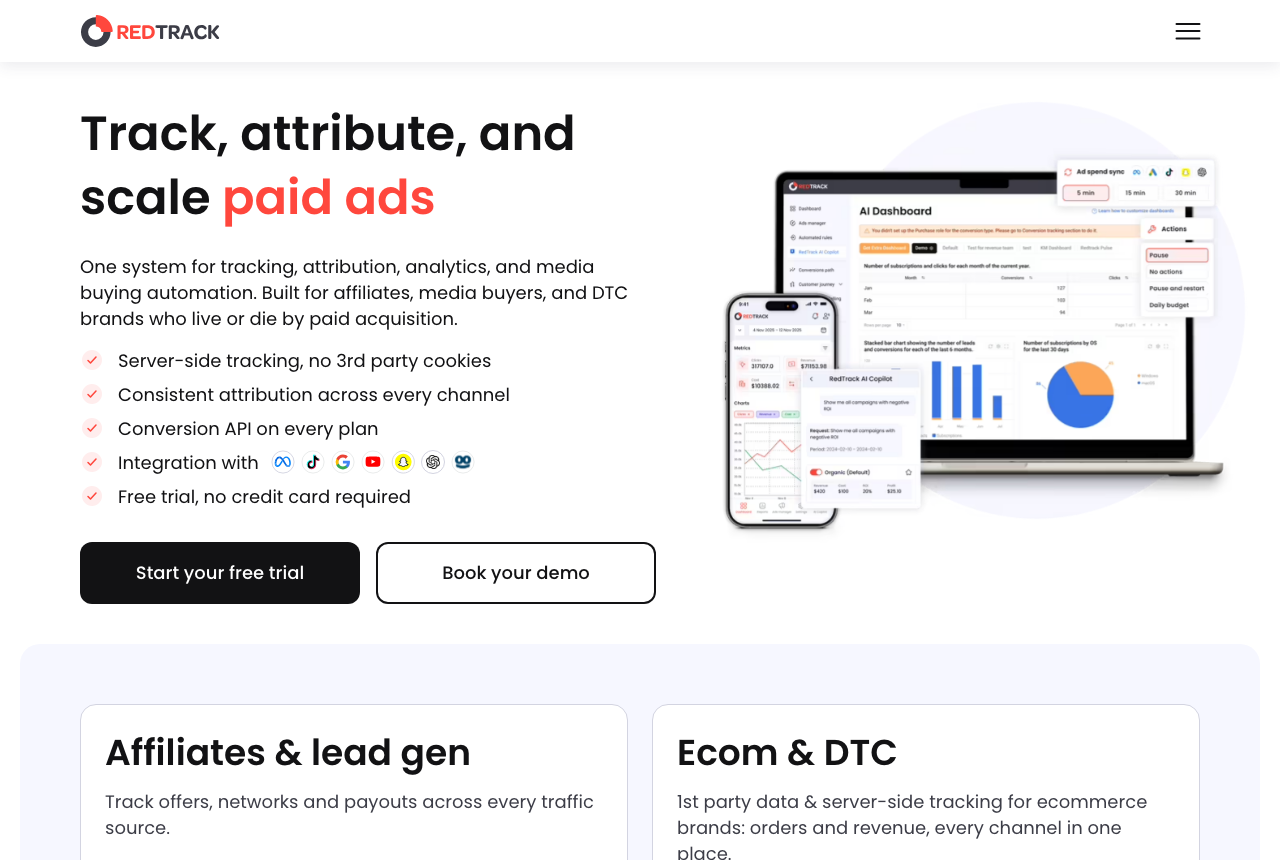
RedTrack answers the problem most media buyers hit first. The browser pixel keeps losing conversions, the ad platform keeps over-reporting ROAS, and you cannot optimize on numbers you do not trust. RedTrack tracks the click deterministically with its own ID, records the conversion on its servers, and pushes it back through CAPI so Meta and TikTok keep learning. Cost is pulled from the ad platforms automatically, so the dashboard shows tracked profit rather than a number you assemble by hand. One account covers affiliate offers, lead-gen forms and ecommerce checkouts.
The economics are the other half of the case. Ecommerce tiers follow tracked revenue, starting with the free Relay plan for UTM last-click reporting, and the affiliate and lead-gen tiers follow event volume, with overage billed per thousand events while tracking keeps running. The honest catch is the on-ramp: postbacks, conversion mapping and traffic-source tokens take real time to wire up, and the interface is dense and looks dated next to newer dashboards. Budget an afternoon, and expect the first numbers to drift until the mapping is right.
Rockerbox: measurement across the whole mix
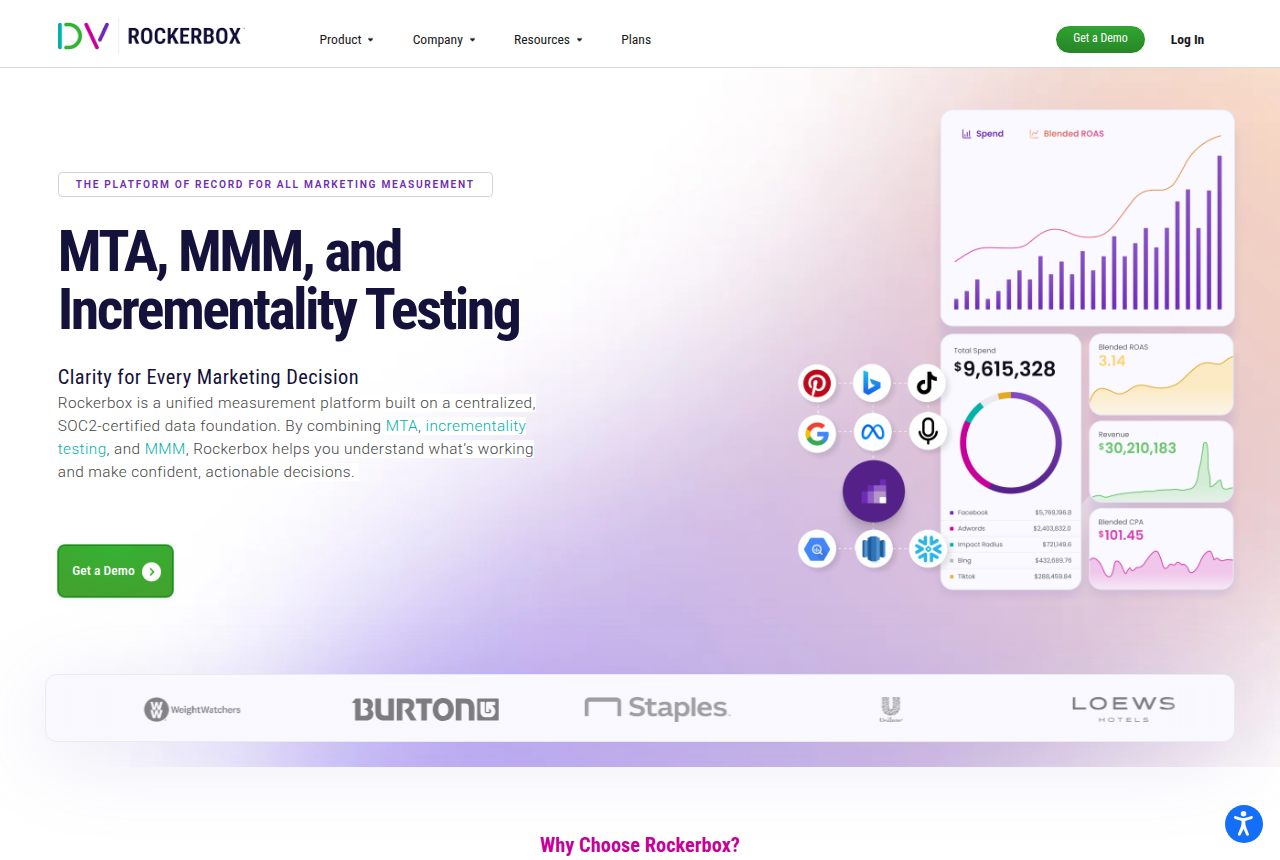
Rockerbox answers a broader question than RedTrack, for a bigger company. It runs multi-touch attribution, marketing mix modeling and incrementality testing on one first-party data foundation, so you cross-check three readings instead of trusting one. Its real edge is breadth, including offline: connected TV, linear TV, direct mail, podcasts, influencers and billboards, reconciled next to your paid social and search. It exports its cleaned dataset to your own warehouse in BigQuery, Redshift or Snowflake, so the numbers feed your BI stack. It holds SOC2 certification, and since March 2025 it has the backing of a public parent in DoubleVerify, which bought it for around $82 million.
The cost of that breadth is friction. There is no public pricing and no self-serve: you book a demo and get a quote scoped to your channels and the modules you enable. Setup is heavy, roughly six to eight weeks for MTA or MMM, and it needs developer time plus Rockerbox's own team. Reviewers also describe bugs in its reports, especially on view-through channels like TikTok and YouTube where the platforms share less data. For a brand with the mix and the team it is built for, that is the price of the breadth. For a media buyer who just needs conversions counted and fed back to the ad accounts, all of it is more platform than the job requires.
Where they actually differ
Strip away the marketing and three differences decide this. The first is what the output even is. RedTrack gives you a deterministic count: this click, from this source, produced this conversion, and here it is sent back to the platform, a record you can reconcile line by line. Rockerbox gives you a model: across every channel, here is the share of revenue each one probably drove once view-through and offline paths are weighed, an estimate you cannot audit line by line. Both are approximations, and each is useful for a different decision.
The second is offline. RedTrack is a digital click tracker and sees nothing that did not start with a click it stamped, so television, direct mail and podcasts are invisible to it. Rockerbox reconciles those channels into the same model, which is the whole reason it costs what it costs. The third is the feedback loop, and here RedTrack has the edge for a buyer: it pushes conversions back to Meta, TikTok and Google so bidding keeps improving, while Rockerbox measures and models but does not feed the ad accounts. If your daily job is keeping the platforms optimizing, that is a real point in RedTrack's favor.
Pricing: a price you can see against a quote you cannot
The sticker difference tells the whole story. RedTrack publishes its tiers, from the free Relay plan up through revenue-priced ecommerce plans and event-priced affiliate plans, so you can size it against your spend before you talk to anyone. Rockerbox prints nothing, and its sales team scopes a quote to your channels, your data volume and the modules you enable, pitched at large brands. The gap shows how differently the two are sold: a self-serve tracker is priced for the buyer who wants every sale reported back to the ad platforms, which is nearly everyone running paid traffic, and an enterprise contract is priced for the brand where reallocating a mixed budget by a few points is worth the fee many times over. Make any Rockerbox demo prove the tracking on your own numbers before you sign.
What neither tool builds
Both of these tools tell you what your spend produced. Neither builds the funnel that spend runs through. RedTrack tracks the clicks and Rockerbox models the channels, but both assume the pages and the checkout already exist somewhere else. ElasticFunnels is a funnel platform for teams running paid traffic that owns that middle: it builds and hosts the pages, splits variants under one URL so the ad platforms keep their learning, hosts the checkout with order bumps and one-click upsells, and keeps sessions, orders, rebills and refunds on one timeline with ad-spend and conversion reporting and affiliate postbacks attached. Its reporting layer is lighter than a dedicated measurement platform, and it does not run mix models or lift tests across offline channels the way Rockerbox does, so it replaces neither tool for that job. It fits a paid-traffic team that wants the funnel and its own spend-to-sale reporting in one place, and it runs a 14-day trial with no card. The honest limit is that it is newer than both tools on this page, and there is very little independent third-party review coverage to check its claims against, which is what you would expect of a platform this new, so until you run real volume through it you are largely taking the vendor's word for how the reporting holds up. It is worth a look here only for a team that hosts its own offer, which the next section covers.
Which one for you
You buy paid traffic and your conversions are drifting from the platform's numbers: RedTrack. Deterministic tracking plus CAPI is exactly the fix, and its published tiers mean you never pay for modeling you will not act on yet. Budget an afternoon for the setup and the numbers will reconcile.
Your mix includes offline and you have a data team: Rockerbox. Lining up TV, mailers and podcast reads with digital, cross-checked three ways and piped into your own warehouse, is a job RedTrack cannot do. Budget for the quote and the six to eight week build, and name the data owner before the first demo.
You host your own offer and want the spend and the sale in one place: look at ElasticFunnels alongside them, with the newness caveat above in mind, then add a tracker later if your traffic ever leaves your own domains.
RedTrack is our default pick because most of this site's readers run digital paid traffic and want each sale counted and sent back to the platforms. Brands with an offline mix and analysts to staff Rockerbox are a much smaller group. For a brand with real offline spend and a data owner, Rockerbox is plainly the better fit, and RedTrack is not in the running.
RedTrack
What works
- CAPI and server-side postbacks are built in, so conversions reach Meta and TikTok even after the pixel drops them
- Pulls ad spend from the platforms automatically, so ROI is calculated for you
- Every paid plan carries CAPI, ad-spend sync and Stop Rules, from Solo at $169/mo with 5M events
- Handles affiliate, lead-gen and ecommerce tracking from one account
What to watch
- First-time setup takes a long time. Postbacks and conversion mapping have to be configured by hand.
- The interface is dense and looks dated next to newer dashboards
- Event-based pricing means a traffic spike can push you into the next tier mid-month
Rockerbox
What works
- Runs multi-touch attribution, marketing mix modeling and incrementality testing on one data foundation, so you cross-check three methods instead of trusting a single number
- Measures the offline and view-through channels most tools ignore: connected TV, linear TV, direct mail, podcasts and billboards, reconciled next to digital
- Exports its cleaned first-party dataset to your own warehouse (BigQuery, Redshift, Snowflake), so the numbers feed your BI stack rather than locking you into its dashboards
- SOC2-certified data foundation, and since March 2025 the backing of a public parent in DoubleVerify
What to watch
- No public pricing and no self-serve. You book a demo and get a custom quote pitched at mid-market and enterprise budgets, so a small store cannot price it before a sales call
- Setup is heavy: MTA or MMM take about six to eight weeks and need developer time plus Rockerbox's own team, and it becomes shelfware without a data owner to run it
- Reviewers describe buggy reports and dashboards that break, especially on view-through channels like TikTok and YouTube where platforms share less data
- Every figure is a modeled estimate, so it needs a reader who can act on ranges, even with incrementality tests calibrating the models
Pricing
RedTrack: from free Relay, Solo from $118/mo. Affiliate Solo: $169/mo list, or $1,420 billed yearly ($118/mo) at the Black Friday rate of 30% off the 12-month price, which the pricing page says is kept on renewal. 5M events/mo, 1 user, 5 ad accounts per ad platform, overage $0.04 per 1K events. Team $399/mo list, $279/mo ($3,352/yr) at the Black Friday rate, 20M events, 5 users. Enterprise $999/mo list, $699/mo ($8,392/yr) at the Black Friday rate, 75M events, 15 users. Ecom plans are priced by annual tracked revenue: Relay is free for one store with UTM last-click attribution. Brand is $99/mo list at the $250K tier, $832 billed yearly at the Black Friday rate, with three stores and multi-touch attribution. Agency is $599/mo list at the $250K tier, $5,032 billed yearly at the Black Friday rate. During the promotion the paid add-ons also show lower yearly prices than their monthly list prices.
Rockerbox: from a custom quote. No public price. Sold through a demo. The plans page lets a buyer choose a data foundation plus analysis products: multi-touch attribution, marketing mix modeling and incrementality testing. The FAQ says most companies set up foundational data within a few weeks and can then use MTA, while MMM and testing need more time. No free tier is listed.
Prices as of 23 October 2026
Our pick
RedTrack
Pick RedTrack if you run paid social or an ecommerce store and need server-side conversions sent back to the ad platform from one account.
Frequently asked questions
Which is cheaper, RedTrack or Rockerbox?
Do RedTrack and Rockerbox do the same thing?
Can RedTrack measure offline channels like TV and direct mail?
Which should a brand spending under six figures a month choose?
Does either offer a free trial?
Sources
Other sources
10 discussions and reviews read for this page. Quotes are excerpts; open a link to read the original in context.
- [r1] How to Setup Facebook Pixel Conversion API + Event Deduplication
- [r2] Has anyone been getting a deduplication Pixel error?
- [r3] Need help regarding setting up CAPI
- [rt-home] RedTrack homepage
- [rt-events] Plans and Pricing
- [rt-accounts] Plans and Pricing compare table
- [rt-capi] Plans and Pricing trial line
- [rt-addons] Plans and Pricing trial add-ons
- [rt-help-event] What qualifies as an event
- [rt-nocard] RedTrack vs BeMob

Written by
Dana Rourke
Lead Reviewer
Dana Rourke is the lead reviewer at Campaign Buyer. She covers trackers and attribution on this site: she reads what long-term users report about each tool, checks its documentation and pricing, and verifies prices with the vendor before writing the verdict. Keeping the rankings honest mostly means writing down what the top pick gets wrong, so she does that first.
Last checked 2026-10-23
Comments
No comments yet. Questions and your own experience are welcome.
Thank you. Your comment will appear once it has been reviewed.