Shogun vs GemPages
By Dana Rourke, Lead reviewer. Reviewed by Campaign Buyer Editorial. Updated 24 September 2026.
Quick answer
Pick Shogun if you are an established Shopify store with a content team that publishes many pages against one storefront and needs reusable sections, version history and a review workflow, and can absorb its $199 or $499 tier to get them; pick GemPages if you run paid traffic and want the conversion funnel built in, the advertorial pre-sale, offer A/B testing and post-purchase upsells, at a lower entry price and with the easier build.
Side by side
| Shogun | GemPages | |
|---|---|---|
| Best for | Stores with a content team | Paid-traffic stores testing offers |
| Entry price | $39/mo (free drafts) | $29/mo (free: 1 page) |
| Conversion funnel tooling | Not its focus | Advertorial to upsell, built in |
| Offer A/B testing | Bolt on a separate app | Built in |
| Post-purchase upsells | Needs a separate app | Native, but metered |
| Reusable sections, versioning | Its main draw | Basic |
| Team review workflow | On $199 and $499 tiers | Limited |
| Editor to build in | Buyers call it slow | GemAI plus 400+ templates |
| Shopify App Store reviews | ~1,970 | 4.9 stars, ~4,246 |
| Mobile page weight | Flagged heavy, injects a pixel | Also flagged heavy |
If you are down to Shogun and GemPages, you have already made the bigger call: an on-store Shopify builder, not a standalone landing page tool. Both install as Shopify apps, render pages inside your theme, read your live product and cart data, and hand the visitor into native checkout without a detour. So this is not a contest between two philosophies. It is two builders aimed at genuinely different jobs, and the honest question is which job is yours.
Shogun is the builder an established store reaches for when several people publish pages against one storefront and the operation needs governing. GemPages is the builder a paid-traffic store reaches for when its profit turns on a pre-sale page, an offer test and an upsell working together. They open within a few dollars of each other, so price is not the fork. What you need the builder to do is.
The one question that decides it: page operations, or the conversion funnel?
Answer that before you compare a single feature. If you run an established store with a content team, ship pages constantly, and your pain is keeping shared sections consistent and pages reviewed before they go live, you are Shogun's buyer. If you run paid traffic and your money is made when a pre-sell warms the visitor, an offer test picks the winner and an upsell lifts order value, you are GemPages's buyer. Both are good at what they are for. The mistake is paying Shogun's upper tiers for a review workflow a solo buyer will never open, or reaching for a governance tool when your profit lives in the funnel.
Shogun: page operations for a content team
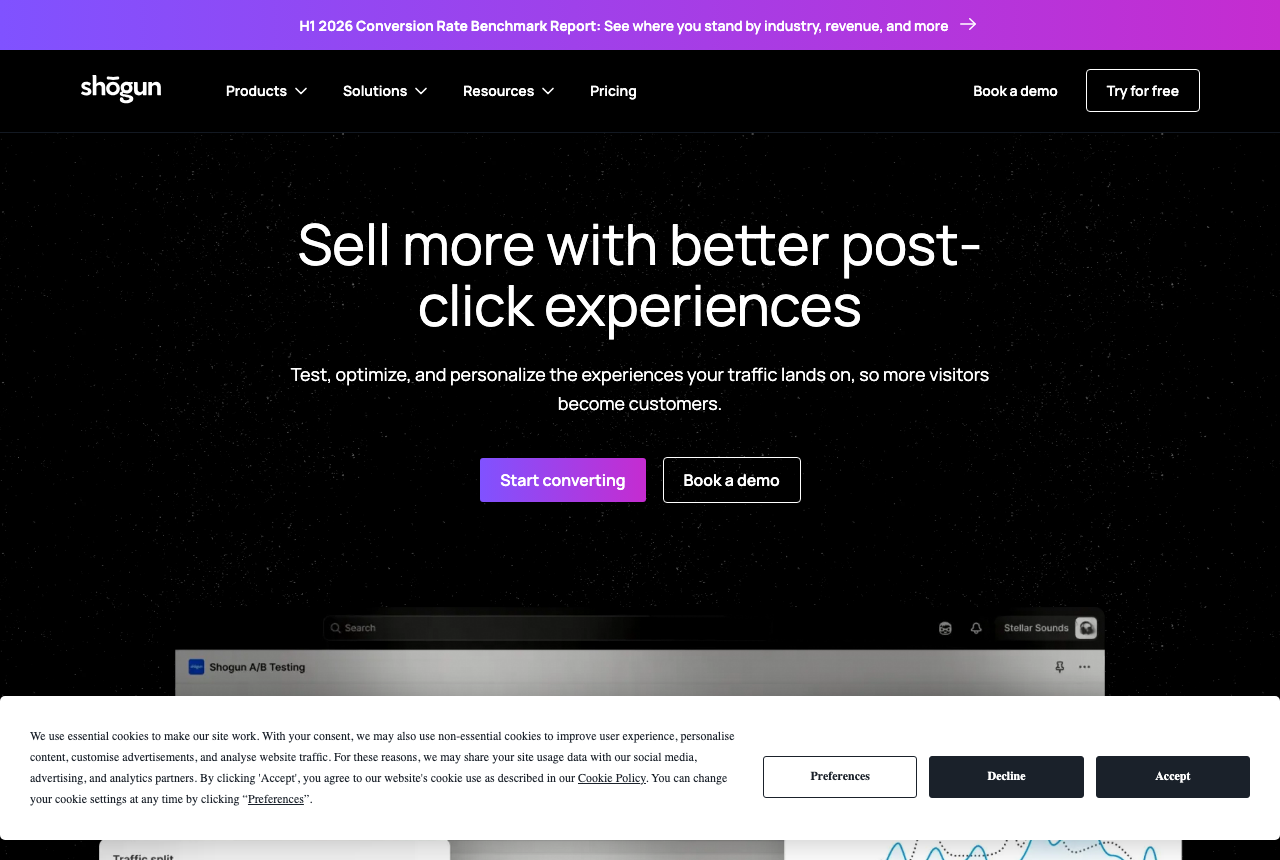
Shogun is aimed at the store that has outgrown a solo builder. Reusable sections, version history and a review workflow are its real draw, and they matter when several people publish pages against one storefront: a change to a shared section propagates, an edit can be rolled back, and a page can be checked before it goes live. It carries a long track record and one of the larger review bases in the category, and you can build in a free draft mode before you commit to a paid plan. For a team running structured content operations, that governance is the reason to look, and it is where Shogun still earns its place over a cheaper builder.
Two things hold it back for a buyer scaling ads. The editor is the complaint that comes up again and again: buyers describe it as slow to load, laggy to drag and slow to save, enough that some reverted to plain Shopify pages. And its useful tiers are expensive. The governance features that are the whole reason to choose it sit on the $199 and $499 a month plans, well above what GemPages charges for a comparable page-building job. Shogun is not built around the ad funnel either: offer A/B testing and post-purchase upsells are not its focus, so a store running offers ends up bolting on separate apps to do what GemPages does in one place.
GemPages: the conversion funnel built for paid traffic
GemPages is the on-store builder that treats the ad funnel as one object. The advertorial or listicle pre-sale page, the sales page, offer A/B testing and the post-purchase upsell are built into the tool rather than stitched together from three separate apps. For a media buyer pointing cold traffic at a Shopify store, that is the shape you want: warm the visitor on a pre-sell, test which offer converts, then lift average order value on the thank-you page, all in one place and all reading live product data.
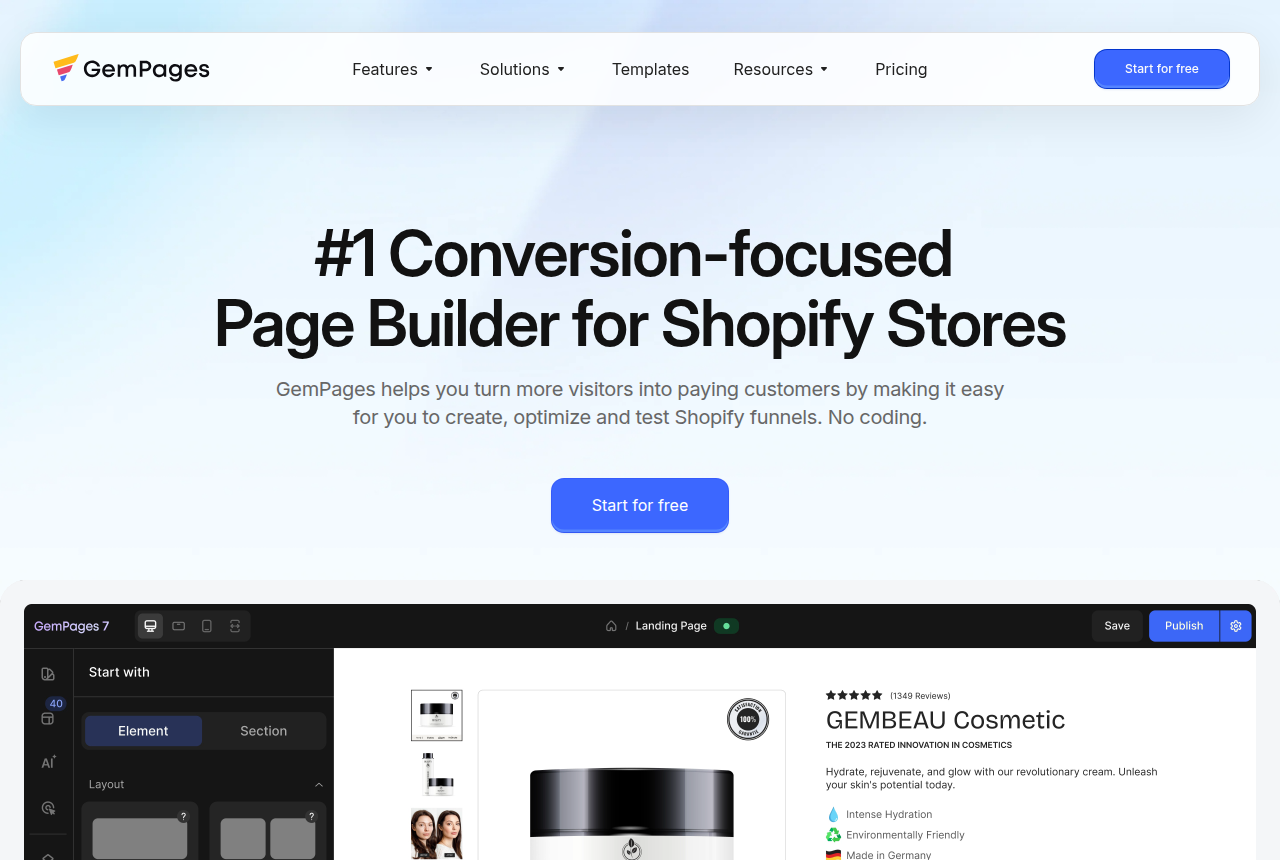
It backs that with the smoother build experience of the pair. GemAI turns a reference image into an editable layout, the template library runs past 400, and CRO elements like a countdown timer, a stock counter and a popup come standard, so you add urgency without a second app. It is one of the most-liked builders in the category, holding a 4.9-star rating on the Shopify App Store across several thousand reviews, so the funnel tooling is not a rough edge bolted onto a weak editor.
The honest costs are two, and both matter for a paid-traffic buyer. The recurring complaint is front-end speed: reviewers report pages loading slowly, one describing a product page that took 15 to 20 seconds, and slow loads are the tax a media buyer feels most, because ads are judged on the slowest quarter of loads. And the funnel's headline feature is metered. Lower plans cap post-purchase upsell volume at $100 a month, the $59 Optimize plan charges a commission on upsell revenue, and the fee only disappears on the $199 Enterprise tier. Read the upsell terms on the plan you would actually buy before you count that revenue.
Both are heavy, so the discipline is the same
Do not read the speed line as a reason to pick one over the other. Every on-store builder adds front-end weight, and both of these do. Older Shogun feedback flags heavy output plus a self-injected tracking pixel, and GemPages draws the same slow-page complaint from its own reviewers, one describing a 15-to-20-second product page. The rule holds whichever you buy: use the builder for the campaign and landing pages that change often, keep your core theme, product pages and collections native, and test the built page on a throttled mobile connection before you point spend at it. Paid traffic is judged on the slowest loads, not the average, so the phone test is the one that matters.
Pricing: close at the door, different further in
The entry prices sit ten dollars apart, Shogun at $39 a month and GemPages at $29, and both let you build before you pay: Shogun in a free draft mode, GemPages on a free plan that publishes one live page. The gap opens above that, and it opens on different things. Shogun's real features, reusable sections, version history and the review workflow, live on its $199 and $499 tiers, so the price you pay is set by whether you need the governance. GemPages's higher tiers, $59 Optimize and $199 Enterprise, are where the upsell metering eases and finally clears. New GemPages customers can no longer choose annual billing either, so its monthly figure is the figure you pay. Read both on the plan your store actually needs, because the limits that bite, Shogun's team features on one side and GemPages's upsell fees on the other, sit above each tool's entry tier, not on it.
A third path if you would rather run your own checkout
Both tools stop at the same line: they build the page and hand the visitor to Shopify's native checkout. That is exactly what most Shopify stores want. But if your margin turns on the checkout itself, order bumps, one-click upsells, subscription dunning, or routing a charge across several merchant accounts you already hold, then the page is only half the funnel, and neither builder owns the other half. ElasticFunnels is one platform that owns the whole path instead: it builds the pages, including an AI builder that writes a page from a prompt or clones one from a URL, runs same-URL split tests so a variant test never changes the campaign link or sends the ad back through review, and hosts its own checkout with order bumps, one-click upsells and multi-account routing. It offers a 14-day free trial with no card, so you can build a real page and a test before you pay. The honest limit to weigh is that it is newer than Shogun or GemPages, and there is very little independent third-party review coverage to check its claims against, so until you run real volume through it you are largely taking the vendor's word for it, which is what you would expect of a platform this new. It also replaces Shopify's native checkout rather than building on top of your theme, so it only fits a seller who actually wants to leave that checkout behind. For the on-store, page-plus-funnel job Shogun and GemPages do inside Shopify, the two builders here remain the direct answer. Keep ElasticFunnels on its own line of the decision rather than treating it as a tiebreaker between these two.
Which one for you
You run an established store with a content team: Shogun. Reusable sections, version history and a review workflow are what keep many pages consistent across one storefront, and no cheaper builder here matches that governance. Budget for the $199 or $499 tier where those features live, and try the editor in free draft mode first, because its speed is the thing buyers regret.
You run paid traffic and your money is made in the funnel: GemPages. The advertorial pre-sale, offer A/B testing and post-purchase upsell are built into one tool, and for a store that lives on ads that loop is worth more than Shogun's page-operations depth, at a lower price. Read the upsell metering on your plan and test your pages on a phone before you scale spend.
Your profit turns on the checkout, not the page: look at ElasticFunnels alongside them, with the newness caveat above in mind, but only if you are prepared to run your own checkout instead of Shopify's.
Shogun
What works
- Reusable sections, version history and review workflow suit a team publishing many pages, not a solo buyer
- A long track record and a large review base on the Shopify App Store
- You can build a page in the free draft mode before you commit to a paid plan
What to watch
- The editor is the recurring gripe: buyers call it unbearably slow to build in, enough that some revert to plain Shopify pages
- The useful tiers jump to $199 and $499/mo, well above PageFly for a comparable job
- Older feedback flags the same front-end weight the category is known for, and that it injects its own tracking pixel
GemPages
What works
- Genuinely conversion-focused: a pre-sale advertorial or listicle page, the sales page, upsells and offer A/B testing are built into one funnel, not bolted on from separate apps.
- Easy to build without code, with a 400+ template library and GemAI that turns a reference image into an editable layout. It holds a 4.9-star rating on the Shopify App Store across several thousand reviews.
- A real free plan publishes one live page, so you can build and ship before you pay anything.
- CRO elements like a countdown timer, stock counter and popup upsell come standard, so you add urgency and social proof without a second app.
What to watch
- Front-end weight is the recurring complaint. Reviewers report pages loading slowly, one describing a product page that took 15 to 20 seconds, which is the trade a paid-traffic buyer feels most.
- Support is hit or miss. Trustpilot reviewers praise it, but low-star reviews report slow replies and no coverage during European business hours.
- Post-purchase upsells are metered: lower plans cap upsell volume at $100 a month, and the Optimize plan charges a commission on upsell revenue until you jump to the $199 Enterprise tier.
- New customers can no longer choose annual billing, so the monthly price is the price you pay.
Pricing
Shogun: from $39/mo. A free draft mode lets you design before paying. The tiers run $39, $199 and $499 a month, checked against the vendor listing.
GemPages: from $29/mo. Free plan publishes one page. Paid tiers billed monthly: Build $29/mo (unlimited published pages), Optimize $59/mo (adds headless instant pages, all design elements, priority support), Enterprise $199/mo (Shopify Plus, dedicated support, no upsell commission). New customers can no longer choose annual billing. 30-day money-back guarantee. No time-limited trial; the free plan is the way to test it. Post-purchase upsell is metered: Free and Build include $100/month of upsell volume, Optimize lifts that to unlimited but charges a commission as revenue grows, and only Enterprise removes that commission.
Pricing verified against each vendor on 2026-09-09. Check before you buy.
Our pick
GemPages
GemPages is the pick if you run a Shopify store, want a builder genuinely built around conversion, and you will keep it to campaign pages and funnels rather than your whole store. It is one of the most-liked builders in its category, and its funnel and upsell tools go further than most rivals. The catch is the one the whole category has, front-end weight, plus a cut of your upsell revenue until you reach the $199 Enterprise plan.
Frequently asked questions
Shogun or GemPages: which should I use?
Which is cheaper, Shogun or GemPages?
Are Shogun and GemPages the same kind of tool?
Which one is better for running ads to a Shopify store?
Why is Shogun more expensive than GemPages?
Is Shogun's editor really that slow?
Which is lighter on my store?
Sources
Other sources
6 discussions and reviews read for this page. Quotes are excerpts; open a link to read the original in context.
- [vapefiend-appstore] GemPages Shopify App Store review — Vapefiend, 2 stars
- [mahi-appstore] GemPages Shopify App Store review — MAHI Leather, 2 stars
- [mindfit-appstore] GemPages Shopify App Store review — MindFit, 1 star
- [dudefood-appstore] GemPages Shopify App Store review — Dude Food, 3 stars
- [hollyb-trustpilot] GemPages Trustpilot review — Holly B
- [tony-trustpilot] GemPages Trustpilot review — Tony

Written by
Dana Rourke
Lead reviewer
Dana Rourke is the lead reviewer at Campaign Buyer. She owns the tracker and attribution coverage: reading what long-term users report about each tool, checking its documentation and pricing, and verifying prices with the vendor before writing the verdict. Keeping the rankings honest mostly means writing down what the top pick gets wrong, so she does that first.
Last checked 2026-09-24