Simple affiliate tracking: software vs appmedia buyer software
RedTrack vs BeMob
By Dana Rourke, Lead Reviewer. Reviewed by Campaign Buyer Editorial. Updated 9 September 2026.
Quick answer
Pick RedTrack if you buy media across sources and need server-side postbacks and CAPI that scale with real spend; pick BeMob if you are still learning or spending lightly and want a genuine free tier to test on before you pay for anything.
Side by side
| Tool | CAPI | S2S postbacks | Cost sync | Self hosted | From |
|---|---|---|---|---|---|
| 1. RedTrack | –Unknown | –Unknown | –Unknown | –Unknown | $118/mo |
| 5. BeMob | –Unknown | –Unknown | –Unknown | –Unknown | Free tier |
If you searched for a simple affiliate tracking tool and ran into the question of software versus an app, here is the honest version of the fork. In affiliate tracking, "app" almost always means a plugin that lives inside one platform you already run, a Shopify referral app being the common case. "Software" means a standalone tracker you log into on its own, wire your traffic sources into, and point at any offer on any domain. The dividing line is where your conversions happen. If every sale closes inside one store, a platform app is enough, and you should stop reading and go install one. If you buy media across Meta, Google, native or email and send it to offers on more than one domain, a store plugin cannot see traffic it did not originate, and you need standalone software.
Most people reading this are in the second camp, which is why this page puts two standalone trackers side by side. RedTrack and BeMob are the two a simple-affiliate buyer usually ends up choosing between: BeMob because it starts free, RedTrack because it is the one most buyers graduate to. They do the same core job, built for two very different stages of the same journey.
BeMob: the free place to learn
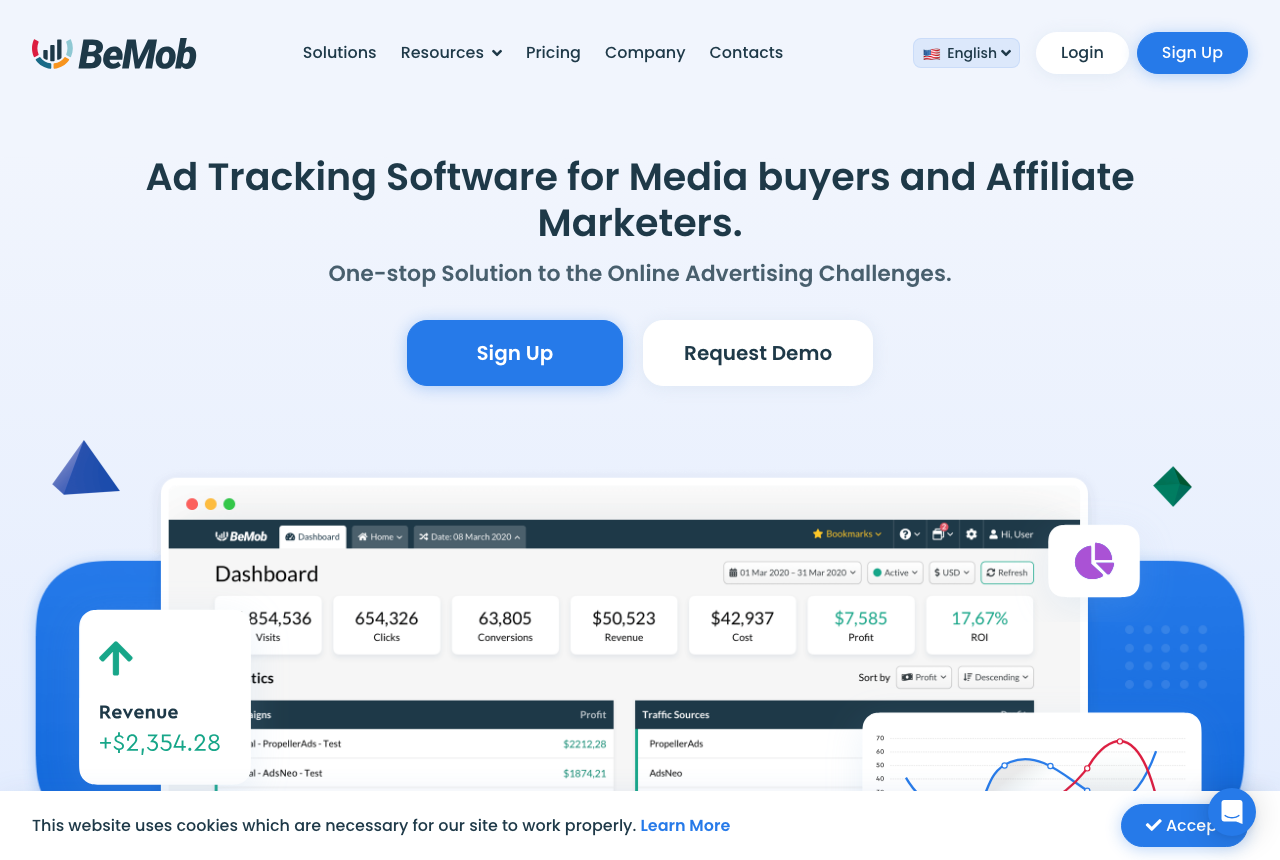
BeMob is the gentlest on-ramp into tracking that exists. The free plan is a working tracker with no time limit: ten campaigns, real landing-page and offer management, and reporting good enough to understand how postbacks and traffic tokens actually behave. For a buyer validating a first funnel, it is the right place to make the early mistakes before money is on the line. Paid entry is cheap as well, and because it is cloud-hosted there is nothing to install or keep patched.
The limits arrive faster than beginners expect. BeMob counts every impression, visit, click and conversion as an event, so the free allowance disappears the moment you run impression-heavy traffic like native or push. Custom tracking and cloaking domains, which most serious campaigns need, only start on the $249 Business plan. BeMob is excellent at getting you tracking for free while you work out whether an offer is worth scaling, and most buyers leave the free tier once one is.
RedTrack: the software you grow into
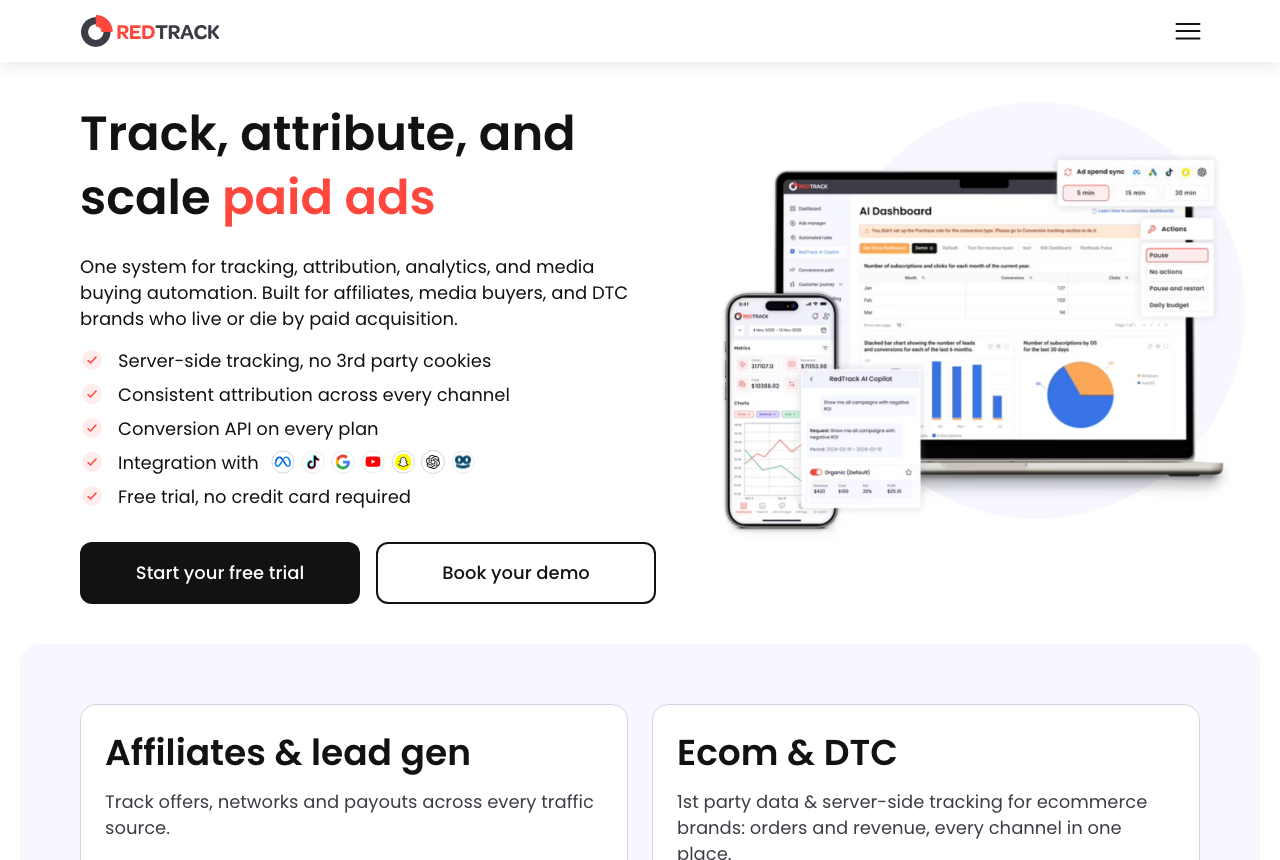
RedTrack is the standalone software most buyers move to once real spend is flowing. Its whole design assumes the modern problem: browser pixels keep dropping conversions and ad platforms keep over-reporting ROAS. So conversions are sent back to Meta and TikTok through CAPI, cost is pulled from the ad platforms automatically, and the dashboard shows tracked profit instead of a number you assemble by hand. One account covers affiliate offers, lead-gen forms and ecommerce checkouts. Affiliate and lead-gen plans start with Solo at 5M events a month, ecommerce brands can begin on the free Relay plan, and RedTrack is the tracker we rank first overall.
The catch is the on-ramp. Postbacks, conversion mapping and traffic-source tokens take real time to wire up correctly, and buyers arriving from a pixel-only world underestimate it. The interface is dense and looks dated next to newer dashboards. Budget an afternoon for setup, and expect the first numbers to disagree with the ad platforms until the mapping is right. After that, RedTrack largely runs itself, and it keeps doing the job long after BeMob's free events would have run out.
How to choose between the two
Stage and traffic type decide this. If you are testing your first offers, spending lightly, or simply want to learn tracking without a bill, BeMob's free tier is the correct answer and nothing else here beats free. The moment you are running consistent paid social or ecommerce traffic, need conversions flowing back to the platforms, or start watching BeMob's event counter climb toward its cap, RedTrack is the better home. Many buyers do both in sequence: learn on BeMob, then move to RedTrack when the spend justifies the depth. That order keeps the bill at zero until the traffic pays for it.
One thing neither tool changes is the work you still own. A tracker reports what you tell it to track, so whichever you pick, the setup discipline (clean postbacks, consistent tokens, a number that reconciles against the ad platform) is what makes the data trustworthy. Pick the tool for your stage, then spend the afternoon getting the wiring right.
A third route: tracking built into the app that hosts the sale
If you sell your own offer through a checkout or funnel app, that app may be able to fire the affiliate postbacks itself, so the tracking comes with a tool you already pay for. ElasticFunnels works this way. It is a funnel platform for teams running paid traffic, and it sends server-side postbacks to affiliate networks on purchase, refund, chargeback and renewal from its own checkout, which suits a vendor who runs pages, checkout and reporting in one place and does not want a second login. It starts with a 14-day free trial that takes no card, on plans from $97 a month plus 0.5% of revenue processed through its hosted checkout.
Its drawback is a short public record: it is newer than both trackers here and has very little independent review coverage, while RedTrack has years of public setups and threads behind it. That is normal for a platform this young, and the no-card trial lets you check its numbers against your network's before you rely on them. For a media buyer whose traffic closes on offers they do not host, a dedicated tracker is still the right call.
The bottom line
"Software versus app" is mostly a wording problem. If all your conversions happen inside one platform, use that platform's app. If they do not, you want standalone software, and the real choice narrows to which one for your stage. BeMob to learn on for free. RedTrack to scale on once the spend is real. Start where you are, and move when the event counter or the missing conversions tell you to.
RedTrack
What works
- CAPI and server-side postbacks are built in, so conversions reach Meta and TikTok even after the pixel drops them
- Pulls ad spend from the platforms automatically, so ROI is calculated for you
- Every paid plan carries CAPI, ad-spend sync and Stop Rules, from Solo at $169/mo with 5M events
- Handles affiliate, lead-gen and ecommerce tracking from one account
What to watch
- First-time setup takes a long time. Postbacks and conversion mapping have to be configured by hand.
- The interface is dense and looks dated next to newer dashboards
- Event-based pricing means a traffic spike can push you into the next tier mid-month
BeMob
What works
- A genuinely usable free plan: 100K events, 10 campaigns and real reporting
- Cheap paid entry at $49/mo for 1M events
- Cloud-hosted, so there is nothing to install or maintain
What to watch
- 100K free events disappear fast once you log impressions or run any volume
- Custom tracking domains only start on the $249 Business plan
- Less depth than Voluum or RedTrack once you scale past testing
Pricing
RedTrack: from $118/mo. Affiliate Solo: $169/mo list, or $1,420 billed yearly ($118/mo) at the Black Friday rate of 30% off the 12-month price, which the pricing page says is kept on renewal. 5M events/mo, 1 user, 5 ad accounts per ad platform, overage $0.04 per 1K events. Team $399/mo list, $279/mo ($3,352/yr) at the Black Friday rate, 20M events, 5 users. Enterprise $999/mo list, $699/mo ($8,392/yr) at the Black Friday rate, 75M events, 15 users. Ecom plans are priced by annual tracked revenue: Relay is free for one store with UTM last-click attribution. Brand is $99/mo list at the $250K tier, $832 billed yearly at the Black Friday rate, with three stores and multi-touch attribution. Agency is $599/mo list at the $250K tier, $5,032 billed yearly at the Black Friday rate. During the promotion the paid add-ons also show lower yearly prices than their monthly list prices.
BeMob: from $0/mo.
Prices as of 23 October 2026
Our pick
RedTrack
Pick RedTrack if you run paid social or an ecommerce store and need server-side conversions sent back to the ad platform from one account.
Frequently asked questions
Which is cheaper, RedTrack or BeMob?
Is affiliate tracking software different from an affiliate tracking app?
Is there a genuinely free affiliate tracker?
Do I need CAPI for affiliate tracking?
Can an app builder like MIT App Inventor track affiliate sales?
Should I build my own affiliate tracking instead of buying it?
Sources
Other sources
10 discussions and reviews read for this page. Quotes are excerpts; open a link to read the original in context.
- [r1] How to Setup Facebook Pixel Conversion API + Event Deduplication
- [r2] Has anyone been getting a deduplication Pixel error?
- [r3] Need help regarding setting up CAPI
- [rt-home] RedTrack homepage
- [rt-events] Plans and Pricing
- [rt-accounts] Plans and Pricing compare table
- [rt-capi] Plans and Pricing trial line
- [rt-addons] Plans and Pricing trial add-ons
- [rt-help-event] What qualifies as an event
- [rt-nocard] RedTrack vs BeMob

Written by
Dana Rourke
Lead Reviewer
Dana Rourke is the lead reviewer at Campaign Buyer. She covers trackers and attribution on this site: she reads what long-term users report about each tool, checks its documentation and pricing, and verifies prices with the vendor before writing the verdict. Keeping the rankings honest mostly means writing down what the top pick gets wrong, so she does that first.
Last checked 2026-09-09
Comments
No comments yet. Questions and your own experience are welcome.
Thank you. Your comment will appear once it has been reviewed.