Two standalone landing page builders, comparedmedia buyer software
Unbounce vs Leadpages
By Dana Rourke, Lead Reviewer. Reviewed by Campaign Buyer Editorial. Updated 24 September 2026.
Quick answer
Pick Unbounce if you run a paid-search account at volume and want the PPC builder with the longest track record and the largest template library, and you can justify the Experiment tier; pick Leadpages if you want predictable, uncapped pricing with A/B testing and keyword-matched headlines on its Grow plan for lead-gen and straightforward campaign pages.
Side by side
| Unbounce | Leadpages | |
|---|---|---|
| What it is | PPC-first hosted builder | Value hosted builder |
| Best for | High-volume paid search teams | Budget lead-gen pages |
| Dynamic text replacement | Yes, from Experiment | Yes, from Grow |
| Automatic traffic routing | Smart Traffic, from Optimize | Smart Traffic, from Optimize |
| A/B testing plan | Experiment, $149/mo | Grow, $99/mo |
| Visitor caps and overage | Yes, by plan | None |
| Builder reputation | Capable but fiddly | Simple and fast |
If you are down to Unbounce and Leadpages, the hard decision is already made: a standalone hosted landing page builder, rather than a WordPress plugin or a page bolted onto a store you already run. Both host the page themselves, both are built for paid traffic, and both do drag-and-drop building, A/B testing and analytics. So this is one job done two ways, and the honest question is which way fits how you buy media.
The short version: Unbounce is the builder serious paid-search teams name first, with the longest PPC track record and a large template library behind its testing tools. Leadpages is the one budget and lead-gen buyers settle on, because the cost is predictable, traffic is never capped, and its Grow plan now carries A/B testing and keyword-matched headlines. Paying for depth you will not use wastes money, and a cheap builder that fights your team wastes spend. Match the tool to your traffic, and the rest is detail.
The question that decides it: volume and team, or a flat bill?
Answer that before you compare a single feature. If you run a large Google Ads or paid-search account, ship many variants a week and want the editor and template depth most PPC agencies already know, you are Unbounce's buyer, and you can justify its Experiment tier. If you ship lead-gen pages, webinar registrations and straightforward campaign pages, and you want the bill to stay flat while traffic moves around, you are Leadpages' buyer, and Grow already carries the testing you need. Both sell their CRO features on higher tiers, so compare the plans you would actually buy.
Unbounce: the long-standing PPC builder
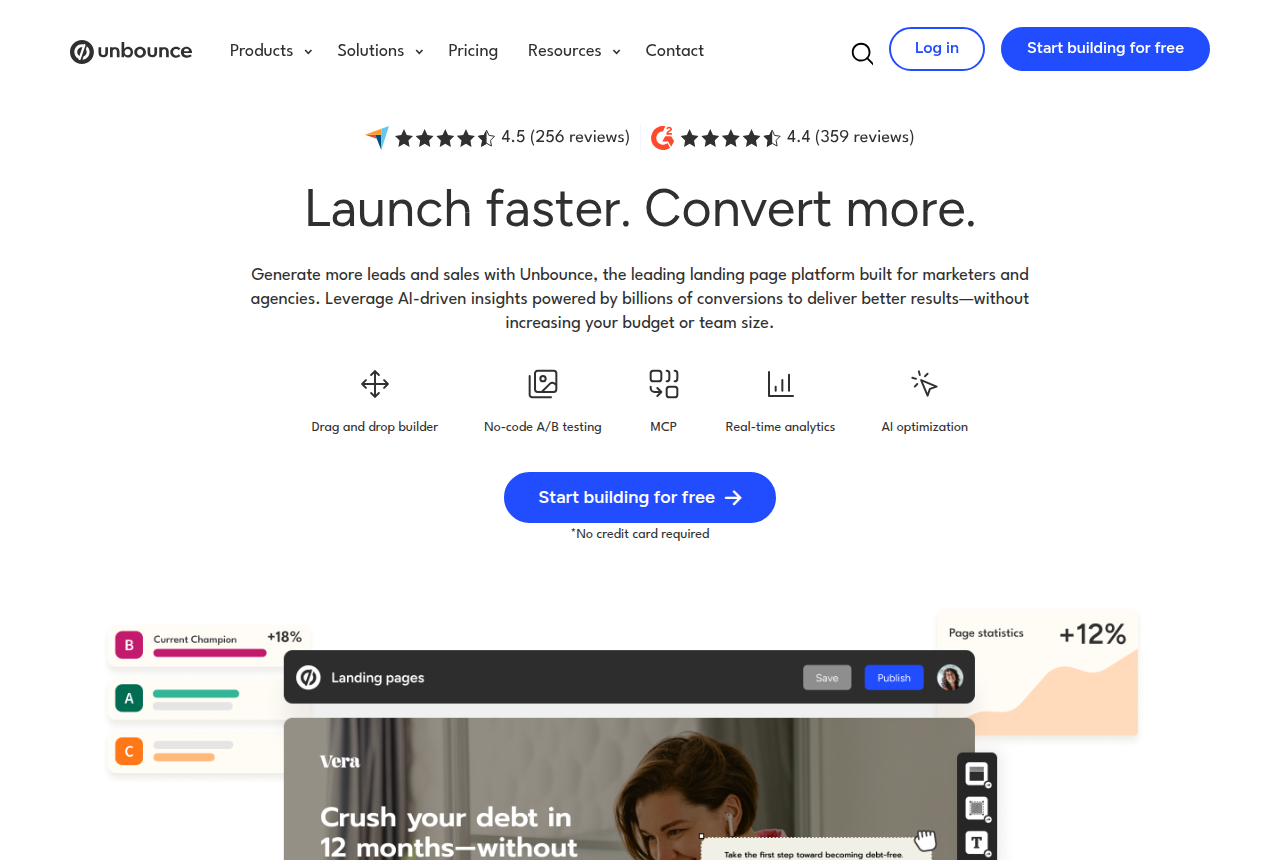
For a search-ad buyer, the single biggest post-click lever is message match: the page headline echoing the search the visitor just made. Unbounce's dynamic text replacement swaps the headline to the visitor's keyword, and Smart Traffic then sends each visitor to whichever variant converts their kind of traffic best. That pairing is why it is still the builder serious PPC teams name first, and it has a large template library and a mature editor behind it.
The catch is where those features live. The entry Starter plan publishes pages without the PPC levers. Keyword-matched headlines and A/B testing start on the Experiment plan at $149 a month, and automatic routing on Optimize above that. Price the plan you actually need.
The builder is also the most-complained-about part. Fixed-section layouts, awkward custom HTML and mobile-layout problems come up often enough that one widely read thread called it a nightmare. Monthly unique-visitor caps add overage anxiety as you scale. A team running heavy paid search will accept those trade-offs for the track record. A light account pays for depth it will not use.
Leadpages: predictable cost and testing on Grow
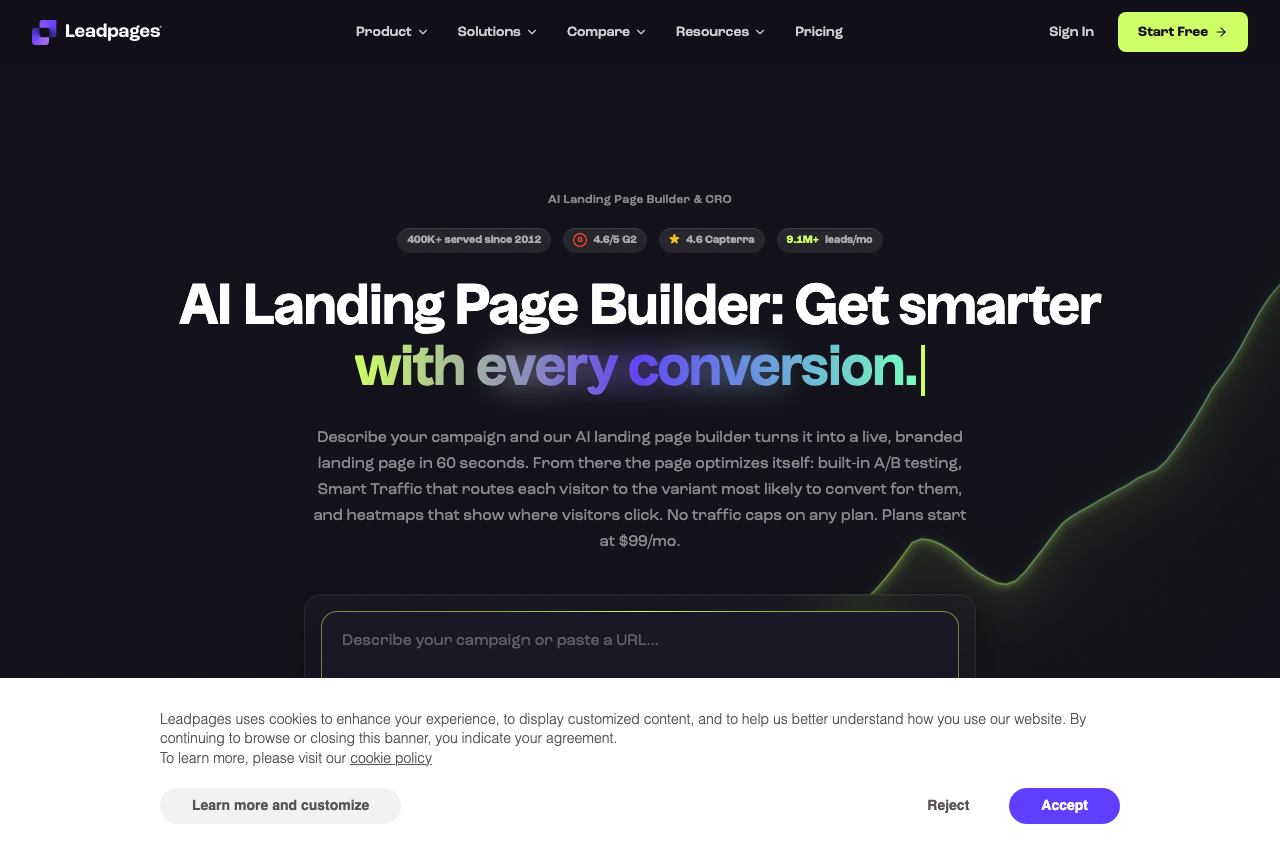
Leadpages wins on the math most buyers actually care about: cost you can predict. No plan has a visitor cap or an overage fee, so a page that suddenly takes off does not trigger a surprise bill. The Grow plan, at $99 billed monthly and less on annual billing, includes manual A/B testing with up to six variants per page, dynamic text replacement, manual personalization and unlimited pages. Its cheaper Pro and Business plans only publish. For a lead-gen or budget-conscious buyer, Grow is the safest place to start, and users say the builder is simple enough that junior staff ship decent pages without much training.
Leadpages rebuilt the product recently, so its newer testing features have less public history than Unbounce's, and support quality is a recurring gripe in older threads. The 7-day trial also takes a card at checkout. For a buyer who wants pages that convert and a bill that does not move, those are acceptable trade-offs.
The real split: depth and track record versus a flat bill
Feature for feature, the gap has narrowed. Both match the headline to the keyword, both A/B test, and both sell Smart Traffic routing on an Optimize plan. Leadpages reaches testing and headline matching on a cheaper plan and never caps traffic. Unbounce keeps the longer record with high-volume PPC teams, the bigger template library and the editor agencies already know, and it charges more and meters visitors for it. A team that lives in paid search and values that record buys Unbounce. A buyer who wants to test and ship pages on a predictable bill buys Leadpages.
Pricing: where the money really goes
Compare the plans that carry the features you need. Unbounce's cheapest tier exists, but its testing tools sit on Experiment, and visitor caps mean a winning page can push you into overage. Leadpages keeps the bill flat: no caps, no overage, and testing from Grow. So Unbounce usually costs more once you are on the plan that makes it worth buying, and Leadpages stays close to where you signed up.
A third path if you host your own checkout
Unbounce and Leadpages both end at the form or the buy button and pass the visitor to a separate checkout. For a lead-gen or click-through campaign, that is the right shape, and one of the two above is your answer. A seller whose margin depends on order bumps and upsells after that button has a second tool to buy and connect. ElasticFunnels is one platform that covers the page and the checkout together. As a landing page and funnel builder it generates a page from a prompt or clones one from a URL, and it split-tests variants under a single URL, so Meta, Google and TikTok keep their learning and a test never sends the ad back through review. It also hosts the checkout with order bumps and one-click upsells, and keeps the clicks, orders and refunds on one timeline. It starts with a 14-day free trial and takes no card, and pricing runs from $97 a month, with a 0.5% fee only on revenue processed through its own checkout.
It is newer than Unbounce or Leadpages, with very little independent review coverage, so until you run real volume through it you are largely taking the vendor's word for how it holds up. It also replaces the checkout you use now, so it fits a seller who wants page and payment in one tool. A team that only needs a hosted page for its ads and is keeping its checkout should choose between the two builders here.
Which one for you
You run a large paid-search account and want the PPC builder agencies know best: Unbounce. Keyword-matched headlines, Smart Traffic and a deep template library are the levers you are paying for, and they justify the Experiment tier once the account is big enough. Accept the fiddly builder and the visitor caps as the cost.
You ship lead-gen or campaign pages and want a bill that does not move: Leadpages. Uncapped traffic, six-variant testing and headline matching on Grow cover most campaigns, at a lower price than Unbounce's testing tier.
You host your own offer and the checkout is where your margin lives: look at ElasticFunnels alongside them, with the newness caveat above in mind, if you want the page and the checkout in one platform.
Unbounce
What works
- The page headline updates to match each search query, the core PPC lever
- Smart Traffic routes each visitor to the variant most likely to convert them
- A large template library and a mature builder
What to watch
- Dynamic text and split testing start on the $149/mo Experiment plan, about five times what Starter costs
- Monthly unique-visitor caps bring overage anxiety at scale
- Users find the fixed-section layout and the mobile editor frustrating, and some call the builder painful
Leadpages
What works
- Unlimited traffic on every plan, so a page that takes off never triggers an overage bill
- A/B testing and ad-matched headlines arrive on Grow, the first testing plan, at $67 a month billed annually
- Unlimited pages and a fast, simple builder
What to watch
- Fewer advanced page-optimization controls than a specialist like Unbounce, and no CRM or native email, so follow-up lives in another tool
- Older complaints about price jumps versus a WordPress page builder
- Support quality is a recurring gripe
Pricing
Unbounce: from $29/mo. Monthly: Starter $29, Build $99, Experiment $149, Optimize $249; annual billing $22/$74/$112/$187 a month (25% off). Agency self-serve from $349/mo billed annually (50k visitors, 5 users, 10 root domains). Concierge custom.
Leadpages: from $67/mo. Comparison table on leadpages.com/pricing (read 2026-10-21) lists Pro $20, Business $33, Grow $67, Optimize $135 a month. Catalog from is Grow, the testing plan. Homepage cards and the FAQ still print Pro $29, Business $49, Grow $99, Optimize $199, and Scale $399. Scale is not on the plan cards. Annual billing on the pricing page is 20% off, billed once a year. The FAQ says that discount is applied at checkout and phrases it as up to 20%. 7-day trial, card required, charged on day 7 unless canceled. No coupon code on the pricing page or the FAQ. Enterprise is custom.
Prices as of 4 November 2026
Our pick
Unbounce
Unbounce is the pick if you buy Google Ads and live or die on message match, and you can justify the Experiment tier.
Frequently asked questions
Which is cheaper, Unbounce or Leadpages?
Can Leadpages match the page headline to the ad keyword?
Which is better for a solo media buyer on a budget?
Do I need Smart Traffic?
Sources
Other sources
2 discussions and reviews read for this page. Quotes are excerpts; open a link to read the original in context.
- [uvb-ppc-ab-easy] PPC discussion of tools for landing page tests
- [uvb-ppc-rec] Looking for recommendations for landing page A/B testing platforms

Written by
Dana Rourke
Lead Reviewer
Dana Rourke is the lead reviewer at Campaign Buyer. She covers trackers and attribution on this site: she reads what long-term users report about each tool, checks its documentation and pricing, and verifies prices with the vendor before writing the verdict. Keeping the rankings honest mostly means writing down what the top pick gets wrong, so she does that first.
Last checked 2026-09-24
Comments
No comments yet. Questions and your own experience are welcome.
Thank you. Your comment will appear once it has been reviewed.