A switching guide formedia buyer software
Elementor alternatives
By Dana Rourke, Lead Reviewer. Reviewed by Campaign Buyer Editorial. Updated 8 September 2026.
You already know what Elementor does. The question is what to run instead, and why. We read what long-term users report about the tools below and checked each vendor's own documentation and pricing, then ranked them by the reasons buyers actually switch: price, a missing capability, or a better fit for your traffic.
Still comparing? Read our full Elementor review first, then come back to these.

Quick answer
The best alternative to Elementor is ElasticFunnels. Elementor builds pages on your own WordPress site and uses whatever checkout the site runs. ElasticFunnels is a funnel platform: it builds the pages, splits them under one URL, and hosts its own checkout with order bumps, one-click upsells, a CRM and attribution on one data layer. It fits a seller who would rather run a dedicated funnel and checkout than WooCommerce. If you only need a page builder on the site you already run, Elementor does that job for less.
The shortlist
- 1. ElasticFunnels is the best Elementor alternative for running the funnel and its own hosted checkout instead of WooCommerce.
- 2. SeedProd is the best Elementor alternative for non-developers launching quick, lightweight WordPress marketing, coming-soon and sales pages.
- 3. Thrive Architect is the best Elementor alternative for marketers who want opt-in forms, timers and sales-page sections built in rather than bolted on.
- 4. Divi is the best Elementor alternative for running unlimited WordPress sites from one theme and builder on a lifetime licence.
Compared at a glance
| Tool | Free version | A/B testing | Dynamic text | Templates | From |
|---|---|---|---|---|---|
| 1. SeedProd | –Unknown | ×No | –Unknown | –Unknown | Free tier |
| 3. Thrive Architect | ×No | Thrive Optimize (included in Suite) | –Unknown | conversion-focused template gallery | $149/mo |
| 4. Divi | ×No | ✓Yes | ×No | ✓Yes | $7.42/mo |
The alternatives, ranked
1. ElasticFunnels
Best Elementor alternative for running the funnel and its own hosted checkout instead of WooCommerce

Elementor builds pages on your own WordPress site and uses whatever checkout the site runs. ElasticFunnels is a funnel platform: it builds the pages, splits them under one URL, and hosts its own checkout with order bumps, one-click upsells, a CRM and attribution on one data layer. It fits a seller who would rather run a dedicated funnel and checkout than WooCommerce. If you only need a page builder on the site you already run, Elementor does that job for less.
What works
- Replaces the stack a growth team usually stitches together: a funnel builder, a checkout or CRM, a testing tool and an analytics tool, so a click, an order, a rebill and a refund sit on one record you never have to merge by hand
- Its strongest feature is split testing under one URL: variants rotate server-side behind a single campaign link, so Meta, Google and TikTok keep the data they have learned and a new test does not send the ad back for review
- The AI builder writes a page of any type from a prompt, and the cloner turns a competitor URL into a working copy in about a minute
- Its checkout takes Stripe, NMI, PayPal, Klarna or Authorize.net, splits sales across several NMI merchant accounts by weight, card brand, product and daily cap, and builds in order bumps, one-click upsells and subscription dunning
- The analytics view puts sessions, orders, rebills and refunds on one timeline, sliced by affiliate, geo, device or creative, and a built-in CRM and call center work off the same records
- A trial tests the whole tool because nothing is gated behind a higher tier: plans differ only by the traffic volume they allow
What to watch
- Multi-MID routing, the standout in its checkout, works across NMI merchant accounts only and pays off only if you already hold several to route between. A seller on a single Stripe account still gets the pages, the testing, the analytics and the CRM, but not that routing advantage
- It is not a merchant of record like Paddle: it will not file your sales tax or carry dispute liability, so that work stays with you and your processors
- The 0.5% checkout fee applies to revenue through its hosted checkout, on top of the monthly plan and your own processor fees, though sales on external networks like ClickBank or BuyGoods are not charged
The catch
ElasticFunnels is newer than the tools on this page, and there is very little independent third-party review coverage to check its claims against. Until you run real volume through it, you are largely taking the vendor's word for it. Work on it started in 2023, so it has had far less time than its rivals to collect user reports. The 14-day trial needs no card, so you can test the features on your own traffic before you pay.
Read the full ElasticFunnels review.
2. SeedProd
Best Elementor alternative for non-developers launching quick, lightweight WordPress marketing, coming-soon and sales pages

It is the pick if you run a WordPress site, buy paid traffic, and want campaign pages that load fast without dragging your whole theme down. It is lighter than the general-purpose builders and quick to learn. The catch is that the useful features live on the Pro plan, and the introductory price renews higher.
What works
- Lighter output than Elementor or Divi, so a campaign page loads faster on a phone
- Fast to learn: drag-and-drop with 300+ marketing, coming-soon and sales templates
- A genuinely free version, and a 14-day money-back guarantee on paid plans
What to watch
- The full editor, the template set and dynamic blocks are gated behind the Pro plan
- Introductory pricing renews at full list, and buyers on Reddit flag the jump
- Not the lightest possible route: native Gutenberg blocks still beat it on raw speed
Read the full SeedProd review.
3. Thrive Architect
Best Elementor alternative for marketers who want opt-in forms, timers and sales-page sections built in rather than bolted on
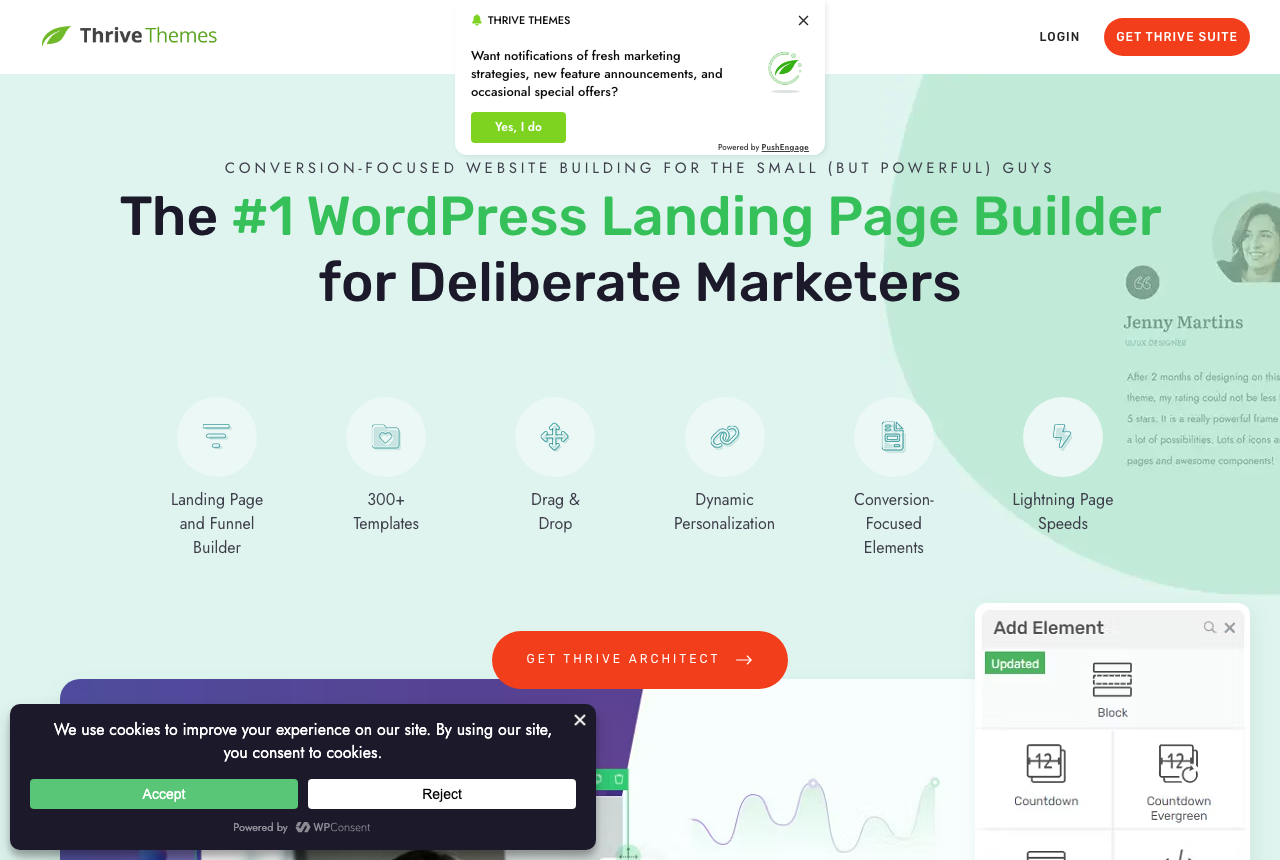
It is the pick if you are a marketer who wants countdowns, sign-up forms and ready-made sales blocks rather than a blank canvas. Split testing runs through the Optimize add-on. The costs are annual renewal pricing that jumps after year one and lock-in on pages you built once the licence lapses.
What works
- Conversion elements ship in the tool: testimonials, timers, forms and sales templates
- Thrive Optimize handles the split tests, bundled into the Suite
- One vendor for pages, forms, quizzes and scarcity, so the marketing stack stays together
What to watch
- Annual renewal jumps after year one, up to $599/yr for the five-site Suite
- When your licence expires you cannot edit Thrive-built components, which is real lock-in
- Buyers report occasional bugs and freezing, and it is WordPress-only
Read the full Thrive Architect review.
4. Divi
Best Elementor alternative for running unlimited WordPress sites from one theme and builder on a lifetime licence
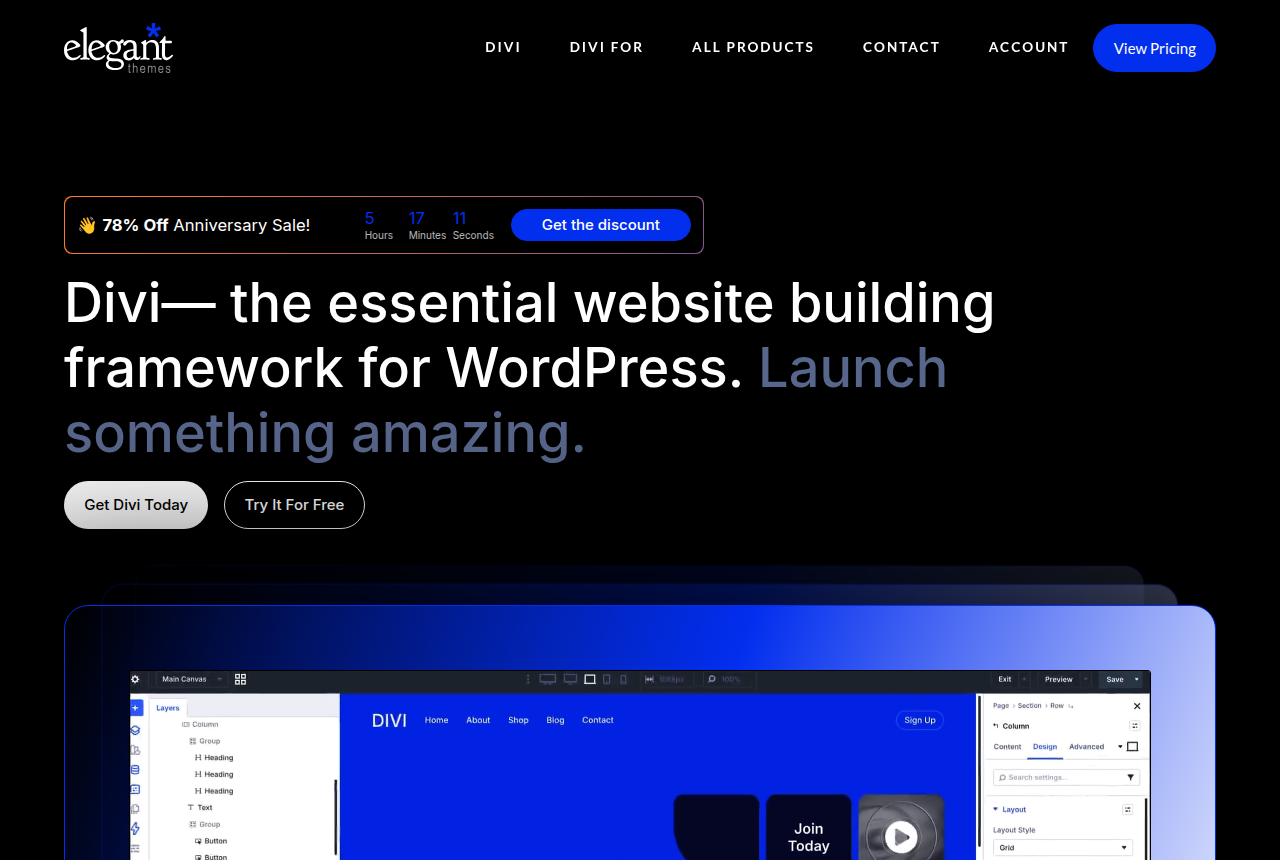
Divi is worth it if you build a lot of sites on WordPress and want one theme, one builder and a lifetime licence that covers every one of them. It is well supported and widely used. The risk is weight: the default output is heavy and a fast Divi site takes work, so a buyer who needs one lean campaign page does better with a lighter tool.
What works
- One licence covers as many sites as you build, and a single payment ends the yearly renewal for Divi itself
- Support is a real strength: 24/7 chat and email on every plan, a faster VIP tier, and a 4.7 Trustpilot rating across 25,000+ reviews
- A deep template and add-on ecosystem, with 2,600+ prebuilt layouts built into the builder
- Divi 5, released February 2026, drops the shortcode storage that made older Divi sites hard to leave
What to watch
- Heavy by default: its builder adds CSS and JavaScript, and users report slow mobile scores unless you optimize hard
- No free version and no trial, only a 30-day money-back guarantee
- Core modules feel basic to some buyers, who end up paying for Divi Marketplace add-ons that stack up
- Its 'sale' is a permanent countdown timer, so the real price and the urgency it implies are hard to trust
Read the full Divi review.
How we evaluated these
We ranked these using the same rubric as the incumbent: we read what long-term users report about each one, checked its documentation and pricing, and verified prices with the vendor before reaching a verdict. The order shows which option fits the largest group of Elementor users. Where an alternative wins only for a specific traffic source or team size, we say so on that card. Our methodology page sets out the full process.
Frequently asked questions
What is the best alternative to Elementor?
Why look for an alternative to Elementor?
Sources
Other sources
3 discussions and reviews read for this page. Quotes are excerpts; open a link to read the original in context.
- [wporg-seedprod] Website Builder by SeedProd - WordPress plugin
- [reddit-renewal] Seedprod renewal rate....wow.... : r/Wordpress
- [cloudways-seedprod] SeedProd Review: A lightweight WordPress Page Builder

Written by
Dana Rourke
Lead Reviewer
Dana Rourke is the lead reviewer at Campaign Buyer. She covers trackers and attribution on this site: she reads what long-term users report about each tool, checks its documentation and pricing, and verifies prices with the vendor before writing the verdict. Keeping the rankings honest mostly means writing down what the top pick gets wrong, so she does that first.
Last checked 2026-09-08
Comments
No comments yet. Questions and your own experience are welcome.
Thank you. Your comment will appear once it has been reviewed.