A cheap tracker with pages built in against a modern CAPI-first onemedia buyer software
AdsBridge vs ClickFlare
By Dana Rourke, Lead reviewer. Reviewed by Campaign Buyer Editorial. Updated 27 September 2026.
Quick answer
Pick AdsBridge if you want cloud tracking with a drag-and-drop landing page builder and split testing bundled into one cheap subscription, you run postback-friendly pop, push or native traffic, and a native conversion API is not what you are paying for; pick ClickFlare if you run paid social and need automatic ad-cost sync plus CAPI to Meta, Google, TikTok, Snapchat and Reddit on every plan, in a modern dashboard with done-for-you migration. Both are real cloud trackers with thin outside proof, so trial each on your own traffic before you commit. ClickFlare takes our default pick for a paid-social buyer on the strength of its CAPI and cost sync; AdsBridge is the better answer for the affiliate who wants pages built in and the lowest entry price.
Side by side
| AdsBridge | ClickFlare | |
|---|---|---|
| What it is | Cloud tracker with a page builder | Modern CAPI-first cloud tracker |
| Landing page builder | Yes, drag-and-drop, split-tested | No, tracking only |
| Native CAPI to ad platforms | No, server-to-server postbacks | Meta, Google, TikTok, Snapchat, Reddit |
| Automatic ad-cost sync | Not its focus | Yes, on every plan |
| Pricing model | From $29/mo, by monthly visits | From $69/mo, by events |
| Best-fit user | Affiliate wanting tracker plus pages | Paid-social buyer needing CAPI |
| Outside proof | Thin, mostly affiliate blogs | Thin, all five-star |
If you are down to AdsBridge and ClickFlare, you have narrowed to two cloud ad trackers a paid-traffic buyer runs with nothing to install. Both stamp a click, catch the conversion, and tell you which source, lander and offer actually made money. Both are established: AdsBridge has run since 2013, ClickFlare since 2021, and neither is a fly-by-night. So the decision is not which one tracks. It is which model fits how you buy media, because these two answer the same job in noticeably different ways.
The honest split runs along two lines. AdsBridge is a cloud tracker with a landing page builder folded in, priced by monthly visits, cheap to start, and built around server-to-server postbacks. ClickFlare is a tracker only, but a more modern one, priced by events, with automatic ad-cost sync and a conversion API on every plan. Work out whether you need pages built in and postback traffic, or CAPI and cost sync for paid social, and the rest of this comparison mostly settles itself.
The question that decides it
Answer this before you weigh a single feature: do you run paid social, and do you need conversions fed back to the ad platforms through their conversion APIs? ClickFlare fires CAPI to Meta, Google, TikTok, Snapchat and Reddit, and pulls your ad spend in automatically to compute ROI by source, all on every tier. AdsBridge has no native conversion API. It leans on postbacks, which is fine for pop, push and native traffic but a weak fit for a Meta or Google buyer who wants the pixel gap closed server-side. If CAPI is central to how you buy, that single line ends the comparison in ClickFlare's favour.
The mirror question is whether you also need your landing pages built. AdsBridge includes a drag-and-drop page editor with templates, HTML access and split testing in the same subscription, so a beginner or a mid-volume affiliate does not pay for a separate page tool. ClickFlare does not build pages at all. If you already have your pages and want the tracker to feed the ad platforms, ClickFlare. If you want tracking and pages in one cheap tool and run postback-friendly traffic, AdsBridge.
AdsBridge: cheaper, with your pages built in
AdsBridge is the more bundled and the cheaper of the two. It has run since 2013 on AWS, serves buyers across 160-plus countries, and connects to more than 100 affiliate networks with one-click postback setup. It carries an anti-fraud filter and a redirectless tracking mode, and its headline advantage over a pure tracker is that it builds and split-tests your landing pages for you. It starts at $29 a month for 100,000 visits, prices upward by monthly visits, and puts the full feature set on every plan with nothing gated to higher tiers. For a beginner or a mid-volume buyer who does not want to touch a server or pay for a second tool, that bundle is a genuinely different proposition. The AdsBridge review covers how it holds up in daily use.
The limits are worth stating flat. Redirect speed is the complaint that comes up most often: a community speed test clocked its redirects slower than several rivals, which matters most on mobile traffic, and reviewers report the dashboard can feel sluggish and that stability wobbles once daily volume gets extreme. It has no native Meta or Google conversion API, so paid-social buyers who want CAPI are better served elsewhere. Its independent proof is thin: its G2 profile carries too few reviews to lean on, so most write-ups are affiliate blogs rather than heavy buyer feedback. And it offers a 14-day trial rather than a permanent free tier, and states it issues no refund on cancellation, so treat the trial as your one look before you commit. If you want it weighed against a self-hosted tracker instead, Binom vs AdsBridge covers that fork.
ClickFlare: CAPI-first, modern, done-for-you setup
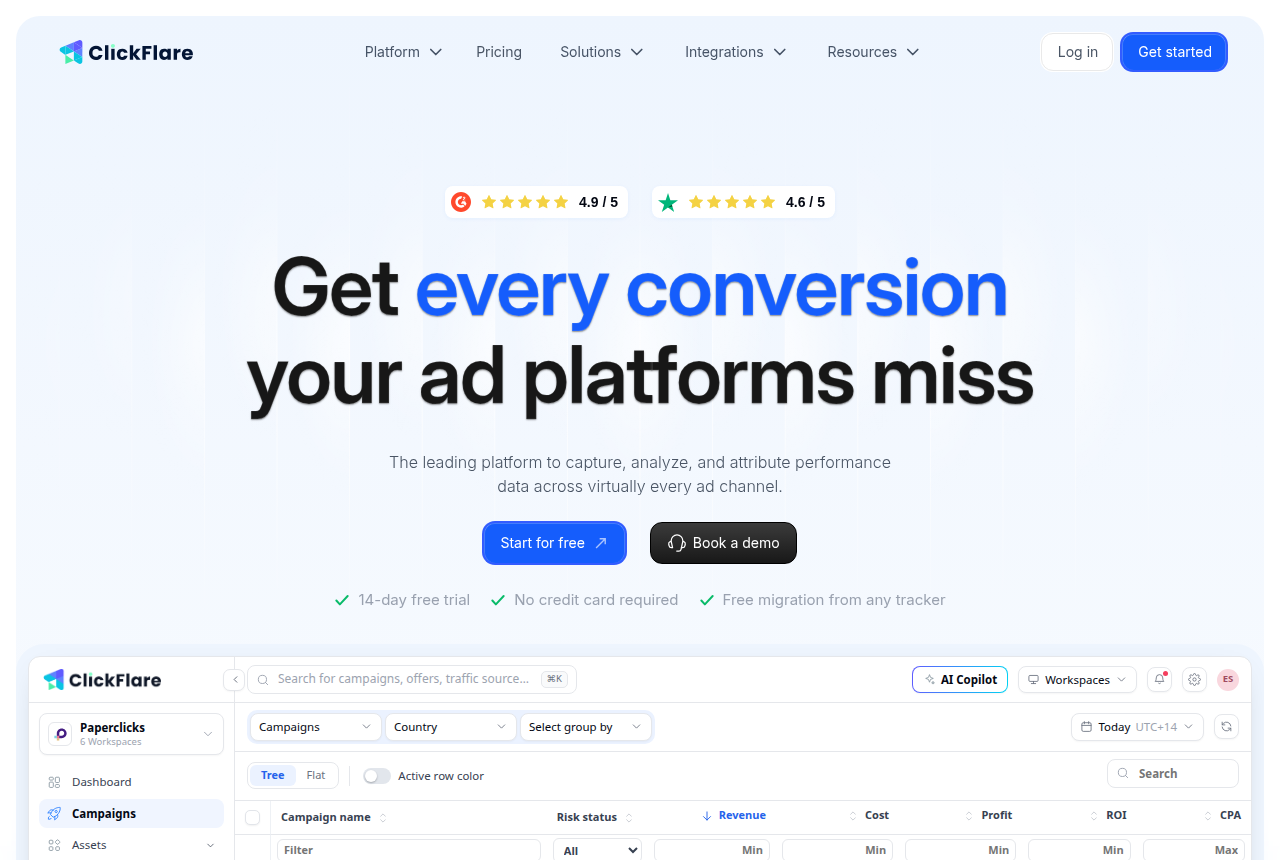
ClickFlare has run since January 2021 and positions itself plainly as the cheaper replacement for Voluum and RedTrack. It is a full media-buyer tracker: server-side capture with both redirect and direct tracking, automatic cost sync and CAPI on every tier including the $69 Starter, plus an AI Copilot, traffic-routing tools and a tag manager included. It reaches five ad platforms by CAPI, adding Snapchat and Reddit to Meta, Google and TikTok, and the two things public reviewers single out most are a free done-for-you migration and fast human support. For a paid-social buyer who wants a modern dashboard and the setup handled, that combination is the appeal. The ClickFlare review covers where it earns its place, and it sits fourth in our ranking.
The limits are real. Independent proof is thin: a couple of dozen Trustpilot reviews, all five-star, with Trustpilot itself flagging the sample may not be representative, and light organic discussion next to the older incumbents, so the trial is your due diligence rather than the scores. Everything counts as an event, so every visit, click, conversion and postback draws down one limit, and high-volume pop or push traffic burns the cap faster than the plan names suggest. Cost sync also lags on the lower tiers, refreshing hourly on Starter and Pro and every 30 minutes on Master, with near-real-time updates a paid add-on, so an hour-old ROAS can mislead on a fast-moving campaign. The counter to the proof gap is the 14-day trial with no card and the free migration: prove the tracking on your own traffic. If you want it against another proven full tracker, RedTrack vs ClickFlare and ClickFlare vs BeMob cover those.
Where the pricing diverges
The two do not price on the same axis, which is why the entry numbers mislead. AdsBridge bills by monthly visits: $29 for 100,000, then $89 and $199 as visits climb, with the full feature set on every plan. ClickFlare bills by events: $69 for 1 million, then $169 for 5 million and $329 for 20 million, and everything counts as an event, so a visit, a click, a conversion and a postback each draw down the same limit. The vendor says ClickFlare's price has not risen since it launched in 2021, and its overage is billed per thousand that never hard-stops.
Read both on your real traffic, not the sticker. If your volume is modest and you value pages built in, AdsBridge's visit-metered entry is the cheaper honest number and it saves you a second tool. If you run paid social and need CAPI and cost sync, ClickFlare's event pricing buys a capability AdsBridge does not have at any tier, and near-real-time cost sync is a paid add-on on top. The cheaper tool depends on your volume shape and whether a native conversion API is something you are paying for. Pricing was verified against each vendor on the date shown on this page; check before you buy.
A third path, if you build and host the funnel yourself
Both tools measure a funnel they do not build. They watch clicks and conversions on landing pages and checkouts hosted elsewhere, then feed a signal back to an ad platform or a network. ElasticFunnels owns that middle instead. It is a funnel platform for teams running paid traffic: it builds the landing pages, split-tests variants under one URL so Meta, Google and TikTok never reset their learning, and hosts the checkout with order bumps and upsells, then keeps its ad-spend and conversion reporting on the same data layer as the pages, the CRM and the sale. Because a purchase closes in a checkout it hosts, that sale is a first-party record it captures directly rather than a click it has to match back later. It starts with a 14-day free trial that takes no card, on plans from $97 a month, plus 0.5% of revenue processed through its own hosted checkout and nothing on sales you run through outside networks.
The honest caveat keeps it on its own line rather than in the head-to-head. ElasticFunnels is newer than either tracker here, and there is very little independent third-party review coverage to check its claims against, so until you run real volume through it you are largely taking the vendor's word for how its reporting holds up. That is what you would expect of a platform this recent, and both AdsBridge and ClickFlare have years of public setups to weigh instead. Its reporting also only covers the funnels it hosts, so a buyer sending paid clicks to landers and offers on domains ElasticFunnels does not host still needs a campaign tracker like AdsBridge or ClickFlare to attribute those. Treat it as a question of whether you want a tracker or a funnel platform, not a third tracker.
Which one for you
You run paid social and need CAPI and cost sync: ClickFlare. Conversions fired server-side to five ad platforms, ad spend pulled in automatically, and a modern dashboard with free migration make it the stronger fit for a Meta, Google or TikTok buyer, and all of it is on every plan. Accept the thin outside proof, estimate your real event count before you pick a tier, and budget for near-real-time cost sync as a paid add-on.
You want tracking and pages in one cheap tool, and run postback traffic: AdsBridge. The bundled drag-and-drop page builder, split testing and $29 entry priced by visits suit an affiliate on pop, push or native traffic who does not need a native conversion API. Accept the slower redirects, test the speed on your own traffic first, and use the trial as your one look before the no-refund charge.
You build and host your own pages and checkout end to end: look at ElasticFunnels alongside them, with the newness caveat above in mind, and keep a dedicated tracker for any traffic that lands on domains it does not host.
Between the two you asked about, ClickFlare takes our default pick, not because AdsBridge fails at tracking, but because most readers weighing these two on this site are buying for paid social, and CAPI with automatic cost sync on every plan is exactly what that buyer needs and what AdsBridge does not offer. For the affiliate who wants pages built in, the lowest entry price and postback-friendly traffic, AdsBridge is the better answer, and it is why both hold their place in our ranking. The full field sits in our head-to-heads.
AdsBridge
What works
- Tracking, a drag-and-drop landing page builder and split testing come in one subscription, so a beginner does not pay for a separate page tool.
- Cheaper entry than Voluum or RedTrack: $29/mo for 100,000 visits, and every plan carries the full feature set with no features gated to higher tiers.
- Prices by monthly visits rather than events, which is easier to predict than event-based billing when a campaign scales.
- Established since 2013 on AWS infrastructure, with 100-plus one-click network integrations, an anti-fraud filter and a redirectless tracking mode.
What to watch
- Redirect speed is the recurring complaint. A community speed test clocked its redirects slower than several rivals, which matters most on mobile traffic.
- Reviewers report stability flaws once daily volume gets extreme, and the dashboard can feel slow at times.
- No native Meta or Google conversion API. It leans on server-to-server postbacks, so paid-social buyers who want CAPI are better served elsewhere.
- Thin independent proof. Its G2 profile has too few reviews to be useful, so most write-ups are affiliate blogs rather than heavy buyer feedback.
- No permanent free tier, only a 14-day trial, and AdsBridge states it issues no refund on cancellation.
ClickFlare
What works
- Cost sync and CAPI are on every tier, including the $69 Starter. You pull your spend in, compute ROI and send conversions to Meta, Google and TikTok server-side, without a paid upgrade and without handing over a cut of your budget.
- Flat pricing that undercuts Voluum on the same event model. The vendor says the price has not risen since it launched in 2021, and there is no percentage of your budget layered on top.
- Server-side capture with both redirect and direct tracking, so a blocked pixel or an iOS restriction does not silently drop the form fill or the sale.
- Free done-for-you migration and fast human support are the two things public reviewers single out most, alongside a setup that is smoother than trackers usually are.
- A real 14-day trial with no card, plus a 99.99% uptime record since January 2021, so you can prove the tracking on your own traffic before you pay.
What to watch
- Thin independent proof. A couple of dozen Trustpilot reviews, all five-star, and little organic Reddit discussion. Trustpilot itself flags that the sample may not be representative, so the trial is your real due diligence, not the scores.
- Everything counts as an event. Every visit, click, conversion and postback draws down one limit, so high-volume pop or push traffic burns the cap faster than the plan names suggest. Estimate your real event count before you pick a tier.
- Spend data lags on the lower tiers. Starter and Pro refresh hourly and Master every 30 minutes, with near-real-time updates a paid add-on. On fast-moving campaigns an hour-old ROAS can mislead you.
- Less battle-tested at extreme scale than Voluum. For the heaviest automation rules and deepest anti-fraud, the older incumbents still have the longer public track record.
- Billing is charged in advance and is generally non-refundable, and you cancel inside the account rather than by asking support. Export your data before you leave.
Pricing
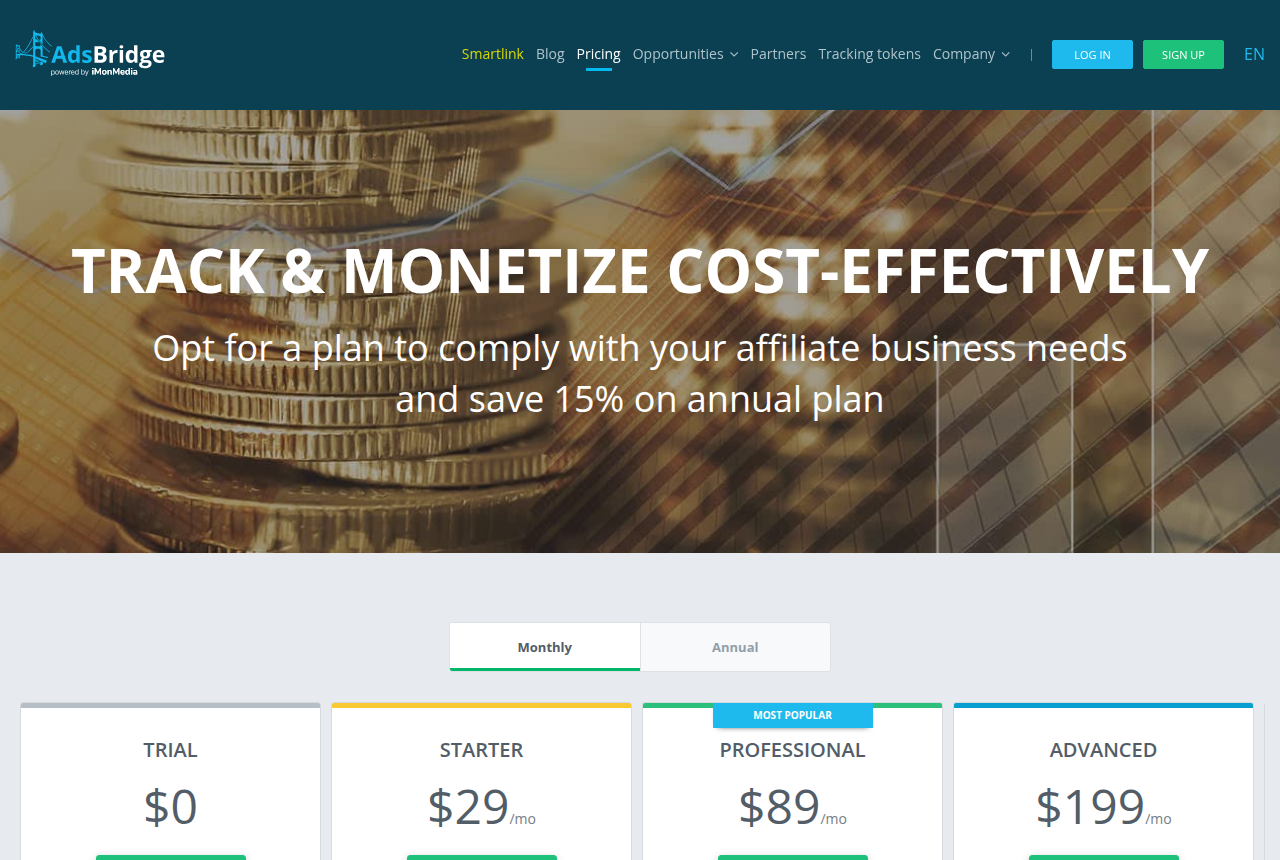
AdsBridge: from $29/mo. AdsBridge prices by monthly visits, not events. Starter is $29/mo for 100,000 visits; Professional, marked most popular, is $89/mo for 3,000,000 visits, then Advanced $199, Business $379, Agency $499 and Enterprise $799 up to 31M visits, with an Exclusive custom tier above 50M. Every plan carries the full feature set, including the landing page builder. Overage is billed per 1,000 visits above the plan limit, from $0.07 on Starter down to $0.029 on Enterprise. Annual billing saves about 15%, and there is a 14-day free trial. AdsBridge states no refund is provided on cancellation.
ClickFlare: from $69/mo. Priced flat by monthly events, not a percentage of ad spend. Events count visits, clicks, conversions and postbacks together. Starter is $69/mo billed yearly ($89 monthly) for 1M events, Pro $169/mo yearly ($219 monthly) for 5M, Master $329/mo yearly ($429 monthly) for 20M, then Agency $559, Enterprise $959 and Corporate $1,759 (yearly). Overage runs $0.04 per 1,000 events on Starter down to $0.015 on Corporate and never stops your tracking. CAPI, the AI Copilot, the tag manager and synced ad costs come standard from the Starter tier up. 14-day free trial, no card, plus free done-for-you migration from another tracker.
Pricing verified against each vendor on 2026-09-27. Check before you buy.
Our pick
ClickFlare
ClickFlare is real. It is an established cloud tracker, running since 2021 and used by 3,500-plus media buyers, that does what Voluum and RedTrack do: server-side capture, CAPI to Meta, Google and TikTok, and spend pulled in for you to compute ROI, all on one flat price. You are unlikely to regret it if you run the 14-day no-card trial against your ad platform's own numbers first. The one real caveat is thin public proof, so trust the trial, not the review scores.
Frequently asked questions
AdsBridge or ClickFlare: which should I use?
Which is cheaper, AdsBridge or ClickFlare?
Does AdsBridge or ClickFlare send conversions to Meta and Google natively?
Which one includes a landing page builder?
Are AdsBridge and ClickFlare both established, real products?
Sources
Other sources
5 discussions and reviews read for this page. Quotes are excerpts; open a link to read the original in context.
- [rd-does-job] Please Help To Track Conversions In Google Ads
- [rd-positioning] Keitaro vs RedTrack vs Voluum - which one for popunder affiliate with S2S tracking?
- [tp-support] ClickFlare Reviews
- [tp-setup] ClickFlare Reviews
- [tp-sample] ClickFlare Reviews

Written by
Dana Rourke
Lead reviewer
Dana Rourke is the lead reviewer at Campaign Buyer. She owns the tracker and attribution coverage: reading what long-term users report about each tool, checking its documentation and pricing, and verifying prices with the vendor before writing the verdict. Keeping the rankings honest mostly means writing down what the top pick gets wrong, so she does that first.
Last checked 2026-09-27