ClickFlare is real. It is an established cloud tracker, running since 2021 and used by 3,500-plus media buyers, that does what Voluum and RedTrack do: server-side capture, CAPI to Meta, Google and TikTok, and spend pulled in for you to compute ROI, all on one flat price. You are unlikely to regret it if you run the 14-day no-card trial against your ad platform's own numbers first. The one real caveat is thin public proof, so trust the trial, not the review scores.
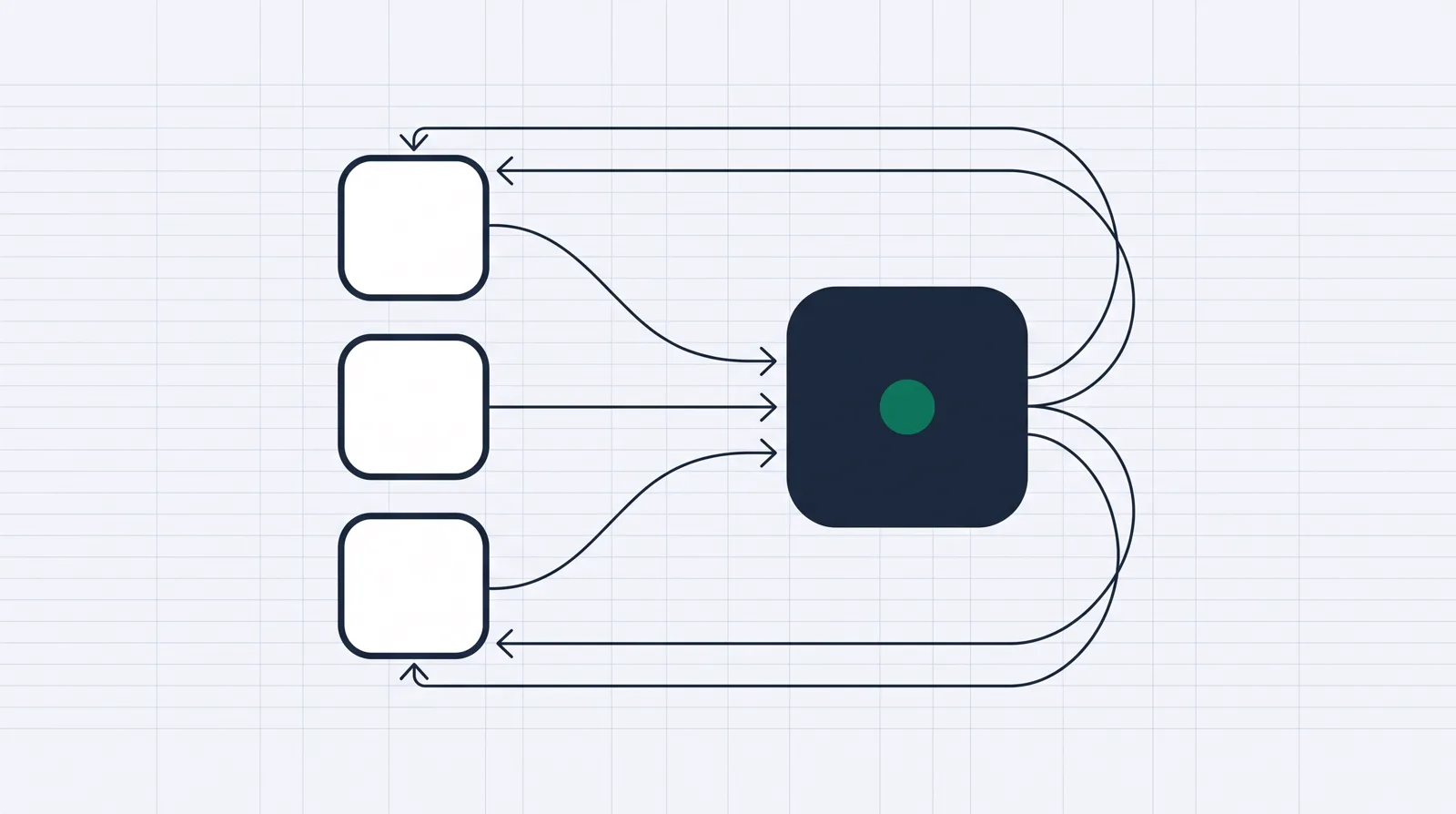
A tracker's whole job in one picture: take clicks and cost in from the ad platforms, and send clean conversions out.
You have probably seen ClickFlare pitched as the cheaper Voluum. Its own homepage says it outright, with a small line that reads "Replaces Voluum, RedTrack." If you are here, the question is not what it claims. It is whether it is real, and whether you will regret moving your tracking onto it. The short answer is that it is a genuine, working cloud tracker with a real user base, and the thing to watch is not a flaw in the product so much as how little public proof there is to lean on.
Here is what it is. The platform is a cloud-hosted ad tracker and attribution tool for people who buy paid traffic: affiliates, lead-gen buyers, search arbitrage, ecommerce and small agencies. It sits between your ad accounts and your funnel, records every click and conversion, ties each sale back to the campaign that drove it, and pushes that data back to the networks so their algorithms optimize on real results. It is the same category as RedTrack, Voluum, Binom and BeMob, and it competes with them head-on.
What ClickFlare actually does
Three jobs, in order. First it captures. ClickFlare records clicks server-side, from a globally distributed redirect network the vendor clocks at under 50 milliseconds, so ad blockers and iOS restrictions do not break the chain. It supports both redirect tracking and direct, no-redirect tracking, which matters on Meta and TikTok where a redirect can hurt compliance or approval. Built-in bot and fraud filtering runs on top.
Second it attributes. Every conversion is stitched back to the click that caused it, with click-level attribution across the journey and multi-touch models. The point is one source of truth instead of five platform reports that disagree with each other and with your bank.
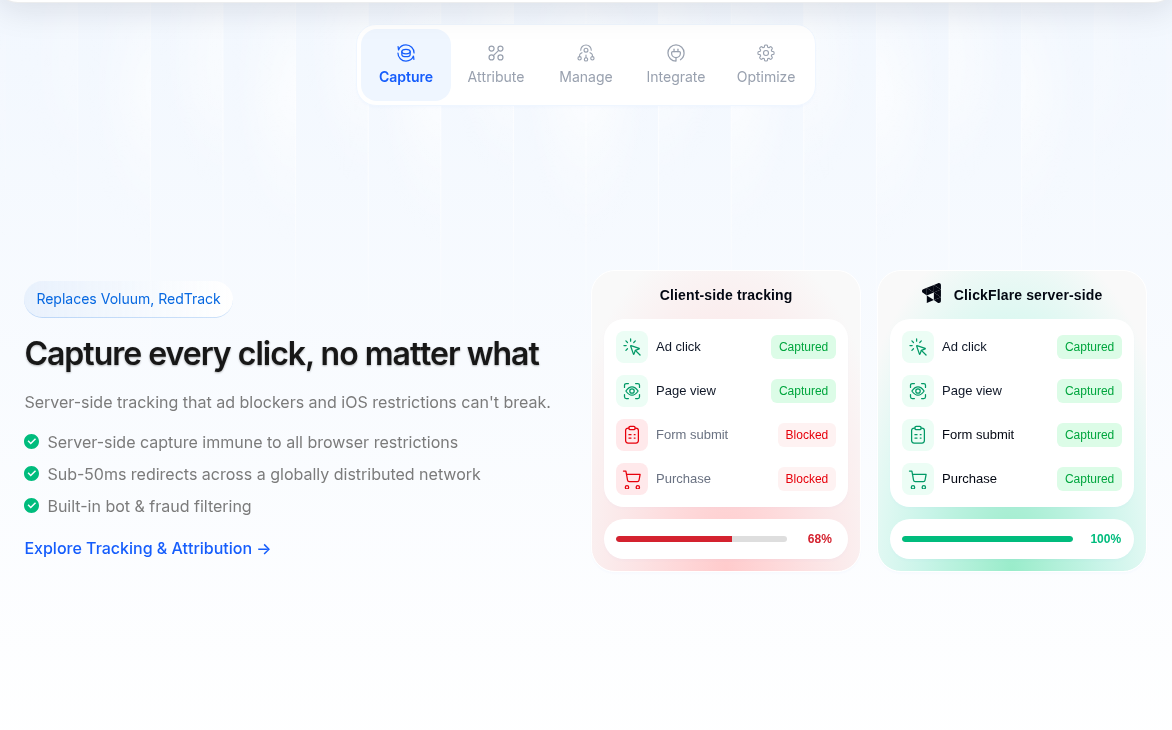
Third it feeds the platforms back. Through the Conversion API, ClickFlare sends server-side events to Facebook, Google Ads, TikTok, Snapchat and Reddit, so the bidding engines see the conversions the browser pixel missed. On its own homepage the difference is drawn as a client-side path capturing 68% of events against a server-side path capturing 100%. That gap is the entire reason server-side tracking exists.
The one thing that separates it from the cheap feeders
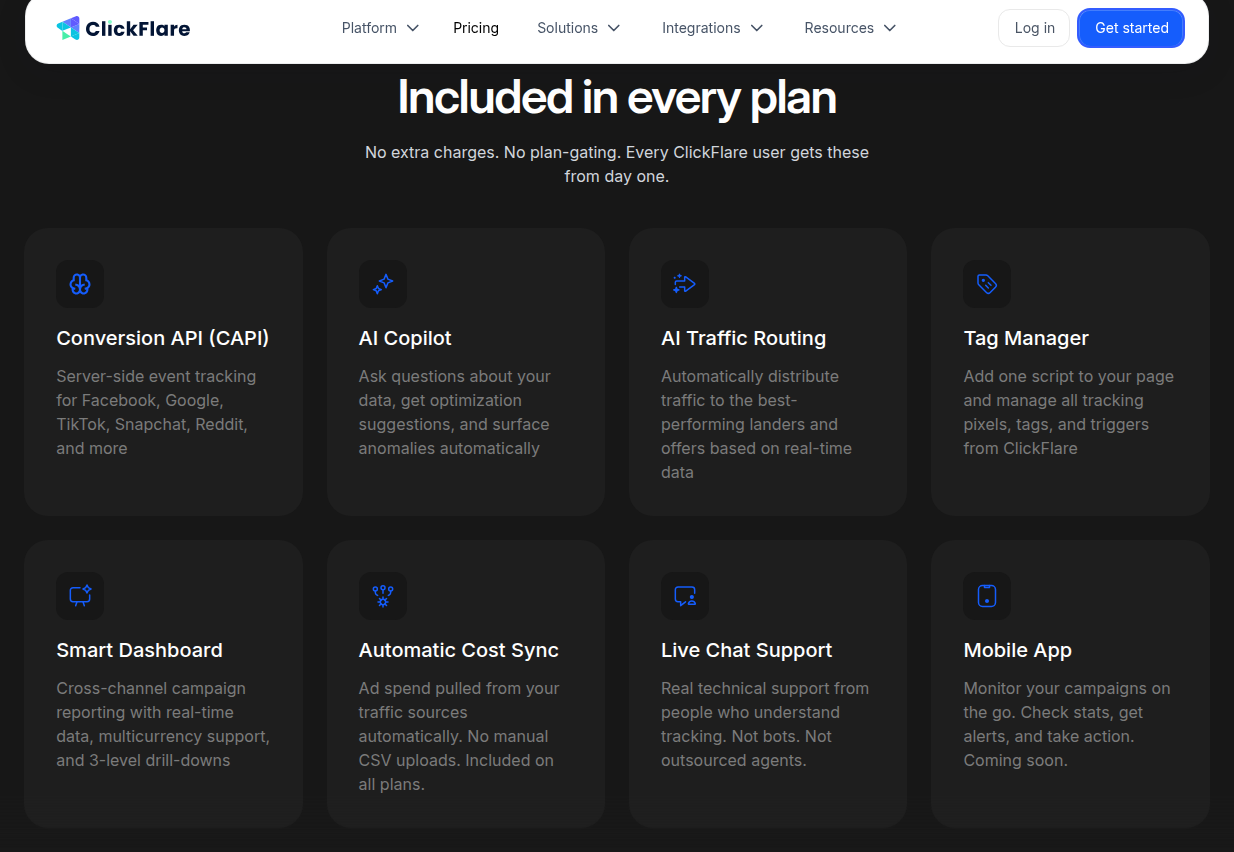
A lot of no-code trackers stop at feeding conversions back. ClickFlare does the media-buying half too, and it does it across the whole range, not just the top tier. It pulls your spend in from the traffic sources automatically, so ROI and CPA are computed for you without a manual CSV upload. That is the feature that turns a conversion pipe into a command center you can make budget decisions from, and it is there from the $69 Starter up rather than gated behind an enterprise plan.
On top of that sits an AI layer. The Copilot answers plain-English questions about your live campaign data and surfaces underperforming offers and anomalies, and AI Smart Traffic routing shifts weight toward the landers and offers that are converting, with built-in A/B testing so you do not need a separate split-test tool. Treat these as useful extras, not the reason to buy. The tracking and the synced costs are the substance.
So, is it real?
This is the actual question behind a trust review, and the honest answer has two halves.
The product is real and it is not new. ClickFlare has been running since January 2021, and the vendor reports a 99.99% uptime record over that whole period, 3,500-plus media buyers using it, and $578 million in ad spend tracked through it in 2025 alone. Those are vendor numbers, so treat them as claims, but they describe a platform with genuine traction, not a landing page with a waitlist. It has native mobile apps, a status page, a help center and a migration team. It reads as a company, not a project.
The proof around it is thin. This is the part to go in clear-eyed about. If you go looking for independent, long-term user reports, there are not many. Trustpilot shows a 4.6 score, but from only a couple of dozen reviews, and every one of them is five stars. Trustpilot itself attaches a notice that the company has not invited customers recently, so the sample may not be representative. G2 shows a high score off a similarly small base. On Reddit, where affiliates argue about trackers constantly, ClickFlare turns up as a recommended cheaper alternative but is not yet one of the default names the way Voluum, RedTrack, Keitaro and Binom are. Where it does come up, the read is positive, with one affiliate describing it as simply getting the job done for S2S postbacks and CAPI. There is just not a large body of it.
None of that is a red flag. A dozen glowing reviews is not the same as a dozen fake ones, and a quieter Reddit presence is what you would expect from a tracker that is newer than the incumbents it is undercutting. But it does change what you should rely on. With Voluum you can lean on a decade of public war stories. With ClickFlare you should lean on the trial instead.
What the reviews do agree on
For all that the sample is small, the praise is consistent, and it clusters on two things. Support is the first. Reviewers repeatedly describe fast, human chat replies from people who understand tracking, on every tier. One recent review reads "Support is A Class and quick replies," and that theme repeats across nearly every entry. The second is setup. Migration is done for you and free, and reviewers describe the onboarding as smoother than they expected for something this technical. For a category where standing up a tracker is usually a multi-day project, both of those are worth real money.
Where the bill can surprise you
Every visit, click, conversion and postback counts as one event against your monthly limit, so your real usage is higher than raw click volume.
ClickFlare prices flat by monthly events, and the word event is doing a lot of work. An event is any action that passes through its infrastructure: a visit, a click, a conversion, or a postback. They all count equally against one limit. That is fine for most funnels, but if you run high click-volume traffic like pop or push, your real event count can be several times your conversion count, and it is easy to underestimate the tier you need. Add up every visit, click, conversion and postback before you choose, not just the sales.
Going over the cap does not stop your tracking. Overage is billed at the end of the cycle, from $0.04 per 1,000 events on Starter down to $0.015 on the biggest tiers. The other detail worth knowing is how fresh the spend data is. It refreshes hourly on Starter and Pro, every 30 minutes on Master, and faster updates are a paid add-on. On a volatile campaign, an hour-old ROAS number can point you the wrong way, so if near-real-time cost is core to how you scale, price in the higher tier or the add-on.
Who should buy it, and who should not
It is a strong fit if you are a media buyer or a small team who wants Voluum-class tracking, with synced costs and CAPI, without the Voluum bill, and you would rather pay a flat rate than a percentage of your budget. It is a particularly easy call if you are already on Voluum or RedTrack and paying more than the tracking is worth to you, because migration is free and done for you, and you can run both side by side while you check the numbers.
Look elsewhere if you run enormous pop or push volume where every fraction of a cent per event matters, in which case a self-hosted tracker like Binom keeps the per-event cost out of the equation. And if you need the deepest, most battle-tested automation and anti-fraud at the largest scale, the older incumbents still have the longer public track record. For most buyers, though, the honest summary is this: ClickFlare is real, it is capable, and the smart way in is to spend the free 14 days proving it against your own ad platform's numbers, rather than trusting anyone's review, including this one.
Pros and cons
What works
Cost sync and CAPI are on every tier, including the $69 Starter. You pull your spend in, compute ROI and send conversions to Meta, Google and TikTok server-side, without a paid upgrade and without handing over a cut of your budget.
Flat pricing that undercuts Voluum on the same event model. The vendor says the price has not risen since it launched in 2021, and there is no percentage of your budget layered on top.
Server-side capture with both redirect and direct tracking, so a blocked pixel or an iOS restriction does not silently drop the form fill or the sale.
Free done-for-you migration and fast human support are the two things public reviewers single out most, alongside a setup that is smoother than trackers usually are.
A real 14-day trial with no card, plus a 99.99% uptime record since January 2021, so you can prove the tracking on your own traffic before you pay.
What to watch
Thin independent proof. A couple of dozen Trustpilot reviews, all five-star, and little organic Reddit discussion. Trustpilot itself flags that the sample may not be representative, so the trial is your real due diligence, not the scores.
Everything counts as an event. Every visit, click, conversion and postback draws down one limit, so high-volume pop or push traffic burns the cap faster than the plan names suggest. Estimate your real event count before you pick a tier.
Spend data lags on the lower tiers. Starter and Pro refresh hourly and Master every 30 minutes, with near-real-time updates a paid add-on. On fast-moving campaigns an hour-old ROAS can mislead you.
Less battle-tested at extreme scale than Voluum. For the heaviest automation rules and deepest anti-fraud, the older incumbents still have the longer public track record.
Billing is charged in advance and is generally non-refundable, and you cancel inside the account rather than by asking support. Export your data before you leave.
ClickFlare, feature by feature
Automatic cost sync on every plan.
ClickFlare's "Included in every plan" feature grid, with the Automatic Cost Sync card reading "Ad spend pulled from your traffic sources automatically. No manual CSV uploads. Included on all plans," alongside Conversion API, AI Copilot, AI Traffic Routing and Tag Manager cards.
Screenshot: clickflare.com, Server-side capture of conversions browsers miss.
A side-by-side on ClickFlare's site: a client-side tracking card where Form submit and Purchase read "Blocked" and the total is 68%, next to a ClickFlare server-side card where Ad click, Page view, Form submit and Purchase all read "Captured" at 100%.
Screenshot: clickflare.com,
What buyers keep saying
Research: unverified
Does the core job for CAPI and S2S buyers↑ frequently praised
Where ClickFlare comes up in affiliate threads, the read is that it captures clicks server-side, sends conversions back to Meta, Google and TikTok through the Conversion API and passes affiliate postbacks without much drama. It is treated as a capable, working tracker, not a toy.
Support and setup draw consistent praise↑ frequently praised
The recurring praise across public reviews is fast, human support and a smoother-than-expected setup, including done-for-you migration from another tracker. Reviewers repeatedly single out quick chat replies and hands-on onboarding.
The catch for a buyer asking 'is this real?' is not bad reviews, it is few reviews. The public footprint is small (a couple of dozen Trustpilot reviews, all five-star, and light organic discussion), and Trustpilot itself flags that the company has not invited customers recently, so the sample may not be representative. In tracker threads the default names are still Voluum, RedTrack, Keitaro and Binom.
Priced flat by monthly events, not a percentage of ad spend. Events count visits, clicks, conversions and postbacks together. Starter is $69/mo billed yearly ($89 monthly) for 1M events, Pro $169/mo yearly ($219 monthly) for 5M, Master $329/mo yearly ($429 monthly) for 20M, then Agency $559, Enterprise $959 and Corporate $1,759 (yearly). Overage runs $0.04 per 1,000 events on Starter down to $0.015 on Corporate and never stops your tracking. CAPI, the AI Copilot, the tag manager and synced ad costs come standard from the Starter tier up. 14-day free trial, no card, plus free done-for-you migration from another tracker.
Pricing verified against the vendor on 2026-09-23. Prices go stale. Check the vendor before you buy.
24 September 2026. First published. Verified pricing and features against the vendor and ranked ClickFlare in its category.
Frequently asked questions
How much does ClickFlare cost?
Priced flat by monthly events, not a percentage of ad spend. Events count visits, clicks, conversions and postbacks together. Starter is $69/mo billed yearly ($89 monthly) for 1M events, Pro $169/mo yearly ($219 monthly) for 5M, Master $329/mo yearly ($429 monthly) for 20M, then Agency $559, Enterprise $959 and Corporate $1,759 (yearly). Overage runs $0.04 per 1,000 events on Starter down to $0.015 on Corporate and never stops your tracking. CAPI, the AI Copilot, the tag manager and synced ad costs come standard from the Starter tier up. 14-day free trial, no card, plus free done-for-you migration from another tracker.
Who is ClickFlare best for?
ClickFlare is real. It is an established cloud tracker, running since 2021 and used by 3,500-plus media buyers, that does what Voluum and RedTrack do: server-side capture, CAPI to Meta, Google and TikTok, and spend pulled in for you to compute ROI, all on one flat price. You are unlikely to regret it if you run the 14-day no-card trial against your ad platform's own numbers first. The one real caveat is thin public proof, so trust the trial, not the review scores.
Sources
Other sources
5 discussions and reviews read for this page. Quotes are excerpts; open a link to read the original in context.
Dana Rourke is the lead reviewer at Campaign Buyer. She owns the tracker and attribution coverage: reading what long-term users report about each tool, checking its documentation and pricing, and verifying prices with the vendor before writing the verdict. Keeping the rankings honest mostly means writing down what the top pick gets wrong, so she does that first.