ClickFlare vs FunnelFlux Pro
By Dana Rourke, Lead reviewer. Reviewed by Campaign Buyer Editorial. Updated 24 September 2026.
Quick answer
Pick ClickFlare if you buy paid traffic on Meta, Google or TikTok and want automatic ad-cost sync and CAPI to the ad platforms built into every plan at a flat price below Voluum, and you accept its thin outside proof and test on your own traffic first; pick FunnelFlux Pro if your money comes from complex multi-step funnels and you want to see the whole journey as a visual map with per-node reporting, and you do not mind adding its Argosync product to get automatic cost data.
Side by side
| ClickFlare | FunnelFlux Pro | |
|---|---|---|
| What it is | Full cloud ad tracker | Cloud visual funnel tracker |
| Best-fit user | Meta, Google, TikTok buyers | Multi-step funnel optimizers |
| How you read data | Campaign dashboards and reports | Visual funnel map, per node |
| CAPI to ad platforms | Built in, 5 platforms | Yes, S2S to 4 platforms |
| Automatic ad-cost sync | Yes, on every plan | Add-on (Argosync), billed apart |
| Pricing model | By events, from $69/mo | By events, from $99/mo |
| Free trial | 14-day, no card | 14-day, card required |
| Outside proof | Thin, all five-star | Smaller community |
If you are down to ClickFlare and FunnelFlux Pro, you have narrowed to two cloud trackers a paid-traffic buyer can run with nothing to install. Both stamp every click, catch the conversion on the server, fire postbacks, and tell you which source, lander and offer actually made money. Neither asks you to run a box, so hosting is not the fork. What separates them is the shape of the data they hand back and what comes built in. ClickFlare reads like a media-buyer dashboard, with your ad spend already synced and your conversions already going back to the ad platforms. FunnelFlux Pro reads like a map of your funnel, drawn node by node, so a leak between the advertorial and the offer is obvious instead of buried in a spreadsheet. Decide which of those two views is the one you live in and most of the rest settles itself.
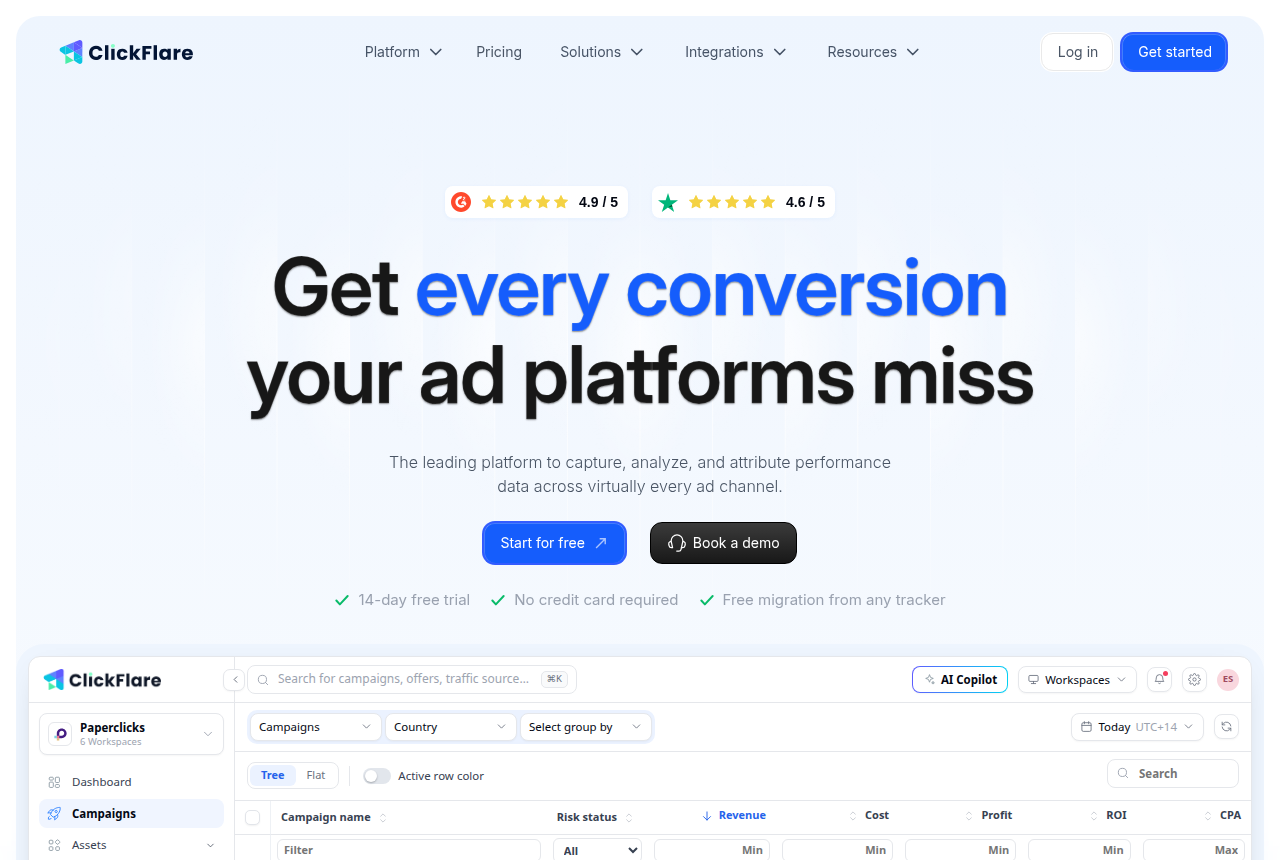
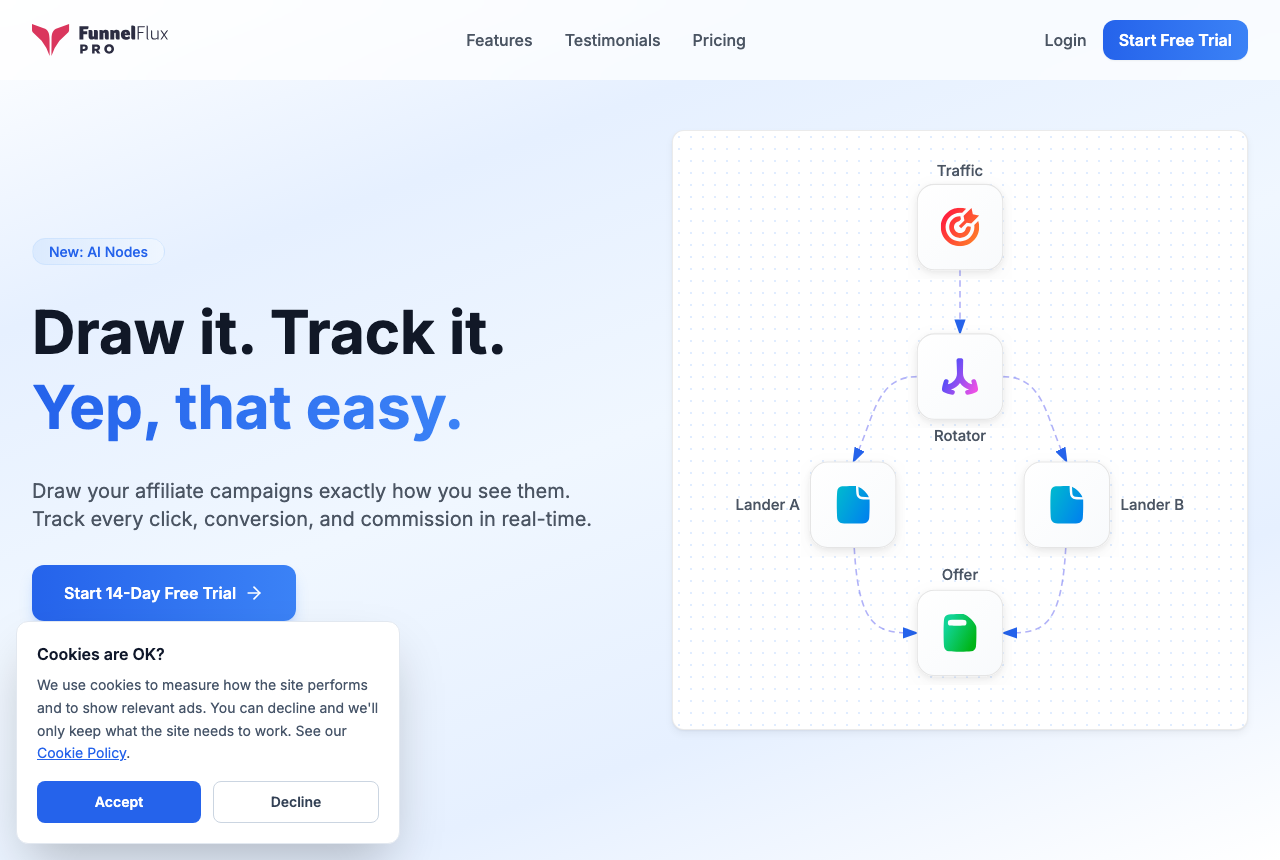
ClickFlare captures conversions server-side, sends them back to Meta, Google, TikTok, Snapchat and Reddit through their conversion APIs, and pulls your ad spend in automatically to compute ROI by source, lander and offer, all on every plan from $69 a month. FunnelFlux Pro gives you a visual canvas where landers, offers, rotators and conditional routing are wired together on one screen, with reporting per node, so complex multi-step flows are its home ground. One computes your ROI for you and keeps your ad accounts fed. The other shows you the whole journey and exactly where it breaks.
The two questions that decide it
Answer these before you weigh a single feature. First: how do you read your campaigns? If you think in sources, landers and offers and want a dashboard that tells you which made money, ClickFlare's reporting is built that way. If your profit comes from optimizing a three or four step flow and you want to see the whole path as a map rather than infer it from a table, FunnelFlux's node-level canvas is genuinely hard to get anywhere else, and it is the reason its users stay.
Second: do you need your ad costs synced and your conversions fed back to the ad platforms without a second subscription? ClickFlare does both on every plan, including the $69 Starter. FunnelFlux passes conversions server-side to TikTok, Facebook, Microsoft and Google Ads, so it feeds the platforms, but automatic cost sync is not native. You either pass cost in your tracking URLs by hand or add Argosync, FunnelFlux's separate cost-sync product, which is its own subscription and its own trial. For a buyer who lives on synced ROAS, that gap is the whole decision.
ClickFlare: cost sync and CAPI on every plan
ClickFlare has run since January 2021 and positions itself plainly as the cheaper replacement for Voluum and RedTrack. It is a full media-buyer tracker, not a light one. It captures conversions server-side with both redirect and direct tracking, so a blocked pixel or an iOS restriction does not silently drop the form fill or the sale. It fires those conversions back to Meta, Google, TikTok, Snapchat and Reddit through their conversion APIs, and it pulls your ad spend in automatically to compute ROI by source, lander and offer. An AI Copilot, traffic-routing tools and a tag manager come with it. The feature buyers point to most is that cost sync and CAPI are on every tier, including the $69 Starter, so you never upgrade to reach them. Our ClickFlare review covers how well that holds up in daily use.
The limits are worth stating flat. Independent proof is thin: a couple of dozen Trustpilot reviews, all five-star, and light organic discussion next to the older incumbents, with Trustpilot itself flagging that the sample may not be representative. Cost sync also lags on the lower tiers, refreshing hourly on Starter and Pro, so an hour-old ROAS can mislead on a fast-moving campaign. And everything counts as an event, so high-volume pop or push traffic burns a tier faster than the plan names suggest. The counter to all of it is the 14-day trial with no card: prove the tracking on your own traffic and trust that over any score. It sits fourth in our ad tracker ranking, two places above FunnelFlux.
FunnelFlux Pro: the visual map for multi-step funnels
Most trackers show you a table of campaigns. FunnelFlux shows you a map. Landers, offers, rotators and conditional routing are drawn on one canvas, and because the reporting is per node you can see exactly where a funnel leaks rather than inferring it from a report. For a buyer whose money comes from complex, multi-step flows, that view is the whole reason to switch, and it is genuinely hard to get from a dashboard-first tracker like ClickFlare. Our FunnelFlux Pro review covers where that canvas pays off.
It is cloud-hosted, so there is nothing to install or patch, and its server-to-server integrations pass conversions to TikTok, Facebook, Microsoft and Google Ads, with cookieless JavaScript tracking that survives browser privacy changes. Pricing is clear: $99 a month for 2 million events, then $10 per additional million, and the first two custom domains are free, with unlimited data retention while your subscription is active.
The costs are real and worth naming. The flexibility of the visual builder comes with a learning curve the docs do not hide, so plan setup time. Automatic ad-cost sync is not native: you either pass cost in the URL or add Argosync, FunnelFlux's separate cost-sync product, which is its own subscription on top of the tracker. The community is smaller than Voluum's or RedTrack's, so you will find fewer third-party walkthroughs when you hit an edge case. And the 14-day trial requires a valid payment method up front, so it is free to try but not card-free, unlike ClickFlare's. It sits sixth in our ranking, and it wins its own segment cleanly: the buyer who optimizes a multi-step flow and wants to see it drawn.
Where the pricing diverges
Both price by events, where a visit, a click, a conversion and a postback each count, so you are comparing the same unit. ClickFlare opens at $69 a month billed yearly for a million events, rises to $169 for five million, with overage billed per thousand rather than a hard stop, and the vendor says the price has not risen since 2021. FunnelFlux opens at $99 a month for two million events, then charges $10 per additional million, with no annual contract and the first two custom domains free.
The entry lines are closer than they look. FunnelFlux's $99 covers twice the events of ClickFlare's $69, so at two million events, once you add ClickFlare's overage on top of its Starter tier, the two land in the same neighbourhood. The real cost gap is not the base price, it is Argosync. ClickFlare bundles automatic cost sync and CAPI into that $69; FunnelFlux charges for cost sync separately, so a media buyer who needs synced ROAS should add the Argosync line before calling FunnelFlux the cheaper of the two. Count your real monthly events on both, price the add-on you will actually use, and the cheaper number is rarely the one on the pricing page. Pricing was verified against each vendor on the date shown on this page; check before you buy.
A third path, if you host the funnel yourself
Neither tracker builds or hosts the funnel it measures. Both follow clicks and conversions on pages and checkouts that live elsewhere, then feed a signal back to a network or an ad platform after the fact. ElasticFunnels owns that middle instead. It is a funnel platform for teams running paid traffic that builds the landing pages, split-tests variants under one URL so the ad platform never resets its learning, and hosts the checkout with order bumps and upsells, then keeps its ad-spend and conversion reporting on the same data layer as the pages, the CRM and the sale. Because a purchase closes in a checkout it hosts, that sale is a first-party event it records directly rather than a click it has to match later, and it fires affiliate postbacks and reports spend against conversions from the same record. It starts with a 14-day free trial that takes no card, on plans from $97 a month, plus 0.5% of revenue processed through its hosted checkout and nothing on sales you run through outside networks. Next to FunnelFlux's card-required trial, the no-card start is worth noting.
The honest caveat keeps it on its own line rather than in the head-to-head. ElasticFunnels is newer than either tracker here, and there is very little independent third-party review coverage to check its claims against, so until you run real volume through it you are largely taking the vendor's word for how its attribution holds up. That is what you would expect of a platform this recent, and both ClickFlare and FunnelFlux have years of public setups and threads to check against instead. Its reporting also covers the funnels it hosts: an affiliate tracking clicks across offers on domains they do not own still needs a dedicated tracker like these two, and a buyer whose visual multi-step funnels span offers ElasticFunnels does not host still wants FunnelFlux's map for that part. It is an option for the seller who runs their own pages and checkout end to end, not a replacement for either tracker.
Which one for you
You buy traffic on Meta, Google or TikTok and want costs synced and accounts fed without a bolt-on: ClickFlare. Automatic cost sync and CAPI to five ad platforms on every plan, at a flat $69, cover the day-to-day decision that matters most to a media buyer, and there is nothing to run. Accept the thin outside proof, estimate your event count before you pick a tier, and test on your own traffic first.
Your money comes from complex multi-step funnels and you want to see them as a map: FunnelFlux Pro. The visual canvas and per-node reporting are the reason to switch, the cloud hosting means nothing to maintain, and $99 for two million events is a fair entry for that view. Budget setup time for the learning curve and add Argosync if you want automatic cost sync.
You host your own pages and checkout end to end: look at ElasticFunnels alongside them, with the newness caveat above in mind, and keep a dedicated tracker for any traffic that lands on domains it does not host.
ClickFlare takes our default pick here, not because it out-tracks FunnelFlux on a drawn funnel, but because most readers weighing these two are buying paid media and want their costs synced and their conversions fed back to the ad platforms without paying for a second product, and that is ClickFlare's ground rather than FunnelFlux's. For the buyer optimizing a multi-step flow who wants the visual map, FunnelFlux is the better and clearer fit, which is why it holds sixth in our ranking while ClickFlare sits fourth. To weigh either against a self-hosted tracker, Binom vs FunnelFlux and Binom vs ClickFlare cover that fork, and RedTrack vs FunnelFlux weighs FunnelFlux against a bigger managed incumbent. All our head-to-heads are in the compare index.
ClickFlare
What works
- Cost sync and CAPI are on every tier, including the $69 Starter. You pull your spend in, compute ROI and send conversions to Meta, Google and TikTok server-side, without a paid upgrade and without handing over a cut of your budget.
- Flat pricing that undercuts Voluum on the same event model. The vendor says the price has not risen since it launched in 2021, and there is no percentage of your budget layered on top.
- Server-side capture with both redirect and direct tracking, so a blocked pixel or an iOS restriction does not silently drop the form fill or the sale.
- Free done-for-you migration and fast human support are the two things public reviewers single out most, alongside a setup that is smoother than trackers usually are.
- A real 14-day trial with no card, plus a 99.99% uptime record since January 2021, so you can prove the tracking on your own traffic before you pay.
What to watch
- Thin independent proof. A couple of dozen Trustpilot reviews, all five-star, and little organic Reddit discussion. Trustpilot itself flags that the sample may not be representative, so the trial is your real due diligence, not the scores.
- Everything counts as an event. Every visit, click, conversion and postback draws down one limit, so high-volume pop or push traffic burns the cap faster than the plan names suggest. Estimate your real event count before you pick a tier.
- Spend data lags on the lower tiers. Starter and Pro refresh hourly and Master every 30 minutes, with near-real-time updates a paid add-on. On fast-moving campaigns an hour-old ROAS can mislead you.
- Less battle-tested at extreme scale than Voluum. For the heaviest automation rules and deepest anti-fraud, the older incumbents still have the longer public track record.
- Billing is charged in advance and is generally non-refundable, and you cancel inside the account rather than by asking support. Export your data before you leave.
FunnelFlux Pro
What works
- A visual funnel canvas: landers, offers, rotators and conditional routing wired together on one screen
- Node-level reporting shows exactly where a funnel leaks
- Predictable pricing: a $99/mo base plus $10 per extra million events
What to watch
- The learning curve is real; the flexibility costs you setup time
- Automatic cost sync needs a separate product, Argosync
- A smaller community than Voluum or RedTrack, so fewer guides when you get stuck
Pricing
ClickFlare: from $69/mo, billed yearly. Priced flat by monthly events, not a percentage of ad spend. Events count visits, clicks, conversions and postbacks together. Starter is $69/mo billed yearly ($89 monthly) for 1M events, Pro $169/mo yearly ($219 monthly) for 5M, Master $329/mo yearly ($429 monthly) for 20M, then Agency $559, Enterprise $959 and Corporate $1,759 (yearly). Overage runs $0.04 per 1,000 events on Starter down to $0.015 on Corporate and never stops your tracking. CAPI, the AI Copilot, the tag manager and synced ad costs come standard from the Starter tier up. 14-day free trial, no card, plus free done-for-you migration from another tracker.
FunnelFlux Pro: from $99/mo for 2M events. One base plan at $99/month including 2 million tracked events; events beyond that are billed at $10 per million. The first two custom domains are free, then $2/month each. Monthly billing, no annual contract, cancel anytime. A valid payment method is required to start the 14-day trial.
Pricing verified against each vendor on 2026-09-23. Check before you buy.
Our pick
ClickFlare
ClickFlare is real. It is an established cloud tracker, running since 2021 and used by 3,500-plus media buyers, that does what Voluum and RedTrack do: server-side capture, CAPI to Meta, Google and TikTok, and spend pulled in for you to compute ROI, all on one flat price. You are unlikely to regret it if you run the 14-day no-card trial against your ad platform's own numbers first. The one real caveat is thin public proof, so trust the trial, not the review scores.
Frequently asked questions
ClickFlare or FunnelFlux Pro: which should I use?
Which is cheaper, ClickFlare or FunnelFlux Pro?
Are ClickFlare and FunnelFlux Pro both cloud-hosted?
Does FunnelFlux sync ad costs and feed the ad platforms like ClickFlare?
Which is better for tracking a complex, multi-step funnel?
Which is more proven, ClickFlare or FunnelFlux Pro?
Sources
Other sources
5 discussions and reviews read for this page. Quotes are excerpts; open a link to read the original in context.
- [rd-does-job] Please Help To Track Conversions In Google Ads
- [rd-positioning] Keitaro vs RedTrack vs Voluum - which one for popunder affiliate with S2S tracking?
- [tp-support] ClickFlare Reviews
- [tp-setup] ClickFlare Reviews
- [tp-sample] ClickFlare Reviews

Written by
Dana Rourke
Lead reviewer
Dana Rourke is the lead reviewer at Campaign Buyer. She owns the tracker and attribution coverage: reading what long-term users report about each tool, checking its documentation and pricing, and verifying prices with the vendor before writing the verdict. Keeping the rankings honest mostly means writing down what the top pick gets wrong, so she does that first.
Last checked 2026-09-24