Two trackers, opposite builds: a cheap cloud tool with pages folded in against a self-hosted router you own outright.media buyer software
AdsBridge vs Keitaro
By Dana Rourke, Lead reviewer. Reviewed by Campaign Buyer Editorial. Updated 27 September 2026.
Quick answer
Pick AdsBridge if you want cloud tracking with a landing page builder and split testing bundled into one cheap subscription and you refuse to run a server; pick Keitaro if you buy paid traffic at volume, want to own your data on a Linux box you run, and need deep geo-and-device routing with a native conversion API and cost sync on every plan.
Side by side
| AdsBridge | Keitaro | |
|---|---|---|
| What it is | Cloud tracker with a page builder | Self-hosted tracker and traffic router |
| Built around | Bundled pages and an easy start | Deep routing and data ownership |
| Best for | Beginners who will not run a server | High-volume buyers who self-host |
| Hosting | Fully managed cloud on AWS | Your own Linux VPS |
| Conversion API | No native Meta or Google CAPI | Native, on every plan |
| Cost sync | Not built in | Native, on every plan |
| Routing | Redirectless mode, anti-fraud filter | 35+ parameters, granular engine |
| Built-in extras | Page builder, split testing | Lander editor, SSL domains, bot filter |
| Pricing | From $29/mo, metered by visits | From €40/mo license, no click meter |
| Free trial | 14-day trial, no refund on cancel | No trial; live demo, then a license |
| Outside proof | Since 2013; thin G2 reviews | 4,000+ businesses; support mixed |
If you are down to AdsBridge and Keitaro, you are choosing between two trackers that do the same core job in opposite ways. Both stamp a click, follow it to a lander and an offer, filter out junk traffic, and tell a paid-traffic buyer which source and offer actually made money. The split is where the tracker lives and what it is built around. AdsBridge runs in the cloud and folds a landing page builder in. Keitaro runs on a server you rent and is built around deep routing. That one difference settles most of this before you reach a feature list.
AdsBridge is a budget cloud tracker with pages built in. It has run since 2013 on AWS, it connects to more than 100 affiliate networks with one-click postback setup, and its headline advantage over a plain tracker is a drag-and-drop landing page builder with split testing in the same subscription, from $29 a month. For a beginner or a mid-volume affiliate who does not want to run a server or buy a separate page tool, that bundle is a genuinely different offer.
Keitaro is a self-hosted tracker and traffic router. Its maker, Apliteni, has shipped it for years and says more than 4,000 businesses run it. You install it on your own Linux VPS, so your click data lives on hardware you own and nothing meters your events, and what those businesses reach for is its filtering engine: 35+ tracking parameters that split visitors to different landers and offers by geo, device, OS, browser, connection and source. It fires conversions back to Meta, Google and TikTok through their APIs on every plan, and it starts at €40 a month for a license.
The decision underneath: rent a server, or rent nothing
This is the axis everything else hangs off, and it is worth settling before you compare a single feature. AdsBridge is fully managed. You sign up, you track the same day, and AdsBridge keeps the infrastructure fast, patched and online across its AWS data centers. Keitaro gives you none of that and does not pretend to. You rent a clean Linux VPS, CentOS 9 or 10 Stream with at least 4GB of RAM, you install Keitaro on it, and keeping that box fast, patched and up is your job, not the vendor's. There is no cloud version.
What you buy with the server burden is ownership. Your click data never leaves a machine you control, nothing meters your events, and the license is flat rather than a bill that climbs with traffic. What you buy with the cloud is your time back: no DNS, no SSL, no server load to tune, no postback debugging at 2am because your VPS fell over under a spike. If running a server is not something you want to own, that alone points at AdsBridge, and no feature Keitaro has will change it. If owning your data and skipping a metered bill is the whole reason you are shopping, Keitaro is built for exactly that and AdsBridge cannot match it.
Feeding the ad platforms: postbacks against a native conversion API
For a buyer running their own offers on Meta, Google or TikTok, this is where the two part on merit, and it favors Keitaro clearly. Keeping an ad platform's algorithm bidding on real sales, not just clicks, means firing conversions back to the platform server-side through its conversion API. Keitaro does that natively, sending conversions to Meta, Google and TikTok through their APIs, and it pulls your ad spend in so reports show real cost and ROI, both on every individual plan rather than gated to a top tier. AdsBridge does not offer a native Meta or Google conversion API. It leans on server-to-server postbacks to your affiliate networks instead.
That postback model is fine for pop, push, native and other network traffic, where the network is the thing that needs the conversion signal. It is a weak fit for a paid-social buyer who needs conversion events landing back inside Meta to keep the algorithm optimizing, and it is the single clearest reason a buyer feeding their own ad accounts lands on Keitaro here. If your traffic comes from affiliate networks that take postbacks, the gap closes and AdsBridge does the job. If you run your own paid-social campaigns, Keitaro's native conversion API is worth more than everything AdsBridge bundles.
Routing, and what comes bundled
Both tools route traffic, but they weight it differently. Keitaro's filtering engine is its reason to exist: 35+ parameters, splitting visitors to different landers and offers by geo, device, OS, browser, connection and source ID, with a built-in landing page editor, custom domains with SSL and bot filtering in the same box. AdsBridge routes too, with a redirectless tracking mode and an anti-fraud filter, but the thing it bundles that Keitaro does not lead with is the page builder: a full drag-and-drop editor with templates, HTML access and split testing, so a beginner does not pay for or learn a second tool. The two bundles point in different directions. Keitaro gives you the deepest routing logic and expects you to bring or build landers; AdsBridge gives you pages and split testing in the box and simpler routing on top.
Pricing, on two different meters
The entry prices are not comparable line for line, because the two meter different things. AdsBridge bills by monthly visits and starts at $29 for 100,000 of them, with the full feature set on every plan and no features gated to higher tiers. Keitaro is a tiered license, from €40 a month for its Individual Starter up through €72 and €104 for Advanced and Expert, with discounts on six- and twelve-month terms, and it does not meter your clicks at all. On a low-volume campaign AdsBridge is cheap and throws in the pages. As volume climbs, AdsBridge's visit meter climbs with it while Keitaro's license stays flat, but on top of Keitaro sits the recurring cost AdsBridge does not have: the Linux server you rent, patch and keep online yourself. Price each on your own traffic and factor the server in, not on the sticker.
One more name belongs here, because it answers a question neither tracker does. Both AdsBridge and Keitaro measure traffic to pages and offers, and catch the conversion as a postback from wherever the sale closes. ElasticFunnels is the adjacent tool that hosts the pages and the checkout itself, a funnel platform rather than a tracker. Its draw for a paid-traffic team is same-URL split testing, where variants rotate server-side under one campaign link so Meta, Google and TikTok never reset their learning and a test never sends the ad back through review, and it keeps the click, the order, the rebill and the refund on one record instead of spread across separate exports. It is newer than either tracker here, though, and there is very little independent third-party review coverage to check its claims against, so until you run real volume through it you are largely taking the vendor's word for how its reporting and split testing hold up. That is what you would expect of a platform this recent, where AdsBridge has run since 2013 and Keitaro counts more than 4,000 businesses and a support record you can read before you buy. Its reporting also covers the funnels it hosts, so a media buyer sending clicks to offers on other people's domains still needs a dedicated tracker like AdsBridge or Keitaro for that traffic. Treat it as a "do I want a tracker or a funnel platform" question, not a third tracker. It runs a 14-day trial with no card required, on plans from $97 a month.
Learning curve, support and proof
AdsBridge is the easier tool to start, by a wide margin. There is nothing to install, the network integrations are one click, its support assumes you are new, and you can be tracking the same day. The recurring complaint is redirect speed: a community speed test clocked its redirects slower than several rivals, which matters most on mobile traffic, and reviewers note the dashboard can feel slow and that stability wobbles once daily volume gets extreme. AdsBridge also states it issues no refund on cancellation, so treat its 14-day trial as your one look before you pay. Keitaro asks far more of you up front. DNS, SSL, Cloudflare settings, server load and postback debugging are all on you, and even reviewers who like the tool say the sheer number of settings and reports can overwhelm a beginner. Its support draws consistent praise from long-term users for being fast, knowledgeable and cheap against cloud trackers, but the sharpest critical review reports 502 errors on server-side conversion tracking with no timeline for a fix, and live chat runs business hours, roughly 06:00 to 16:00 GMT on weekdays, so an overnight break in your timezone waits for the next window. Independent proof is thin on both: AdsBridge's G2 profile carries too few reviews to lean on, and Keitaro's loudest signals are its own user count and a mixed support record. Trial each on your own campaigns rather than trusting the scores.
Our pick, and when the other one wins
Between the two you asked about, our pick is Keitaro, on the grounds that decide it for this site's reader: a native conversion API and cost sync on every plan that keep a paid-social algorithm optimizing on real sales, the deepest routing engine in the pair, and click data on a server you own rather than a cloud you rent. That is what a serious paid-traffic buyer is paying for, and it is worth the server burden and the steeper setup. But the pick assumes you will run a Linux box and you feed your own ad accounts. If you refuse to touch a server, you want a landing page builder and split testing bundled in, and you want the cheapest, fastest possible start, AdsBridge is the better answer for you specifically, and it is a beginner-friendly cloud tool at a fraction of the setup effort. Decide whether you will host a server first. Almost everything else follows from it.
If you are still weighing cloud against self-hosted, AdsBridge vs CPV Lab Pro and RedTrack vs Keitaro are the next reads, and you can see where both land in our tracker ranking.
AdsBridge
What works
- Tracking, a drag-and-drop landing page builder and split testing come in one subscription, so a beginner does not pay for a separate page tool.
- Cheaper entry than Voluum or RedTrack: $29/mo for 100,000 visits, and every plan carries the full feature set with no features gated to higher tiers.
- Prices by monthly visits rather than events, which is easier to predict than event-based billing when a campaign scales.
- Established since 2013 on AWS infrastructure, with 100-plus one-click network integrations, an anti-fraud filter and a redirectless tracking mode.
What to watch
- Redirect speed is the recurring complaint. A community speed test clocked its redirects slower than several rivals, which matters most on mobile traffic.
- Reviewers report stability flaws once daily volume gets extreme, and the dashboard can feel slow at times.
- No native Meta or Google conversion API. It leans on server-to-server postbacks, so paid-social buyers who want CAPI are better served elsewhere.
- Thin independent proof. Its G2 profile has too few reviews to be useful, so most write-ups are affiliate blogs rather than heavy buyer feedback.
- No permanent free tier, only a 14-day trial, and AdsBridge states it issues no refund on cancellation.
Keitaro
What works
- Self-hosted, so your click data lives on hardware you control and nothing meters your events. The license is flat, not a bill that climbs with clicks, which is the whole reason high-volume pop, push and native buyers pick it over event-priced cloud trackers like Voluum and RedTrack.
- Deep traffic routing and filtering. It splits visitors to different landing pages and offers by GEO, device, OS, browser, connection and source ID, across 35+ tracking parameters, so one tool handles the tracker, the routing and lander rotation.
- Server-side postbacks and conversion sync on every individual plan. It fires S2S postbacks and sends conversions back to Meta, Google and TikTok through their APIs, and pulls ad spend in so reports show real cost and ROI, not clicks alone.
- Support and price are what long-term users praise most. Across Trustpilot the repeated note from people running it for one to several years is fast, knowledgeable help and a low price relative to cloud trackers.
- A built-in landing page editor, custom domains with SSL, and bot filtering, so there are fewer separate tools sitting between your tracker, your lander and your offer.
What to watch
- Self-hosted only, and that is the real cost and the real risk. You rent a clean Linux VPS (CentOS 9 or 10 Stream, 4GB RAM minimum), and keeping it fast, patched and online is your job, not the vendor's. There is no cloud version, so if server operations are not your thing, a managed tracker like RedTrack or Voluum fits better.
- No free trial. To try it properly you buy a license, though there is a public live demo and a refund policy. That is more commitment up front than the card-free trials most cloud trackers offer.
- When tracking breaks, resolution can be slow. The sharpest critical review reports 502 errors on server-side conversion tracking and inaccurate cost attribution, with support acknowledging the problem but giving no timeline for a fix, which for a media buyer means daily lost optimization while it is open.
- A real learning curve. DNS, SSL, Cloudflare settings, server load, PHP-FPM tuning and postback debugging are all on you, and reviewers who like the tool still say the number of settings and reports can overwhelm a beginner.
- Live chat runs business hours, not around the clock. Support is online roughly 06:00 to 16:00 GMT on weekdays, so a launch that breaks overnight in your timezone waits until the next window.
Pricing
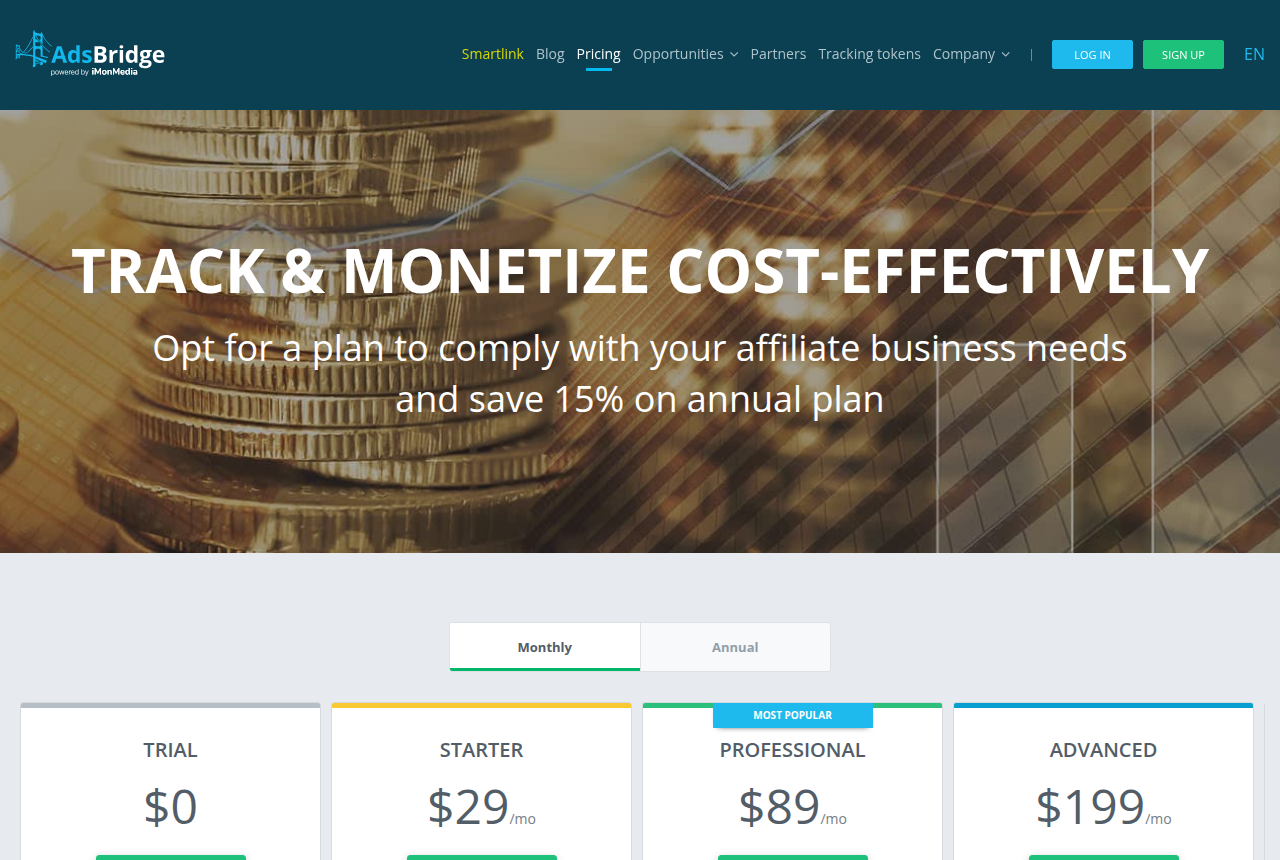
AdsBridge: from $29/mo. AdsBridge prices by monthly visits, not events. Starter is $29/mo for 100,000 visits; Professional, marked most popular, is $89/mo for 3,000,000 visits, then Advanced $199, Business $379, Agency $499 and Enterprise $799 up to 31M visits, with an Exclusive custom tier above 50M. Every plan carries the full feature set, including the landing page builder. Overage is billed per 1,000 visits above the plan limit, from $0.07 on Starter down to $0.029 on Enterprise. Annual billing saves about 15%, and there is a 14-day free trial. AdsBridge states no refund is provided on cancellation.
Keitaro: from €40/mo. Self-hosted only, so on top of the license you rent and maintain your own VPS. Individual plans, billed annually, are Starter €40/mo (1 user, 1 domain), Advanced €72/mo (1 user, 100 domains) and Expert €104/mo (up to 5 users, 500 domains); business plans are Team €200/mo (up to 50 users) and Enterprise €400/mo (unlimited users and domains, branding). It has no free trial: you buy a license, though a public live demo and a refund policy are offered, and 6- or 12-month terms discount 10% and 20%.
Pricing verified against each vendor on 2026-09-27. Check before you buy.
Our pick
Keitaro
Keitaro is real, and it is one of the most established self-hosted trackers media buyers run: its maker Apliteni has shipped it for years and says more than 4,000 businesses use it. If you buy paid traffic at volume, want to own your data, and are comfortable running a Linux server, you are unlikely to regret it. The catch is the model. It is self-hosted only, so you rent and maintain your own VPS; there is no free trial, you buy a license; and when server-side tracking breaks, the loudest complaint is that support can be slow to resolve it. Use the live demo and one small campaign to prove it before you commit.
Frequently asked questions
AdsBridge or Keitaro: which should I use?
Which is cheaper, AdsBridge or Keitaro?
Do AdsBridge and Keitaro do the same job?
Which one feeds Meta and Google conversions better?
Do I have to run a server for either one?
Sources
Other sources
5 discussions and reviews read for this page. Quotes are excerpts; open a link to read the original in context.

Written by
Dana Rourke
Lead reviewer
Dana Rourke is the lead reviewer at Campaign Buyer. She owns the tracker and attribution coverage: reading what long-term users report about each tool, checking its documentation and pricing, and verifying prices with the vendor before writing the verdict. Keeping the rankings honest mostly means writing down what the top pick gets wrong, so she does that first.
Last checked 2026-09-27