Keitaro is real, and it is one of the most established self-hosted trackers media buyers run: its maker Apliteni has shipped it for years and says more than 4,000 businesses use it. If you buy paid traffic at volume, want to own your data, and are comfortable running a Linux server, you are unlikely to regret it. The catch is the model. It is self-hosted only, so you rent and maintain your own VPS; there is no free trial, you buy a license; and when server-side tracking breaks, the loudest complaint is that support can be slow to resolve it. Use the live demo and one small campaign to prove it before you commit.
Keitaro in one picture: it runs on a machine you own, takes traffic from every source, and routes it to the right page.
You have seen the name in a media-buying group or on an affiliate forum, and now you want the honest answer to two questions. Is Keitaro a real, working tracker? And if you buy it, will you regret it?
The first answer is easy. Keitaro is real, and one of the longer-running trackers in the business. It is built by Apliteni, it has been shipping for years, and the vendor says more than 4,000 businesses run it. This is not a tool that turned up last quarter, and the reviews go back years with the same buyers in them.
The second answer is the one that matters, and it does not turn on whether the software works. It works. It turns on one design decision: it is self-hosted, and self-hosted only. You install it on your own rented server, and you run it. Whether you will regret that is the whole review.
What Keitaro actually is
It is an ad tracker and attribution platform for people who buy paid traffic. You place a tracking link at the source, and Keitaro records the path from click to landing page to offer to conversion, across any source you can put a link on: Facebook, Google Ads, TikTok, native, push, pop, email. It reads more than 35 parameters per click, from UTM tags to partner and zone IDs, and stitches clicks, conversions and cost into one dashboard so your reports show ROI rather than clicks alone.
Under that sit the parts a serious buyer needs. Cookieless server-to-server postback tracking that keeps firing on iOS and in privacy browsers. Conversion sync that sends sales back to Meta, Google and TikTok through their APIs to feed the bidding algorithms. Bot and proxy filtering. A landing page editor and custom domains with SSL. And its strongest single feature, deep traffic routing: it can send different visitors to different landers and offers by GEO, device, OS, browser and source, with click caps and scheduled rotation.
Keitaro's routing: one stream of traffic, split to the right page by rules like geo, device and source before it ever reaches an offer.
Who it fits, and who it does not
It fits paid media buyers, CPA affiliates and agencies who run real volume and need to compare cost against commission, rotate landers and offers, and feed conversions back to the ad platforms. If you run pop, push, native or redirect traffic where a cloud tracker's event caps get expensive fast, the self-hosted, flat-license model is the point. One buyer on Reddit who runs popunder campaigns framed it exactly that way: self-hosted, no event limit, cheaper over time at large volume.
It is the wrong tool for a content-site affiliate who only wants to know which blog link got clicked. A link cloaker or your network's sub-ID report is simpler and cheaper for that. This is far more tracker than that job needs, and its settings will feel like overkill. It is also the wrong first tool for someone who has never run a server, which is the trade-off the next section is about.
The self-hosting trade-off
Here is the catch, stated plainly. Keitaro runs on your own Linux box. The vendor's own requirements are a clean server on CentOS 9 or 10 Stream, KVM virtualization, at least 4GB of RAM and a 20GB SSD, with the core count sized to your clicks per day. That machine is a separate bill you pay a host, and keeping it fast, patched, backed up and online is your job. So is DNS, SSL, Cloudflare configuration and the odd session of PHP-FPM tuning when the box starts dropping clicks under load. The flat, no-overage pricing is only as good as the hardware under it.
The upside of that same decision is why people choose it. Your data sits on hardware you control, and no cloud vendor meters your events. One long-term user on Reddit put the balance well: the self-hosting part is nerve-wracking at first, but the cost savings and flexibility are worth it in the long run. If patching a box is not your idea of a good time, note that Keitaro has no cloud version of its own, so a managed tracker like RedTrack or Voluum is the easier path, and the closest self-hosted peer is Binom.
No trial, and support when things break
Two reservations are worth reading before you buy. The first is that it has no free trial. To try Keitaro on your own campaigns you buy a license, though the vendor runs a public live demo you can click through first, and offers a refund if it is not the right fit. That is more commitment up front than the card-free trials at most cloud trackers, so lean on the demo and start with the cheapest license on one real campaign.
The second is support under pressure. Most public reviews praise it, and fast help is the single most repeated compliment. But the sharpest critical review on Trustpilot is worth reading in full: a buyer reported 502 errors on server-side conversion tracking and inaccurate cost attribution, with support acknowledging the issue but giving no timeline, workaround or escalation while campaigns bled money. On a self-hosted tool, some of that is yours to fix and some is the vendor's, and live chat runs business hours on GMT rather than around the clock. If accurate tracking is mission-critical, prove it at low spend before you move everything over.
So, will you regret it?
On capability, no. Keitaro does what a paid-traffic tracker should, its routing is among the deepest in the category, and the flat license is friendlier than event-metered cloud plans once your volume climbs. On fit, it depends entirely on whether you will run a server. If you will, the people who do keep it for years and rate the price and support highly. If you will not, buy a managed cloud tracker instead and do not fight the infrastructure.
Net: for a buyer who runs volume and owns their stack, Keitaro is a proven, cost-efficient pick, and the live demo plus a cheap first license take most of the risk out of finding out. Not sold? Read our Keitaro alternatives, or see where it lands against the field in our best ad tracker ranking.
Pros and cons
What works
Self-hosted, so your click data lives on hardware you control and nothing meters your events. The license is flat, not a bill that climbs with clicks, which is the whole reason high-volume pop, push and native buyers pick it over event-priced cloud trackers like Voluum and RedTrack.
Deep traffic routing and filtering. It splits visitors to different landing pages and offers by GEO, device, OS, browser, connection and source ID, across 35+ tracking parameters, so one tool handles the tracker, the routing and lander rotation.
Server-side postbacks and conversion sync on every individual plan. It fires S2S postbacks and sends conversions back to Meta, Google and TikTok through their APIs, and pulls ad spend in so reports show real cost and ROI, not clicks alone.
Support and price are what long-term users praise most. Across Trustpilot the repeated note from people running it for one to several years is fast, knowledgeable help and a low price relative to cloud trackers.
A built-in landing page editor, custom domains with SSL, and bot filtering, so there are fewer separate tools sitting between your tracker, your lander and your offer.
What to watch
Self-hosted only, and that is the real cost and the real risk. You rent a clean Linux VPS (CentOS 9 or 10 Stream, 4GB RAM minimum), and keeping it fast, patched and online is your job, not the vendor's. There is no cloud version, so if server operations are not your thing, a managed tracker like RedTrack or Voluum fits better.
No free trial. To try it properly you buy a license, though there is a public live demo and a refund policy. That is more commitment up front than the card-free trials most cloud trackers offer.
When tracking breaks, resolution can be slow. The sharpest critical review reports 502 errors on server-side conversion tracking and inaccurate cost attribution, with support acknowledging the problem but giving no timeline for a fix, which for a media buyer means daily lost optimization while it is open.
A real learning curve. DNS, SSL, Cloudflare settings, server load, PHP-FPM tuning and postback debugging are all on you, and reviewers who like the tool still say the number of settings and reports can overwhelm a beginner.
Live chat runs business hours, not around the clock. Support is online roughly 06:00 to 16:00 GMT on weekdays, so a launch that breaks overnight in your timezone waits until the next window.
Keitaro, feature by feature
Individual pricing plans.
Keitaro's Individual pricing tab showing three tiers on yearly billing: Starter at €40/mo, Advanced at €72/mo and Expert at €104/mo, each with a Get button.
Screenshot: keitaro.io, Campaign reports dashboard.
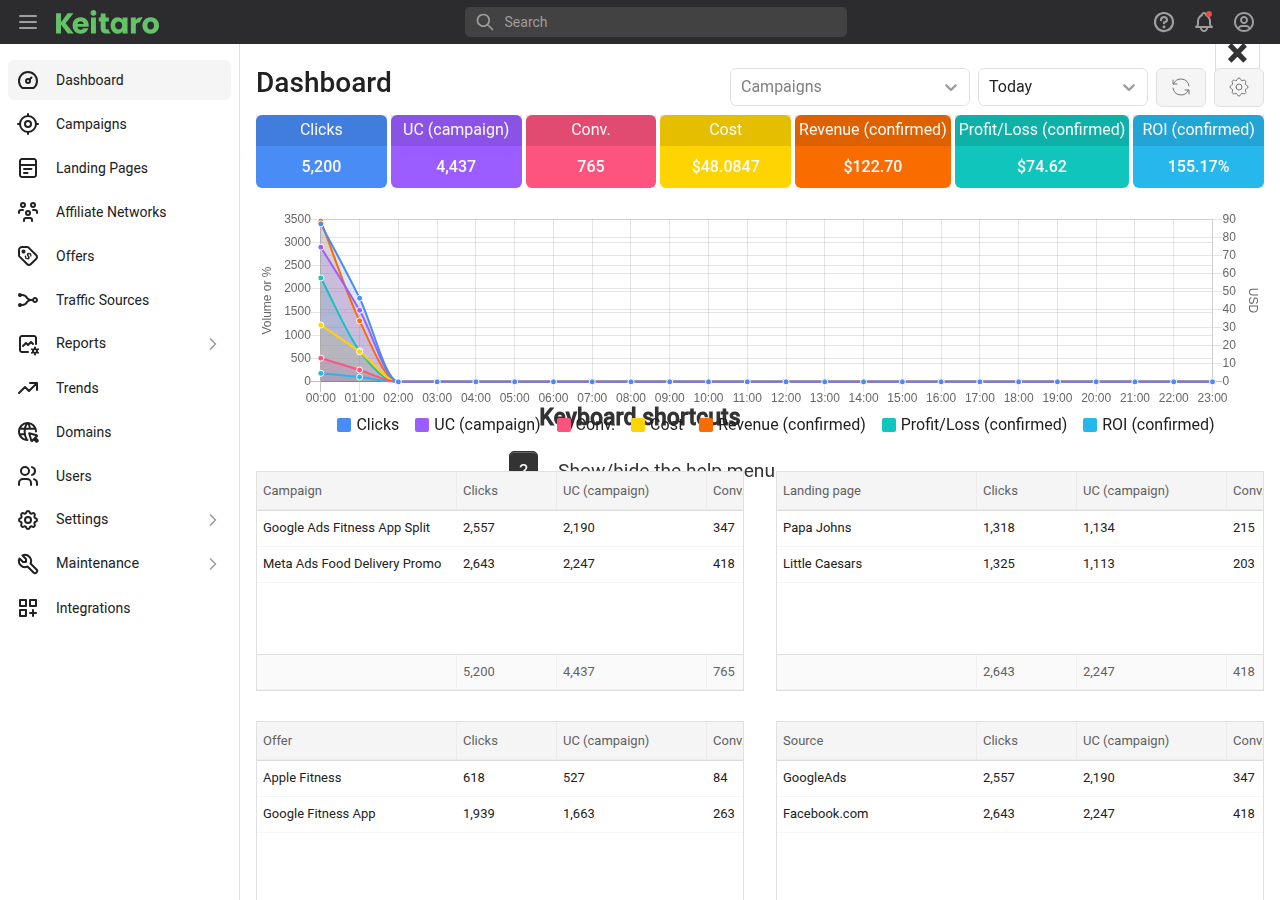
The Keitaro dashboard showing top-line metric cards (Clicks 5,200, Conversions 765, Cost, Revenue, Profit/Loss and ROI 155.17%), a time-of-day chart, and breakdown tables of clicks and conversions by campaign, landing page, offer and traffic source.
Screenshot: demo.keitaro.io,
What buyers keep saying
Research: unverified
Self hosted control and flat cost, at the price of running a server
The recurring draw for high-volume buyers is that Keitaro is self-hosted: no per-event meter, your data on your own box, and a flat license instead of a bill that climbs with clicks. The recurring cost is that you run the VPS, DNS, SSL and updates yourself, which users describe as a real learning curve that is worth it once configured.
“I've used Keitaro for a bit, and while it does have a learning curve, once you get it set up, it's pretty powerful for tracking. The self-hosting part can be a bit nerve-wracking at first, but the cost savings and flexibility are definitely worth it in the long run.”
Support and price are what long term users praise↑ frequently praised
Across Trustpilot the loudest positive theme is fast, knowledgeable support and a low price relative to cloud trackers, from reviewers running the tool for one to several years.
“i have been working with keitaro for over 2 years, never wanted another tracker they have everything you need and the support is the best i have seen & ofcourse the price is unbeatable !”
“I've been using this tracker for one year. It's easy to use, works well, and doesn't cost much. It met all my expectations and the support is great. They are always available to help and fix problems fast.”
“Excellent tracker, makes your life so much easier in every sense. Now its even better cause of multiple integration that make everything simpler. The support is also amazing, probably the best support ive ever seen, they are really really helpful, fast and comprehensive.”
When tracking breaks, resolution can be slow↓ common complaint
The sharpest critical review reports the software becoming unreliable (502 errors on server-side conversion tracking, inaccurate cost attribution) with support acknowledging the issue but giving no timeline, which for a media buyer means daily lost optimization while it is unresolved.
“Great product, terrible support - costing me money daily”
We read the threads before we ranked. Here is where the sentiment above comes from, at links you can open.
“I've used Keitaro for a bit, and while it does have a learning curve, once you get it set up, it's pretty powerful for tracking. The self-hosting part can be a bit nerve-wracking at first, but the cost savings and flexibility are definitely worth it in the long run.”
“i have been working with keitaro for over 2 years, never wanted another tracker they have everything you need and the support is the best i have seen & ofcourse the price is unbeatable !”
“I've been using this tracker for one year. It's easy to use, works well, and doesn't cost much. It met all my expectations and the support is great. They are always available to help and fix problems fast.”
“Excellent tracker, makes your life so much easier in every sense. Now its even better cause of multiple integration that make everything simpler. The support is also amazing, probably the best support ive ever seen, they are really really helpful, fast and comprehensive.”
Self-hosted only, so on top of the license you rent and maintain your own VPS. Individual plans, billed annually, are Starter €40/mo (1 user, 1 domain), Advanced €72/mo (1 user, 100 domains) and Expert €104/mo (up to 5 users, 500 domains); business plans are Team €200/mo (up to 50 users) and Enterprise €400/mo (unlimited users and domains, branding). It has no free trial: you buy a license, though a public live demo and a refund policy are offered, and 6- or 12-month terms discount 10% and 20%.
Pricing verified against the vendor on 2026-09-24. Prices go stale. Check the vendor before you buy.
24 September 2026. First published. Verified pricing and features against the vendor and ranked Keitaro in its category.
Frequently asked questions
How much does Keitaro cost?
Self-hosted only, so on top of the license you rent and maintain your own VPS. Individual plans, billed annually, are Starter €40/mo (1 user, 1 domain), Advanced €72/mo (1 user, 100 domains) and Expert €104/mo (up to 5 users, 500 domains); business plans are Team €200/mo (up to 50 users) and Enterprise €400/mo (unlimited users and domains, branding). It has no free trial: you buy a license, though a public live demo and a refund policy are offered, and 6- or 12-month terms discount 10% and 20%.
Who is Keitaro best for?
Keitaro is real, and it is one of the most established self-hosted trackers media buyers run: its maker Apliteni has shipped it for years and says more than 4,000 businesses use it. If you buy paid traffic at volume, want to own your data, and are comfortable running a Linux server, you are unlikely to regret it. The catch is the model. It is self-hosted only, so you rent and maintain your own VPS; there is no free trial, you buy a license; and when server-side tracking breaks, the loudest complaint is that support can be slow to resolve it. Use the live demo and one small campaign to prove it before you commit.
Sources
Other sources
5 discussions and reviews read for this page. Quotes are excerpts; open a link to read the original in context.
Dana Rourke is the lead reviewer at Campaign Buyer. She owns the tracker and attribution coverage: reading what long-term users report about each tool, checking its documentation and pricing, and verifying prices with the vendor before writing the verdict. Keeping the rankings honest mostly means writing down what the top pick gets wrong, so she does that first.