Head-to-headmedia buyer software
AdSpy vs BigSpy
By Dana Rourke, Lead reviewer. Reviewed by Campaign Buyer Editorial. Updated 27 September 2026.
Quick answer
Pick AdSpy if you research Facebook and Instagram ads seriously and want the deepest searchable archive with filters for offer id, affiliate network and landing-page tech; pick BigSpy if you want the cheapest, widest ad library across many channels for creative inspiration and can treat its metrics as directional and set a reminder before the renewal.
Side by side
| AdSpy | BigSpy | |
|---|---|---|
| What it is | Deep Meta ad archive | Cheap, broad ad library |
| Ad platforms | Facebook, Instagram | Up to 11 channels |
| Affiliate filters | Yes, offer and network | No |
| Comment mining | Yes | Limited |
| Data reliability | Consistent | Directional |
| Free entry | 24-hour refund only | Free plan |
| Entry price | $149/mo flat | $69/mo, FB and IG only |
AdSpy and BigSpy are both sold as ad spy tools, so a buyer down to these two often assumes it is the same product at two prices. It is not. They sit at opposite ends of the same shelf. AdSpy is a paid, focused archive of Facebook and Instagram ads, built for someone hunting a proven angle. BigSpy is the cheap, wide option: a library that reaches across as many as 11 ad channels and starts on a free plan. The decision is less about which is better in the abstract and more about whether you need depth on Meta or breadth on a budget.
The one question that decides it: depth on Meta, or breadth on a budget?
Answer this before you compare a single feature. If your work is reverse-engineering Facebook and Instagram creative, and you want to search by advertiser, offer, affiliate network or the tech behind a landing page, AdSpy is built for that and BigSpy is not. If you want the widest possible pool of ad ideas across many platforms for the least money, and you can live with rougher data and a dated interface, BigSpy is built for that and AdSpy costs a good deal more to do less of it.
That is why the sticker price misleads here. A serious Meta researcher who saves money on BigSpy has bought a shallower tool on the exact filters they live in, and spends the difference in time wading through weaker search results. A buyer who only wants creative inspiration and pays $149 for AdSpy has bought Meta depth they do not need and given up TikTok, YouTube and the rest. Match the job first, and the price makes sense after.
AdSpy: the deepest Meta and Instagram archive
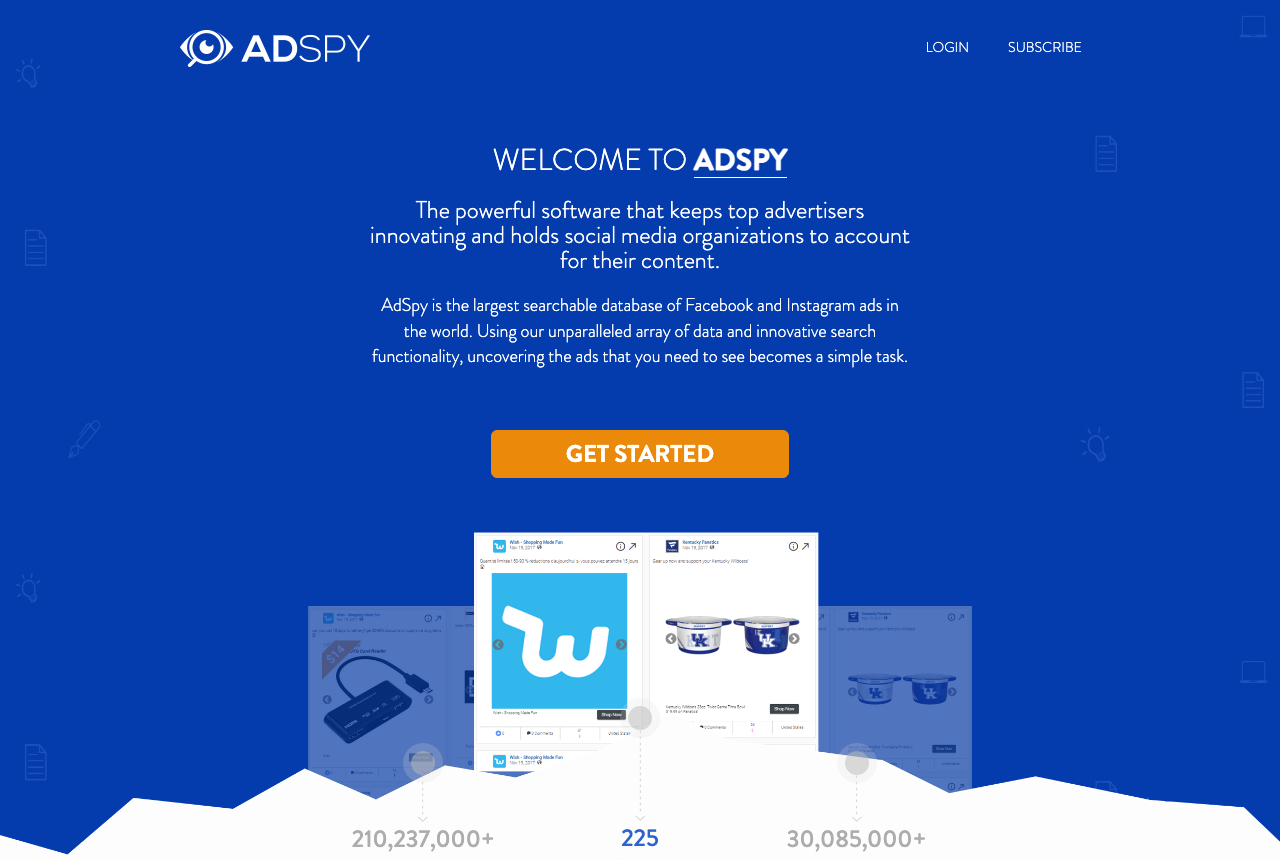
When the work is Facebook and Instagram, AdSpy has the larger, sharper archive of the two. Its own site puts the library above 211 million ads across 225 countries. You can search by advertiser page, ad text, user reactions and comments, country, offer id, affiliate network and even the technology a landing page runs on, and it says it reads past cloakers to the real page. For an affiliate or media buyer hunting a proven angle, that filter set is the reason to be here. Comment mining is a strength buyers name on its own: reading the comments under a winning ad for the objections and hooks that feed the next test.
Two honest edges. The coverage is Meta only, so TikTok, YouTube, Pinterest and native are all invisible to it. And a big archive is not the same as a fresh one: buyers report results that feel stale or products already saturated. On Reddit one affiliate called the data "a little stale sometimes" and another summed the tool up as "clunky and expensive." Treat what AdSpy surfaces as patterns to validate, not proof a campaign is scaling today.
BigSpy: the cheapest way to a wide creative library
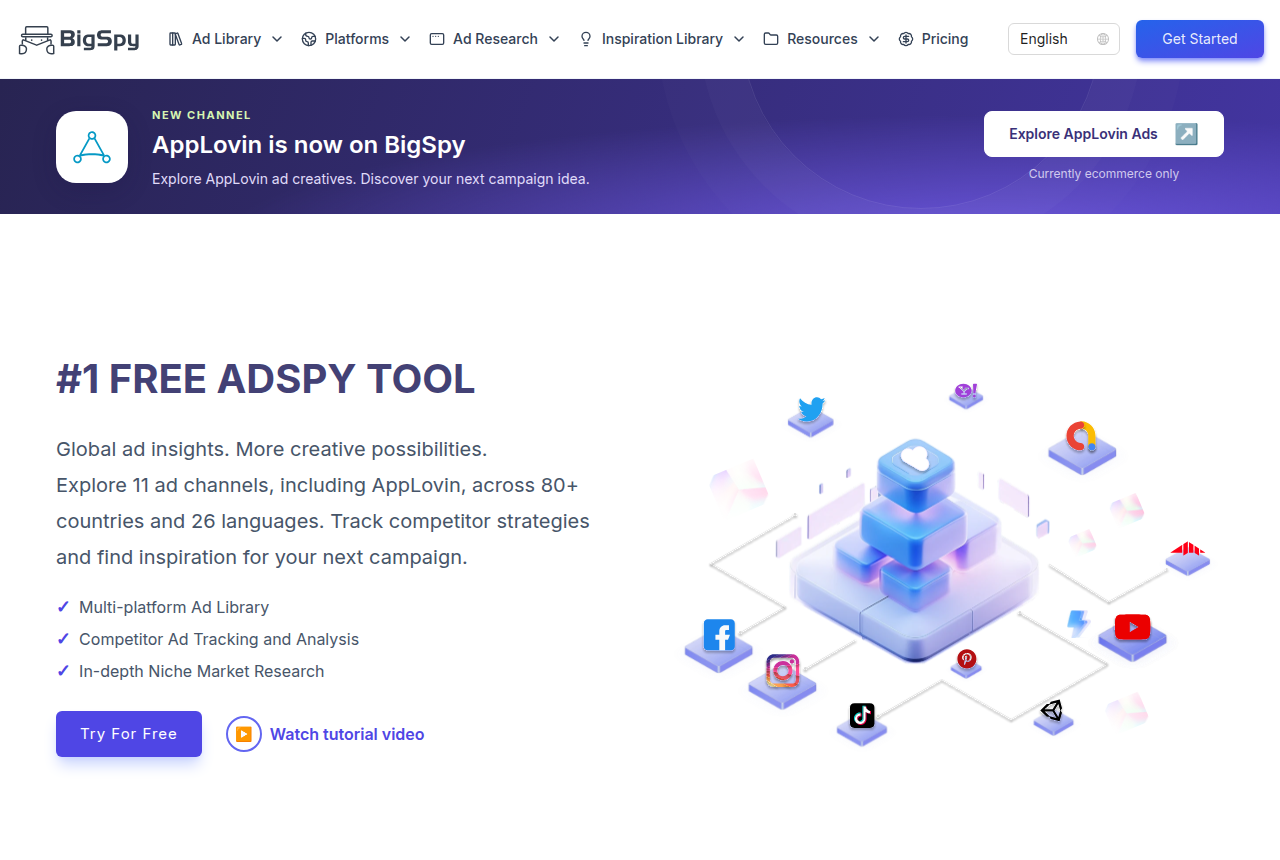
BigSpy is built for the opposite buyer: someone who wants the broadest pool of ad ideas for the least money. It has cataloged more than a billion creatives since 2018, advertises coverage across as many as 11 channels including Facebook, TikTok, YouTube, Pinterest and in-app networks like AppLovin, and it starts free. For finding hooks, angles and creative formats that a single-network tool would miss, it is fast and cheap, and the free plan lets you test it before paying a cent.
The catches are real and worth knowing before you commit. The 11-channel coverage it advertises needs the $499 Ultimate plan. The $69 Starter tier is Facebook, Instagram and AppLovin only, and TikTok starts at $159. The data is directional: users report impression numbers that repeat suspiciously, with one dropshipper noting that "all the ad impressions are either 4.2k or 8.4k" and concluding "the data is not accurate." Search is hit or miss and the interface feels dated, so you sort through low-quality results to find the good ones, as one buyer put it, "sometimes you find gold, sometimes you wade through garbage for 20 minutes." And billing is the loudest complaint of all: plans auto-renew, refunds are limited to the first 24 hours, and there is no refund on cancellation. On the budget end, BigSpy earns its place, as long as you know exactly what the entry price buys.
Platform coverage: two channels deep, or many channels shallow
This is the cleanest line between them. AdSpy is Facebook and Instagram, done deeply, with the filters and comment search a Meta researcher lives in. BigSpy spreads across many channels but thinly, and the channels you actually get depend on the tier you pay for. If your paid social is Meta and nothing else, AdSpy's depth wins and BigSpy's extra channels are noise. If you are pulling creative ideas from TikTok, YouTube and Pinterest as much as Facebook, AdSpy simply cannot show them to you and BigSpy can, provided you pay for the tier that unlocks them.
Data you can act on, or data you have to sanity-check
Both tools show engagement and impression figures, and neither should be read as proof of profit. But the gap in reliability is wide. AdSpy's numbers are steadier and its filters let you narrow to something specific before you trust it. BigSpy's repeating impression figures mean the metrics are best used to spot that an ad exists and what it looks like, not to rank winners. As one seller flatly put it, "No spy tool can prove that an ad is profitable." That is true of both, but it bites harder on BigSpy, where the numbers themselves are shakier. Use either one to find candidates, then validate against live sources.
Pricing: a flat fee versus a tiered ladder
AdSpy is a flat $149 a month, one plan, whoever logs in, with effectively unlimited searching. There is no free trial, but a full refund within 24 hours of purchase works as a same-day paid trial. BigSpy starts lower, with a free plan and a $69 Starter tier, but the ladder climbs fast once you want more than Facebook, Instagram and AppLovin: TikTok begins at $159 and the full multi-channel coverage it advertises sits on the $499 Ultimate plan. On the headline number BigSpy is cheaper, and for a light user on the free or Starter tier it stays cheaper. Want the platforms it markets, and the bill can pass AdSpy's flat fee. Compare on the channels you actually need, not the entry price, and remember BigSpy auto-renews with refunds limited to the first 24 hours.
What neither tool does
A spy tool finds you an angle. It does not build the funnel behind it. Once AdSpy or BigSpy hands you a promising competitor ad, the next steps are yours: building the presell page and checkout, and finding the variant that converts. That is a separate tool on a separate bill. ElasticFunnels is one platform that covers that part: a landing page builder that generates or clones a page, a hosted checkout, and ad-spend and conversion reporting with affiliate postbacks attached, so the spend-to-sale numbers sit on one timeline instead of across separate exports. It runs a 14-day trial with no card. The honest limit is that it is newer than the tools on this page, and there is very little independent third-party review coverage to check its claims against, so until you run real volume through it you are largely taking the vendor's word for how the attribution holds up. Keep it out of your spy-tool decision rather than letting it sway one.
Which one for you
You research Facebook and Instagram seriously: AdSpy. The archive depth, the comment search and the offer, network and landing-page filters are what you are paying for, and BigSpy does not match them on Meta. Use the 24-hour refund as a trial and do a full day of real searching before you decide.
You want the widest, cheapest pool of creative ideas: BigSpy. Start on the free plan, use it for hooks, angles and formats across platforms, and treat every metric as directional. Check which channels your tier actually includes before you upgrade, and set a reminder before the renewal.
You buy on TikTok, YouTube or Pinterest as well as Meta: BigSpy is the only one of the two that sees those channels at all, but budget for the tier that unlocks them, because the $69 entry plan does not. AdSpy cannot help you there whatever you pay.
AdSpy takes our default pick because more of this site's readers do serious Facebook and Instagram research than shop for the cheapest multi-channel library, and its depth and filters are what that larger group actually needs. That is a statement about who is reading, not a knock on BigSpy, which is the honest better buy for a budget-first creative hunt across channels.
AdSpy
What works
- The deepest Meta and Instagram ad archive, with granular filters
- Filter by advertiser, offer id, affiliate network and landing-page tech
- Flat $149/mo with no per-seat surprises
What to watch
- Facebook and Instagram only; it is not a native spy tool
- At $149/mo it only pays off if you use it weekly
- It is a searchable database, not a creative-workflow tool
BigSpy
What works
- A genuine free plan and a $69 entry price make it the cheapest way to get a wide ad library.
- Covers 11 ad channels, from Facebook and TikTok to YouTube, Pinterest and in-app networks like AppLovin.
- More than a billion creatives cataloged since 2018, deep enough to build real swipe files across platforms.
- Fast for finding hooks, angles and creative formats that single-network tools miss.
What to watch
- The 11-channel coverage it advertises needs the $499 Ultimate plan. Starter at $69 is Facebook, Instagram and AppLovin only, and TikTok starts at $159.
- Users report impression numbers that repeat suspiciously, so treat the data as directional, not proof of a winner.
- Search is hit or miss and the interface feels dated, so you sort through low-quality results to find the good ones.
- Billing is the loudest complaint. It auto-renews, refunds are limited to the first 24 hours, and there is no refund on cancellation.
Pricing
AdSpy: from $149/mo. One flat plan at $149/mo, whoever logs in, with effectively unlimited searching. No free trial; a full refund is available only within 24 hours of purchase.
BigSpy: from $69/mo. Free plan (5 searches/day, 20 downloads/day, no card). Paid: Starter $69/mo (Facebook, Instagram, AppLovin only), Growth $159/mo (adds TikTok, Twitter, Pangle, Google, YouTube), Scale $399/mo (5 seats), Ultimate $499/mo (all 11 channels incl. Pinterest, Yahoo, Unity). Annual 20-30% off. Auto-renews; no downgrade without cancelling first. Pays via card or Alipay.
Pricing verified against each vendor on 2026-09-24. Check before you buy.
Our pick
AdSpy
AdSpy is the pick if you research Facebook and Instagram ads seriously and want to search by page, offer, affiliate network or landing page.
Frequently asked questions
AdSpy or BigSpy: which should I use?
Which is cheaper, AdSpy or BigSpy?
Do AdSpy and BigSpy cover the same platforms?
Is BigSpy's data accurate?
Which is better for finding affiliate offers?
Is there a free trial for AdSpy or BigSpy?
Sources
Other sources
3 discussions and reviews read for this page. Quotes are excerpts; open a link to read the original in context.
- [value] Best Ad Spy Tool? : r/Affiliatemarketing
- [freshness] Best Ad Spy Tool? : r/Affiliatemarketing
- [comments] Best tools for Facebook/Meta Ads : r/FacebookAds

Written by
Dana Rourke
Lead reviewer
Dana Rourke is the lead reviewer at Campaign Buyer. She owns the tracker and attribution coverage: reading what long-term users report about each tool, checking its documentation and pricing, and verifying prices with the vendor before writing the verdict. Keeping the rankings honest mostly means writing down what the top pick gets wrong, so she does that first.
Last checked 2026-09-27