Head-to-head
ClickFunnels vs Kartra
By Dana Rourke, Lead reviewer. Reviewed by Campaign Buyer Editorial. Updated 25 September 2026.
Quick answer
Pick ClickFunnels if you want the fastest way to get a sales funnel and its checkout live and selling, with the largest template library in the category and no cut of your revenue; pick Kartra if you want the widest bundle under one login, email, SMS, memberships, an affiliate manager and a helpdesk, at a lower entry price.
Side by side
| ClickFunnels | Kartra | |
|---|---|---|
| What it is | Funnel-first builder | Bundled creator suite |
| Best for | Selling your own offers | Whole creator business |
| Core strength | Pages, checkout, speed | Widest tool bundle |
| Email and SMS | Email follow-up | Email and SMS |
| Courses, memberships | Included, basic | Included, deeper |
| Affiliate manager | No | Yes |
| Cut of sales | None | 5% entry, 0% above |
| Track record | 10+ yrs, 4.6/5 | Since 2018, 60k+ |
| Entry price | $97/mo | $59/mo |
If you have narrowed the whole market to ClickFunnels and Kartra, you have already made the big decision: you want one platform to run the selling, not a page builder wired to a separate cart, a separate email tool and a separate course host. Both do that. Both build the pages, take the order, follow up with the buyer and deliver the product. The reason to keep reading is that they bundle a different amount, aim at a slightly different buyer, and the wrong pick leaves you either paying for tools you never open or missing one you needed.
The one question that decides it: a fast funnel, or the whole business in one login?
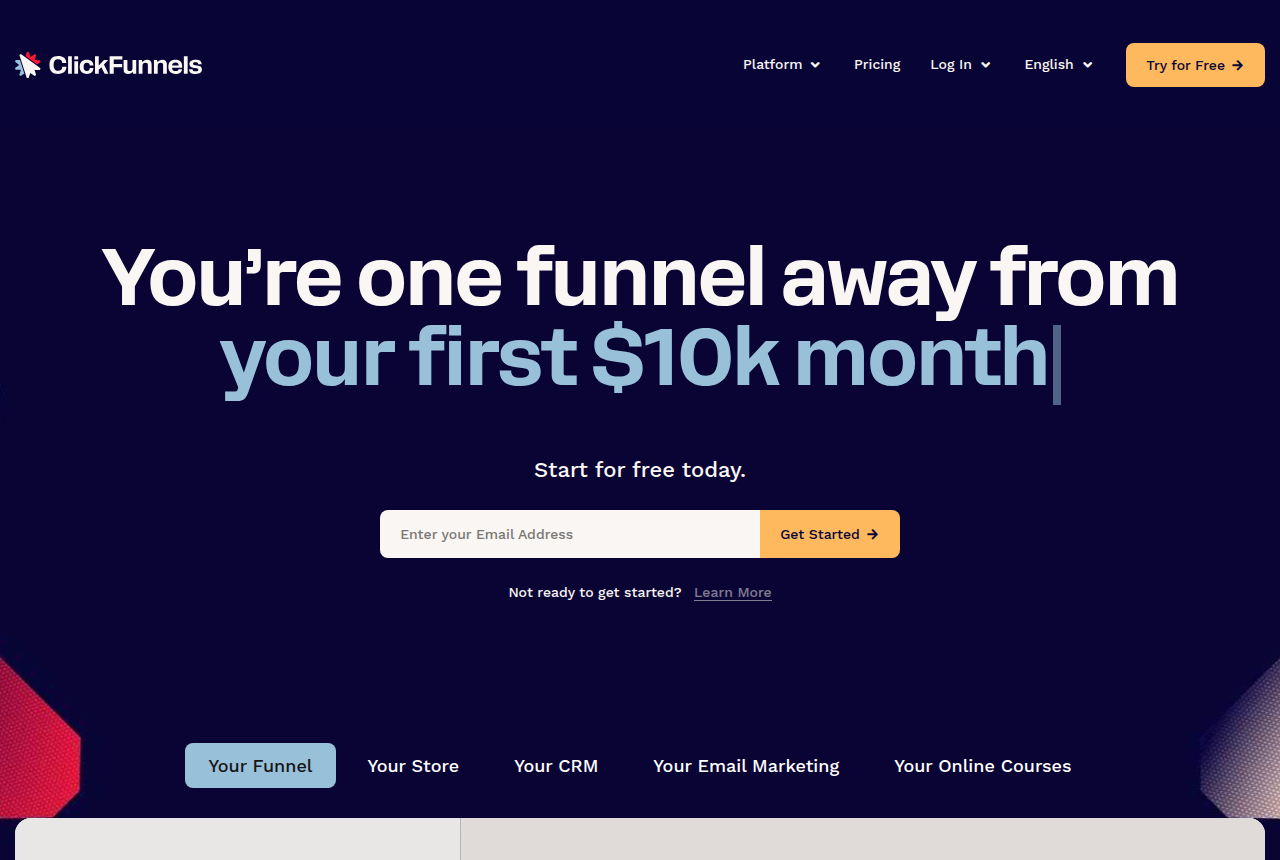
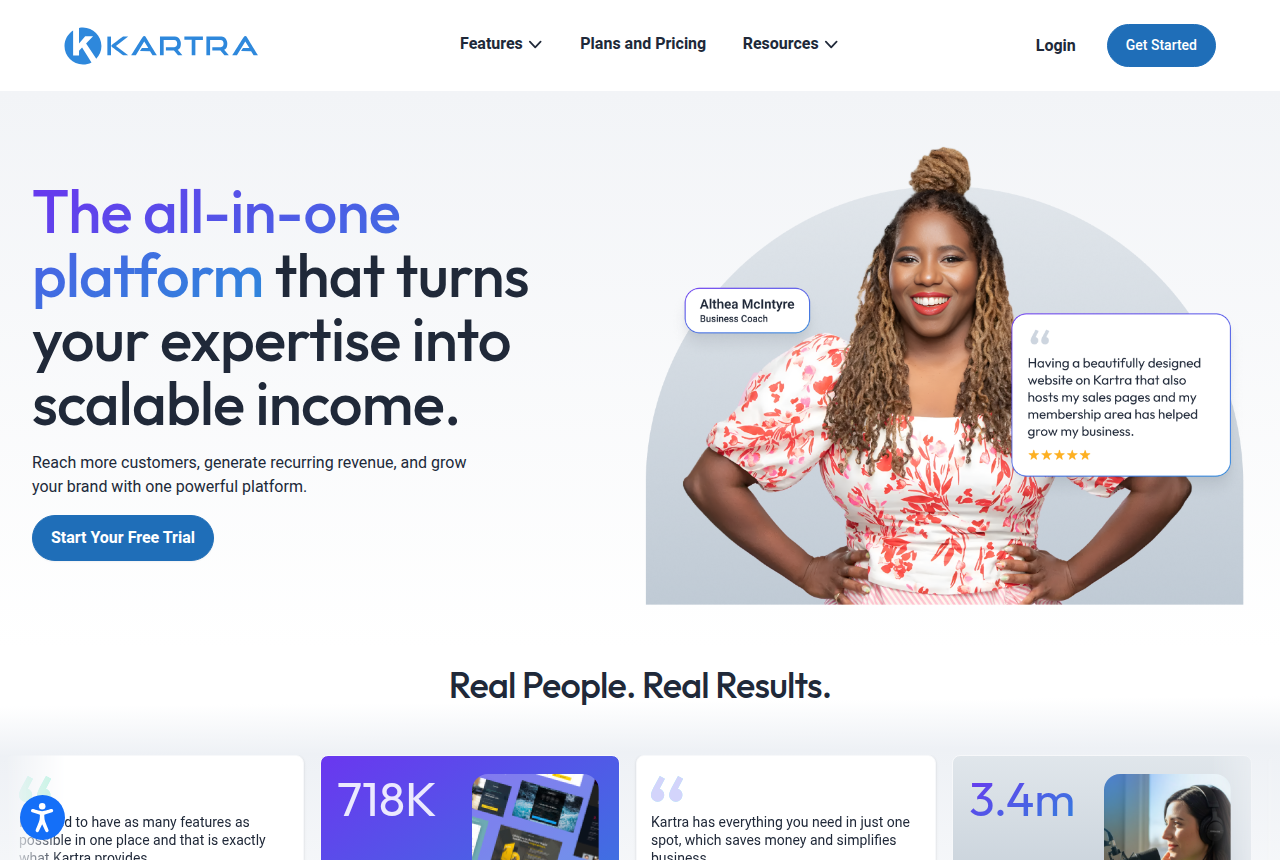
Answer that before you compare a single feature. ClickFunnels is a funnel-first builder. Its center of gravity is getting a sales funnel and its checkout live and selling as fast as possible, with the largest template library in the category behind it. Kartra is a bundled suite. Its center of gravity is running your entire creator business, pages, email, SMS, memberships, an affiliate program and a helpdesk, from one account. If your problem is getting an offer live and converting this week, that points one way. If your problem is that you pay for six tools and want them under one login, that points the other. Everything below is a version of that split.
ClickFunnels: the fastest way to get a funnel live
ClickFunnels is one of the names that made "sales funnel" a category, and after more than a decade it is still one of the most recognized funnel builders online. For a creator, coach or info-product seller, the pitch holds up: landing and sales pages, a checkout with order bumps and one-click upsells, email follow-up, a light CRM, courses and a community, all in one account. The most-praised part on Reddit and the review sites is speed. You build the pages, the checkout and the follow-up in one system instead of gluing four tools together, and the drag-and-drop editor plus prebuilt funnel templates get a non-technical seller from idea to live funnel without a developer.
Its checkout is built for selling rather than merely collecting money, with order bumps and one-click upsells aimed at raising average order value, and it takes no cut of your sales on any plan. Aggregate scores are strong, around 4.6 out of 5 across more than 400 G2 reviews and thousands on Trustpilot. The weak spots are price and billing. Plans run $97 a month for Launch, $197 for Scale and $297 for Optimize, and users say the cost climbs fast if you only need part of it. Billing and cancellation are the loudest complaints, along with confusion between the older ClickFunnels Classic and the newer 2.0 accounts. Course and membership delivery is the part users rate weakest, so if a serious course is your product, a dedicated platform gives a better student experience.
Kartra: the widest bundle under one login
Kartra, run by Kartra Inc., part of Genesis Digital, since 2018 and listing more than 60,000 customers, bundles more than ClickFunnels does. On top of pages, funnels and a selling checkout, it includes email and SMS, memberships and courses, a calendar, an affiliate manager, a helpdesk and video hosting. The pitch is that a coach, consultant or course creator runs the whole path from first click to paid customer, and the tools around it, in one account rather than renting five subscriptions that half-talk to each other.
The checkout is the strongest part, built for selling with branded order forms, coupons, Klarna installments and one-click upsells. The funnel mapper lets you plan and simulate a multi-page journey, and share or export the map, before you build a page, and more than 100 done-for-you campaign templates mean you rarely start from a blank page. Where users report regret is support and the builder. Slow human support is the single most repeated complaint, with Trustpilot reviewers in 2025 describing waits of up to a week, which hurts most during a launch when a broken checkout needs an answer that hour. The editor is capable but slow, with reported lag and glitches. And the entry Essentials plan at $59/mo takes 5% of every sale and caps you at 500 contacts, five pages and one product, so most real businesses start at Starter, $119/mo, where the cut disappears.
The real split: funnel speed and ecosystem versus bundle breadth
Strip away the shared surface and the difference is what each one optimizes for. ClickFunnels optimizes for the seller who wants a funnel and a selling checkout live fast, backed by the largest template ecosystem in the category and no revenue share. Kartra optimizes for the operator who wants the widest set of tools, email, SMS, memberships, affiliates and a helpdesk, consolidated under one bill. If speed to a live, converting funnel is your daily problem, ClickFunnels is the more focused tool. If your monthly software bill is a stack of separate subscriptions you want to collapse, Kartra replaces more of it. Neither is a worse product. They solve two different versions of one platform.
If you buy your own paid traffic, a third option
Both of these are built for selling to an audience you build: a list, a following, a coaching pipeline. If your growth instead comes from bought media, affiliate campaigns or product launches run on Meta, Google and TikTok, neither is built around the ad click, and a platform that is may fit better. ElasticFunnels is a funnel platform aimed at teams that buy their own traffic. It builds the pages and hosts the checkout with order bumps, one-click upsells and multi-MID payment routing, and it keeps every session, order, rebill and refund on one record with reporting on the same data, so you are not exporting from separate tools to see which angle actually made money. Its distinguishing feature is testing under one URL: variants rotate server-side behind a single campaign link, so the ad platform keeps its learning and a test does not send the ad back through review.
The honest caveat is that ElasticFunnels is newer than both ClickFunnels and Kartra, and there is very little independent third-party review coverage to check its claims against, so until you run real volume through it you are largely taking the vendor's word for how it holds up. That is what you would expect of a platform this young, and it matters most if you lean on years of public reviews before you trust a tool. A 14-day trial that takes no card lets you prove it on your own funnel first. If you are a coach or creator selling to your own audience, this is not your tool and the choice stays between ClickFunnels and Kartra. If you live on cost per acquisition from cold traffic, it belongs on the shortlist.
Which one for you
You want a funnel live and selling fast: ClickFunnels. The largest template library, a selling-focused checkout, a decade of track record and no cut of your sales make it the quickest, safest path from idea to a converting funnel. Note your renewal date and test cancellation inside the trial, since billing is where its complaints cluster.
You want to collapse a whole stack into one login: Kartra. Email, SMS, memberships, an affiliate manager and a helpdesk alongside the funnel builder replace more separate subscriptions than ClickFunnels does, at a lower entry price. For the operator who genuinely uses that breadth, it is the better buy every time. Start on Starter rather than the crippled Essentials plan, and stress-test the builder and support on the trial before you move a business inside it.
You buy your own paid traffic: look past both to a platform built around the ad click, such as ElasticFunnels, with the newness caveat above in mind.
ClickFunnels
What works
- Runs the whole funnel in one account: pages, checkout, email, a light CRM, courses and a community, so you are not stitching four tools together
- Fast to get live. The drag-and-drop editor and prebuilt funnel templates are the most-praised part, especially for non-technical sellers
- Smart Checkout is built for selling, with order bumps and one-click upsells aimed at raising average order value
- Strong aggregate scores: about 4.6 out of 5 across more than 400 G2 reviews and thousands of Trustpilot reviews
- Takes no cut of your sales, includes hosting, and carries a 30-day money-back guarantee
What to watch
- Priced at the top of the market. Plans run $97 to $297 a month, and users say the cost adds up fast, especially if you only need part of it
- Billing and cancellation are the loudest complaints, along with confusion between ClickFunnels Classic and the newer 2.0 accounts
- Some long-time users feel 2.0 was a step back from Classic, and marketers report occasional bugs and page speed that is hit or miss
- Less flexible than a custom stack, and course and membership delivery is weaker than a dedicated platform
Kartra
What works
- Genuinely covers the whole creator business under one roof: pages and funnels, email and SMS, a checkout, memberships and courses, calendars, affiliates and a helpdesk, so you stop paying for and wiring together five separate tools.
- Checkout is designed for selling, not just collecting money. You get branded order forms, coupons, buy-now-pay-later through Klarna, and one-click upsells aimed at lifting average order value.
- The funnel mapper lets you plan and simulate a multi-page journey before you build it, and more than 100 done-for-you campaign templates mean you rarely start from a blank page.
- Established and widely used. Kartra Inc. (Genesis Digital) has run it since 2018, with 60,000-plus customers, and billing is flat-rate with no surprise usage fees stacked on top.
- Plans above the entry tier take 0% of your sales, and a 30-day money-back guarantee lets you build a real funnel before you commit.
What to watch
- Support speed is the loudest complaint from long-term users. Trustpilot reviewers in 2025 report waits of up to a week for simple questions, which hurts most during a launch when something breaks.
- The editor is capable but slow. Reviewers describe lag and glitches, and simple edits taking too many steps. Stress-test it on the trial before you build anything real.
- It is expensive unless you use the whole suite. Buy it for one job, a landing page or email alone, and cheaper single-purpose tools win on price.
- The entry Essentials plan takes 5% of every transaction and caps you at 500 contacts, 5 pages and one product, so most real businesses need Starter at $119/mo or higher.
- It is not a full CRM: it tracks contacts, tags and purchases but has no deal stages, forecasting or task management if a sales team lives in a pipeline. And building everything inside one platform means lock-in, since the work does not transfer cleanly if you leave.
Pricing
ClickFunnels: from $97/mo. Four plans, billed monthly or annually. Launch $97/mo, Scale $197/mo, Optimize $297/mo, and a Dominate plan at $5,997/year. Paid annually the first three drop to about $81, $164 and $248/mo. Every plan starts with a free trial, carries a 30-day money-back guarantee, and ClickFunnels takes no percentage of your sales.
Kartra: from $59/mo. Four monthly plans, with annual billing saving up to 22%. Essentials, at $59/mo, allows 500 contacts, 10,000 emails, five pages and one product, but takes a 5% cut of your sales. Starter, $119/mo, lifts that to 2,500 contacts with unlimited email and SMS, unlimited pages, products and courses, and no such cut. Growth, $229/mo, adds automations, affiliate management and funnel simulation for up to 12,500 leads. Professional tops the range at $549/mo, reaching 25,000 contacts and real-time funnel analytics. Annual pricing works out to $52, $99, $189 and $429 a month. There is a 14-day free trial and a 30-day money-back guarantee. Only the entry plan charges that 5%; every tier above it keeps your revenue whole.
Pricing verified against each vendor on 2026-09-23. Check before you buy.
Our pick
ClickFunnels
ClickFunnels is the pick if you sell coaching, courses or info products and want the pages, checkout, upsells and email running as one funnel instead of four separate tools. It is fast to launch and covers the whole sales process end to end. The trade-offs are real: it sits at the top of the market on price, the bill climbs as you scale, and billing and cancellation draw the most complaints.
Frequently asked questions
ClickFunnels or Kartra: which should I use?
Which is cheaper, ClickFunnels or Kartra?
Does ClickFunnels or Kartra take a cut of my sales?
Which is easier to build in?
I sell courses and memberships. Which one?
What if I buy my own paid traffic to cold offers?
Sources
Other sources
3 discussions and reviews read for this page. Quotes are excerpts; open a link to read the original in context.
- [reddit-askmarketing-worth] Is ClickFunnels Actually Worth It for Real Marketers?
- [reddit-digitalmarketing-hate] Does anyone else hate Clickfunnels as much as I do?
- [g2-sellers-cf2] ClickFunnels Products | Read 417 Reviews on G2

Written by
Dana Rourke
Lead reviewer
Dana Rourke is the lead reviewer at Campaign Buyer. She owns the tracker and attribution coverage: reading what long-term users report about each tool, checking its documentation and pricing, and verifying prices with the vendor before writing the verdict. Keeping the rankings honest mostly means writing down what the top pick gets wrong, so she does that first.
Last checked 2026-09-25