A self-hosted tracker you own against a hosted funnel map you rent
CPV Lab Pro vs FunnelFlux Pro
By Dana Rourke, Lead reviewer. Reviewed by Campaign Buyer Editorial. Updated 24 September 2026.
Quick answer
Pick CPV Lab Pro if you want to own your tracking data on a server you run, pay one flat price with unlimited events instead of a per-event meter, and get conversion API and automatic ad-cost sync built in from the $97 Pro plan; pick FunnelFlux Pro if you run multi-step funnels, want to optimize them from a visual map of the whole journey rather than a table of clicks, and would rather rent hosted software with nothing to install.
Side by side
| CPV Lab Pro | FunnelFlux Pro | |
|---|---|---|
| What it is | Self-hosted marketing tracker | Hosted visual funnel tracker |
| Best-fit user | CPA and paid-media affiliates | Multi-step funnel optimizers |
| How you read data | Campaign and click tables | Visual funnel map, per node |
| Where data lives | Your own server | FunnelFlux's cloud |
| CAPI to ad platforms | Built in, from Pro ($97) | S2S to 4 platforms |
| Automatic cost sync | Built in, from Pro ($97) | Add-on (Argosync), billed apart |
| Testing in the box | A/B and multivariate (top plan) | Rotators and splits across the funnel |
| Pricing model | Unlimited events; lifetime option | By events, $99/mo for 2M |
| Free trial | 14-day, no card | 14-day, card required |
| Outside proof | Thin (3.8/5, 16 reviews) | Smaller community |
If you are down to CPV Lab Pro and FunnelFlux Pro, you have narrowed to two trackers that agree on the job and disagree on almost everything about how they do it. Both stamp every click, catch the conversion server-side even when a browser blocks the pixel, follow a visitor from source to lander to offer, and tell a paid-traffic buyer which combination actually made money. What splits them is not what they measure. It is where the software lives, how you read the numbers, and how the bill is built.
The honest short version. CPV Lab Pro is the one you install on your own server and own the data on, with unlimited events for a flat price and a licence you can buy outright. FunnelFlux Pro is the one that runs in the vendor's cloud, that you read as a visual map of the whole funnel instead of a table of clicks, and that meters you by event. Which of those two sentences describes how you want to work is most of the decision.
The question that decides it
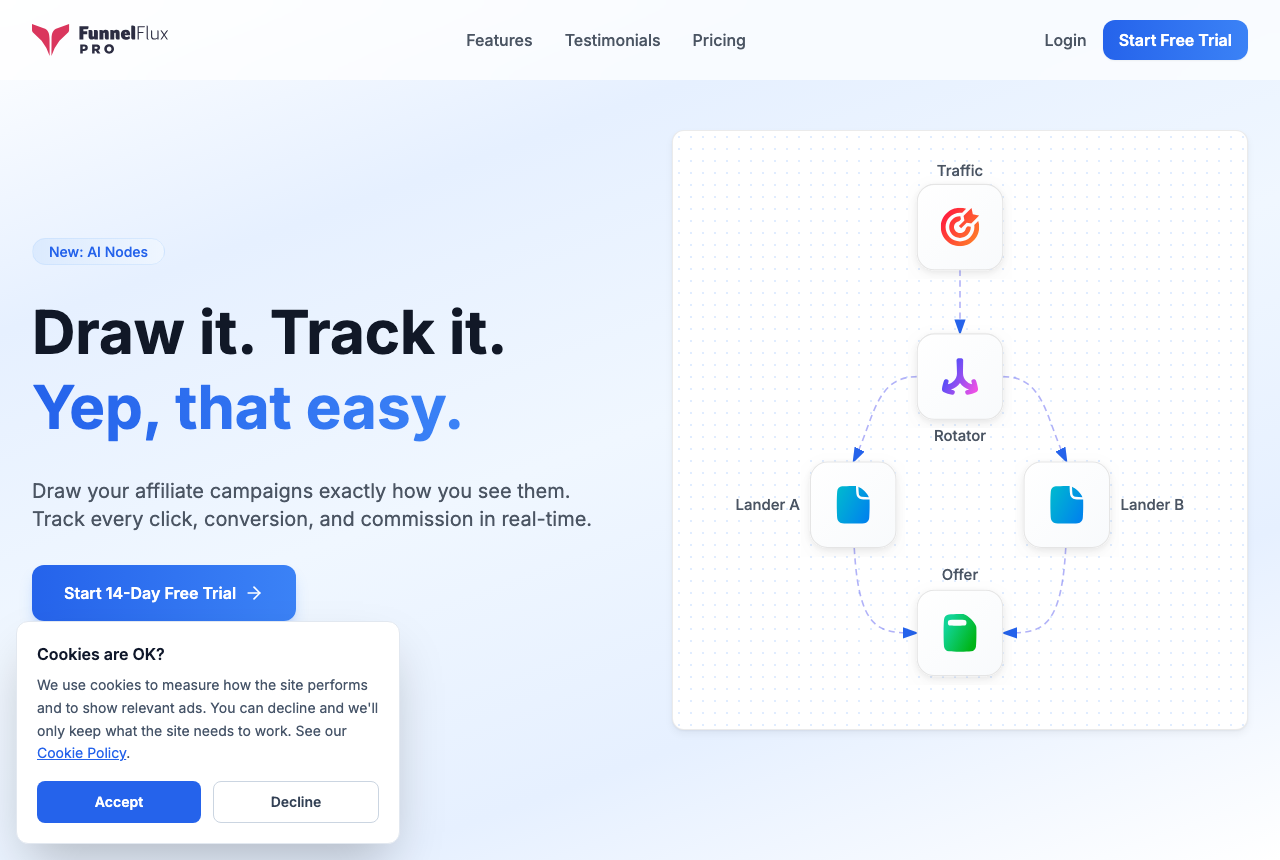
Start with how you optimize. If your profit comes from complex, multi-step funnels, an advertorial into a quiz into an offer, or a lander that routes different visitors down different paths, then seeing that flow drawn out matters. FunnelFlux was built for exactly this: you draw the funnel on a canvas the way you would sketch it on a whiteboard, and the reporting is per node, so a leak between two steps is a spot on the map rather than a row you have to hunt for. CPV Lab Pro tracks the same multi-step flows and tests them from inside the tracker, but you read the result as campaign and click tables. For a simple source-lander-offer campaign that difference barely shows; for a five-node funnel it is the whole experience.
Second question: do you want to own the box, or own none of it? CPV Lab Pro puts the software and your click logs on a Linux server you rent and control, which is the reason a lot of long-term affiliates run it, and the reason it prices on unlimited events instead of metering you. FunnelFlux hosts everything; you bring a couple of custom domains and nothing else, and you pay by the event. One of those removes a server from your life and the other removes a vendor from your data. You cannot have both, and most of the people who reach this page already lean one way.
CPV Lab Pro: own the data, unlimited events, run the box
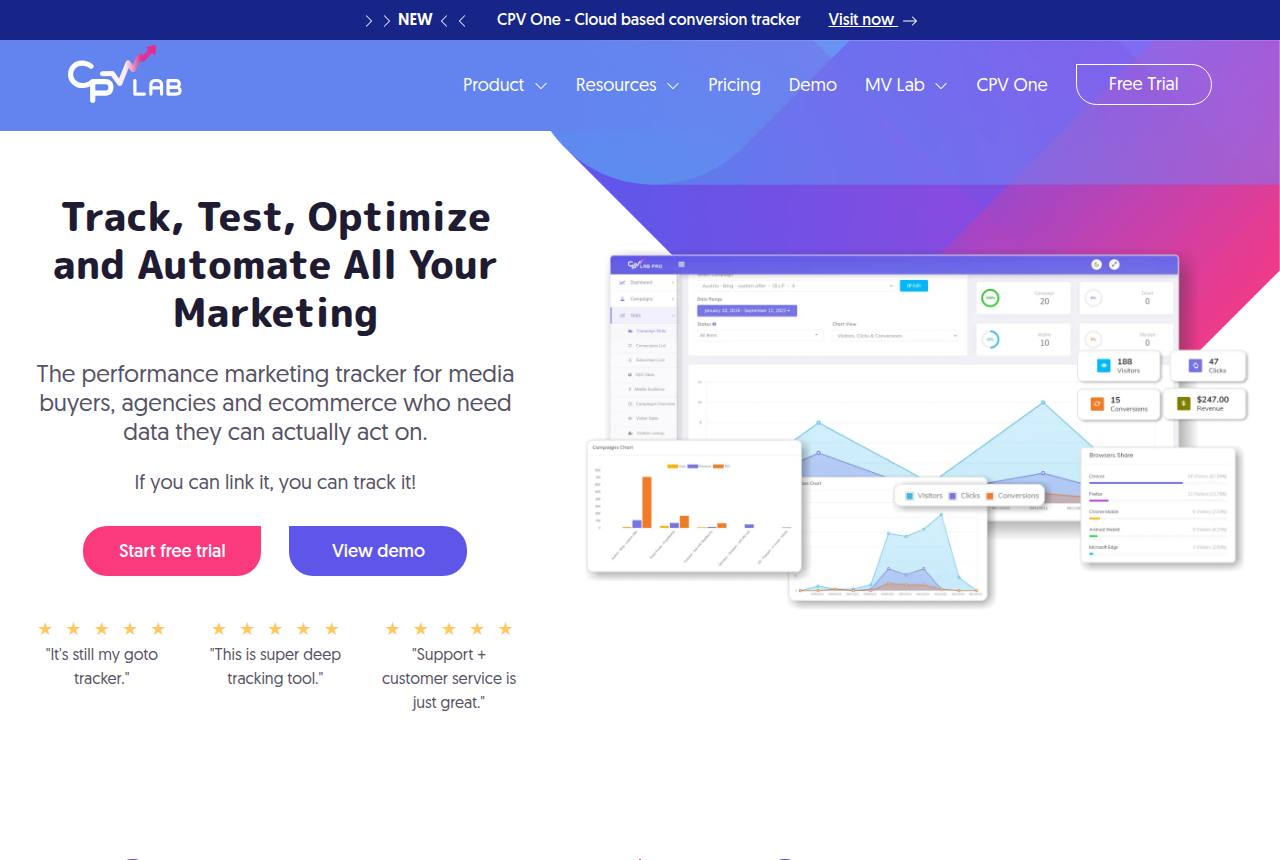
CPV Lab Pro is one of the longer-running trackers in the category, run by media buyers for about a decade. It installs on your own Linux VPS, so your click data sits on hardware you control, and it prices on unlimited events with no click limits or overage on any plan. That last part is the pitch: you can pour traffic at a winning campaign without watching a meter climb, which is the opposite of how a metered cloud tracker bills. It is a full tracker underneath, not a lite tool: cookieless server-to-server postbacks that keep firing on iOS and in privacy browsers, 30-plus data points per click, bot and proxy filtering, and A/B plus multivariate testing of landers and offers from inside the tracker. On the $97 Pro plan it adds conversion API to Meta, TikTok, Google and more, plus automatic ad-spend cost sync, so ROI is computed without a CSV.
The cost is operational, and it is real. Self-hosting means a VPS you rent, patch and keep online (PHP 8.1 to 8.4, MySQL or MariaDB, ionCube), a separate bill and your responsibility, and the cheap unlimited tracking is only as good as the machine under it. Reviewers who like the tool still say the sheer number of campaign types and settings can overwhelm a beginner, so budget setup time. And its independent proof is thin: Trustpilot sits at 3.8 from only 16 reviews, with most public praise on the affiliate forum afflift rather than the big review sites, so lean on the 14-day trial, which needs no card, to prove it on one real campaign. We do not earn a commission on CPV Lab Pro, so there is no affiliate button for it here; the recommendation stands on its own.
FunnelFlux Pro: see the funnel, host nothing
FunnelFlux Pro is the tracker for the buyer who thinks in funnels rather than campaigns. Its visual builder is the thing no other tracker aimed at performance marketers really matches: you wire landers, offers, rotators and conditional routing together on one canvas, and the reporting drills into any node, so you can see exactly where a multi-step flow leaks and fix that step. It is hosted, so there is nothing to install or keep patched; you provide your own custom domains, the first two free and $2 a month each after that. It fires server-to-server conversions to Facebook, Google, TikTok and Microsoft, does cookieless JavaScript tracking that survives browser privacy changes, and keeps unlimited data retention while your subscription is active.
Two things to weigh against it. Automatic cost sync is not in the base product: it lives in a separate tool, Argosync, with its own subscription and its own trial, so the tidy reconcile-spend-with-revenue workflow is a second line on your bill. And FunnelFlux has a smaller community than Voluum or RedTrack, so when you hit a complex setup there are fewer public guides and forum answers to lean on, though the vendor's own support and documentation are well regarded. The pricing is at least easy to read: one base plan at $99 a month for 2 million events, then $10 per additional million, billed monthly with no annual contract. FunnelFlux does carry an affiliate link on this site, and the disclosure above covers it exactly as it covers every other tool we link.
Where the pricing diverges
These two do not bill the same way, so you are comparing shapes, not looking for a crossover point. CPV Lab Pro tiers by feature: $57 a month gets you in, but the CAPI and automatic cost sync most paid-media buyers want start on the $97 Pro plan, so treat $97 as the real entry price, and a one-time lifetime licence lets you stop subscribing. All of it sits on top of the server you rent. FunnelFlux meters events: $99 a month covers 2 million, then $10 per additional million, with nothing to host, and automatic cost sync billed separately through Argosync. Add that Argosync line before you call FunnelFlux cheaper, and price CPV Lab Pro on the server it will run on, not the sticker.
A third path if you host the funnel yourself
Both of these trackers watch traffic move to pages and offers that live somewhere else. They stamp the click and follow it to a lander and an offer you host on another platform, then catch the conversion by postback. There is a different way to close that gap, worth naming because it changes where the sale is recorded. ElasticFunnels is a funnel platform for teams running paid traffic that builds the pages and hosts the checkout itself, and keeps its ad-spend and conversion reporting on the same data layer as those pages, the CRM and the order. Because the sale closes in a checkout it hosts, that conversion is a first-party event it records directly rather than a postback it has to catch, and it fires server-side postbacks to your affiliate networks on purchase, refund, chargeback and renewal, the network-attribution job both trackers here do for click traffic. It also split-tests page variants under one URL, so a test never resets the ad platform's learning, and its checkout routes across multiple merchant accounts. It starts with a 14-day free trial that takes no card, on plans from $97 a month, plus 0.5% of revenue processed through its hosted checkout.
The honest limit that keeps it on its own line rather than in the table: ElasticFunnels is newer than either tracker here, and there is very little independent third-party review coverage to check its claims against, so until you run real volume through it you are largely taking the vendor's word for how its attribution holds up. That is what you would expect of a platform this recent, where CPV Lab Pro has a decade of public setups behind it and FunnelFlux years of them. And its reporting covers the funnels it hosts, so a buyer tracking clicks across offers on other people's domains still needs a dedicated tracker like CPV Lab Pro or FunnelFlux for that traffic. It is an option for the seller who runs their own pages and checkout end to end, not a replacement for either tracker.
Which one for you
You run complex multi-step funnels and want to host nothing: FunnelFlux Pro. The visual builder and per-node reporting are its reason to exist, the hosted model means no server to keep online, and the metered pricing is predictable if your event count is. Start the trial and wire up one real funnel; add Argosync only if you need cost sync automated.
You want to own your data, skip the per-event meter, and get CAPI and cost sync built in: CPV Lab Pro. Unlimited events on your own server, a lifetime licence if you want to stop subscribing, and the modern paid-media plumbing switched on from the $97 Pro plan. Prove it on one campaign during the no-card trial, since its public review count cannot do that for you, and budget the server and the setup time.
You host your own pages and checkout end to end: look at ElasticFunnels alongside them, with the newness caveat above in mind, and keep a tracker like CPV Lab Pro or FunnelFlux for any traffic that closes on domains you do not host.
FunnelFlux Pro takes our default pick here, and not because it is the deeper tracker. CPV Lab Pro plainly owns the data question and the unlimited-events math, and for a high-volume buyer who wants both and will run the server, it is the better buy, which we say without hedging. FunnelFlux wins the default because more readers who reach this exact page want a tracker with nothing to host and a way to see a multi-step funnel as a picture, and it hands them both. Read our full CPV Lab Pro review and FunnelFlux Pro review for the detail, weigh either against a cloud tracker on our ClickFlare vs FunnelFlux and ClickFlare vs CPV Lab Pro pages, or see where they land in our ad tracker ranking.
CPV Lab Pro
What works
- Unlimited events, no click limits, no overage fees, on every plan. You can pour traffic at a winning campaign without watching a meter, which is the opposite of the event-metered pricing at Voluum and RedTrack where the bill climbs with volume.
- You own the data. It is self-hosted on your own Linux server, so your click logs and campaign data sit on hardware you control rather than a vendor's cloud. For many long-term affiliates that is the whole reason they run it.
- A full tracker, not a lite tool. Cookieless server-to-server postback tracking that keeps firing on iOS and in privacy browsers, 30-plus data points per click, bot and proxy filtering, A/B testing of landers and offers from inside the tracker, and multivariate testing on the top plan.
- Support is the part users praise most. Across the affiliate forum afflift and Trustpilot the repeated note is fast, knowledgeable help that walks you through postback and CAPI setup by name, and the vendor helps with the initial install at no cost.
- Predictable cost, and a lifetime option. Starter is $57/mo and Pro $97/mo, and one-time lifetime licences let you own the software outright instead of subscribing. No per-event bill to model.
What to watch
- Self-hosting is the real cost and the real risk. It runs on your own Linux VPS (PHP 8.1 to 8.4, MySQL or MariaDB, ionCube), a separate bill and your job to keep fast, patched and online. The cheap unlimited tracking is only as good as the machine under it. If server administration is not your thing, the cloud sibling CPV One or a managed tracker like RedTrack fits better.
- Expect a learning curve. Reviewers who like the tool still say the number of campaign types, settings and reports can overwhelm a beginner, so budget setup time.
- The features you probably came for start on Pro. CAPI, automatic ad-spend cost sync and API access are not on the $57 Starter plan, so the real entry price for a modern paid-media setup is $97/mo.
- Thin independent proof. Trustpilot sits at 3.8 from only 16 reviews, and most public praise lives on affiliate forums rather than the large review sites, a smaller footprint than Voluum or RedTrack. The 14-day trial is the due diligence the review count cannot give you.
- Overkill for a content-site affiliate. If all you need is which blog link got clicked, a link cloaker or your network's sub-ID report is simpler. This is far more tracker than that job wants.
FunnelFlux Pro
What works
- A visual funnel canvas: landers, offers, rotators and conditional routing wired together on one screen
- Node-level reporting shows exactly where a funnel leaks
- Predictable pricing: a $99/mo base plus $10 per extra million events
What to watch
- The learning curve is real; the flexibility costs you setup time
- Automatic cost sync needs a separate product, Argosync
- A smaller community than Voluum or RedTrack, so fewer guides when you get stuck
Pricing
CPV Lab Pro: from $57/mo, $97 for CAPI. Four tiers, and every one includes unlimited campaigns and unlimited events, with no click limits and no overage fees. Starter is $57/mo month to month, or $48/mo billed annually ($577 a year). Pro is $97/mo, or $81/mo annually ($977). Expert is $187/mo, or $156/mo annually ($1,877). Agency is custom, quoted on a call. Lifetime licences are a one-time payment instead of a subscription: $1,157 Starter, $1,957 Pro, $3,757 Expert, and they cover CPV Lab v13 for life, not future major versions. CAPI, automatic ad-spend cost sync and API access begin on the Pro plan, not Starter. It is self-hosted, so a Linux VPS is a separate cost you pay your host. The trial runs 14 days with no card up front, backed by a 30-day money-back guarantee.
FunnelFlux Pro: from $99/mo for 2M events. One base plan at $99/month including 2 million tracked events; events beyond that are billed at $10 per million. The first two custom domains are free, then $2/month each. Monthly billing, no annual contract, cancel anytime. A valid payment method is required to start the 14-day trial.
Pricing verified against each vendor on 2026-09-23. Check before you buy.
Our pick
FunnelFlux Pro
FunnelFlux Pro is the pick if you run multi-step funnels and want to see the whole journey as a map instead of a table of clicks.
Frequently asked questions
CPV Lab Pro or FunnelFlux Pro: which should I use?
Which is cheaper, CPV Lab Pro or FunnelFlux Pro?
Is FunnelFlux Pro still self-hosted like it used to be?
Which one has CAPI and automatic ad-cost sync without a separate add-on?
Do I have to run a server for either one?
Which is better for complex multi-step funnels?
Sources
Other sources
5 discussions and reviews read for this page. Quotes are excerpts; open a link to read the original in context.
- [ff-home-visual] FunnelFlux Pro homepage
- [ff-home-s2s] FunnelFlux Pro homepage
- [ff-home-pricing] FunnelFlux Pro pricing notes
- [reddit-affmkt] Need software that links ad data with affiliate network data
- [reddit-ppc] Best FB ad tracking software?

Written by
Dana Rourke
Lead reviewer
Dana Rourke is the lead reviewer at Campaign Buyer. She owns the tracker and attribution coverage: reading what long-term users report about each tool, checking its documentation and pricing, and verifying prices with the vendor before writing the verdict. Keeping the rankings honest mostly means writing down what the top pick gets wrong, so she does that first.
Last checked 2026-09-24