Checkout vs creator platformmedia buyer software
SamCart vs Kajabi
By Dana Rourke, Lead reviewer. Reviewed by Campaign Buyer Editorial. Updated 28 September 2026.
Quick answer
Pick SamCart if you already have the offer and the traffic and want a checkout tuned to lift the value of every order with bumps and one-click upsells, without paying for course and community tools you will not open; pick Kajabi if you are building a whole knowledge business and want the courses, the community, the memberships and the delivery experience under one login, and will grow into its higher price.
Side by side
| SamCart | Kajabi | |
|---|---|---|
| What it is | Conversion checkout | Creator business platform |
| Best for | Selling to traffic you drive | Courses, coaching, membership |
| Core strength | Checkout, bumps, upsells | Course and community delivery |
| Sells courses | Yes, with a members area | Yes, the core focus |
| Community and app | Basic memberships | Deep: cohorts, community, app |
| Email and funnels | No, connect your own | Included |
| Failed-payment recovery | Subscription Saver (Pro) | Included |
| Cut of sales | None (processor fee) | None (processing fees apply) |
| Track record | Since 2014, $8B+ processed | Since 2010, 100k+ built |
| Entry price | $79/mo | $179/mo |
If you are down to SamCart and Kajabi, you already know the shape of what you are buying: a place to take the money for a digital product, a course or a coaching offer. Both do that. Both host a checkout with order bumps and upsells, both sell subscriptions, both can host a course behind a login. The reason the choice is hard is that they are built for two different jobs, and the wrong pick leaves you either bolting a community platform onto a simple offer or running a growing course business through a checkout that was never meant to deliver it.
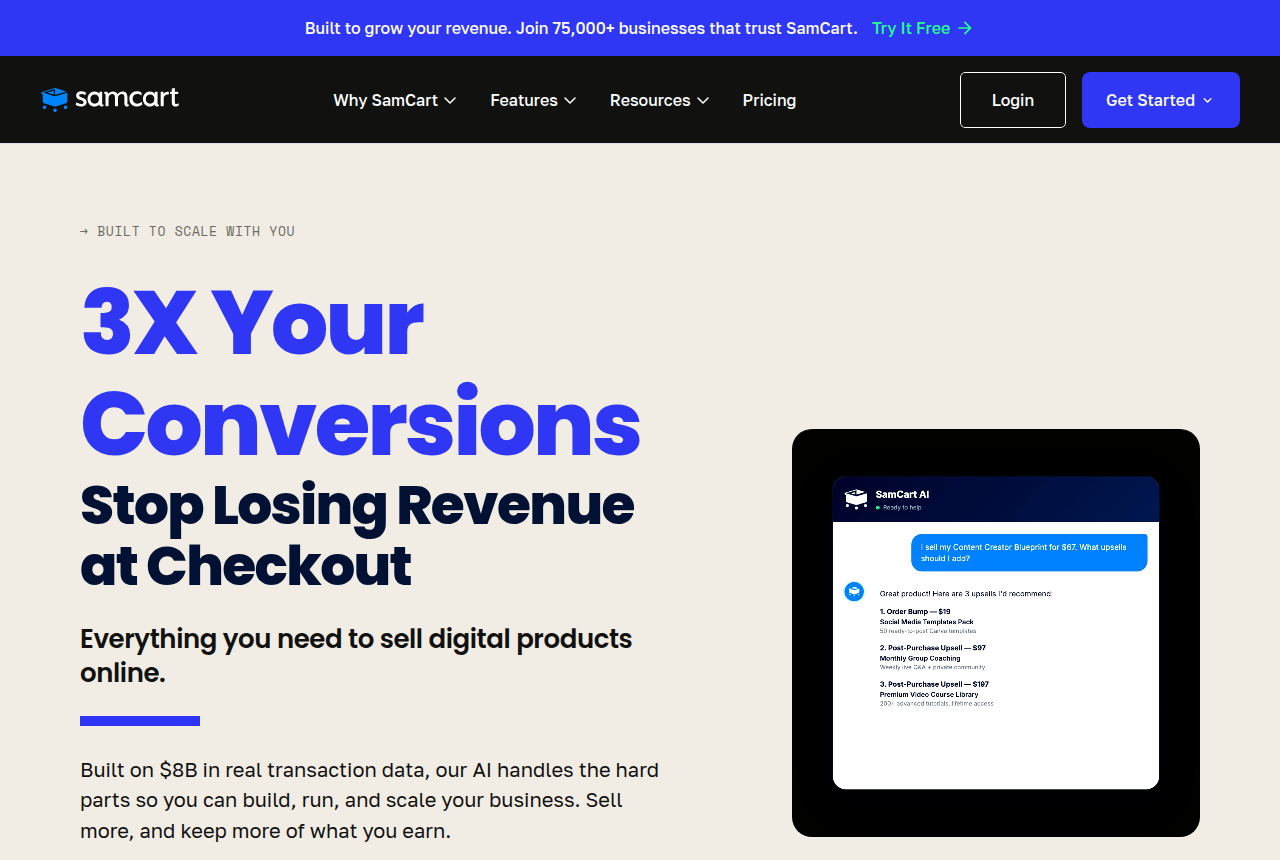
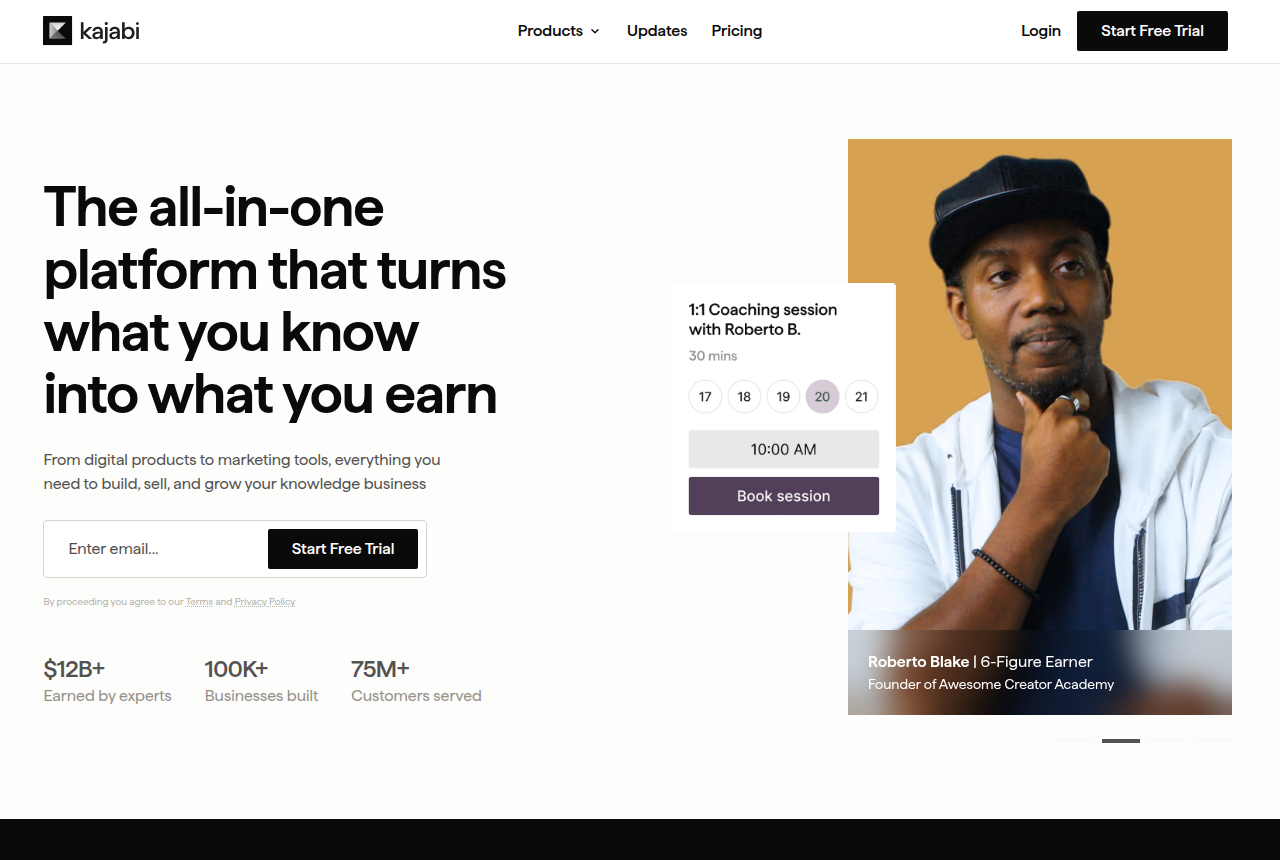
SamCart is a conversion-focused checkout. Its whole design points at one number: the value of the order as it is placed. Kajabi is a creator business platform, built from the delivery end, where the product is your knowledge and the course, the membership and the community matter as much as the sale. That is the fork, and everything below follows from it.
The one question that decides it
Are you optimizing the sale, or the whole business around it?
If the money turns on the moment of purchase, on a checkout that converts the traffic you send it, an order bump, a one-click upsell and a higher average order value, that is SamCart's home ground. If the money turns on what happens across the whole relationship, a course people finish, a membership they renew, a community they keep coming back to, that is Kajabi's. Each can technically reach into the other's territory. Neither does the other job as well as the one it was built for, and paying for the wrong strength is the most common regret with either.
The case for SamCart
SamCart has been selling checkouts since 2014, and the company says more than 75,000 businesses and over $8 billion in transactions have run through it. This is an established, dependable place to put your sales, and long-time users describe it that way: one calls it "no frills but fine", which is exactly what you want from the page where the card is charged.
What sets it apart is that it is built to raise order value, not just to accept the payment. Order bumps add a companion product with one checkbox at checkout, and one-click upsells charge the same card again after the first purchase without re-entering details. SamCart reports up to a 98% lift in average order value when a seller runs both. Subscription Saver retries failed payments and handles dunning, cart abandonment emails are included, and Apple Pay, Google Pay, PayPal, Venmo and Buy Now Pay Later are all supported, with payment routing across processors on Pro.
The catch is cost and gating. Core is $79 a month, well above a single-purpose cart, and the features that justify buying SamCart, the upsells, the bumps, A/B testing, Subscription Saver and the Affiliate Center, are all locked to the $199 Pro plan. So the honest price is $199, not $79. It is also checkout-first by design: there is no built-in email marketing, no CRM and no multi-step funnel management, so anything before or after the buy you connect yourself. Billing and refund friction, not the software, is the recurring complaint in its Trustpilot and BBB records, so read the renewal terms before the trial ends.
The case for Kajabi
Kajabi comes at the same buyer from the delivery end. Since 2010 it has become one of the most complete homes for a knowledge business, and the consistent praise from long-time users is having everything in one place: courses with cohorts and drip content, communities, memberships, podcasts, email, landing pages, a checkout with subscriptions, order bumps and upsells, and a branded mobile app on the top plan. If your product is a course people should actually finish, or a membership they should renew, Kajabi's delivery is the strongest in this pair, and it takes no revenue share either.
Its weak spot is cost, and it got worse in 2026. A January restructure raised plan prices and cut the entry Basic plan's contact limit to 2,500, and long-time customers lost their grandfathered rates, which drew a visible backlash. The entry plan is now $179 a month, about $143 billed annually, with no free plan, and affiliates and advanced automations are locked to the $249 Growth plan and up. Kajabi only pays off once you are genuinely selling. Its checkout is also lighter than SamCart's on the sales mechanics: it has bumps and upsells, but fewer of the aggressive AOV and page-testing options SamCart is built around, because that is not where Kajabi spends its effort.
If you buy your own traffic, a third option
Both of these assume you are selling to an audience you build: a list, a following, a community you already have. Neither is built around the paid ad click, and if your growth comes from buying traffic on Meta, Google or TikTok, there is a gap both leave that is worth naming before you commit.
ElasticFunnels is a funnel platform built for that buyer. Its lead feature is same-URL split testing: page variants rotate server-side under one campaign link, so the ad platform keeps its optimization and a test never sends the ad back through review. Around that it builds the pages, with an AI builder that can clone a page from a URL, hosts a checkout with order bumps and one-click upsells, and keeps the click, the order, the rebill and the refund on one record with a CRM and attribution on the same data. For a media buyer, that single record is the point: you see which ad and which angle made money without reconciling exports from separate tools.
Set against these two, it is wider in one direction and narrower in another. It is not a course and community home the way Kajabi is, so if delivering a membership experience is your product, Kajabi remains the better-fitted tool; and where SamCart is a dedicated, battle-tested standalone checkout you can bolt onto anything, ElasticFunnels is the whole build-and-sell layer, not a cart on its own. What it adds over both is the testing that does not reset ad learning and one source of truth for paid campaigns. The honest caveat is proof: ElasticFunnels is newer than either of these, and there is very little independent third-party review coverage to check its claims against, so until you run real volume through it you are largely taking the vendor's word for it. That is what you would expect of a platform this recent next to a checkout selling since 2014 and a platform running since 2010. Its 14-day trial needs no card, every feature is on every plan from $97 a month, and it adds 0.5% only on revenue through its own hosted checkout, so you can prove the split testing and the checkout on your own campaigns before you pay.
Which one for you
Pick SamCart if you have the offer and the traffic and want a checkout that converts and lifts the value of every order, without paying for course and community tools you will not open. Pick Kajabi if you are building a knowledge business and the course, the community and the membership are the product you want people to keep, and you will grow into its higher price. And if the engine is paid traffic rather than an audience you already own, weigh a funnel platform like ElasticFunnels alongside both, then read our full SamCart review and Kajabi review before you commit. Still deciding? Browse our other head-to-heads and the full ranking.
SamCart
What works
- Built to raise order value, not just take the payment. Order bumps add a companion product with one checkbox at checkout, and one-click upsells charge the same card after the first purchase. SamCart reports up to a 98% lift in average order value when a seller runs both.
- Reliable at its core job. Long-term users describe it as dependable for checkout, one calling it "no frills but fine", which is what you want from the page where the money changes hands.
- Sells more than downloads. Courses, memberships, subscriptions and physical goods all run through one checkout, with a members area and course hosting built in, so there is no second platform to hand customers off to.
- Defends recurring revenue. Subscription Saver retries failed payments and handles dunning, and cart abandonment recovery emails are included, so lapsed cards and stalled carts are chased automatically.
- Flexible payment options. Apple Pay, Google Pay, PayPal, Venmo and Buy Now Pay Later are supported, and Pro adds payment routing across several processors.
What to watch
- Expensive for what it is, and the good parts are gated. Core is $79/mo, well above single-purpose carts, and one-click upsells, order bumps, A/B testing, Subscription Saver and the Affiliate Center are all Pro-only at $199/mo. The tools that make it worth buying are the ones you pay the most for.
- Billing and refunds are the recurring friction, not the software. Unexpected renewals and slow refund resolution turn up across Trustpilot and BBB records, and the vendor's own docs confirm that cancelling through the customer portal stops future billing but does not refund charges already taken. Read the renewal terms before the trial ends.
- Checkout-first, not a full stack. There is no built-in CRM, email automation or multi-step funnel management. Sellers who want lead capture, nurture sequences and funnels in one place report reaching for something broader.
- Runs on standard processors, so it is not built for high-risk categories. Payments move through SamPay, Stripe, PayPal and similar, which means sellers in categories those gateways decline are not served.
Kajabi
What works
- Runs the whole knowledge business from one login: courses, coaching, memberships, a community, email, landing pages, funnels and checkout, so you are not paying for five tools that do not talk to each other
- Built for delivery. The course builder, cohorts, community, podcasts and a branded mobile app make the student experience the strongest part, which is where a pure funnel builder is thin
- Takes no revenue share on any plan. You pay the monthly fee and card processing, and nothing extra per sale
- Well reviewed by long-time users, who most often praise having everything in one place and a builder that is straightforward to set up
- Checkout handles subscriptions, one-time payments, order bumps, upsells and downsells, with automated tax
What to watch
- Expensive, and more so since the January 2026 restructure. The entry Basic plan is now $179 a month (about $143 billed annually), its contact limit was cut to 2,500, and affiliates and advanced automations are locked to the $249 Growth plan and up
- Long-time customers lost grandfathered rates in the 2026 change, and price plus support are the two most common complaints in recent reviews
- If you only need to sell a simple offer through a hard-driving funnel, you are paying for course and community tools you may never open
- Its funnel and checkout are lighter than a dedicated funnel tool, with fewer aggressive upsell and page-testing options than ClickFunnels
- Some users find the initial setup time-consuming, and there is no dedicated tech support for your students
Pricing
SamCart: from $79/mo. Core $79/mo, Pro $199/mo (1-click upsells, order bumps, A/B testing, API and 3rd-party processors are Pro-only). SamPay processing 2.9% + 30c; no added platform fee on SamPay.
Kajabi: from $179/mo. Basic is $179/mo (2,500 contacts, 5 products, 1 website), Growth $249/mo (25,000 contacts, 50 products, affiliate program and advanced automations), and Pro $499/mo (100,000 contacts, unlimited products, 3 websites, branded mobile app). Billing annually saves about 20%, bringing Basic to roughly $143/mo. Kajabi takes no revenue share on any plan, but its own payment processing runs 2.7% to 2.9% plus 30 cents per sale, and using a third-party processor adds 0.5% to 2% on top depending on plan. 30-day money-back guarantee.
Pricing verified against each vendor on 2026-09-27. Check before you buy.
Our pick
SamCart
SamCart is the pick if you sell digital products, courses or coaching and want order bumps, one-click upsells and failed-payment recovery running inside the checkout, without stitching a cart onto a separate platform. It is an established, reliable tool, genuinely built to raise the value of every order. The catch is cost. Pricing opens at $79/mo, and the features that justify buying it sit on the $199 Pro plan.
Frequently asked questions
SamCart or Kajabi: which should I use?
Which is cheaper, SamCart or Kajabi?
Is SamCart or Kajabi better for selling online courses?
Does SamCart or Kajabi take a cut of my sales?
What if you buy your own paid traffic to the offer?
Sources
Other sources
3 discussions and reviews read for this page. Quotes are excerpts; open a link to read the original in context.
- [reddit-reliability] Order Upgrades (Thrivecart Alternative?) : r/digital_marketing
- [reddit-cost] 3 month results from selling a $47 ebook using SamCart : r/passive_income
- [samcart-refund-doc] Customer Portal : SamCart Knowledge Base

Written by
Dana Rourke
Lead reviewer
Dana Rourke is the lead reviewer at Campaign Buyer. She owns the tracker and attribution coverage: reading what long-term users report about each tool, checking its documentation and pricing, and verifying prices with the vendor before writing the verdict. Keeping the rankings honest mostly means writing down what the top pick gets wrong, so she does that first.
Last checked 2026-09-28