Landing page vs full funnelmedia buyer software
Unbounce vs ClickFunnels
By Dana Rourke, Lead reviewer. Reviewed by Campaign Buyer Editorial. Updated 29 September 2026.
Quick answer
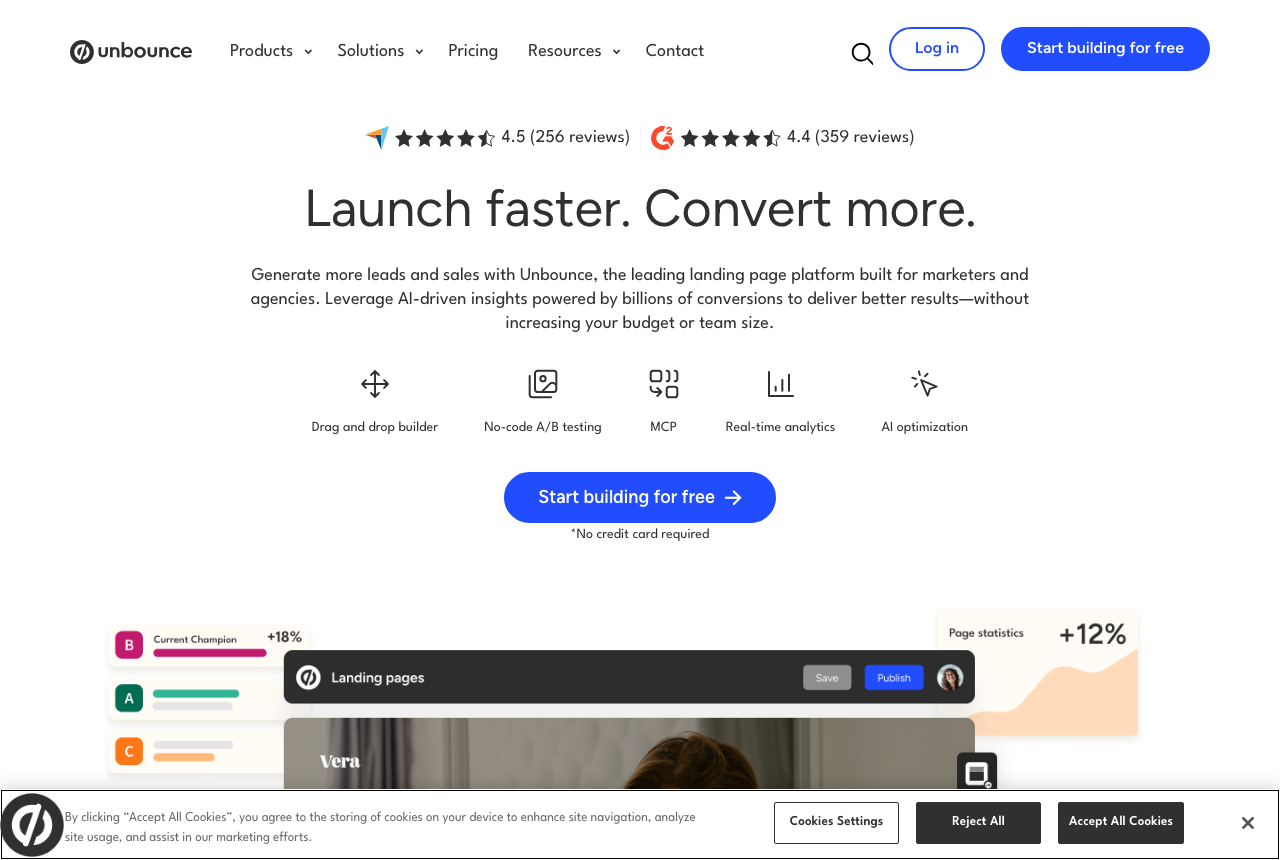
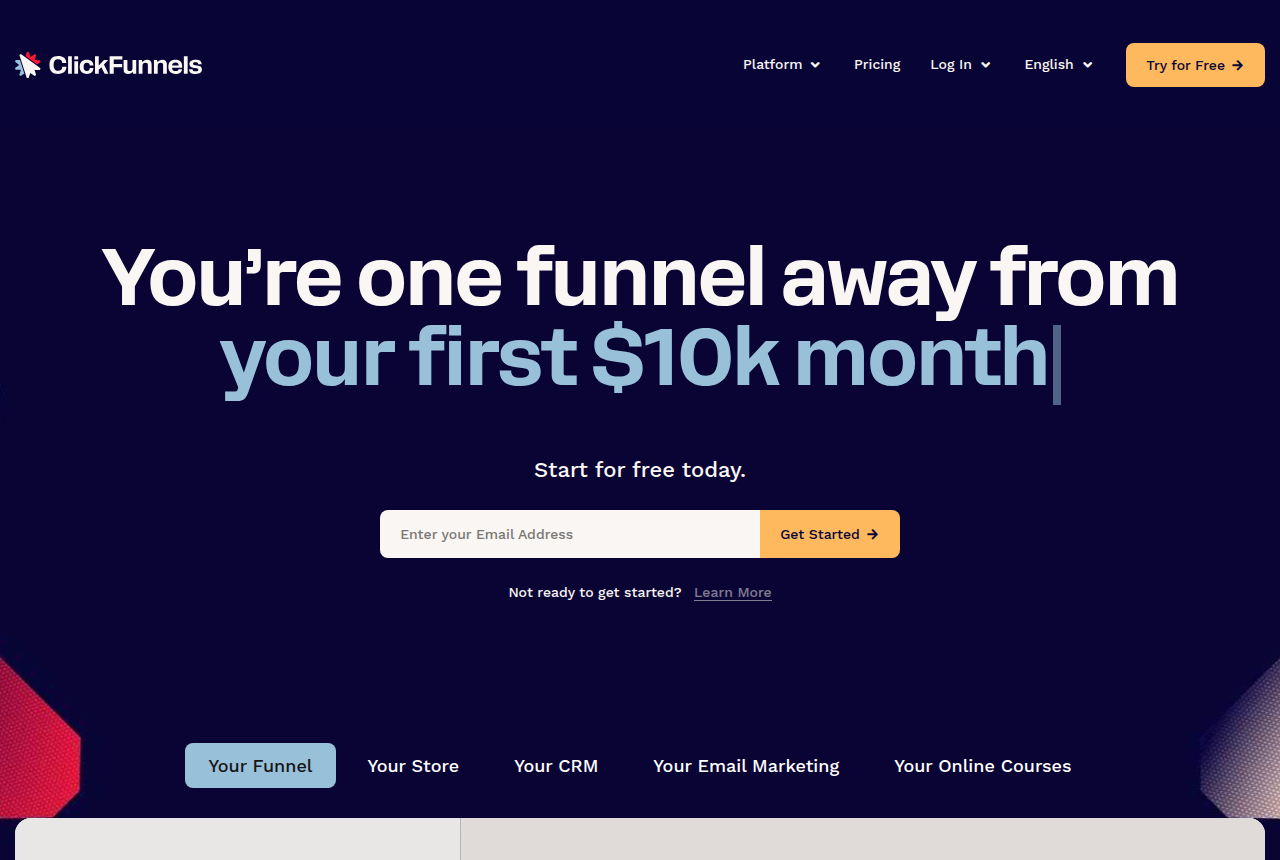
Pick Unbounce if you buy paid traffic and your conversion rate turns on matching the page to the exact ad or keyword, and you already have (or do not need) a checkout of your own; pick ClickFunnels if you are selling your own course, coaching or info offer and want the pages, checkout, upsells and email running as one funnel instead of four separate tools.
Side by side
| Unbounce | ClickFunnels | |
|---|---|---|
| What it is | PPC landing page builder | End-to-end funnel platform |
| Best for | Cold paid-traffic pages | Selling your own offer |
| Builds the page | Yes | Yes |
| Hosts the checkout | No, connect your own | Yes, with upsells |
| Order bumps, upsells | No | Yes |
| Message match (DTR) | Yes, from Experiment | No |
| Auto traffic routing | Yes, Smart Traffic | No |
| Email and CRM | No, bring your own | Email plus light CRM |
| Courses, community | No | Included |
| Cut of sales | None | None |
| Entry price | $29/mo | $97/mo |
If you are down to Unbounce and ClickFunnels, the two names sit in the same shortlist but they are not the same kind of tool. Unbounce builds the page. ClickFunnels builds the whole funnel around the page: the checkout, the upsells, the email, the course behind the login. So the real question is not which is better. It is whether your job stops at the page or runs all the way to the sale.
The one decision that settles it
Ask what you are actually pointing your ads at. If the answer is a landing page that captures a lead or hands the visitor to a checkout you already run, you want the sharpest page tool you can get, and that is Unbounce. If the answer is a page that then has to take the money, add an order bump, offer a one-click upsell and follow up by email, you want a platform that does all of that in one account, and that is ClickFunnels.
Everything else follows from that split. Buying the funnel platform to run a single lead-gen page is paying for machinery you never open. Buying the page builder when you need a checkout and upsells means stitching in a cart, an email tool and a way to tie them together yourself.
What Unbounce is better at
For search-ad buyers, the biggest lever after the click is message match: the page headline echoing the exact query the visitor just typed. Unbounce's dynamic text replacement does that automatically, and Smart Traffic then routes each visitor to whichever variant converts their kind of traffic best. That pairing is why serious PPC teams still name Unbounce first, and it is the reason this site ranks it the top landing page builder for paid search.
The honest catch is where those features live. Starter at $29 a month is not a PPC tool. Dynamic text and A/B testing begin on the Experiment plan at $149 a month, and automatic routing higher still. Price the plan you actually need, not the one on the front of the pricing page. What Unbounce does not do is take the money: there is no native checkout, no order bump, no one-click upsell. You connect your own cart or send the visitor onward.
What ClickFunnels is better at
ClickFunnels is one of the names that made "sales funnel" a category, and after more than a decade it is still one of the most recognised funnel builders online. It runs the whole path from click to customer in one account: landing and sales pages, a checkout with order bumps and one-click upsells built to lift average order value, email follow-up, a light CRM, plus courses and a community. For a creator selling their own coaching, course or info product, that is the appeal. One login, whole funnel, fast to launch, and no cut taken from your sales.
It sits at the top of the market on price, running $97 to $297 a month, and the bill climbs as you scale. Billing and cancellation draw the loudest complaints, along with the confusion between the older Classic accounts and the newer 2.0. It is heavier than a page builder and its course delivery is weaker than a dedicated platform. But if the job is to sell your own offer end to end without assembling a stack, it does that in one place.
The build-and-sell layer for a paid-traffic team
There is a third case these two leave in the gap between them: you buy your own cold traffic on Meta, Google or TikTok, you need the page and the checkout and the upsell, and you need to know which ad actually made the money. Unbounce stops at the page. ClickFunnels takes the money but tests variants in a way that can reset the ad platform's learning, and it keeps the sale on a light CRM rather than tied to the click.
ElasticFunnels is built for that segment. Its distinguishing feature is same-URL split testing: variants rotate server-side under one campaign link, so Meta, Google and TikTok keep their learning and a test never sends the ad back through review. On top of that it builds the pages, including an AI builder that generates a page from a prompt or clones one from a URL, hosts the checkout with order bumps and one-click upsells and multi-MID routing, and keeps the click, the order, the rebill and the refund on one record with a CRM and automations. It starts at $97 a month with a 14-day trial that needs no card, every feature is on every plan, and it adds 0.5% only on revenue through its own hosted checkout.
The real cost to weigh is proof. ElasticFunnels is newer than both tools here, Unbounce has been around since 2009 and ClickFunnels since 2014, and there is very little independent third-party review coverage to check its claims against. Until you run real volume through it you are largely taking the vendor's word for it, which is exactly what you would expect of a platform this recent standing next to two tools with a decade of reviews behind them. The no-card trial exists to let you prove the split test and the checkout on your own campaigns before you commit. And to be clear on scope: if all you need is one landing page feeding a checkout you already run, ElasticFunnels is more platform than that job requires, and Unbounce is the smaller, better-fitted tool for it.
Which one for you
Buying paid search or running lead-gen pages? Unbounce. Message match and Smart Traffic are the two levers that move paid-search conversion, and no page tool here does them better. Budget for the $149 Experiment plan, because that is where they live.
Selling your own course, coaching or info offer? ClickFunnels. The pages, checkout, upsells, email and community in one account get a whole funnel live fast, and you keep every dollar of the sale.
Buying cold traffic and need the page, the checkout and the attribution on one record? ElasticFunnels. Same-URL testing that keeps ad learning, a checkout with bumps and upsells, and click-to-sale on one timeline, with a no-card trial to prove it first.
Still deciding across the wider field? See our landing page and funnel rankings, the full Unbounce review and ClickFunnels review, or every head-to-head.
Unbounce
What works
- The page headline updates to match each search query, the core PPC lever
- Smart Traffic routes each visitor to the variant most likely to convert them
- A large template library and a mature builder
What to watch
- DTR and split testing only start at Experiment ($149/mo); Starter is not a PPC tool
- Monthly unique-visitor caps bring overage anxiety at scale
- The builder frustrates on fixed-section layout and mobile, enough that some users call it painful
ClickFunnels
What works
- Runs the whole funnel in one account: pages, checkout, email, a light CRM, courses and a community, so you are not stitching four tools together
- Fast to get live. The drag-and-drop editor and prebuilt funnel templates are the most-praised part, especially for non-technical sellers
- Smart Checkout is built for selling, with order bumps and one-click upsells aimed at raising average order value
- Strong aggregate scores: about 4.6 out of 5 across more than 400 G2 reviews and thousands of Trustpilot reviews
- Takes no cut of your sales, includes hosting, and carries a 30-day money-back guarantee
What to watch
- Priced at the top of the market. Plans run $97 to $297 a month, and users say the cost adds up fast, especially if you only need part of it
- Billing and cancellation are the loudest complaints, along with confusion between ClickFunnels Classic and the newer 2.0 accounts
- Some long-time users feel 2.0 was a step back from Classic, and marketers report occasional bugs and page speed that is hit or miss
- Less flexible than a custom stack, and course and membership delivery is weaker than a dedicated platform
Pricing
Unbounce: from $29/mo. Starter $29/mo (500 visitors), Build $99/mo (20K), Experiment $149/mo (A/B testing, 30K), Optimize $249/mo. Plans are capped by monthly traffic.
ClickFunnels: from $97/mo. Launch $97, Scale $197, Optimize $297/mo; Dominate $5,997/yr. Takes no percentage of sales. 30-day money-back guarantee.
Pricing verified against each vendor on 2026-09-27. Check before you buy.
Our pick
Unbounce
Unbounce is the pick if you buy Google Ads and live or die on message match, and you can justify the Experiment tier.
Frequently asked questions
Unbounce or ClickFunnels: which should I use?
Which is cheaper, Unbounce or ClickFunnels?
Does Unbounce have a checkout?
Is ClickFunnels overkill if I just need a landing page?
What if you buy your own paid traffic and need both the page and the checkout on one record?
Sources
Other sources
3 discussions and reviews read for this page. Quotes are excerpts; open a link to read the original in context.
- [ppc-price-2024] Unbounce 121.54% price increase in 2024 : r/PPC
- [ppc-nightmare] Unbounce is a nightmare : r/PPC
- [capterra] Unbounce Reviews 2026, Pros & Cons | Capterra

Written by
Dana Rourke
Lead reviewer
Dana Rourke is the lead reviewer at Campaign Buyer. She owns the tracker and attribution coverage: reading what long-term users report about each tool, checking its documentation and pricing, and verifying prices with the vendor before writing the verdict. Keeping the rankings honest mostly means writing down what the top pick gets wrong, so she does that first.
Last checked 2026-09-29